
Ta marbuta pronunciation can be confusing: if you see ة at the end of an Arabic word, should you read a t, an h, or simply stop on the vowel? The answer depends on how the word is being read. Ta marbuta (تاء مربوطة) is a word-ending form whose sound changes with pausing and connection. Once you know what to listen for, words such as مَدْرَسَة (school) become much easier to read aloud.
This guide explains the beginner rule, shows it in short examples, and separates ordinary Arabic practice from Quran recitation. English spellings such as “t,” “h,” and “ah” are only approximations; listening to a qualified teacher is still the best way to refine the sound.
What does ta marbuta look like?
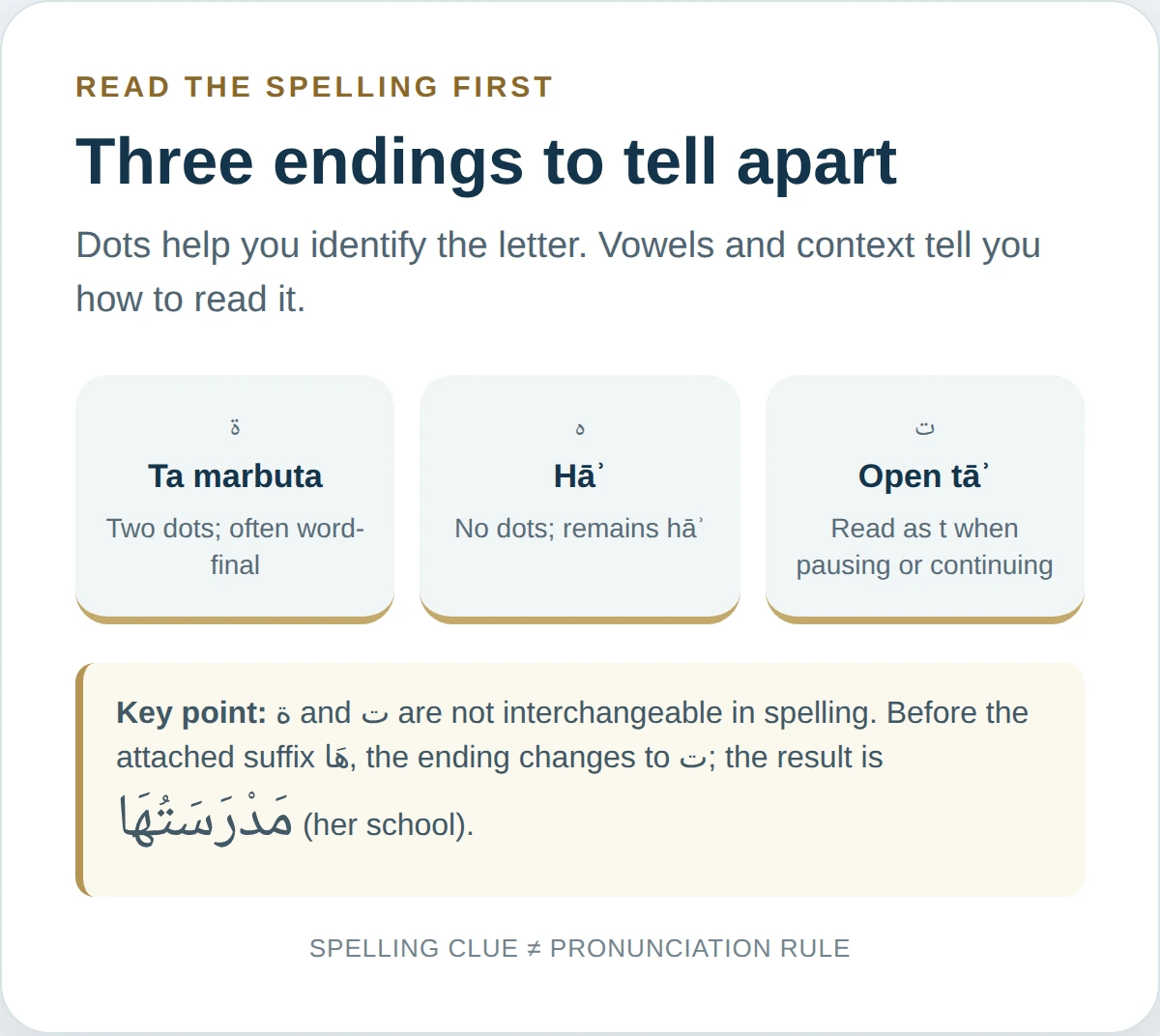
Ta marbuta is the rounded character ة, usually found at the end of a noun or adjective. When joined to the previous letter it looks like ـة. It has two dots above it. Do not confuse it with ه (hāʾ), which has no dots, or with ت (tāʾ), which has a different open shape.
Many Arabic words use ta marbuta as a feminine marker, as in مُعَلِّمَة (female teacher) beside مُعَلِّم (teacher). But do not use the ending alone to guess a word’s full meaning or a person’s gender: Arabic has exceptions, and the word’s context matters. If vowel signs are unfamiliar, review how fatha, kasra, damma and sukun guide Arabic reading before practising the examples below.
Ta marbuta pronunciation: pause or continue
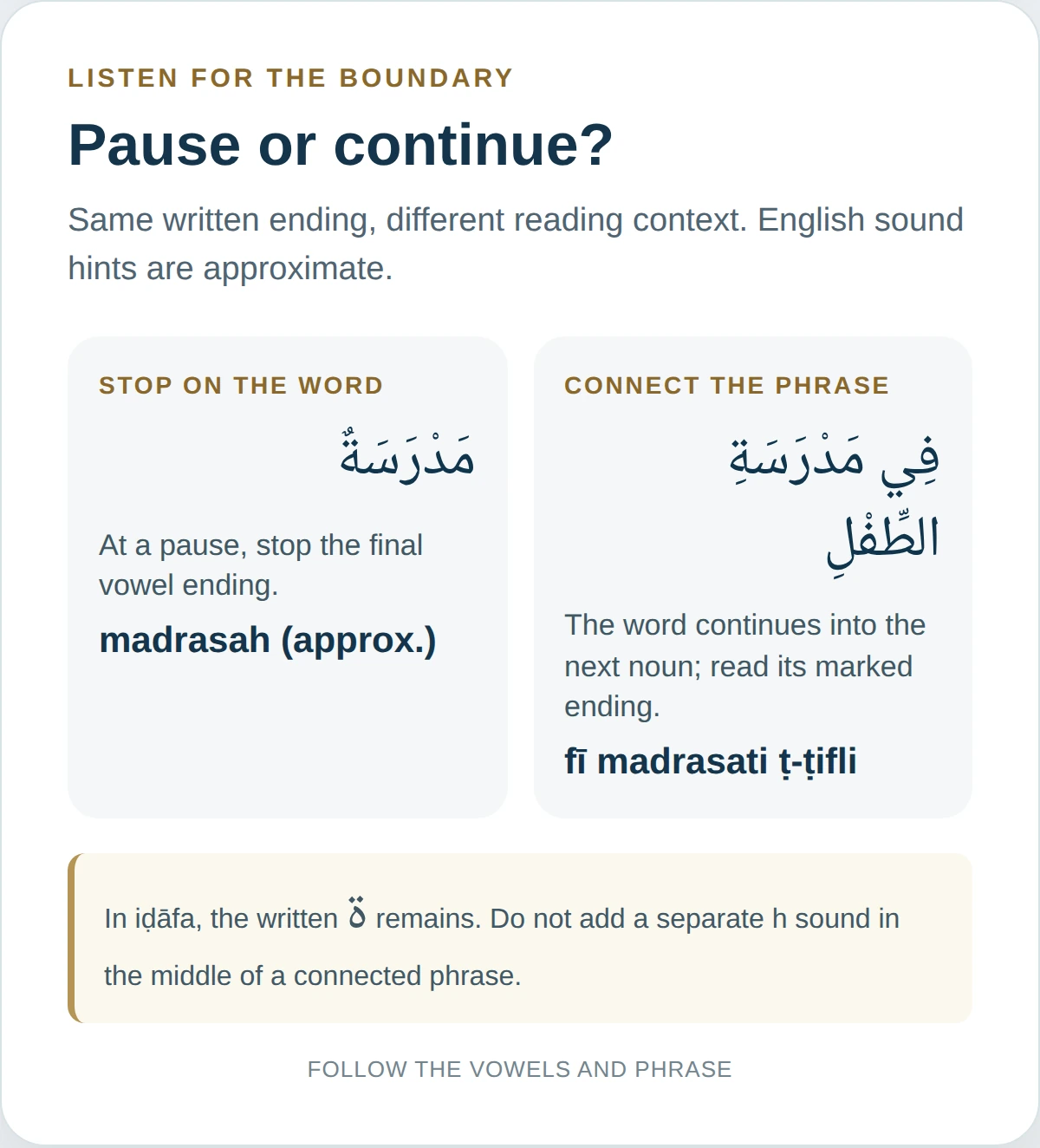
When a reader pauses at a word ending in ta marbuta, the final vowel ending is generally not carried on into the pause. In a common teaching approximation, the ending is heard as a soft h-like sound after the preceding vowel, often written in English as -ah. For example, مَدْرَسَةٌ may be practised as madrasah when you stop there. Do not add a hard, separate English “h” if your teacher’s model is softer.
When the ending is pronounced as part of a connected phrase, the ta is heard as t, together with the vowel required by the fully marked word and its grammatical role. In فِي مَدْرَسَةِ الطِّفْلِ (“in the child’s school”), the phrase continues through مَدْرَسَةِ, so learners commonly hear fī madrasati ṭ-ṭifli. The final i here is a case vowel; it is not a new syllable inserted after the word.
The useful contrast is therefore not “this word always ends in t” versus “this word always ends in h.” Ask first: Am I stopping here, or is the word continuing into the next part of the phrase? Then read the vowel signs and grammatical context. For more examples of possession phrases, see Quranytime’s guide to iḍāfa, the Arabic noun-linking construction.
Three examples to hear slowly
1. A word by itself: مَدْرَسَةٌ
Read the word once as a complete, fully vowelled form, then repeat it as a pause at the end of a short practice phrase. In the pause form, stop the ending rather than carrying the final case or tanween sound forward. A beginner-friendly rendering is madrasah. It is not a request to replace the written ة with ه; the spelling stays the same.
2. A phrase that continues: فِي مَدْرَسَةِ الطِّفْلِ
Here the word مَدْرَسَةِ is linked to the noun after it. Say the ending with its marked vowel as a t sound before moving into the next word. The spelling still contains ta marbuta. This is an example of an iḍāfa phrase; it is not the same thing as adding a possessive pronoun.
3. A possessive ending: مَدْرَسَتُهَا
When a pronoun suffix is attached, the written ending changes from ة to ت: مَدْرَسَة + هَا becomes مَدْرَسَتُهَا (“her school”). The t is visible in the spelling and heard in the pronunciation. Compare that with the separate iḍāfa example above, where the original ة remains. Quranytime’s Arabic pronoun guide can help you recognize attached pronouns in longer words.
Why the word’s ending matters
Arabic words may carry short vowels or tanween that show their role in a sentence. In a fully vowelled lesson, those marks help you know how to connect the word. At a pause, a reader does not simply pronounce every written ending as though the sentence were continuing. This is one reason an unvowelled word list cannot show the complete pronunciation rule by shape alone.
For example, مَدْرَسَةٌ in a practice list may show a nominative tanween. If you stop on the word, the tanween is not normally carried into the pause. In a connected sentence, the word’s grammatical ending and the syntax determine what is pronounced. The details vary with the sentence, so do not memorize one transliteration and apply it to every appearance of the word.
This also explains why written ة is not a generic “silent letter.” The mark has a regular role in the word, but the audible ending depends on whether you connect or stop and on the vowelled form. If you are learning sentence patterns, Quranytime’s beginner guide to Arabic adjective agreement gives useful examples of feminine nouns and the adjectives that describe them.
Ta marbuta is not the same as hāʾ or open tāʾ
Three endings can look or sound confusing to a new reader:
- ة has two dots and is ta marbuta. Its final sound depends on pause, connection and the word’s vocalization.
- ه has no dots and is hāʾ. It remains hāʾ; it does not switch to tāʾ merely because you continue to the next word.
- ت is open tāʾ. It is read as a t sound whether you stop or continue.
Use the dots as a spelling clue, not as a substitute for reading the vowel marks. If the characters are hard to distinguish on your screen or in a printed Mushaf, compare them with a visual guide to the Arabic alphabet and ask a teacher to check your reading.
A short listening practice
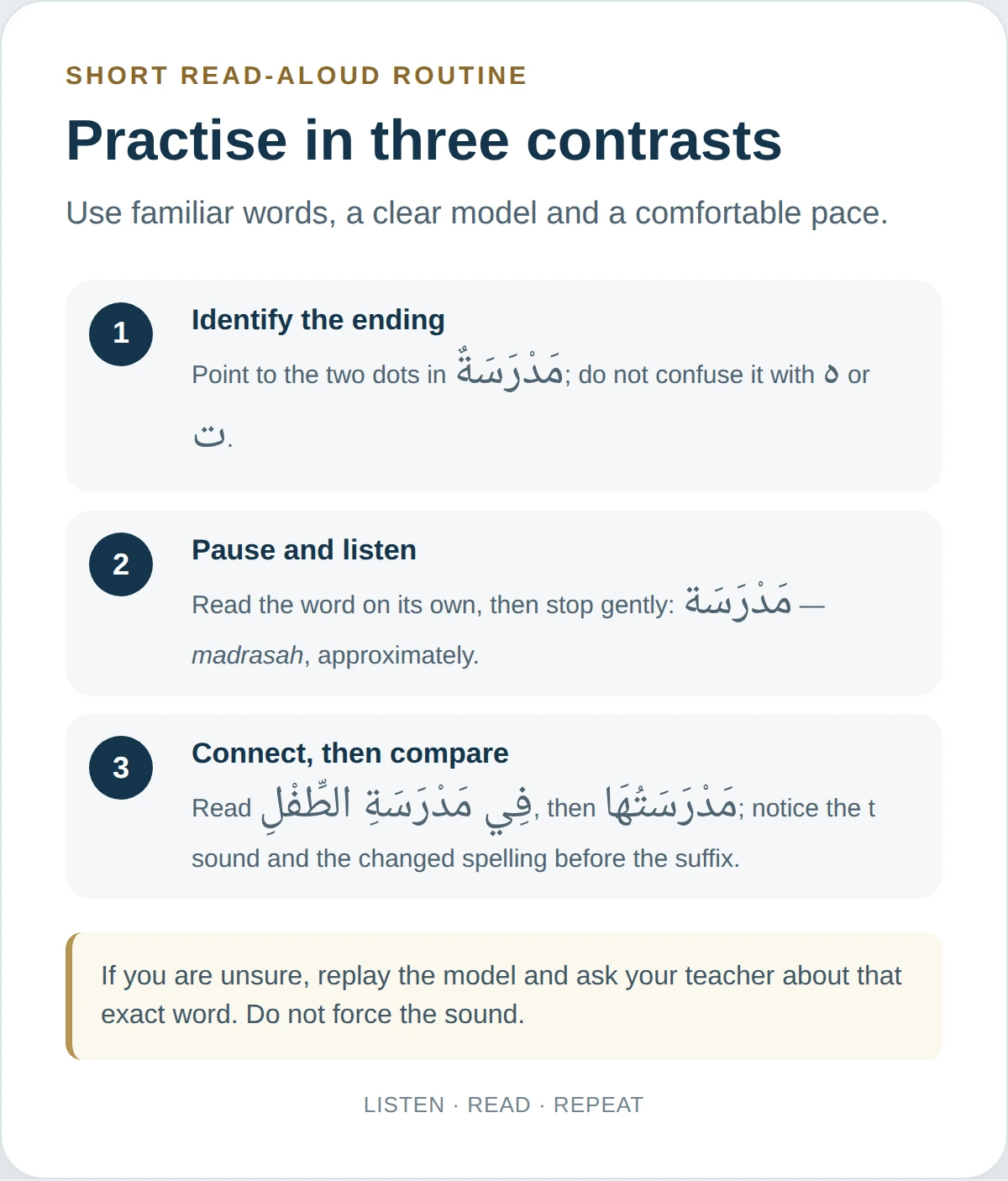
Choose one word you already know, such as مُعَلِّمَةٌ (female teacher). First listen to a fluent reader say it at a natural pause. Then listen to the same word in a phrase where its marked ending is connected to the next word. Notice that the pronunciation changes because the reading continues, not because the written ة has been swapped for a different letter.
Repeat each version gently and at a comfortable pace. Keep the vowel before ة clear; do not force an extra burst of air to manufacture the t. Next, compare the standalone word مَدْرَسَةٌ with the linked phrase فِي مَدْرَسَةِ الطِّفْلِ. Finally, read مَدْرَسَتُهَا and point to the open tāʾ in its spelling. Three small contrasts are more useful than repeating a long list without checking the sound.
Try not to learn the rule through transliteration alone. Listen to a clear model, read the Arabic spelling while the audio is playing, then repeat without looking at the English hint. If the ending still feels uncertain, slow down and ask whether the phrase is continuing. Bring one exact example to a teacher rather than trying to correct the entire paragraph at once.
Common mistakes to avoid
- Using one sound everywhere: a word at a pause is not read exactly like the same ending in a connected, vowelled phrase.
- Adding h in the middle: do not break a phrase just to pronounce the pause form of ta marbuta.
- Changing the spelling when you stop: the written ending remains ة. The pronunciation cue does not turn it into ه.
- Assuming dialect and recitation are identical: everyday speech differs by region, while Quran reading follows its own learned conventions and the marks of the Mushaf.
If a word does not match the simple practice examples, do not guess. Look it up with its sentence, listen to a reliable model, and ask a teacher to clarify the particular form.
What to keep in mind for Quran reading
In Quran recitation, pause and continuation are part of careful reading. Follow the printed vowel signs and the stopping guidance you have learned; do not insert a pause just to make ة sound like h, or continue through a suitable pause only to pronounce a t. If you are unsure where a phrase should stop, consult a teacher and a trusted guide to Quran waqf signs and stopping points. This article explains a language-reading pattern; it does not replace instruction in Tajweed or establish a religious ruling.
When you meet a new word, use this quick check: identify whether the ending is ة, ه or ت; look at its vowel marks; decide whether your reading pauses there or connects; and listen to a reliable model. If you want personalised help with Arabic reading and Quran pronunciation, you can book your free Quran and Arabic trial class for feedback on your current level.
Watch a ta marbuta lesson
Listen for the difference between a word read at a pause and the same ending connected to the next word. Treat the English spellings as practice hints, not exact phonetic instructions.
For another beginner-level explanation with listening examples, read this open Arabic lesson on ta marbuta, pausal forms and the construct state.