
The simplest way to say thank you in Arabic is شُكْرًا — shukran. It works when a teacher corrects your reading, a friend shares notes, or someone holds a door. You do not need a long sentence before you can express genuine appreciation.
This guide brings the closely related questions together: how to pronounce the word, write it in Arabic, say “thank you very much,” address different people, and reply politely. The goal is not to memorize dozens of interchangeable phrases. It is to choose a few expressions you understand and can use confidently.
Three Arabic phrases to learn first
Begin with this small exchange rather than a long vocabulary list:
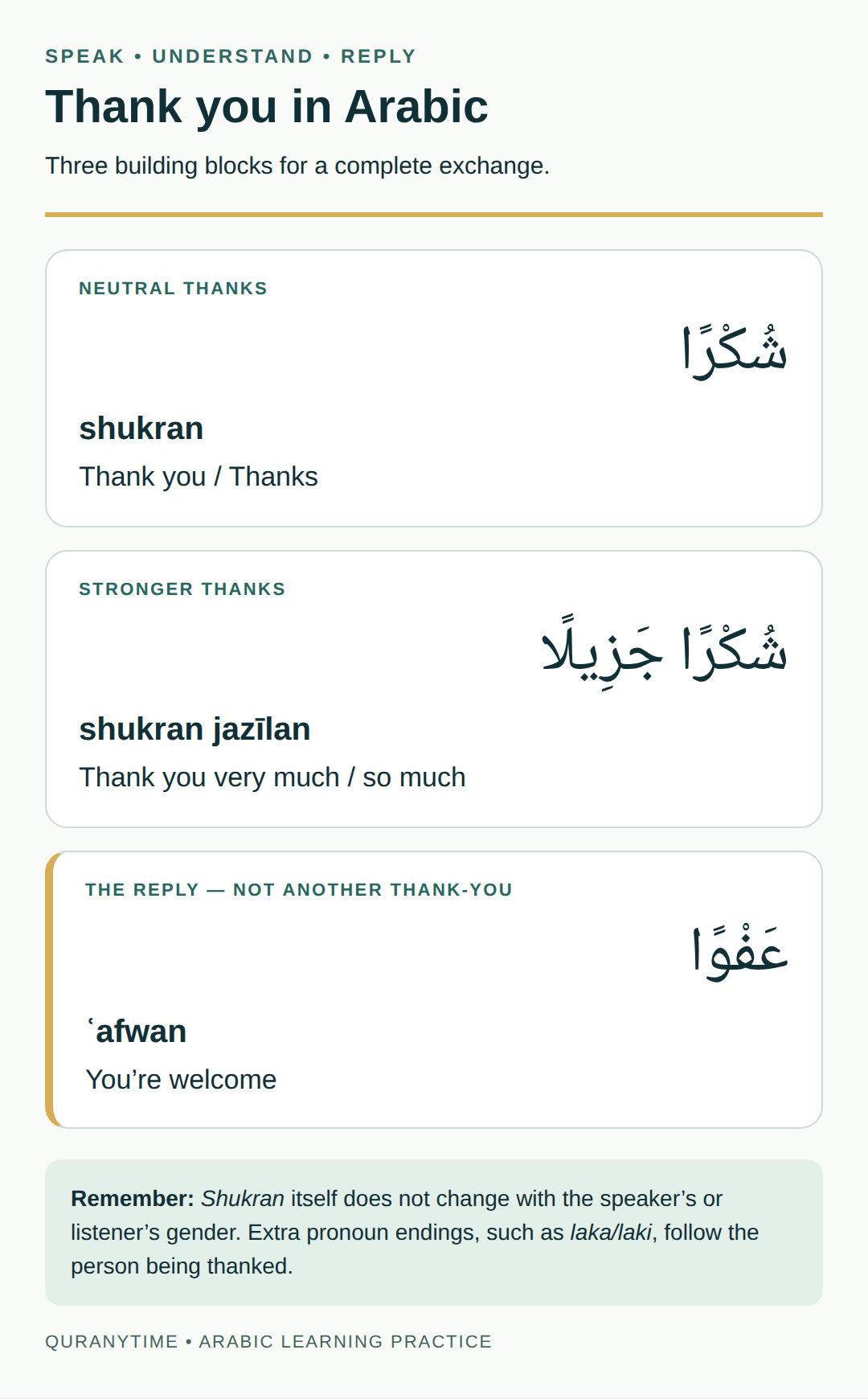
- شُكْرًا — shukran — “Thank you” or “Thanks.”
- شُكْرًا جَزِيلًا — shukran jazīlan — “Thank you very much.” It can also convey “Thank you so much.”
- عَفْوًا — ʿafwan — “You’re welcome,” when replying to thanks.
The first two express gratitude; the third answers it. Learning both sides helps you participate instead of recognizing only one word.
How to pronounce shukran without adding extra vowels
Think of two compact syllables: SHUK-ran. Put the emphasis on the first. The sh is one sound, as in “ship,” and the u is brief. Avoid stretching it into “shoo” or turning the word into three syllables such as “shu-ka-ran.”
Say the first part, shuk, then connect ran without inserting a new vowel between the consonants. Keep the final n audible in this everyday expression. A gentle Arabic r may sound different from your English r; listen and imitate rather than forcing a dramatic roll.
For shukran jazīlan, the mark above ī indicates a longer vowel. Ordinary English spellings such as “jazeelan” represent the same word. Transliteration is a temporary aid, not a separate Arabic spelling system or a precise substitute for audio.
If the letters are still unfamiliar, use our step-by-step guide to recognizing all 28 Arabic letters. Identify what you see before trying to read faster.
Use the lesson below for listening practice. Hear the teacher’s model first, pause, repeat once, and compare your rhythm. Do not assume every phrase in a video needs to enter your active vocabulary immediately.
How to write thank you in Arabic
The usual spelling is شكرًا. With learning marks, it is شُكْرًا. Everyday messages often omit the small vowel marks, so you may also see شكرا. These are not different ways of expressing gratitude.
Arabic runs from right to left. The main letter sequence here is ش، ك، ر، ا. The small marks help a beginner recover the pronunciation; they are not extra full-sized letters. Our Arabic alphabet PDF practice guide explains how to study letters and marks together.
When handwriting, copy the word slowly, noticing which letters join and which do not. Then cover the model and write it again. If you are unsure about the joins, work through the Arabic letter-writing guide rather than treating the whole word as a picture.
Does thank you change for a man or a woman?
Shukran alone does not change. A man or woman can use it to thank anyone. If you add “to you,” the ending follows the person being thanked, not the person speaking:
| Who you are thanking | Arabic | Pronunciation |
|---|---|---|
| One man | شُكْرًا لَكَ | shukran laka |
| One woman | شُكْرًا لَكِ | shukran laki |
| Two people | شُكْرًا لَكُمَا | shukran lakumā |
| A group of men or a mixed group | شُكْرًا لَكُمْ | shukran lakum |
| A group of women | شُكْرًا لَكُنَّ | shukran lakunna |
These are formal Arabic forms. You may hear different endings in local speech. Beginners can safely start with shukran and add pronouns later. Our introduction to Arabic grammar provides broader context for how words change within a sentence.
Thank you very much, so much, and more formal thanks
Shukran jazīlan is a useful standard choice for stronger appreciation. You might use it after a teacher spends extra time explaining a difficult point. English “very much” and “so much” do not require two separate Arabic expressions here.
ألف شكر — alf shukr, literally “a thousand thanks” — adds warmth. For a more sentence-like formal expression, أَشْكُرُكَ (ashkuruka, to one man) or أَشْكُرُكِ (ashkuruki, to one woman) means “I thank you.” Again, the ending follows the recipient.
A longer phrase is not automatically more sincere. Match the situation and your current ability. A clear shukran is better than an elaborate expression whose meaning you cannot explain.
Shukran and Islamic expressions of gratitude
Many Muslims also say جَزَاكَ اللهُ خَيْرًا — jazāka Allāhu khayran — meaning “May Allah reward you with good,” when addressing one man. To one woman, the form is جَزَاكِ اللهُ خَيْرًا, jazāki Allāhu khayran.
This is a supplication, not a word-for-word translation of “thank you.” Likewise, alḥamdulillāh, “praise be to Allah,” expresses praise and gratitude to Allah; it is not simply the same conversational message as thanking the person who helped you.
The consonants sh-k-r connect with thanking and gratitude. Our beginner explanation of Arabic roots and patterns shows how related words can share a root without having identical meanings or uses.
What about Egyptian, Levantine, and other dialects?
Shukran remains a practical starting point across Arabic-speaking communities, including Egypt. You will also encounter local expressions whose pronunciation and social feel vary.
For example, تسلم / تسلمي (tislam/tislami) can express thanks with a wish for well-being in the Levant and parts of the Gulf. يعطيك العافية (yaʿṭīk al-ʿāfiya) recognizes someone’s effort. NaTakallam’s guide to Arabic gratitude expressions gives useful cultural and regional context.
Do not collect dialect phrases as though they were interchangeable everywhere. Choose the community you speak with and ask a teacher what sounds natural there. Our comparison of Quranic Arabic, Modern Standard Arabic, and everyday usage helps keep these learning goals distinct.
Choose by situation, not by the longest phrase
Before speaking, ask two questions: who helped me, and what am I appreciating? A routine favor needs no elaborate speech. Extra effort may deserve shukran jazīlan. In a formal note, write a clear sentence about the help instead of stacking several gratitude expressions together.
To say “thank you, my friend,” you can use شُكْرًا يَا صَدِيقِي (shukran yā ṣadīqī) to a male friend, or شُكْرًا يَا صَدِيقَتِي (shukran yā ṣadīqatī) to a female friend. You can also simply use the person’s name. A form of address is optional, not something to add to every exchange.
If you are unsure about a relationship, title, or local expression, stay with neutral shukran. Appropriate simplicity is a useful language skill.
Practise a complete thank-you exchange
Try these original classroom situations aloud:
- Your teacher sends the corrected exercise: “Shukran.” The teacher replies, “ʿAfwan.”
- A classmate explains something twice: “Shukran jazīlan.” You are emphasizing appreciation without needing a new grammatical pattern.
- You thank one female teacher explicitly: “Shukran laki.” The ending describes the teacher, not your own gender.
Make one small card with Arabic on the front and meaning plus a situation on the back. Add it to a manageable Arabic vocabulary study routine. Read, say, recall, and use the phrase rather than copying it repeatedly without attention.
For writing practice, check one detail at a time: letter order, joins, then marks. These ways to improve Arabic writing can help you turn a copied phrase into something you can reproduce independently.
A five-minute listening-and-recall drill
- Listen: hear one clear model of shukran. Notice the two syllables before you speak.
- Compare: repeat once, then hear the model again. Check one feature, such as the short first vowel, rather than judging your whole accent.
- Recall: hide the English meaning and explain the Arabic. Then hide the Arabic and produce the phrase from a situation.
- Switch roles: say thanks, then answer with ʿafwan. This prevents mixing the expression with its reply.
- Transfer: use the phrase after a real piece of help. Return tomorrow and recall it before looking at your notes.
If recall is difficult, reduce the set to shukran and ʿafwan. Add stronger thanks only when that short exchange feels secure. Progress means using the right expression at the right moment, not completing a longer list.
Quick questions
Is it shukran or shakran?
Shukran is the standard beginner transliteration. Keep the first vowel brief and listen to a reliable spoken model.
Can I just say shukran?
Yes. It is a complete, useful expression of thanks. You do not need to add a name, gender ending, or blessing every time.
What should I say when someone thanks me?
Start with ʿafwan. Practise it as the reply, not as another way to initiate thanks.
Your next step is simple: use one phrase accurately in a real exchange. If you want feedback on sounds, spelling, and appropriate register, compare Arabic class formats that fit your level and bring a few short examples to your teacher.