
Reading the Quran without tajweed is not a sin in itself. What is forbidden is making clear mistakes that change a letter, a vowel, or the meaning of a word, when you are able to learn and avoid them. Scholars separate those major errors (lahn jali) from subtle ones (lahn khafi). Avoiding the first kind is required. Mastering every detailed rule is recommended, not required of each individual. Tajweed means "to make excellent," and in practice it is the set of rules for pronouncing each letter of the Quran correctly.
That short answer has details that matter, and many online answers either frighten readers or wave the question away. At Quranytime Academy, we teach Quran reading and tajweed one-to-one, and we hear this worry often from adult beginners, parents, and people who have read daily for years. They want to know whether their reading counts and what to fix first.
This article gives you the ruling and the reasoning behind it. You will see which mistakes matter, what prayer requires, how the ruling changes for beginners, people with limits, and imams, and what order to follow to improve.
Why tajweed matters when you read the Quran
Tajweed matters because Arabic sounds carry meaning, so one wrong letter or vowel can turn a word into a different word. Reading the Quran without tajweed is risky exactly where sound and meaning meet, and that one idea explains every ruling in this article.
What tajweed actually covers
Tajweed comes from an Arabic root meaning to make something excellent. Scholars define it as giving every letter its due. That means its correct point of articulation (makhraj), its characteristics (sifat), and the rules that apply when letters meet, such as merging, nasal sounds, and elongation. It is not a separate version of the Quran or a style of singing. Every accepted recitation (qira’a) is taught with its own tajweed, so there is no authentic "no-tajweed" recitation to choose from.
The Quran points to this standard itself. In Surah Al-Muzzammil (73:4), Allah tells the Prophet to recite with measured recitation, known as tartil. Ali ibn Abi Talib is reported to have explained tartil as perfecting the letters and knowing where to pause.
Why mistakes can change meaning
A single sound can separate two unrelated words. In Arabic, qalb (قلب) means heart, while kalb (كلب) means dog. A reader who cannot tell the deep qaf from the kaf can turn one into the other. In the same way, ʿalima (عَلِمَ) means "he knew," while ʾalima (أَلِمَ) means "he felt pain." The only difference is a throat sound that many non-native speakers flatten into a plain "a."
Vowels work the same way, and a famous example in Al-Fatihah appears later in this article. This is why classical scholars of recitation treated pronunciation as part of protecting the text, not as decoration. Yet many tajweed rules, such as how long to hold a nasal sound, do not change any word at all. That gap is the basis of the two categories below.
The two categories of mistakes
Scholars of recitation sort errors into lahn jali, the "clear mistake," and lahn khafi, the "hidden mistake." The table shows how they differ.
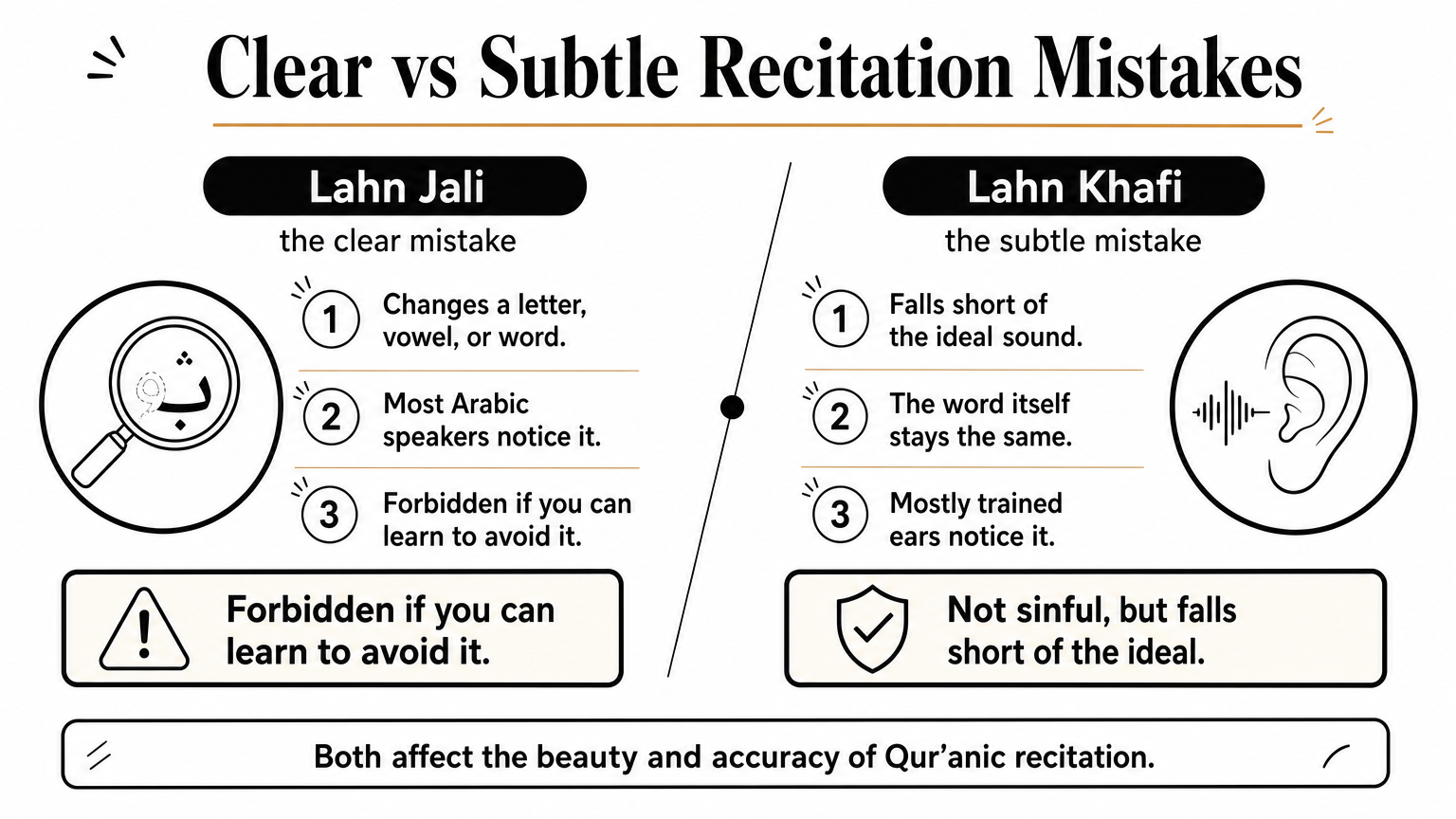
| Lahn jali (clear mistake) | Lahn khafi (subtle mistake) | |
|---|---|---|
| What it is | Changes a letter, a vowel, or a word, or adds or drops a letter | Falls short of the ideal sound without changing the word |
| Examples | Saying ك for ق, ه for ح, a wrong vowel, skipping a shaddah | Weak ghunnah, light qalqalah, an elongation held a little too long |
| Who notices | Most Arabic speakers | Mostly trained ears |
| Ruling in brief | Forbidden if you can learn to avoid it | Most scholars say it is not sinful and falls short of the ideal. Some call it disliked |
These labels give you a working filter. Ask whether the mistake changes what the word is. If it does, fix it first. If it does not, it belongs on your improvement list and is not a cause for guilt.
Tajweed is the craft of giving each letter its due, and the mistakes that change meaning are the ones that count most.
Is it haram to read the Quran without tajweed?
Reading the Quran without tajweed is not haram as a blanket rule. What is forbidden is making clear mistakes when you are able to learn the correct form. What is recommended, but not required of every individual, is mastering every refinement. Most scholars land on this position, though some use stronger wording, so it helps to see where the strict statements come from and how the lenient texts balance them.
What the strict statements mean
The best-known strict line comes from the 15th-century scholar Ibn al-Jazari. His poem al-Muqaddimah al-Jazariyyah says that applying tajweed is a binding duty and that whoever does not apply it to the Quran is sinful. Read alone, that sounds like every reader without perfect rules is guilty. Commentators on the poem generally do not read it that way. They explain that the duty falls on those who are able to learn, and that the core concern is distorting the words of the Quran, not missing a fine point of nasalization.
Most teachers frame it the same way today. Avoiding lahn jali is a duty because it protects the wording and meaning of revelation. The detailed rules beyond that belong to reciting beautifully and precisely, which scholars strongly encourage and describe as recommended.
What the lenient texts add
The central text for learners is the hadith of Aisha, reported in Sahih al-Bukhari and Sahih Muslim. The Prophet, peace be upon him, said that the one who is skilled in the Quran will be with the noble, righteous angel-scribes. He added that the one who recites it haltingly and finds it hard will have two rewards. Struggling is not punished. It is rewarded, and scholars explain the double reward as one for reciting and one for the hardship.
Two verses support the same principle. Allah says, "Allah does not burden a soul beyond its capacity" (2:286), and "Fear Allah as much as you are able" (64:16). Together they show that obligation follows ability. The Prophet never told the struggling reader to put the Quran down until perfect.
The line between hardship and neglect
The leniency has a limit. The hadith praises someone who is trying, not someone who avoids learning when a teacher is available. If you keep a mistake that changes meaning and you could correct it, the fault lies in neglect. Three questions help you place yourself:
- Does my mistake change a letter, a vowel, or a word?
- Can I realistically correct it with a teacher, audio, and practice?
- Am I actively working on it?
If the first two answers are yes, correcting it is your duty. If the third is yes, you are on the right path while you improve. Allah knows best, and for a personal case, a qualified scholar is the right person to ask.
Avoiding clear mistakes is a duty when you are able, and perfecting every refinement is encouraged, not required.
Reading the Quran without tajweed in prayer
In prayer, the minimum is a recitation of Al-Fatihah without mistakes that change its meaning. Full tajweed is not a condition for a valid prayer, but errors in the one surah every rak’ah depends on carry real weight. Anyone reading the Quran without tajweed should treat this surah as the first thing to fix.
Why Al-Fatihah comes first
You recite Al-Fatihah in every rak’ah, which means at least 17 times a day in the five obligatory prayers, before counting any voluntary prayers. Most scholars count it as a required part of each rak’ah, though the schools differ on details. Because you repeat it so often, a small habitual error is repeated just as often, and it is also the easiest surah to correct with a teacher.

Mistakes that can affect it
Some errors in Al-Fatihah are cited by scholars again and again because they alter the words. The table lists three, with how they are generally treated.
| Mistake | What happens | How scholars treat it |
|---|---|---|
| Saying an’amtu instead of an’amta | "I have bestowed" replaces "You have bestowed" | A clear change of meaning that must be corrected |
| Dropping a shaddah, as in iyyaka | The word is no longer the word revealed | Serious, and especially strict in the Shafi’i school |
| Mixing ض and ظ in ad-dallin | Two close sounds blur together | Scholars differ, and many are lenient with people who are still learning |
The schools vary in strictness, so ask a qualified scholar about your own situation instead of guessing. Do not stop praying, and do not stop reciting, out of fear. Keep praying while you correct the mistake, because the goal is to improve while worship continues.
The rest of the prayer
Outside Al-Fatihah, the same rule applies with more room. Choose short surahs you can recite correctly, and keep the Arabic words of the prayer such as the tashahhud accurate too. Small imperfections in refinements like ghunnah do not threaten your prayer. A vowel or letter that changes meaning is worth correcting wherever it appears.
Your prayer rests on Al-Fatihah, so correct that surah before anything else.
Beginners, learners with limits, and imams
Beginners and people with genuine limits should keep reading, while imams and teachers are held to a higher standard. The ruling on the Quran without tajweed shifts with your ability and your role, so it helps to look at each case on its own.
Beginners and new readers
If you are new to Arabic, keep reading. Waiting until your recitation is perfect is the wrong plan, because the Prophet affirmed the struggling reader and promised reward for the effort. Read slowly, read a small portion daily, and start learning at the same time. A simple rule works well: read daily, learn weekly.
We see many adult beginners delay for years out of embarrassment. That delay is the worst outcome, because mistakes that are repeated daily become habits, and habits are harder to fix than new sounds are to learn. Starting early with a teacher costs you far less than starting late.
Learners with a real limitation
Some people have a speech impairment, hearing loss, or an age and health situation that makes certain sounds truly out of reach. For them, the principle of 2:286 applies fully: Allah asks only what you can do. Recite the best you can, keep reciting, and do not treat an unavoidable limit as a sin.
This does not mean giving up on improvement. A patient teacher can often find a way to approach the sound even when it never becomes perfect. For prayer-specific rulings in your situation, talk with a scholar who knows your circumstances.
Imams, teachers, and parents
The standard rises when others rely on you. The Prophet said that the one most versed in the Book of Allah should lead the people in prayer, as reported in Sahih Muslim. An imam should therefore work on correcting lahn jali, and a congregation does well to prefer a better reciter when one is available.
Teachers and parents carry a quieter duty. Children copy what they hear, so a child who learns a letter wrongly will repeat the mistake for years. When you choose a teacher for your child, look for ijazah or equivalent training, and for someone who corrects gently and repeatedly.
Capacity decides obligation: you are asked to do what you can, and you are never asked to stop.
How to improve your Quran recitation step by step
Start with the mistakes that change meaning, then build toward the full rules with a teacher who can hear you. Moving from reading the Quran without tajweed to reading with it happens through a sequence, not a leap. Each stage below depends on the one before it.
A four-stage order that works
- Letters and vowels. Learn the sounds that non-native speakers confuse most: ح and ه, ع and ء, ق and ك, ص and س, ض and د, ظ and ذ, ط and ت. Practice short and long vowels until you stop swapping them.
- Al-Fatihah and the prayer words. Recite them to a teacher until a trained ear finds nothing to correct. This covers your highest-use text first.
- Core rules. Study noon sakinah and tanween (izhar, idgham, iqlab, ikhfa), meem sakinah, ghunnah, natural madd, qalqalah, and the rules for lam and ra.
- Longer elongations, stopping, and refinement. Learn the longer madd types, where to stop and restart (waqf and ibtida), and the finer points of letter characteristics.
Keep the order. Learning a rule like ikhfa while you still swap ق and ك builds on a weak base.
Habits that speed up progress
Daily home practice habits matter more than long, rare sessions. These work for most learners:

- Record yourself reciting a short passage, then listen back. You will hear mistakes that you could not catch while reading.
- Listen to a respected reciter such as Mahmoud Khalil al-Husary, then repeat after the audio, a short phrase at a time.
- Study one rule per week. Apply it to the surah you read daily, not just to examples.
- Read to a teacher weekly. A fixed review keeps small errors from hardening.
Pace varies by person, and no honest teacher promises a fixed timeline. What holds for everyone is that mistakes caught early are cheaper to fix.
Why a teacher beats self-study
Tajweed has always been passed on by listening and correcting, which scholars call talaqqi. That is why ijazah chains exist. You cannot reliably hear your own errors, because your ear fills in the sound you intended to make. A teacher hears what actually came out and tells you which fix to make first.
At Quranytime Academy, lessons are live and one-to-one, with teachers who are Al-Azhar graduates and Ijazah holders. A free assessment class checks your current level and recommends a path, so you start with your own mistakes and not a generic syllabus.
Fix the errors that change meaning first, then build toward the refinements.
Quick answers to related questions
People who ask about the Quran without tajweed often ask a few neighboring questions. Short answers follow so you can find what you need and move on.
What are the 7 rules of tajweed?
There is no single official list of seven. Teachers group the subject differently, so you will see anywhere from five to ten headings. A common seven-part grouping for beginners is:
- Points of articulation (makharij) and letter characteristics (sifat)
- Noon sakinah and tanween
- Meem sakinah
- Madd (elongation)
- Qalqalah (echoing sound)
- Ghunnah and shaddah
- Rules for lam and ra
Stopping and starting (waqf and ibtida) is usually taught alongside these.
Is there a term for reading without tajweed?
There is no formal term. The classical vocabulary describes speeds of recitation done with tajweed: tahqiq, tartil, tadwir, and hadr, from slowest to fastest. None of them means recitation without the rules. People usually say "reading without tajweed" or "plain reading."
Tajweed also applies only to the Quran. If you read ordinary Arabic such as news, poetry, or a letter, you pronounce words by normal Arabic rules. That is why reading Arabic without tajweed is normal, while reading the Quran without it needs the care described above.
Can you read the Quran without wudu?
Reading the Quran from memory without wudu is permissible. The majority of scholars require wudu to touch a printed copy of the Quran, while a minority permit it. Many contemporary scholars treat a phone screen differently from a printed copy, so ask a scholar you trust.
Scholars apply stricter rules to someone in a state of major ritual impurity, and the schools differ on details. For a personal ruling, ask a scholar instead of relying on a short summary. Whichever view you follow, wudu has nothing to do with tajweed, and neither one replaces the other.
Tajweed is a rule for the Quran only, and no single list of seven rules is official.
Read now, and keep improving
Reading the Quran without tajweed is not a sin when your mistakes are small and your effort is real. It becomes a problem when you make clear errors that change letters, vowels, or meaning while able to correct them. Start with those errors, put Al-Fatihah first, and add the rules in order. The Prophet promised reward for the one who struggles, so there is no reason to wait for perfection.
If you are not sure where your recitation stands, a teacher can tell you in one session. Book a free assessment class with Quranytime Academy to have your reading heard, your level checked, and a clear path recommended for your goals.