
The best online Quran classes for ladies pair you with a certified teacher in a live, one-to-one lesson at a time that fits your day. For most women, that format gives the fastest progress in Tajweed, Hifz, or basic reading. Small women-only groups suit tighter budgets, free programs suit a first taste, and apps work best as a supplement to a teacher.
The hard part is that nearly every academy makes the same promises: certified teachers, flexible schedules, a free trial. You still need to know what a format costs, whether you can choose a female teacher, and whether anyone will actually hear and correct your recitation.
This article compares five ways to take online Quran classes for women, starting with the one-to-one program at Quranytime Academy, which teaches live Quran and Arabic lessons. Each option gets the same three-part breakdown, and the last section matches formats to your goal so you can enroll with confidence.
1. Quranytime Academy one-to-one classes
Quranytime Academy is the strongest fit for most women, because every minute of the lesson is yours. It teaches live, one-to-one Quran and Arabic lessons online through Al-Azhar graduates and Ijazah holders, with more than 10 years of teaching experience behind the program.
How it works
You book a live video lesson with one teacher. She or he listens to you recite, corrects you on the spot, and sets the next step. The course range covers the goals most women come with:
- Quran Reading and Tajweed, from the Arabic letters to fluent recitation
- Quran Memorization (Hifz), with paced new lessons and revision
- Arabic Language, including Quranic vocabulary and grammar
- Islamic Education, covering faith, jurisprudence, and history
Lessons are scheduled around your time zone and your household, so a mother in Texas and a nurse in London can both keep a steady routine. Students also receive achievement certificates that mark progress.
Who it suits
This format suits adult beginners who feel shy about reading aloud, because nobody else hears your mistakes. It also suits busy women who need to move lessons around, learners who want to fix Tajweed errors, and anyone pursuing Hifz.
If you want a female teacher, say so when you book and get the answer confirmed before you pay. Do not assume it.
The more private the lesson, the faster a mistake gets corrected.
Cost and free trial
Start with the free assessment class. A teacher evaluates your level, then recommends a path: Quran reading, Tajweed, Hifz, Arabic, or Islamic Education.
One-to-one teaching costs more per lesson than a group, and the final price depends on the plan and how many lessons you take each week. Ask for the full monthly figure during the trial, so you compare it honestly with the other options below.
2. Small women-only group classes
Small group classes let several women learn together with one teacher, and they usually cost less than private lessons. They work well for online Quran classes for women who already read with some confidence and want practice, structure, and company.

How it works
The teacher runs the session at a fixed weekly time. Each student takes a turn reciting while the others follow along, then the teacher corrects the mistakes she hears.
Because lesson time is shared, each student gets fewer minutes of direct correction. Before you join, ask how many students sit in a class and how long you will actually recite.
Who it suits
Groups suit women who learn better with accountability, and those who enjoy hearing a sister recite the same passage. They also fit anyone who can commit to the same slot every week.
They are a poor fit if you are a complete beginner with pronunciation problems. A teacher cannot hold a class back to fix your letter sounds, so those errors tend to stay uncorrected for months.
A group is cheaper because you share the teacher, and you share the correction time too.
Cost and free trial
Group classes are usually priced below private lessons, since the teacher’s hour is split across several students. Fees are often monthly.
Ask for a trial class and watch how much the teacher corrects each student. If she corrects only the loudest voices, move on.
3. Independent private tutors
An independent tutor is a teacher you hire directly, through a recommendation from your community or a tutoring marketplace. This can be an excellent route for online Quran classes for ladies when you already trust the person, but nobody else vouches for her.
How it works
You agree on the lesson times, the fee, and the video app yourself. The lessons are one-to-one, so the teaching style resembles an academy.
The difference is everything around the lesson. There may be no set curriculum, no progress reports, and no replacement teacher if she falls ill.
Who it suits
This option suits women who have a personal referral from someone whose recitation they respect. It also suits learners who want a very specific teacher, such as one from their own community or who speaks their first language.
It suits you less if you cannot judge a teacher’s level yourself. Credentials are your only filter, so verify them before the first payment.
With an independent tutor, you do the quality control that an academy would otherwise do for you.
Cost and free trial
Prices vary widely because each tutor sets her own rate, so there is no standard figure to expect. Compare at least two tutors before choosing.
Always ask for one trial lesson. A tutor who refuses, or who cannot explain what she studied and who certified her, is a risk you do not need.
4. Free online classes for sisters
Free classes are real and useful, but they are best treated as a starting point. Volunteer-run programs, community and mosque initiatives, and recorded video series can all be found online. They cost nothing, but you pay with limited personal feedback.
How it works
Most free programs run as scheduled group sessions or pre-recorded lessons. You watch, repeat, and practice by yourself.
Recorded lessons can teach you the rules of Tajweed, but a video cannot hear you. Only a live teacher catches the letter you keep pronouncing slightly wrong.
Who it suits
Free options fit women who want to test their commitment before paying, and those with a tight budget who still want a routine. They also help learners who already have a teacher and want extra review.
They fit poorly if you are trying to memorize or to correct recitation. Both goals depend on frequent, personal correction.
Free content teaches you the rules, and only a live teacher can check whether you apply them.
Cost and free trial
The money cost is zero, but check for limited seats, fixed times, and waitlists. Free classes often fill fast.
A smart alternative is a free trial at a paid academy. You get a real teacher and a real assessment without paying, and you leave knowing your level.
5. Self-paced apps and recorded courses
Apps and recorded courses give you lessons anytime, with no teacher on the other end. They are good for daily practice and revision, and they are not a replacement for a live teacher in online Quran classes for ladies.

How it works
You open an app or course and follow audio recitation, word-by-word translation, or color-coded Tajweed at your own speed. Some tools offer recitation checking, though its accuracy varies.
Progress depends entirely on you. There is no one to notice when you skip three days or repeat the same mistake.
Who it suits
Self-paced tools suit disciplined learners and women with unpredictable days, such as new mothers. They are also a great companion for Hifz students who need a daily revision routine between lessons.
If you are starting from zero, do not rely on them alone. Early habits are hard to undo, and wrong pronunciation sticks quickly.
Use apps to practice what a teacher has already corrected, not to find out what is wrong.
Cost and free trial
Many apps are free or low-cost, often with an optional paid tier. Recorded courses typically charge once or by subscription.
Test an app for a week before paying. If you keep using it without reminders, it is a good supplement to your live lessons.
How to choose the right class for you
Choose by goal first, then by budget. A beginner needs a live teacher more than anyone, so even a modest budget is better spent on a few private lessons than on a year of videos. Use the same checks for every option you consider.
Compare the five formats
| Format | Teacher attention | Cost level | Schedule | Best for |
|---|---|---|---|---|
| One-to-one academy | Full lesson | Highest | Flexible | Tajweed, Hifz, beginners |
| Small group | Shared | Medium | Fixed | Practice and accountability |
| Independent tutor | Full lesson | Varies | Negotiated | A trusted referral |
| Free classes | Minimal | None | Fixed or on demand | Testing the waters |
| Apps and recordings | None | Free to low | Anytime | Daily revision |
Match the format to your goal
Your goal decides how much personal correction you need.
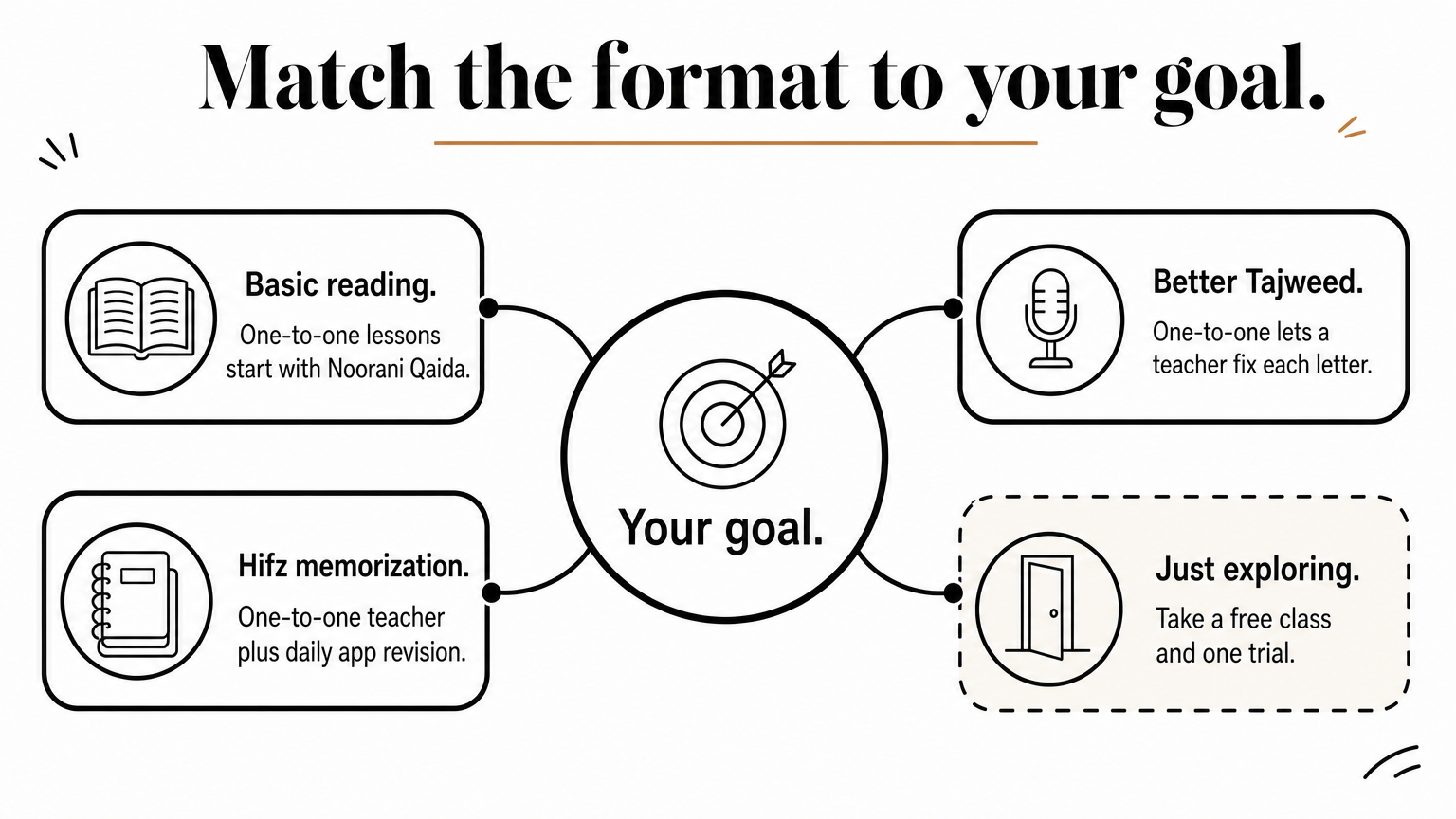
- Never read the Quran before: start with basic reading, such as Noorani Qaida, one-to-one.
- Better Tajweed: choose one-to-one, so a teacher can hear and fix individual letters.
- Hifz: pair a one-to-one teacher with daily app revision.
- Understanding meaning: take Quranic Arabic in a small group or one-to-one.
- Just exploring: take a free class plus one trial lesson.
Check the teacher before you pay
Run every academy or tutor through this short checklist.
- Ask what she studied, and who certified her recitation.
- Get the teacher’s gender confirmed in writing if it matters to you.
- Recite a short passage in the trial and notice whether she names specific mistakes.
- Ask about the policy for missed or rescheduled lessons.
- Request the total monthly cost and the number of lessons it includes.
- Confirm class times in your own time zone.
A good trial lesson ends with you knowing exactly what to fix next.
Start with one lesson
The right class is the one where a qualified teacher can hear you recite and correct you. For most women that means one-to-one lessons, with small groups, free programs, and apps as support for a tighter budget or extra practice.
Do not choose from a brochure. Take a trial, recite aloud, and see whether the teacher is precise. If you are unsure whether to begin with reading, Tajweed, Hifz, or Arabic, book a free level assessment class at Quranytime Academy. A teacher will assess your level and match you to a path, and you can confirm your teacher preference before you commit.