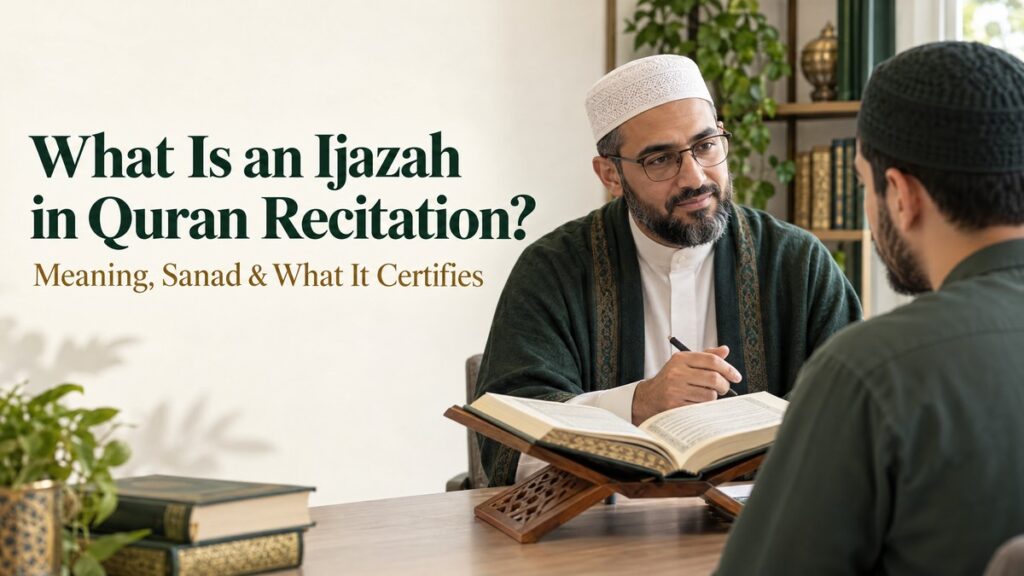
If you have searched for an Ijazah in Quran recitation, you may have seen the terms ijazah, sanad, certificate, and permission used almost interchangeably. They are related, but they do not always mean the same thing. An Ijazah is generally a teacher-granted authorization or certification connected to a defined area of Quranic study. Its scope depends on the reading, teacher, and program. This guide explains the terms, common learning paths, and practical questions to ask before enrolling, without treating every certificate or course as an Ijazah.
What is an Ijazah in Quran recitation?
In Quran recitation, an Ijazah is a formal recognition from a qualified teacher that a student has demonstrated the standard required for a specified recitation or body of knowledge. The teacher listens to the student, corrects mistakes, and decides whether the requirements for that particular pathway have been met. The written document may identify the reading or narration covered and the teacher who granted it.
The exact meaning is not identical across every institution. One program may focus on accurate recitation from the Mushaf, while another may require memorization or cover a particular riwayah. Before relying on a label, ask the issuing teacher what was assessed, what the document authorizes, and what is outside its scope. A course attendance certificate or completion badge is not automatically an Ijazah.
Ijazah and sanad: how are they different?
Sanad means a chain of transmission. In Quran recitation study, it refers to the named line of teachers through whom a reading was learned and passed on. An Ijazah may record a sanad, but the terms are not interchangeable: one describes authorization or certification, while the other describes a chain of transmission associated with it.
A responsible teacher should be able to explain the reading covered, the standard used, and how their own authorization relates to the sanad. Do not assume that every Ijazah covers every canonical reading, that every sanad document has identical wording, or that a certificate grants broad authority beyond what it states. For religious rulings about a specific document, consult a trusted qualified scholar.
Common Ijazah pathways
Some pathways assess recitation while the learner reads from the Mushaf; others require reciting from memory. A program may focus on one narration, such as Hafs ‘an ‘Asim, or may offer advanced study in additional readings. The terminology and prerequisites vary, so these are useful questions to discuss with the teacher rather than universal categories with one fixed rule.
In many pathways, the student works through substantial portions of the Quran with direct listening and correction. A teacher may expect a strong command of Tajweed, accurate articulation, and consistent application before beginning a formal assessment. Memorization is essential for some routes, but not necessarily all. Ask for the curriculum and final assessment criteria in writing.
How to prepare for an Ijazah in Quran
Preparation usually starts well before a formal Ijazah assessment. Learners benefit from a steady foundation in Arabic letter pronunciation, articulation points, Tajweed rules, and fluent reading. A teacher can identify recurring errors that are hard to notice when practising alone. A realistic plan may include:
- Confirming your current reading level with a qualified instructor.
- Practising pronunciation and Tajweed rules consistently between lessons.
- Reviewing corrections and recording difficult passages for guided practice.
- Agreeing on a manageable recitation or memorization schedule.
Progress depends on your starting level, available lesson time, accuracy, and the requirements of the chosen reading. Be cautious of promises that everyone can complete an Ijazah in a fixed number of weeks. A good teacher prioritizes sound recitation and clear standards over speed.
Questions to ask a Quran teacher
Before enrolling, ask who will assess your recitation and whether that person holds the relevant authorization for the specific reading. Ask what the Ijazah covers, whether the sanad is documented, whether you must recite from the Mushaf or memory, and what level of accuracy is expected. You can also ask how lessons are structured, how corrections are tracked, and what happens if you need more practice before assessment.
Look for direct, specific answers rather than vague claims such as “certified Quran course.” A teacher should be comfortable explaining their qualifications and the limits of a program. If you are comparing teachers, review their stated experience and recitation credentials, then arrange a level assessment before committing to an advanced pathway.
Can you study for an Ijazah online?
Online lessons can make it easier to study with a qualified teacher when a suitable instructor is not nearby. A live one-to-one format allows the teacher to hear recitation, pause for corrections, and assign practice. But the video-call format alone does not determine whether a program awards an Ijazah or whether a particular community or scholar recognizes it. Confirm the teacher, assessment method, reading covered, documentation, and any local expectations before you start.
For a general Quran or Tajweed class, the goal may simply be better reading and understanding; it may not include a formal Ijazah assessment. Treat those as different learning goals and ask the provider which one a course supports.
Do you need an Ijazah to learn Quran?
No. You can study Quran reading, Tajweed, and memorization with a teacher without pursuing an Ijazah. Ijazah is a more specialized goal for learners seeking formal recognition in a specified recitation or transmission pathway. If you are a beginner, focus first on steady, accurate learning; you can discuss advanced certification later, once a qualified teacher has assessed your progress.
Frequently asked questions
Is an Ijazah the same as a Quran course certificate?
Not necessarily. A course certificate may confirm attendance or completion. An Ijazah is generally tied to an assessment and a defined authorization; ask the issuing teacher to explain exactly what the document certifies.
Does every Ijazah require memorizing the Quran?
Requirements vary. Some paths emphasize recitation from the Mushaf, while others may require recitation from memory. Confirm the prerequisites for the specific reading and teacher.
How long does it take to earn an Ijazah?
There is no single timeline. It depends on your foundation, practice schedule, accuracy, and the teacher’s assessment standard. A reliable program should set expectations after evaluating your level.
If your immediate goal is to strengthen recitation, explore Quranytime’s online Quran classes or request an assessment class to discuss your level. Quranytime’s teacher profiles list individual qualifications, including Ijazah credentials. A teacher’s personal credential does not mean that every class awards an Ijazah, so ask about the course scope before enrolling.