
The best online Skype Quran classes share three traits: a live teacher with verified credentials such as an Ijazah, true one-to-one attention so your recitation is corrected as you read, and a schedule that bends around your life. A full academy like Quranytime suits most families and adult beginners. An independent tutor suits learners on a tight budget who can vet credentials themselves. Group classes and mosque programs suit children who learn well with peers, and an app plus an occasional tutor suits disciplined self-starters.
The problem is that most pages still promoting Quran classes over Skype were written years ago. Microsoft retired Skype in May 2025, so today’s lessons run on Zoom, Google Meet, or a similar tool. It is hard to tell which providers are real, what they charge, and whether a free class is actually free.
This guide comes from the team at Quranytime Academy, where we have taught live Quran and Arabic lessons online for over 10 years. It walks through five ways to learn live over video, who each one suits, and how to compare them before you pay.
What happened to Skype Quran classes
Skype is gone, but the format it popularized is not. A live video lesson with a qualified teacher now runs on Zoom, Google Meet, or Microsoft Teams, and the standard for a good Quran classes online Skype style lesson is the same as before.
Why the Skype label still sticks
Parents and students still search for online Quran classes Skype because the tool showed a whole generation that a teacher in Cairo could sit in their living room by video. The name stayed after the software changed.
What matters is the lesson itself, not the logo on the call screen. You need a clear microphone, screen sharing for the mushaf pages, and a teacher who can hear every letter you pronounce.
The tool changed, but the standard did not: a live teacher who can hear you recite.
What to confirm about the platform
Ask every provider the same practical questions before you book anything. The answers show how organized they are.
- Which app do lessons run on, and do I need an account?
- Does it work in a browser, or do I need to install something?
- Can the teacher share a digital mushaf and highlight Tajweed rules live?
- What happens if my connection drops mid-lesson?
- Are recordings available so I can review my recitation?
A provider that answers these quickly has run live lessons before. One that dodges them is a warning sign.
1. Quranytime Academy: live one-to-one lessons
Quranytime Academy is a full online academy that pairs each student with a qualified teacher for live one-on-one classes over video. It fits learners who want structure, verified credentials, and a clear plan, not just a call with a tutor.
How it works
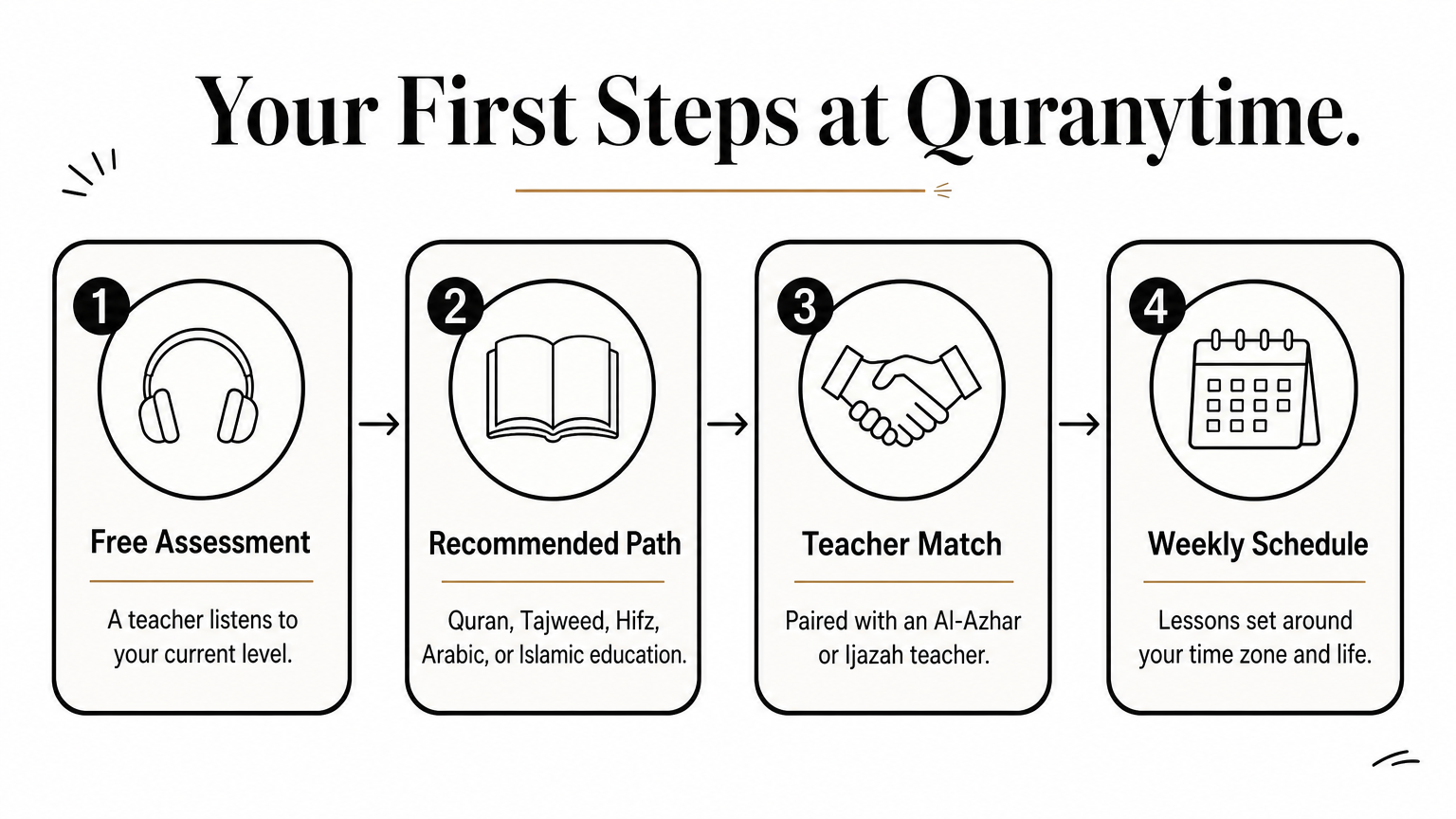
You begin with a free trial assessment class. A teacher listens to your level, then recommends a path: Quran reading and Tajweed, Hifz, Arabic language, Quranic Arabic, or Islamic education. After that you are matched with a teacher and set a weekly schedule.
Teachers include Al-Azhar University graduates and Ijazah holders. Between lessons, you get an Arabic Reading Guide, educational quests and games for younger children, and achievement certificates that mark progress.
A free assessment class tells you more about a teacher than any brochure.
Who it suits
This route works for almost every learner who wants a guided start and steady correction.
- Parents who want a safe, structured setting for children
- Adult beginners with no Quran reading or Arabic background
- Busy professionals who need lessons in different time zones
- Students polishing Tajweed or following a Hifz plan
Cost and trade-offs
The trial class costs nothing and gives you a recommended path before you spend anything. Pricing after that depends on the plan and how many lessons you take per week, so ask for the per-lesson rate at the end of the trial.
The trade-off is plain. One-to-one teaching costs more per hour than group classes, because the teacher’s full attention is yours. In exchange, every mistake gets heard and fixed that day.
2. A privately hired independent tutor
An independent tutor is the closest match to the old-style Skype lesson: one teacher, one student, arranged directly. It can be an excellent choice, but it puts the vetting work on you.

How it works
You find a tutor through personal referrals, a mosque, or a community group, agree on a lesson time, and pay the tutor directly. The tutor picks the book, usually a Noorani Qaida for beginners or the mushaf for those who can already read.
Most of the structure depends on the person. A strong tutor gives a clear plan. A weak one simply listens to you read, and weeks pass without a measurable goal.
Who it suits
This option suits learners who already know what they want and can judge quality.
- Adults on a tight budget who can verify credentials
- Families who already trust a teacher from their community
- Learners who need only one narrow skill, such as fixing noon sakinah rules
Cost and trade-offs
Independent tutors often charge less per lesson than academies, because there is no platform overhead. Asking to see an Ijazah or a university certificate is a fair and normal request.
The risks are real. There is usually no backup teacher when your tutor is ill, no progress reporting, and no one to turn to if lessons stop being useful. Many online Skype Quran classes from individuals work well for a year, then fade for exactly these reasons.
3. Group classes at an online academy
Group classes put several students with one teacher in a live video session. They cost less than private lessons, and they work best for review and for children who enjoy learning alongside others.
How it works
An academy runs a fixed timetable by level, such as beginner Qaida, Tajweed basics, or short surah memorization. You join the slot for your level, and the teacher takes turns listening to each student.
Each student recites only for a few minutes per session. The rest of the time you listen to others, which helps with rules and patterns but not with your own pronunciation.
Who it suits
Groups suit learners who are motivated by company and don’t need heavy correction yet.
- Children aged around 7 to 12 who like a classroom feel
- Siblings or cousins who can sit together
- Adults who want a low-cost refresher on Tajweed rules
Cost and trade-offs
Group pricing is lower because the teacher’s time is shared. Times are also fixed, so a busy schedule or an awkward time zone can make attendance hard.
Group classes teach the rules well, but only one-to-one lessons correct your own mouth.
If your goal is accurate recitation, treat a group class as a supplement rather than your main route.
4. Mosque and Islamic center online programs
Many mosques and Islamic centers now offer Quran lessons over video, and these are often the lowest-cost route. They fit learners who value community and need the basics, but the level of teaching and scheduling varies widely.
How it works
A local center, or a larger organization, lists classes for children and adults. Registration is usually through the center’s office. Lessons are held in small groups at set times, often on weekends or evenings.
Some centers connect students with a volunteer teacher for one-to-one practice. Others run only group classes, and the format can shift from term to term.
Who it suits
This route suits learners who want community ties as much as instruction.
- Families who want their children to know other Muslim children
- Beginners learning letters and short surahs
- Anyone who wants a free or low-cost first step toward formal study
Cost and trade-offs
Fees are often low, and some programs are free. That is where most genuine free Quran classes online are found, as community offerings, not as polished services.
The trade-offs are limited levels, fixed timetables, and teachers whose credentials you must ask about. Hifz and Tajweed mastery usually need more individual time than these programs can provide.
5. Self-paced apps with occasional live tutoring
A hybrid approach combines recitation apps or recorded lessons with a live tutor every few weeks. It is the cheapest structured option and the most demanding on your discipline.

How it works
You study daily with an app, a video course, or a book, and record your recitation. Every two to four weeks, you book a live session where a teacher listens, corrects, and sets the next targets.
The live session is the quality control. Without it, errors in makharij, the points where letters are pronounced, can go unnoticed for months.
Who it suits
This setup suits independent adults with steady habits.
- Professionals who can practice 15 to 20 minutes every day
- Returning learners who already read but want checkups
- Learners who live in a tricky time zone and prefer flexible check-ins
Cost and trade-offs
Apps are cheap, and you pay a tutor only for the sessions you book. The weakness is that software cannot reliably judge Tajweed the way a trained ear can.
If you choose this path, keep the live sessions regular. Online Quran classes Skype style work best when a teacher hears you often, even in a hybrid plan.
How to compare options before you pay
Compare providers on five things: teacher credentials, lesson format, price per lesson, schedule flexibility, and how you can test them first. A short side-by-side makes the choice clear.
Side-by-side comparison
| Option | Teacher attention | Cost level | Schedule flexibility | Best for |
|---|---|---|---|---|
| Academy one-to-one (Quranytime) | Full, one-to-one | Moderate to high | High | Structured goals, children, Hifz |
| Independent tutor | Full, one-to-one | Lower to moderate | Depends on tutor | Budget learners who can vet |
| Group academy classes | Shared | Lower | Fixed times | Children who like peers |
| Mosque or center program | Shared | Lowest, sometimes free | Fixed times | Community and basics |
| App plus occasional tutor | Occasional | Low | Highest | Disciplined self-starters |
Choose by how much correction you need, then by price.
Questions to ask before enrolling
Put these questions to any provider in writing so you can compare answers later.
- Can I see the teacher’s Ijazah or university certificate?
- Is the trial free, how long is it, and do I owe anything after?
- What is the price per lesson and per month, and what is the makeup policy?
- Can I change teachers if the fit is wrong?
- Do you teach children, and may a parent sit in?
- Which platform do you use, and which time zones do you cover?
Free classes and trials
Free ongoing one-to-one lessons with a certified teacher are rare, so be careful when an offer sounds too generous. Free trials and community programs are the honest versions of free Quran classes online Skype searches promise.
Use a trial to judge three things: whether the teacher corrects you kindly and clearly, whether the audio and screen sharing work well, and whether you leave with a clear plan.
Start with a class that fits your level
Good online Skype Quran classes now run on any reliable video tool. What counts is a credentialed teacher, direct correction, and a plan you can follow. Academies suit most families, independent tutors suit careful budgets, and groups, community programs, and apps work as supports or stepping stones.
If you are unsure where to begin, take the trial. At Quranytime, the free assessment class places you with a teacher and a learning path for Quran, Tajweed, Arabic, Hifz, or Islamic education, so you can judge the lessons before you commit.