
Madd tajweed rules tell you when to stretch a vowel sound in the Quran and for how long. "Madd" means "to stretch" in Arabic, and the stretch happens on three letters: Alif, Waw, and Ya. The length is measured in counts. Natural Madd takes 2 counts, Madd caused by a Hamzah takes 4 or 5 counts, and Madd caused by a permanent Sukoon takes 6 counts. The counts in this guide follow Hafs ‘an ‘Asim, the most widely used recitation.
This article gives you the whole picture in one place. You will see why Madd matters, how to decide the length of any Madd you meet, and every type with its cause, count, and Quranic examples. A reference table and a list of common mistakes close the guide.
Quranytime Academy teaches Tajweed in live, one-to-one lessons with Al-Azhar-trained teachers. This guide is written for the reader who wants to recite correctly, not just memorize terms.
Why Madd rules matter in Quran recitation
Madd rules matter because vowel length is part of the word itself, and a recitation with wrong lengths is a recitation with errors. Almost every verse contains at least one Madd, so you meet these rules from your first page.
Length changes words, and rhythm shows accuracy
In Arabic, a long vowel can be the only difference between two words. The verb كَتَبَ (kataba, "he wrote") becomes كَاتَبَ (kātaba, "he corresponded with") when you add a long Alif. If you shorten a required stretch, you can blur the word you are reading or produce something that is not in the verse.
The opposite error matters too. Stretching a natural Madd too long, or giving every Madd the same length, flattens the rhythm that listeners recognize in good recitation. Careful reciters keep long vowels long and short vowels short.
Madd is not decoration. It is the length of the vowels, and it is checked in every verse you read.
What a count is, and which recitation these counts follow
A count (harakah) is the time of one short vowel, about the time it takes to open or close a finger at a steady pace. A 2-count Madd lasts as long as two short vowels. The speed changes with your pace, whether you recite slowly or faster, but the ratio does not. A 4-count Madd is twice as long as a natural Madd, and a 6-count Madd is three times as long.
The counts here follow Hafs ‘an ‘Asim. Other recitations, such as Warsh ‘an Nafi’, assign different lengths to some types. If you study with a teacher, follow the transmission your teacher uses and stay consistent with it.
How to apply the Madd rules step by step
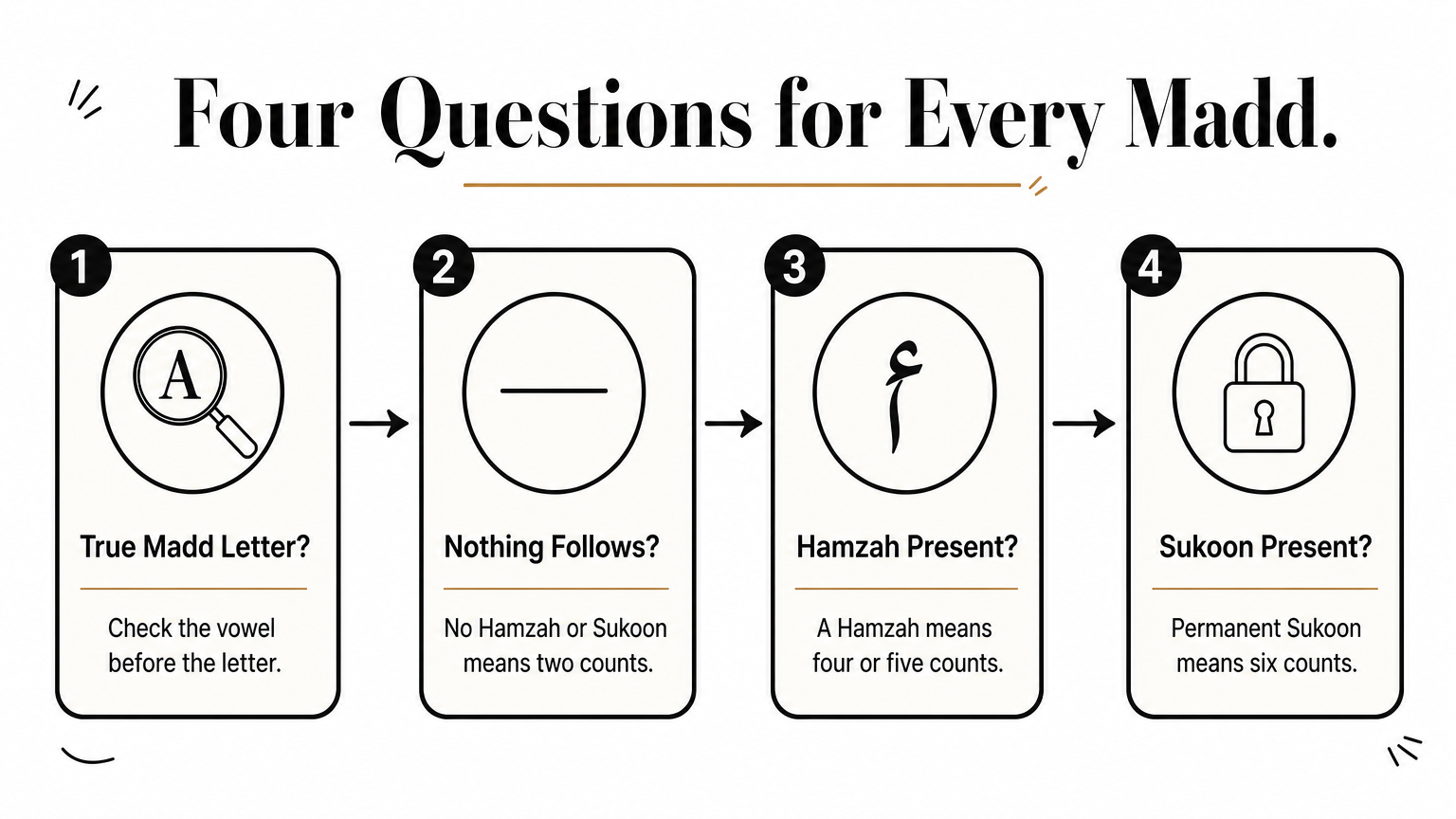
To apply the Madd rules in Tajweed, first confirm that you have a true Madd letter, then look at what comes right after it, and let that decide the count. Four questions are enough for every case.
The three Madd letters and their conditions
A letter only counts as a Madd letter when the vowel before it matches. If the match is missing, the letter is an ordinary consonant.
| Letter | What must come before it | Example |
|---|---|---|
| Alif (ا) | A letter with Fathah | قَالَ (qāla) |
| Waw (و) | A Sakin Waw after a letter with Dammah | يَقُولُ (yaqūlu) |
| Ya (ي) | A Sakin Ya after a letter with Kasrah | فِي (fī) |
A Sakin Waw or Ya after a Fathah, as in خَوْف (khawf) and بَيْت (bayt), is not a true Madd letter. These are called Lin letters, and they only stretch in one situation that you will see in the last section.
Four questions to ask at every Madd letter
Work through these in order each time you see a possible Madd:
- Is it a true Madd letter? Check the vowel before it using the table above.
- What follows it? If nothing follows, meaning no Hamzah and no Sukoon, it is natural Madd at 2 counts.
- Is there a Hamzah? If the Hamzah is in the same word, the Madd is obligatory. If it starts the next word, the Madd is separated. Both take 4 or 5 counts in Hafs.
- Is there a Sukoon? If it is permanent, the count is 6. If it appears only because you stop on the word, you have 2, 4, or 6 counts to choose from.
Then pick one length and keep it across the passage. In many printed Qurans, a wavy mark above the Madd letter signals that one of the longer rules applies.
Cause decides count: nothing after it means 2, a Hamzah means 4 or 5, a Sukoon means up to 6.
A practice routine that works
Begin by listening. Play a few verses from a qualified reciter, find each Madd, and say its count aloud before you read the verse yourself. Your ear learns the ratio before your memory learns the names.
Then mark a copy of the text. Circle every Madd letter, write the count above it, and read slowly with a steady tapping rhythm. Record yourself and compare the recording with the reciter. A live teacher speeds this up, because someone can hear your timing and correct it on the spot, which is what Quranytime’s one-to-one Tajweed lessons are built around.
Madd Asli, the natural Madd at two counts
Madd Asli, also called natural Madd, is the base stretch of 2 counts that happens whenever a Madd letter has no Hamzah or Sukoon after it. Every other Madd is measured against it.

The rule and its examples
The test for natural Madd is simple. If you remove the stretch, the word is no longer correct. Examples:
- قَالَ (qāla): the Alif after Fathah is held for 2 counts.
- يَقُولُ (yaqūlu): the Waw after Dammah is held for 2 counts.
- فِي (fī): the Ya after Kasrah is held for 2 counts.
Sometimes no full letter is written. A small dagger Alif above a letter, as in ذَٰلِكَ (dhālika) and هَٰذَا (hādhā), marks the same 2-count stretch. Do not shorten it just because the letter is not written out.
Natural Madd is always two counts, never shorter, and never longer unless a cause is present.
Other Madd types that also take two counts
Four more types share the 2-count length with natural Madd:
- Madd Tamkin: a doubled Ya followed by a Madd Ya, as in النَّبِيِّينَ (an-nabiyyīna). Pronounce both Yas clearly, then hold 2 counts.
- Madd Iwad: when you stop on a word that ends in a Tanween Fathah, as in عَلِيمًا (ʿalīman), the Tanween becomes an Alif held for 2 counts.
- Madd Badal: a Hamzah comes before the Madd letter in the same word, as in آمَنُوا (āmanū), إِيمَانًا (īmānan), and أُوتُوا (ūtū). In Hafs it is 2 counts.
- Madd Silah Sughra: the pronoun Ha (هُ or هِ) sits between two voweled letters and no Hamzah follows, as in إِنَّهُ كَانَ (innahu kāna). The Ha stretches into a Waw or Ya sound for 2 counts.
Silah does not apply when the letter before the Ha is Sakin, as in مِنْهُ. The one famous exception is فِيهِۦ in Surah Al-Furqan, where Hafs does stretch it.
Madd Far’i caused by a Hamzah
When a Hamzah sits next to a Madd letter and follows it, the rules of Madd in Tajweed lengthen the sound to 4 or 5 counts in Hafs. Where the Hamzah sits decides whether the rule is obligatory or permissible.

Madd Muttasil, the connected Madd
Madd Muttasil happens when the Madd letter and the Hamzah are in the same word. It is obligatory (wajib), and no authentic recitation reads it at 2 counts. Examples are جَاءَ (jā’a), السَّمَاءِ (as-samā’i), and سُوءٌ (sū’un). Teachers of Hafs usually give 4 or 5 counts, and your teacher will tell you which to use.
Madd Munfasil, the separated Madd
Madd Munfasil happens when a Madd letter ends one word and a Hamzah begins the next, as in بِمَا أُنزِلَ (bimā unzila), قَالُوا آمَنَّا (qālū āmannā), and فِي أَنْفُسِكُمْ (fī anfusikum). It is called permissible (ja’iz) because some recitations shorten it to 2 counts. In Hafs, you read it at 4 or 5 counts.
Many readers give Munfasil a longer count than Muttasil by accident. Use the same count for every Muttasil and Munfasil in a passage, so the rhythm stays even.
Madd Silah Kubra
Madd Silah Kubra is the longer sister of Silah Sughra. The pronoun Ha sits between two voweled letters, but this time a Hamzah starts the next word. The Ha stretches into a Waw or Ya sound at 4 or 5 counts, like Munfasil. Examples are مَالَهُ أَخْلَدَهُ (mālahu akhladah) in Surah Al-Humazah and بِهِ أَذًى (bihi adhā) in Surah Al-Baqarah.
A Hamzah in the same word makes the Madd obligatory. A Hamzah in the next word makes it permissible, but you still keep it consistent.
Sukoon-based Madd rules and a quick reference chart
When a Sukoon follows a Madd letter, the stretch is 6 counts if the Sukoon is permanent and 2, 4, or 6 if it appears only because you stop. This section also gives you a chart of every type and the mistakes that cost readers the most.
Madd Lazim, the six-count rule
Madd Lazim is the strongest Madd. A Madd letter is followed by a permanent Sukoon or a Shaddah, one that stays whether you stop or continue, so the length is always 6 counts. It has four kinds:
- Kalimi Muthaqqal: a Shaddah follows in the same word, as in الضَّالِّينَ (ad-dāllīn) and الْحَاقَّةُ (al-ḥāqqah).
- Kalimi Mukhaffaf: a plain Sukoon follows in the same word, as in الْآنَ (al-āna). It appears in only two places in the Quran, both in Surah Yunus.
- Harfi Muthaqqal: the middle of a letter name at the start of a Surah merges into the next letter, as in the Lam of الٓمٓ (Alif Lam Mim).
- Harfi Mukhaffaf: the same pattern without a merge, as in قٓ, نٓ, and صٓ. The ‘Ayn in Surah Maryam and Surah Ash-Shura may take 4 or 6 counts.
Madd Arid lil-Sukoon and Madd Lin
Madd ‘Arid lil-Sukoon applies only when you stop. A Madd letter is followed by a letter that becomes Sakin because you stopped, as at the end of الْعَالَمِينَ (al-ʿālamīn). You may read it at 2, 4, or 6 counts. When you continue instead of stopping, you give natural Madd only.
Madd Lin works the same way for the Lin letters. When you stop on خَوْفٍ (khawf) or بَيْتٍ (bayt), the soft Waw or Ya can stretch for 2, 4, or 6 counts. Choose one length and hold to it, because switching mid-passage is a common flaw.
Madd types at a glance
| Type | Cause | Counts (Hafs) | Ruling | Example |
|---|---|---|---|---|
| Asli | No cause | 2 | Fixed | قَالَ |
| Badal | Hamzah before Madd letter | 2 | Fixed in Hafs | آمَنُوا |
| Silah Sughra | Ha pronoun, no Hamzah after | 2 | Fixed | إِنَّهُ كَانَ |
| Muttasil | Hamzah in same word | 4 or 5 | Obligatory | جَاءَ |
| Munfasil | Hamzah in next word | 4 or 5 | Permissible | قَالُوا آمَنَّا |
| Silah Kubra | Ha pronoun, Hamzah after | 4 or 5 | Permissible | مَالَهُ أَخْلَدَهُ |
| ‘Arid lil-Sukoon | Temporary Sukoon at a stop | 2, 4, or 6 | Permissible | الْعَالَمِينَ |
| Lin | Lin letter, stop | 2, 4, or 6 | Permissible | خَوْفٍ |
| Lazim | Permanent Sukoon | 6 | Fixed | الضَّالِّينَ |
You may see the number of types given as 8, 9, or 10. The difference is only in grouping. Some teachers fold Badal and Silah Sughra into natural Madd, and others split Lazim into its four kinds. The rulings and counts do not change.
Mistakes that cost readers the most
- Over-stretching natural Madd to 3 or 4 counts without a Hamzah or Sukoon to cause it.
- Mixing counts inside one passage, such as 4 for one Munfasil and 5 for the next.
- Stretching Lin or Arid letters while continuing. These rules apply only when you stop.
- Dropping the stretch on a written dagger Alif, because no full letter shows.
Pick one length for each type, and apply it the same way every time you meet it.
Where to go from here
Madd tajweed rules come down to one habit: find the Madd letter, check the cause that follows it, and give the matching count. Two counts for no cause, 4 or 5 for a Hamzah, and 6 for a permanent Sukoon cover most of what you will meet. The reference table above gives you the quick check while you practice.
Reading about Madd gets you the rules, but timing needs a listener. If you want a teacher to hear your recitation and correct it, book a free assessment class with Quranytime Academy. You will meet a teacher one-to-one, discuss your current level, and get a recommended next step, with no obligation to continue.