
The best way to learn Tajweed Quran online is with a live teacher who hears you recite and corrects you on the spot. Free videos, apps and community circles teach the rules well, but none of them can tell you that your heavy letter sounds light. Choose live one-to-one classes for the fastest progress, group courses for structure on a smaller budget, and free videos or apps if you are testing the water or backing up lessons.
The trouble is that search results mix very different things together: academies, video series, apps and free courses, all promising Tajweed. It is hard to tell which one fits a beginner, a busy adult, a parent choosing for a child, or a sister who wants a comfortable setting. The honest answer is that the formats do different jobs.
This article walks through five ways to learn, each judged on how it works, who it suits, and what it costs and limits. At Quranytime Academy we teach Tajweed live and one-to-one, so we list our format first and hold every option to the same standard.
1. Live one-to-one classes with Quranytime Academy
How it works
Quranytime Academy teaches live, one-to-one Quran and Arabic lessons over video from your home. You start with a free assessment class, where a teacher hears you read, checks your level and recommends a path, such as Quran reading with Tajweed, recitation correction or Hifz. After that, you recite and your teacher helps identify errors and build confidence step by step.
Our teachers are Al-Azhar University graduates with Ijazah in Quranic and Islamic studies. That matters because Tajweed has always been passed on by listening to a qualified reciter, not only by reading about the rules.
Tajweed is a spoken skill, so the fastest progress comes from a teacher who hears your mouth, not just your notes.
Who it suits
These classes suit complete beginners, since no previous knowledge is required. They also suit readers who can already read but keep repeating the same pronunciation errors. Parents can book classes for children, and teenagers and adults can request their own. Flexible scheduling helps busy professionals and learners in other time zones. If you are a sister who prefers a female teacher, ask about it when you book.
Cost and limits
The assessment class is free, with no obligation to continue. Paid plans come after the assessment, so ask for the details before you commit. The limits are straightforward. One-to-one lessons cost more than group or free options, and you need to attend regularly and practice between sessions.
2. Structured group courses and online academies
How it works
A group Tajweed course follows a fixed curriculum, taught live to a class or delivered as recorded modules with some teacher contact. Most courses cover the rules in a set order: noon sakinah and tanween, meem sakinah, madd, qalqalah, the lam rules, heavy and light letters, then makharij and sifat. The teacher explains each rule to the whole class, and students recite in turn.
A group course gives you the map of Tajweed, but you only get a few minutes of correction per lesson.
Who it suits
Group courses suit learners who can already read Arabic script and want a clear syllabus at a lower price. They work well if you stay motivated when a class meets at a fixed time. They fit less well if you are a nervous beginner or recite in front of others with difficulty.
Cost and limits
Group classes usually cost less than private lessons. The trade-off is that the teacher cannot fix every student’s pronunciation. Before you pay, check four things:
- Who the teachers are and what they have studied
- How many students are in a class
- Whether you get a trial lesson
- Whether the certificate means anything beyond a completion note
3. Free video lesson series
How it works
Free Tajweed video series on YouTube take you through the rules one lesson at a time, often with on-screen Arabic text and slow examples. The method that works is active. Watch a lesson, pause, repeat the example aloud, then record yourself reciting and compare it with the teacher. Passive watching teaches you the vocabulary of Tajweed but rarely changes your mouth.

Who it suits
Videos suit self-motivated adults who want to learn Quran with Tajweed online for free, and anyone deciding whether a paid course is worth it. They also work as revision between live lessons. A video series is not enough for a child or for someone who cannot yet read the letters.
Free videos explain the rules, but they cannot hear you, so mistakes stay invisible.
Cost and limits
The cost is zero, and the real limit is feedback. If you pronounce a letter wrongly, no one tells you, and the error becomes a habit. Quality varies widely, so use these filters:
- Pick one series and finish it before starting another
- Choose a teacher with a stated Quran education and recitation background
- Make sure the lessons follow the Hafs reading, the most widely taught one
4. Tajweed and Quran learning apps
How it works
Apps break learning into short sessions: letters, vowel signs, makharij (the articulation points) and basic rules, usually with audio and quizzes. Some let you listen to a reciter, then record yourself and compare. That makes apps the easiest way to practice for five or ten minutes a day on a commute or a lunch break.
Who it suits
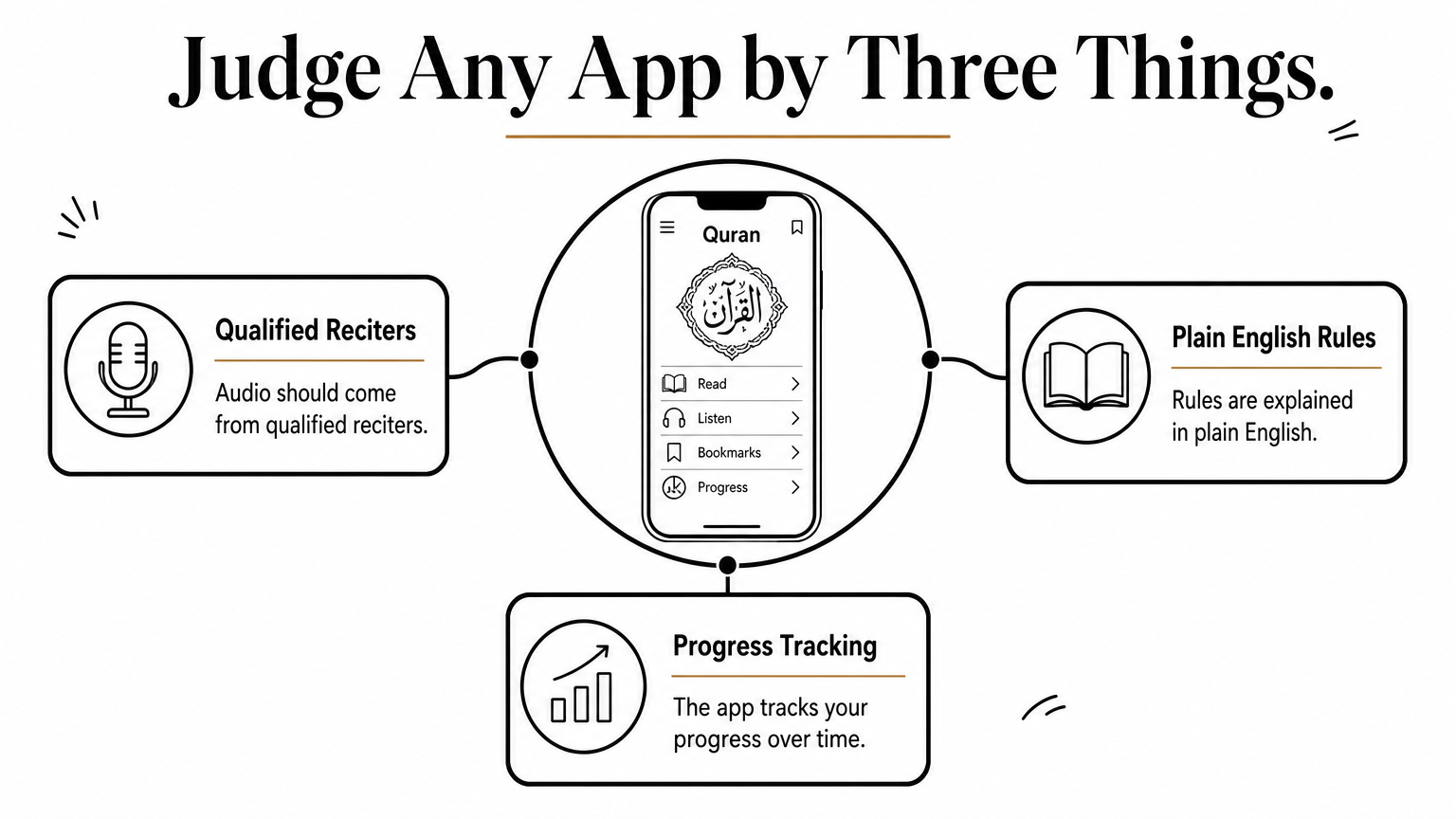
Apps suit beginners drilling the alphabet, parents who want a screen activity that is actually useful, and students reinforcing what a teacher taught. People ask which app is best for Tajweed, and there is no single answer. Judge any app on whether the audio comes from qualified reciters, whether it explains rules in plain English, and whether it tracks your progress.
An app builds daily habit, not correct pronunciation, so treat it as practice and not as a teacher.
Cost and limits
Many apps are free to start, with paid tiers that unlock later lessons. Check what sits behind the paywall before you invest time. The main limit is that an app cannot reliably judge your pronunciation, so it may mark you correct when your letter is still off.
5. Free courses, study circles and home practice
How it works
You can learn Quran with Tajweed at home by combining free resources. Take a free structured course or weekly online circle, add a Tajweed book, and practice daily. Work through the seven core rules in this order:

- Noon sakinah and tanween
- Meem sakinah
- Madd (elongation)
- Qalqalah
- Lam shamsiyyah and qamariyyah
- Heavy and light letters
- Makharij and sifat
Practice each one aloud for ten to fifteen minutes a day, and record yourself weekly.
Who it suits
This route suits learners on a tight budget and people who like community study. Some circles are women-only, so sisters can look for those. Check the schedule, language and teacher background before you join.
Free circles are best treated as a supplement, because a big group leaves little time for your recitation.
Cost and limits
Courses and circles are free or donation-based, but places and timing are not guaranteed. Large groups mean little personal correction, and free programs rarely offer an Ijazah or a path to one. If you want certification or reliable feedback, plan to add a teacher later.
Choosing where to start
Match the format to your biggest problem. If you need correction, learn with a live teacher. If you need structure, take a group course. If you only need practice or a free first look, use videos, apps and circles. Many learners combine two: lessons for feedback, free tools for daily repetition.
If you are unsure which fits, start with a free assessment class with Quranytime Academy. A teacher will hear you recite, tell you your level and recommend your next step, with no obligation to continue.