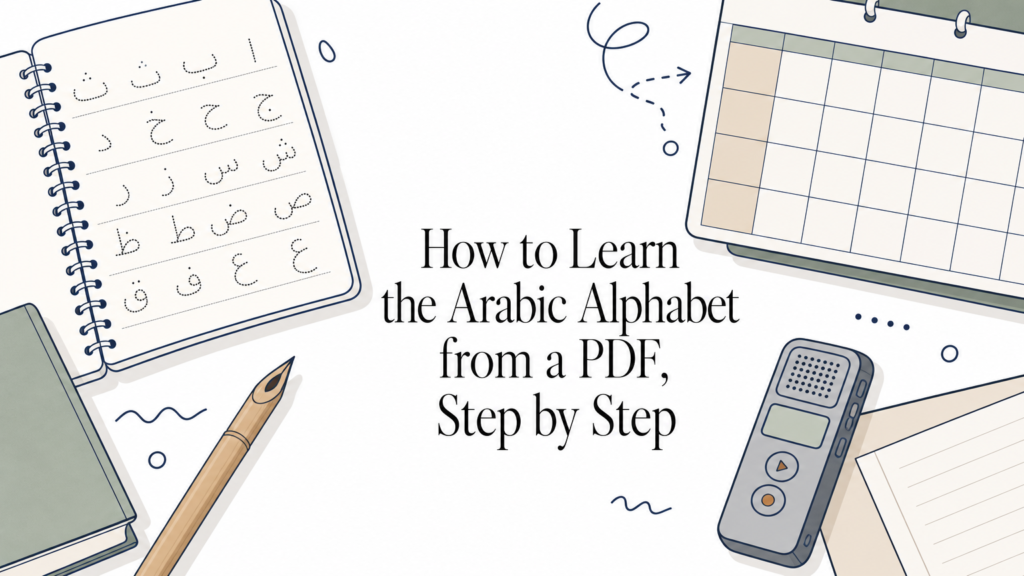
To learn the Arabic alphabet from a PDF, pick a workbook that shows all 28 letters in their four forms, with short vowels and room to trace. Print it and study the letters in shape families, not in alphabetical order. Write every letter by hand, then read simple voweled words aloud. A steady 20 to 25 minutes a day gets many beginners through the full set in about four weeks, though how long it takes to learn the Arabic alphabet varies.
The search results for this topic are crowded with booklets, coloring sheets, tracing packs and textbook scans. Most of them show the 28 letters in a chart and leave you alone with it. A chart gives you names, but it does not teach you how letters join, where the vowels go, or how to say the throat sounds. That is why many learners know the letters in isolation and still freeze when they meet a connected word.
This guide covers what a good alphabet PDF or book contains, how to avoid weak or unsafe free files, and seven steps from your first letter to your first words. It ends with a four-week schedule. At Quranytime Academy we teach Arabic letters to beginners in live one-to-one lessons, so the steps follow the places where learners usually get stuck.
Why a PDF works for the Arabic alphabet
A PDF works for the alphabet because the alphabet is a visual and physical skill. You need to see clean letter shapes and copy them with a pen, and a printed page lets you do both. A PDF falls short on one thing only, which is sound, and Step 7 deals with that.
Why print beats screen for letters
Reading Arabic letters on a phone is easy. Writing them is where the learning happens. When you print the sheets and trace by hand, your hand learns the curve of each letter, and that motor memory sticks far better than recognition alone.
A PDF is also cheap and endlessly repeatable. If baa still looks wobbly after the first page, print the same page again. You can work offline, mark mistakes in pen, and keep every page in a folder to see your own progress.
A printed sheet turns the alphabet from something you look at into something you do.
What you are actually learning
The Arabic alphabet has 28 letters, and all of them are consonants. Some lists count hamza (ء) as a 29th letter, and the joined pair lam-alif (لا) often appears as an extra entry. Neither changes the core set you need to learn first. Five facts shape everything that follows:
- Arabic is written and read from right to left.
- There are no capital letters and no separate print and handwriting styles.
- Letters connect to their neighbors, so most have up to four forms.
- Short vowels are small marks above or below the letters.
- Alif, waaw and yaa also stretch vowels into long sounds.
The alphabet is easier than it looks. The 28 letters fall into 17 families of similar shapes, and dots separate the members of each family. The real difficulty is a handful of throat sounds, not the writing.
What you need before you start
You need very little. Gather these before day one:
- A printer, or a notebook where you can copy the sheets by hand
- A pencil for practice and a fine pen for clean copies
- 20 to 25 quiet minutes a day
- A phone to record your voice
- No previous Arabic knowledge at all
If your goal is the Quran, the alphabet you learn here is the same one you will meet in the Quran. Quran copies add extra signs, such as the small alif, which you pick up later when you study Tajweed. The letters themselves do not change.
Step 1. Choose the right PDF or book
Choose a PDF that shows all 28 letters, all four forms of each letter, the vowel marks, and plenty of tracing space. If it only gives you a chart of isolated letters, it is a reference sheet, not a learning tool.
What a good alphabet PDF includes
Check the preview pages against this list before you print anything:
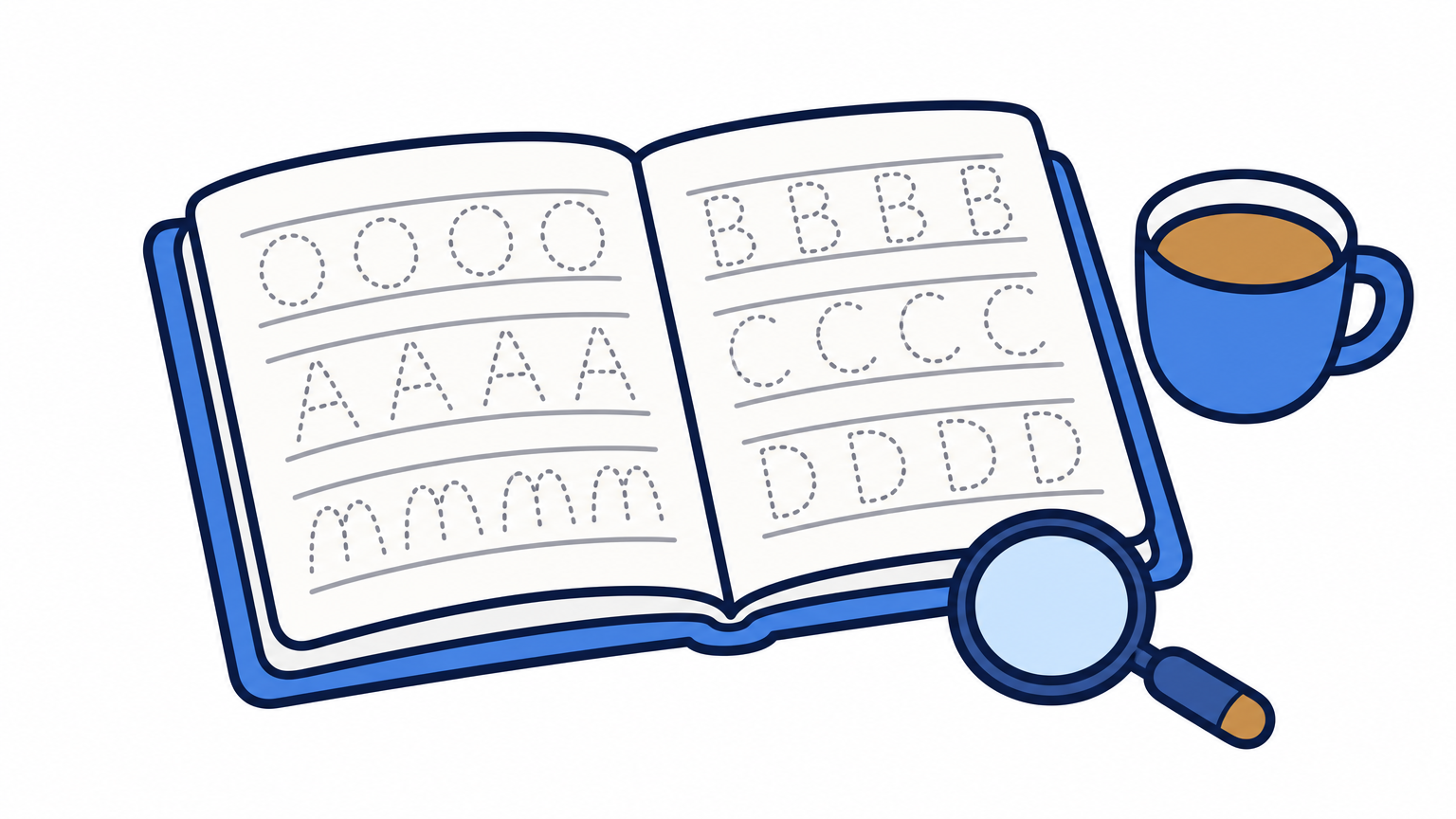
- All 28 letters, each with its name and a sound guide
- The isolated, initial, medial and final form of every letter
- Dotted tracing lines, then blank lines for writing from memory
- Short vowel marks (fatha, damma, kasra) on example syllables
- Simple voweled words for reading practice
- A note on which letters do not connect forward
- Audio or a link to audio, if the PDF is part of a course
Do not expect all of this from a single free sheet. A combination often works best: one tracing workbook for writing, plus one source with audio for sound.
PDF, workbook or book: which fits you
Each format does one job well and one job badly. This table sets them side by side.
| Format | Best for | Weak spot |
|---|---|---|
| Free tracing worksheets | Hand practice, one letter per page | Rarely cover joining or reading |
| Alphabet workbook PDF | A full path from letters to first words | Quality varies a lot between authors |
| Printed beginner book with audio | Sound, structure, long-term study | Costs money and arrives more slowly |
| Chart or poster PDF | Quick reference on your wall | Teaches nothing by itself |
If you want a book rather than a file, the textbook Alif Baa is a widely used choice. It is built around letters and sounds and comes with audio. A printed book is the better pick if you want one source from alphabet to simple sentences.
Staying safe with free downloads
Free Arabic alphabet PDFs are easy to find, but treat each free download with care. Use pages from schools, universities, established language publishers or teachers you can identify. Skip any site that asks you to install software or enter payment details to get a "free" file.
Preview the pages before you print. Check that the letters are drawn clearly, that the dots sit where they should, and that the transliteration matches the letters beside it. A sheet with one wrong dot teaches you a different letter. If something looks off, compare it with a second source before you commit.
Judge a free alphabet PDF by its four forms and its vowel marks, not by how many pages it has.
Step 2. Learn the 28 letters in shape families
Learn the letters in shape families, not in the alphabetical order of a chart. Letters that share a body and differ only by dots are easier to learn together, because you master one shape and then learn its dot variations.
Why families beat alphabetical order
Alphabetical order is a sorting system, not a teaching order. In that order, baa, taa and thaa come together, but jeem is followed by Haa and khaa, then daal, and so on. Grouping by body shape is almost the same thing at the start, but it later pairs letters like seen and sheen, or Saad and Daad, which the chart separates.
You still want the alphabetical order eventually, because dictionaries use it. Learn it in week four, once your hand knows every shape. That is the answer to the common question of what the best way to learn the Arabic alphabet is: shapes first, order later, and always with a pen in your hand.
The 17 families
The table below sorts all 28 letters into 17 families. Noon and yaa also share the opening shape of the baa family, which is why they are easy to confuse early on. Their dots tell them apart.
| Family | Letters | Names | Sound notes |
|---|---|---|---|
| Alif | ا | alif | Long "aa"; does not join forward |
| Baa | ب ت ث | baa, taa, thaa | b, t, th as in "think"; 1 dot below, 2 above, 3 above |
| Jeem | ج ح خ | jeem, Haa, khaa | j (g in Egyptian Arabic); breathy throat h; "ch" in Bach |
| Daal | د ذ | daal, dhaal | d; th as in "this"; no forward join |
| Raa | ر ز | raa, zayn | Tapped r; z; no forward join |
| Seen | س ش | seen, sheen | s; sh |
| Saad | ص ض | Saad, Daad | Heavy s; heavy d |
| Taa | ط ظ | Taa, Zaa | Heavy t; heavy th or z |
| Ayn | ع غ | ayn, ghayn | Squeezed throat sound; gargled r |
| Faa | ف ق | faa, qaaf | f; k pronounced further back |
| Kaaf | ك | kaaf | k |
| Laam | ل | laam | l |
| Meem | م | meem | m |
| Noon | ن | noon | n; 1 dot above |
| Haa | ه | haa | h as in "hot" |
| Waaw | و | waaw | w, or long "uu"; no forward join |
| Yaa | ي | yaa | y, or long "ii"; 2 dots below |
Capital-H Haa (ح) and plain haa (ه) are different letters. Textbooks write the first with a capital or a dot below to keep them apart, so match that notation in your PDF.
How to study one family in one sitting
Use the same four moves for each family, about five minutes per move:
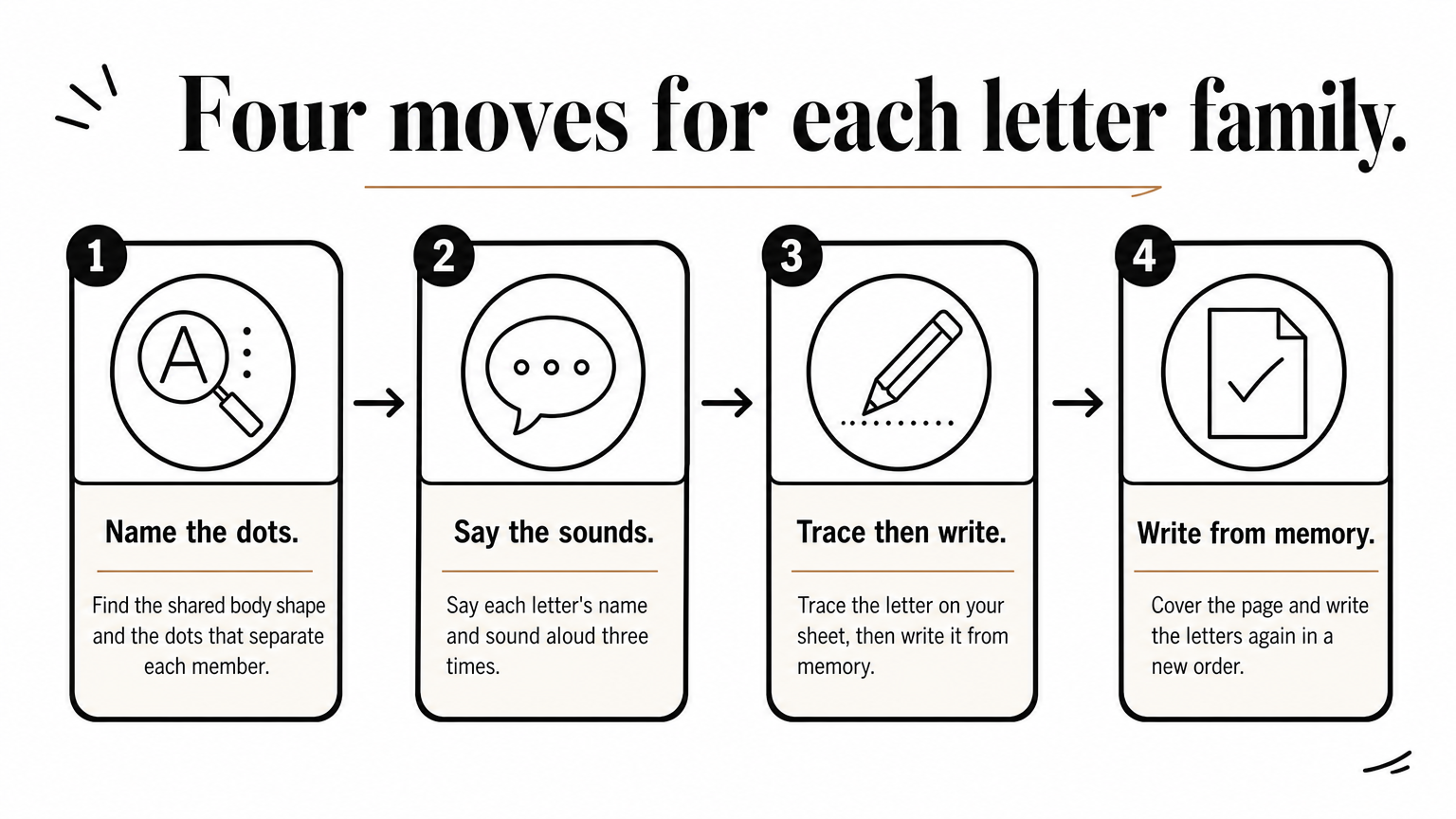
- Look at the family’s shared body shape and name the dots that separate each member.
- Say each letter’s name and sound aloud three times.
- Trace the letter on your sheet, then write it from memory on a blank line.
- Cover the page and write the letters again in a different order.
Do not add a new family until you can finish move 4 without peeking. Moving on too fast is the most common reason letters fade a week later.
Learn one body shape and its dots as a single unit, and 28 letters shrink to 17 jobs.
Step 3. Master the four letter forms
Every Arabic letter changes shape depending on where it sits in a word, and most have four forms: alone, at the start, in the middle and at the end. You learn them by connecting each letter to its neighbors, not by memorizing four separate drawings.
The four positions
The initial form connects to the letter after it. The medial form connects on both sides. The final form connects to the letter before it. The isolated form stands alone. For most letters, the body of the letter stays recognizable, and a short connecting stroke appears or disappears.
| Letter | Alone | Start | Middle | End |
|---|---|---|---|---|
| baa ب | ب | بـ | ـبـ | ـب |
| jeem ج | ج | جـ | ـجـ | ـج |
| ayn ع | ع | عـ | ـعـ | ـع |
| kaaf ك | ك | كـ | ـكـ | ـك |
| haa ه | ه | هـ | ـهـ | ـه |
| alif ا | ا | ا | ـا | ـا |
The dashes show where the letter links to its neighbor. Ayn and haa change the most, so give them extra time. Alif looks the same everywhere because it only joins from behind.
The six letters that never join forward
Six letters connect to the letter before them but never to the letter after them: alif (ا), daal (د), dhaal (ذ), raa (ر), zayn (ز) and waaw (و). After one of these, the next letter starts fresh in its initial or isolated form, and a small gap appears in the word.
Look at كِتَاب (kitaab, "book"). The kaaf and taa connect, the alif joins the taa from behind, and then the baa stands apart because alif will not join forward. That gap is not a mistake. It is the rule.
One more shape to know is lam-alif. When laam is followed by alif, the pair merges into a single crossed shape, لا. You will see it constantly, for example in the word for "no."
A short drill for the forms
Take any joining letter and run this drill. Write the isolated form once. Write the initial form, then connect it to a baa to make a two-letter chunk. Write the medial form between two baa letters. Write the final form after a baa. That gives you each form in a real context, not as an abstract drawing.
Then spell three short words, letter by letter, saying each letter’s name as you write. بَيْت (bayt, "house") is a good start. It uses a joining baa, a yaa and a final taa, and it shows how one word contains three different forms.
If a letter will not join forward, the next letter always starts over.
Step 4. Add short vowels and reading marks
Arabic has three short vowels, written as small marks above or below a consonant: fatha (a), damma (u) and kasra (i). Learn them right after your first letters, so that every syllable you practice has a vowel you can read.
The three short vowels and the marks beside them
Put the marks on baa and you can already read three syllables. Sukoon, shadda and tanween round out the set that beginner texts use.
| Mark | Name | What it does | Example |
|---|---|---|---|
| ـَ | fatha | Short "a", written above | بَ (ba) |
| ـُ | damma | Short "u", written above | بُ (bu) |
| ـِ | kasra | Short "i", written below | بِ (bi) |
| ـْ | sukoon | No vowel on this letter | بَيْت (bayt) |
| ـّ | shadda | Doubles the letter | جَدّ (jadd, "grandfather") |
| ـً | tanween | Adds an "-an" sound at the end | شُكْرًا (shukran, "thank you") |
A vowel mark always comes after its letter in sound. بَ is "ba," not "ab." Keep that order in your head, because it is the opposite of what many English speakers expect.
Long vowels and the two glide sounds
Alif, waaw and yaa act as long vowels when they follow a matching short vowel. Alif after fatha gives "aa" (بَا, baa). Waaw with sukoon after damma gives "uu" (بُو, buu). Yaa with sukoon after kasra gives "ii" (بِي, bii).
Waaw and yaa can also glide. After a fatha, a sukoon-marked yaa gives "ay" (بَيْ, bay) and a sukoon-marked waaw gives "aw" (بَوْ, baw). This is why بَيْت is read "bayt," not "ba-yi-t."
A final detail you will meet soon: the letter ة appears only at the end of a word and is a form of taa, often pronounced as a soft "ah." Learn it when you meet it in a word, not as a separate letter.
Why vowels matter, and when they disappear
Beginner materials and the Quran write every vowel. Newspapers, books and signs mostly leave the short vowels out, because fluent readers supply them from context. That is a skill you build later.
At this stage, always practice with the vowels written in. They let you read each word correctly the first time, so you never practice a mistake. If your PDF only shows bare letters, add the marks yourself from a second source.
Learn the vowels while you learn the letters, so every syllable you practice is one you can actually read.
Step 5. Write each letter by hand
Write every letter by hand in all four forms, at least ten times each, before you move on. Writing is what turns recognition into memory. It also shows you exactly which shapes you are still confusing.
Set up your writing space
Use ruled paper so your letters sit on a steady baseline. A medium pen or a soft pencil works well, and you should not grip it hard. Write from right to left, and start each word at the right edge of the line.
A useful habit is to write the body of the word first, then go back and add the dots and vowel marks. Add them from right to left as well. This keeps the writing smooth and stops you from breaking the flow after every letter.
The five-row routine
Copy this layout onto each page, or ask your PDF’s tracing sheet to follow the same pattern. It works for any letter.
Letter: ب    Name: baa    Sound: b    Family: baa (1 dot below)

Row 1: Trace the model letter 5 times (alone form)
Row 2: Write the start form بـ 5 times
Row 3: Write the middle form ـبـ 5 times
Row 4: Write the end form ـب 5 times
Row 5: Write the joined word بَيْت 3 times from memory
Say the sound out loud after every row. Rate yourself 1 to 3.
A rating of 3 means you wrote the row without looking. Repeat any letter that scores a 1 the next day.
Common handwriting mistakes
These mistakes appear in almost every beginner’s notebook, so check yours against the list:
- Putting the wrong number of dots on a letter, or putting them above when they belong below
- Writing letters unconnected, as if the word were typed in print
- Making alif and laam too short, so they look like part of the neighboring letter
- Closing the loops of ف, ق and م so tightly that they look alike
- Writing from left to right out of habit
Fix one mistake per session instead of trying to correct everything at once. Dots deserve the most attention, since a single dot turns baa into noon or taa.
Count your dots before you move on, because one dot changes the letter.
Step 6. Read your first words aloud
Start reading real words as soon as you know your first eleven letters. Reading simple voweled words shows you whether you truly know the letters. It is also the moment the alphabet starts to feel like a language.
Sound out a word letter by letter
Take one word and read it in four passes. First, name each letter. Second, add its vowel. Third, join the sounds into one smooth word. Fourth, say it without pausing between letters. For مَسْجِد, that sequence runs "meem, seen, jeem, daal" and then "ma, s, ji, d," ending in "masjid."
Keep your finger under the word and move it from right to left. This builds the right-to-left habit and stops your eyes from jumping around.
Twenty words to practice on
Use this table as a reading drill. These words use common letters, clear vowels and no unusual signs. The point is reading practice, not vocabulary, though you will pick up the meanings along the way.
| Arabic | Sounds like | Meaning |
|---|---|---|
| كِتَاب | kitaab | book |
| بَيْت | bayt | house |
| بَاب | baab | door |
| قَلَم | qalam | pen |
| شَمْس | shams | sun |
| قَمَر | qamar | moon |
| نَهْر | nahr | river |
| وَلَد | walad | boy |
| بِنْت | bint | girl |
| مَسْجِد | masjid | mosque |
| كَلْب | kalb | dog |
| جَمَل | jamal | camel |
| وَرْد | ward | rose |
| زَيْت | zayt | oil |
| خُبْز | khubz | bread |
| يَد | yad | hand |
| عَيْن | ayn | eye |
| نُور | nuur | light |
| دَرْس | dars | lesson |
| سَلَام | salaam | peace |
How to use the table
Cover the middle column with a card. Read each word aloud, then slide the card away and check yourself. Mark the words you missed and come back to them the next day.
When you can read all twenty without checking, write each one from memory. Reading and writing the same word reinforce each other, and that double pass is what makes vocabulary stay.
If you can read a word you have not memorized, you have learned the alphabet and not just a list.
Step 7. Check your pronunciation
Check your pronunciation against native audio and, ideally, a teacher. A PDF can show you a letter perfectly and still tell you nothing about how it sounds. A handful of Arabic sounds have no English match, and you cannot correct them by reading about them.
The sounds a PDF cannot teach
Six letters cause most of the trouble, along with four heavy letters.
- ع (ayn): a voiced squeeze in the throat. Think of saying "ah" while the throat is tight.
- ح (Haa): a breathy, whispered h made deep in the throat, like fogging a window.
- خ (khaa): the "ch" of German "Bach."
- غ (ghayn): a gargled sound, close to the French r.
- ق (qaaf): a k made further back in the mouth than ك.
- ص ض ط ظ: heavy versions of s, d, t and th, with the back of the tongue pulled down and back. They also make nearby vowels sound deeper.
Contrast pairs help: س and ص, ت and ط, د and ض, ه and ح, and ك and ق. Say each pair back to back and notice that the second one is heavier or deeper.
Record yourself and compare
Record yourself reading the twenty words, then play them next to native audio from a course, a textbook or an Arabic reading guide with teacher audio. Listen for the six trouble sounds first. You will hear differences that you could not feel while speaking.
Re-record the same words a week later. Progress on throat sounds is slow and quiet, and a side-by-side recording is the only reliable way to see it.
Can you learn the alphabet on your own?
Yes, you can learn to recognize and write all 28 letters on your own with a good PDF and a notebook. Where self-study struggles is pronunciation, because nobody tells you when a sound is off. If your aim is reading the Quran, accurate sounds matter even more.
That is the gap a live teacher fills. At Quranytime Academy, Arabic language and Quran reading lessons are one-to-one and live, with Al-Azhar-trained teachers who hear your sounds and correct them on the spot. The free assessment class is a low-pressure way to find out where you stand.
A PDF teaches your eyes and hands, and only a listener can teach your mouth.
A four-week plan to finish the alphabet
A four-week plan splits the 28 letters into three groups and leaves the last week for reading and review. It assumes about 25 minutes a day, five or six days a week. Adjust the pace if you need to, because finishing a week with every letter secure matters more than finishing on time.
The weekly schedule
| Week | Letters covered | Count | Focus |
|---|---|---|---|
| 1 | ا ب ت ث ج ح خ د ذ ر ز | 11 | Shapes, dots, short vowels on each letter |
| 2 | س ش ص ض ط ظ ع غ ف ق | 10 | Four forms, joining, heavy and throat sounds |
| 3 | ك ل م ن ه و ي | 7 | Long vowels, sukoon, shadda, tanween |
| 4 | All 28 | 28 | Reading the twenty words, alphabetical order, review |
The counts add up: 11 + 10 + 7 = 28. Week four adds no new letters, so use it to rewrite the full alphabet from memory and fix whatever is still shaky.
A 25-minute daily session
Split each day the same way, so you never wonder what to do:
- Review yesterday’s letters by writing them from memory (5 minutes).
- Learn and trace the new family with the five-row routine (10 minutes).
- Read aloud words or syllables built from letters you know (5 minutes).
- Say the day’s sounds into your phone and listen back (5 minutes).
Those blocks add up to 25 minutes. Short, regular sessions beat one long weekend session every time.
If you fall behind
Do not skip ahead. Repeat the week and spend the extra days on the letters you rated 1 in your five-row routine. A slow first pass makes the next three weeks faster.
If one sound keeps defeating you after a week of recording and comparing, that is the signal to get live feedback instead of repeating the same mistake. A few corrected sessions can save weeks of guessing.
Finish a week with every letter secure before you move on, even if it takes ten days.
Your next step with the Arabic alphabet
You now have the whole method. Choose a PDF or workbook that shows four forms and vowel marks, learn the letters in shape families, and write each one by hand. Add the vowels early, read your first twenty words aloud, and check your sounds against real audio. Follow the four-week plan, and the alphabet stops being a wall of unfamiliar symbols.
The step most learners cannot do alone is the last one, hearing whether their throat sounds are right. If you want that feedback from a teacher, book a free assessment class and we will check your level and suggest a path for reading Arabic or the Quran. Until then, print your first sheet and write your first letter today.