
To use a Noorani Qaida Tajweed rules PDF in Urdu, pick an edition in the language you think in, learn the letters and short vowels first, then study the noon saakin and tanween rules, and read aloud every day. Have a qualified teacher correct your pronunciation. A PDF shows you the rules, but it cannot hear whether you are saying them correctly.
The problem is that searching for a Qaida returns dozens of files. Some are Urdu only, some mix English and Urdu, and some are blurry scans. They differ in page count, in lesson order, and in how much Tajweed they include. Most learners download one, flip to page one, and stall when the rules start. Nobody tells them how to study it.
This guide fixes that. You will see what a Qaida teaches, how to judge an edition, and how to work through it in four steps. At Quranytime Academy we teach beginners one to one, so the advice below comes from the places where learners usually get stuck.
What a Noorani Qaida PDF covers and what you need
A Noorani Qaida is a short primer that takes you from the Arabic letters to reading Quranic text with basic Tajweed. Whether it is in Urdu, English, or both, the content is the same. Only the language of the explanations changes.
What the lessons teach, in order
Most editions follow this order, though page numbers vary.
- The 28 individual letters and their sounds.
- Joined letters, as they appear inside words.
- Short vowels: zabar, zer, and pesh.
- Tanween, the doubled vowel marks.
- Long vowels and the madd letters.
- Sukoon (jazm) and tashdeed.
- Noon saakin and tanween rules.
- Meem saakin, madd, and stopping rules, depending on the edition.
Each lesson depends on the one before it. If you cannot name the letters, the vowel page will not make sense. If you cannot read vowels, the noon rules will feel like memorizing a chart.
A Qaida is a ladder, not a reference book: read it in order and skip nothing.
What you need before you open the file
You need very little. No Arabic or prior Quran reading is required, and a child of about five can start with a parent beside them. You need a device where you can zoom, a quiet ten to fifteen minutes a day, and a pencil and paper for writing letters.

One habit matters from page one. Arabic reads from right to left, and you read each line to its end before moving down. Point to each letter with your finger or a pen. This stops you from guessing and guarding against skipped letters.
Step 1. Pick an edition that fits your language
Choose the edition whose explanations you understand without effort. If Urdu is your first language, use an Urdu edition. If you think in English, use an English or bilingual edition. Pages that explain a rule in a language you half understand waste your attention.
Urdu, English, or bilingual
| Edition | Best for | Watch out for |
|---|---|---|
| Urdu only | Urdu speakers and families who teach at home | Hard to follow if you read Urdu slowly |
| English only | English-first learners and converts | Terms like zabar and zer appear in Urdu lessons you may later hear |
| Noorani Qaida with Tajweed rules in English and Urdu PDF | Mixed households, teachers working with both languages | Crowded pages with small print |
| Roman transliteration | Learners who cannot read Urdu or English script comfortably | Transliteration cannot show sounds like ع and ح accurately |
If you pick transliteration, treat it as a temporary aid and move to the Arabic text itself as soon as you can.
What to check in any PDF
Open the file and test it before you commit:
- Zoom in. The dots on letters and the small vowel marks must stay sharp.
- Check that the lessons run from single letters to joined letters to vowels, in that order.
- Look for a page on noon saakin and tanween with the four rules (five outcomes) laid out.
- Count the pages. Editions often run from about 30 to 46 pages, and a very short file may skip lessons.
- Check that it comes from a recognized teacher or institute, not an anonymous re-upload.
Judge an edition by a sharp scan and a correct lesson order, not by how many extras it promises.
Step 2. Master letters and short vowels
Spend the most time here. If you can name every letter and read every vowel mark without pausing, the Tajweed rules later will take days, not weeks. Most learners who struggle with the rules are really struggling with this step.
Letters and their joined forms
Start with the 28 letters one at a time. Say the name, say the sound, and write it. Then move to joined forms, where a letter changes shape at the start, middle, or end of a word. Learners often confuse ب ت ث ن ي, which share one shape and differ only in dots, so quiz yourself on the dots daily.
Say each letter from its correct point of exit. Throat letters like ح and ع need real practice, since they have no match in English or Urdu.
Harakat, tanween, and sukoon
The Qaida uses Urdu terms. Learn both names so you can follow any teacher.

| Urdu term | Arabic term | What it does |
|---|---|---|
| Zabar | Fatha | Short "a" sound |
| Zer | Kasra | Short "i" sound |
| Pesh | Damma | Short "u" sound |
| Do zabar, do zer, do pesh | Tanween | Adds an "n" sound at the end of a word |
| Jazm | Sukoon | No vowel; the letter stops |
| Tashdeed | Shaddah | Doubles the letter |
Read each vowel short and clean, without stretching or jerking. Only when a madd letter (alif, waw, or ya) follows its matching vowel do you extend the sound, by about two counts.
If you can read every vowel mark without stopping, the rules that follow become easy.
Step 3. Learn the noon saakin and tanween rules
This is the Tajweed heart of the Qaida. Whenever a noon with sukoon (نْ) or tanween is followed by a letter, the following letter decides how you pronounce the noon. There are four rules, and one of them splits into two forms. Together they cover all 28 letters.
The rules, side by side
| Rule | Letters that trigger it | What you do |
|---|---|---|
| Izhar | ء ه ع ح غ خ (6) | Pronounce the noon clearly, with no nasal sound |
| Idgham with ghunnah | ي ن م و (4) | Merge into the next letter with a nasal sound |
| Idgham without ghunnah | ل ر (2) | Merge into the next letter with no nasal sound |
| Iqlab | ب (1) | Change the noon to a meem sound, with ghunnah |
| Ikhfa | ت ث ج د ذ ز س ش ص ض ط ظ ف ق ك (15) | Hide the noon softly, with ghunnah |
The counts check out: 6 + 4 + 2 + 1 + 15 = 28. Ghunnah is the nasal sound held for about two counts. One exception is worth knowing early. When noon saakin and an idgham letter sit in the same word, as in دُنْيَا, you do not merge them. Pronounce the noon clearly.
How to spot the rule while reading
Use the same three questions every time:
- Do you see a noon with sukoon, or tanween?
- Which letter comes right after it?
- Which row of the table does that letter belong to?
Mark ten examples from your PDF with a pencil, one color per rule. After a week, you will start recognizing the groups without the chart.
Later pages in many editions add meem saakin and madd. Treat them as new lessons with their own tables, not as extras to skim.
Never memorize the rules as a list; learn to ask which letter comes next.
Step 4. Practice with a daily routine
Practice a little every day, out loud, and get a teacher to correct you early. Short daily sessions beat one long weekly session, because pronunciation is a physical skill that your mouth must repeat.
A daily routine that works
Use this 15-minute pattern:
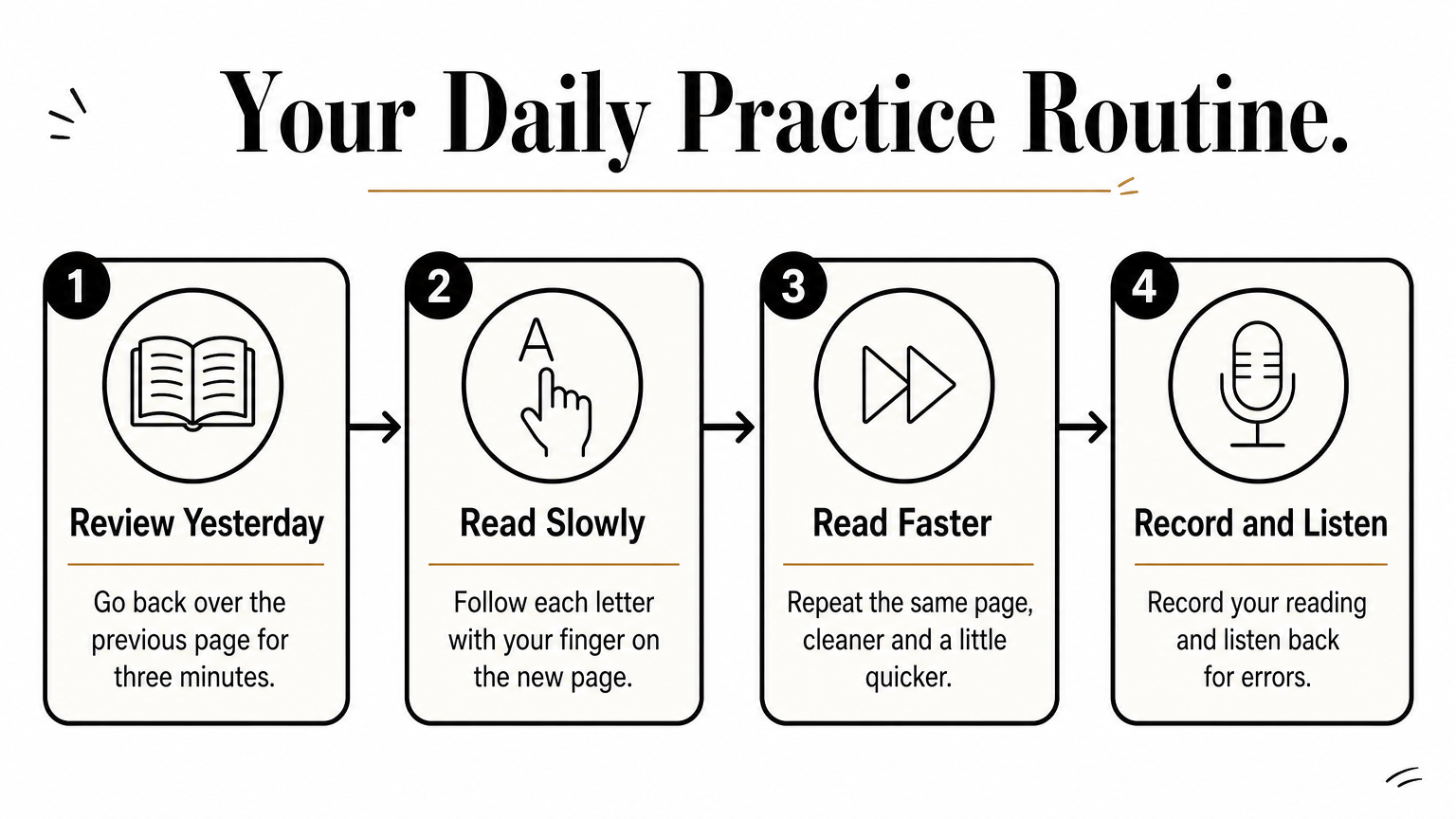
- Review yesterday’s page (3 minutes).
- Read the new page slowly, with your finger on each letter (7 minutes).
- Read the same page again, faster and cleaner (3 minutes).
- Record yourself and listen back (2 minutes).
Here is a worked example. Take a 32-page edition and move to a new page every two sessions. That is 64 sessions. At five sessions a week, you finish in about 13 weeks. The first pages usually go faster than that and the rules pages slower, so adjust the pace to your own accuracy.
When to add a teacher
Add a teacher as soon as you start the vowel pages. Audio in your PDF or an online recording helps you hear the sound, but it cannot tell you that your ع sounds like an alif. A person can. At Quranytime Academy, our live one-to-one lessons are taught by Al-Azhar-trained teachers with Ijazah, who correct each error as it happens. They suit children, adult beginners, and anyone who wants to fix Tajweed habits.
A PDF teaches you the rules, but only a listening teacher can tell you if you are saying them right.
Where to go after you finish the Qaida
A Noorani Qaida PDF in Urdu works best when you follow its order, learn the vowel marks thoroughly, treat the noon saakin and tanween table as a question rather than a chart, and read aloud daily. Pick an edition you understand, and check that it is sharp and complete.
When you finish the last page, begin reading short surahs with a teacher beside you, so you apply each rule in real recitation. If you want to know where you stand first, book a free trial assessment class and we will listen to your reading and recommend your next step.