

Tajweed madd rules govern how long you hold the three long-vowel letters, alif, waw, and yaa, when you recite the Quran. Madd means "stretching." The shortest stretch is two counts, called natural madd. Every other type lengthens it to four, five, or six counts, depending on what follows the letter (a hamzah or a sukoon) and on whether you are stopping.
This article gives you the full picture. You will see why the rules matter, all nine types with their counts side by side, Quranic examples with surah references, and a practical method for applying them as you read. The counts follow Hafs an Asim, the most widely used reading and the one printed in most mushafs today.
At Quranytime Academy, our one-to-one Tajweed teachers are Al-Azhar graduates, and they correct madd timing live. Length is the part of recitation that is hardest to judge on your own, so this guide is built to be used alongside a teacher’s ear.
Why madd rules matter when you recite
Madd rules matter because length is part of the pronunciation itself. Allah commands measured recitation, "And recite the Quran with measured recitation" (Al-Muzzammil 73:4), and correct madd is a large part of what makes a recitation measured rather than rushed.
What goes wrong when madd is skipped
The most common error is clipping the natural madd. A reciter who reads qaala with a short vowel is no longer saying the word as it was taught. The opposite error is just as common. Once a student learns that one madd lasts six counts, every alif starts getting six.
You may also have seen the question of whether Tajweed is haram. It is not. Tajweed is the discipline of reciting the Quran exactly as it was transmitted. Scholars teach that every Muslim should avoid clear mistakes in recitation, and that the finer rules, madd included, are learned to recite properly. The exact ruling on each fine rule is discussed in detail by scholars, so ask your teacher if you want specifics.
Madd is not decoration. A wrong length means the word you recite is not the word that was taught.
How madd length is measured
Madd length is measured in counts, called harakat. One count is the time of a short vowel, roughly the time it takes to fold or open a finger at a steady pace. Two counts is double that, four is twice the natural madd, and six is three times it.

Counts are relative to your recitation speed. A slow reciter holds each count longer than a fast one, but the ratios stay the same. That is why teachers talk about ratios and consistency rather than seconds. In any list of the core Tajweed rules, madd sits beside noon sakinah and tanween, meem sakinah, qalqalah, ghunnah, and the heavy and light letters. It is the rule you meet on almost every page.
The nine types of madd and their counts
A common list names nine types of madd: natural, badal, muttasil, munfasil, lazim, arid lis-sukoon, lin, silah, and iwad. Natural madd is the original (asli) type held for two counts, and the other eight are secondary (far’i) types that extend it or change it.
The nine types at a glance
Use this table as your reference. Each trigger is explained in the sections below.
| Type | What triggers it | Counts (Hafs) |
|---|---|---|
| Natural (tabii) | A madd letter with no hamzah or sukoon after it | 2 |
| Badal | A hamzah before the madd letter | 2 |
| Muttasil | Madd letter, then a hamzah in the same word | 4 or 5, obligatory |
| Munfasil | Madd letter ends a word, hamzah starts the next | 4 or 5, permissible (some routes 2) |
| Lazim | Madd letter, then a permanent sukoon or shaddah | 6 |
| Arid lis-sukoon | You stop on a word whose last letter follows a madd letter | 2, 4, or 6 |
| Lin | You stop after a waw or yaa with sukoon preceded by a fathah | 2, 4, or 6 |
| Silah | The pronoun ha (his, its) between two vowels | 2, or 4 to 5 before a hamzah |
| Iwad | You stop on a word ending in fathah tanween | 2 |
Natural madd and badal
Natural madd needs three pairings: an alif after a fathah, a waw with sukoon after a dammah, or a yaa with sukoon after a kasrah. "With sukoon" means the letter carries no vowel of its own. Nothing else may follow the letter, no hamzah and no sukoon. The word qaala is the standard example.
Badal is the mirror image. The hamzah comes before the madd letter, as in aamana, and in Hafs it stays at two counts. Some other readings lengthen it, which is one reason students learn one reading well before comparing others.
Muttasil and munfasil
Both types involve a hamzah after the madd letter. In madd muttasil, the madd letter and the hamzah are in the same word, as in jaa’a. It is obligatory (wajib) in every reading, and you cannot shorten it.
In madd munfasil, the madd letter ends one word and the hamzah starts the next, as in yaa ayyuhaa. Because the letters belong to different words, it is only permissible (jaiz), and transmission routes differ on its length. Most teachers teach four counts, some five, and some routes give two.
Lazim, arid lis-sukoon, and lin
A madd letter followed by a permanent sukoon or shaddah is madd lazim. It is always six counts, in every reading, and it is the longest madd in the Quran. Scholars classify it as kalimi when it occurs in an ordinary word and harfi when it occurs in the opening letters of a surah, such as the laam of الم. They also split it into heavy (muthaqqal, with a shaddah) and light (mukhaffaf, with a plain sukoon).
Arid lis-sukoon and lin appear only when you stop. Arid means incidental. Stopping puts a temporary sukoon on the last letter, and the madd before it may be two, four, or six counts. Lin applies to a waw or yaa with sukoon after a fathah when you stop on the word. Continue reading and both disappear.
Silah and iwad
Silah is the small waw or yaa sound added to the pronoun ha (his, its) when it sits between two vowelled letters. It is two counts normally, and four or five when the next word begins with a hamzah.
Iwad means "substitute." When you stop on a word ending in fathah tanween, the -an sound becomes a two-count alif, so hakeemaa is read with a stretched ending. Words ending in a round ta (ة) with tanween are stopped with a ha sound instead, so they get no iwad.
Memorize the triggers before the numbers. Once you can name what follows the madd letter, the count follows from the table.
Quranic examples of each madd type
The best way to learn tajweed madd rules is to find each type in verses you already know. The table below gives one clear example per type, with its location.
Examples from familiar surahs
| Word | Reference | Type | Counts |
|---|---|---|---|
| نُوحِيهَا (nooheehaa) | Hud 11:49 | Natural, with all three madd letters | 2 each |
| قَالَ (qaala) | Al-Baqarah 2:30 | Natural | 2 |
| آمَنَ (aamana) | Al-Baqarah 2:62 | Badal | 2 |
| جَاءَ (jaa’a) | An-Nisa 4:43 | Muttasil | 4 or 5 |
| يَا أَيُّهَا (yaa ayyuhaa) | Al-Baqarah 2:21 | Munfasil | 4 or 5 |
| إِنَّا أَعْطَيْنَاكَ (innaa a’taynaaka) | Al-Kawthar 108:1 | Munfasil | 4 or 5 |
| الضَّالِّينَ (ad-daalleen) | Al-Fatihah 1:7 | Lazim | 6 |
| الْعَالَمِينَ (al-‘aalameen), stopping | Al-Fatihah 1:2 | Arid lis-sukoon | 2, 4, or 6 |
| خَوْفٍ (khawf), stopping | Quraysh 106:4 | Lin | 2, 4, or 6 |
| مَالَهُ أَخْلَدَهُ (maalahu akhladah) | Al-Humazah 104:3 | Silah before a hamzah | 4 or 5 |
| حَكِيمًا (hakeemaa), stopping | An-Nisa 4:11 | Iwad | 2 |

How stopping changes the same word
Take al-‘aalameen. In the middle of a verse, you read the yaa as a natural madd of two counts. When you stop on the word at the end of Al-Fatihah 1:2, the noon takes a temporary sukoon and the madd becomes arid lis-sukoon, with a choice of two, four, or six counts.
The same logic applies to khawf and hakeemaa. Lin and iwad only exist at a stop. This is why recorded recitations sometimes sound different on the same word. The reciter is not changing the rule, only whether they are continuing or stopping.
The same word can carry different madd depending on whether you continue or stop, so always check where you are pausing.
How to apply madd rules while reciting
To apply madd rules, look at every long vowel, ask what follows it, and choose the count from the table. Then keep that count the same everywhere it appears. A short routine makes this automatic.
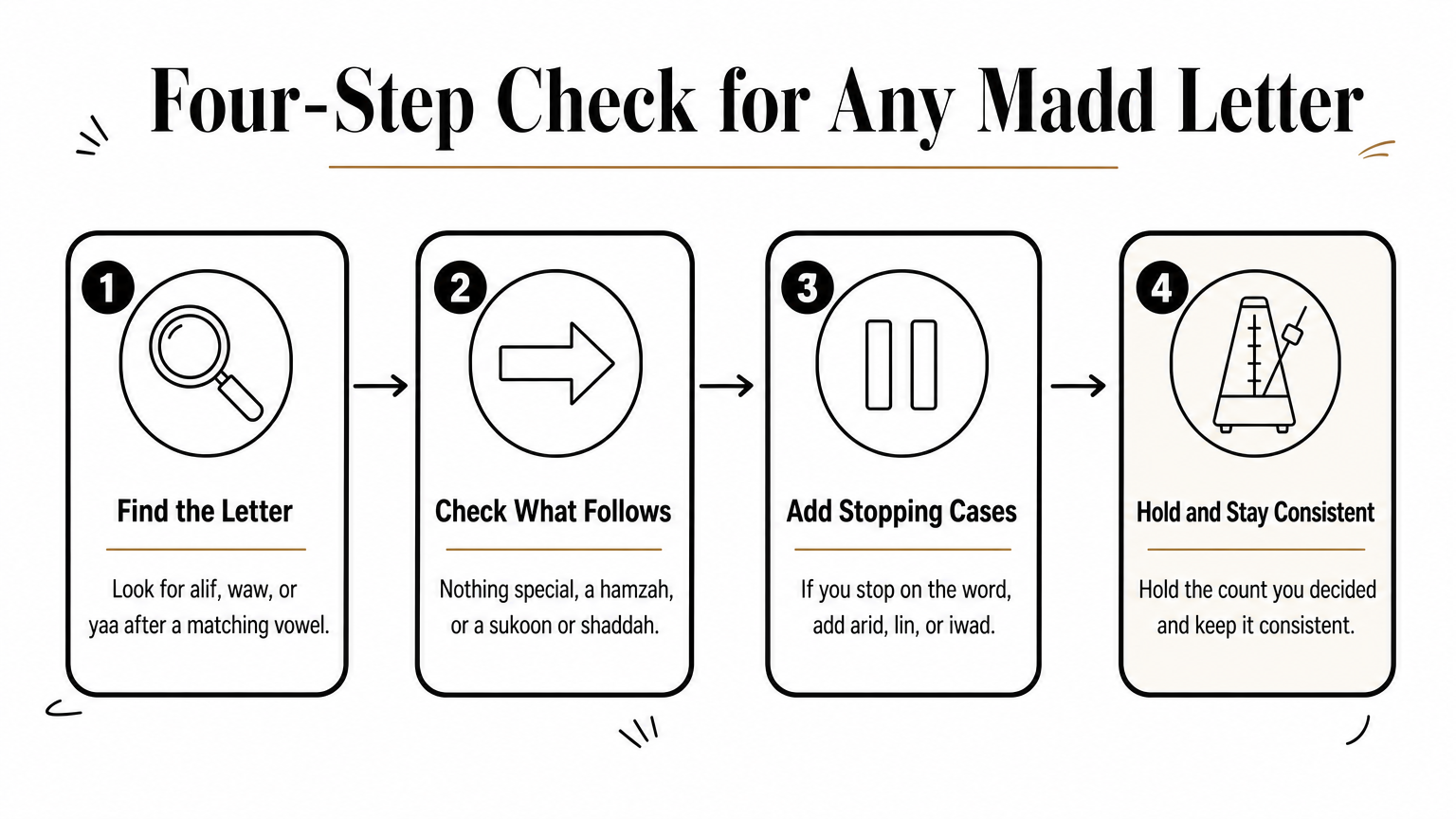
A four-step check for any madd letter
- Find the madd letter: an alif after a fathah, or a waw or yaa with sukoon after a matching vowel.
- Look at what comes right after it: nothing special, a hamzah, or a sukoon or shaddah.
- If you are stopping on the word, add arid, lin, or iwad to your check.
- Hold the count you decided and keep it consistent.
Work it through with yaa ayyuhaa. The alif follows a fathah, so it is a madd letter. A hamzah starts the next word, so it is munfasil. If your teacher uses four counts, hold four. If the natural madd in the same recitation is two, the munfasil is exactly twice as long.
Four counts or five? Pick one and keep it
Both four and five are accepted for muttasil and munfasil in Hafs, because the reading reaches us through more than one transmission route. The real error is mixing lengths inside one recitation, such as four counts on yaa ayyuhaa and two on innaa a’taynaaka.
The same applies to arid lis-sukoon. Choose two, four, or six for your stops and hold that choice through the whole recitation. If you change teachers and the count changes, raise it in your first class. It is a difference in routes, not a sign that either teacher was wrong.
Common mistakes and how to practice
Watch for these four habits:
- Cutting natural madd short.
- Stretching every madd to six counts.
- Changing length partway through a recitation.
- Stretching short vowels that have no madd letter.
To practice, tap the counts while you recite Al-Fatihah: two for each natural madd, six for ad-daalleen, and your chosen length at each stop. Recording yourself helps, but your own ear accepts whatever length you are used to. A live teacher catches the error within seconds, which is why our Quran Tajweed lessons are one-to-one.
Choose your counts once, then keep them. Consistency is what separates a measured recitation from a guessed one.
Putting the madd rules into practice
Madd comes down to one question asked of every long vowel: what follows it? Nothing special means two counts. A hamzah means four or five. A permanent sukoon or shaddah means six. Stopping adds the arid, lin, and iwad cases. Whatever counts your teacher uses, keep them the same through the whole recitation.
Reading about counts only takes you so far, because the timing has to be heard and corrected. If you want a teacher to listen to your current recitation and show you exactly where your madd needs work, book a free assessment class. You will be matched with a teacher and a learning path that fits your level, with no obligation to continue.