
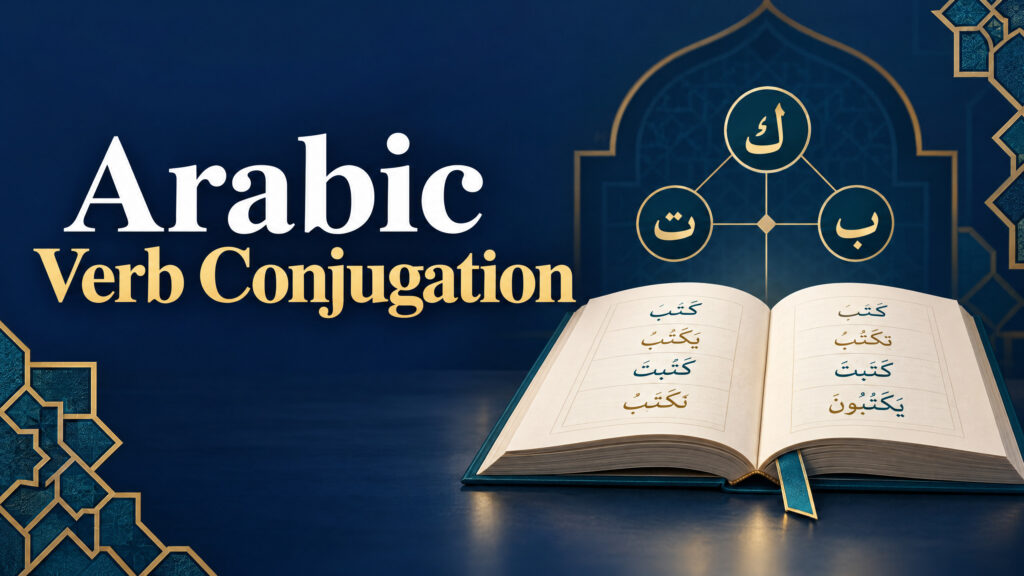
Arabic verb conjugation can look like a wall of forms until you notice what changes. A verb may signal who acts through a prefix, an ending, or both. In this beginner’s guide, we will use one regular model—كَتَبَ (kataba, “he wrote”) and its common imperfect form يَكْتُبُ (yaktubu, “he writes”)—to see how person, number, and gender shape a verb, then read three short Quranic examples in context.
What does Arabic verb conjugation mean?
Conjugation is the way a verb changes to fit its subject and grammatical form. In Arabic, you can often learn something about the subject from the verb itself, even when a separate pronoun is not written. For example, نَعْبُدُ (naʿbudu, “we worship”) begins with nūn, a clue for “we.” In يَكْتُبُونَ (yaktubūna, “they write”), the initial yāʾ and the ending -ūna work together to mark a third-person masculine plural form in the usual beginner chart.
Arabic grammar commonly calls the perfect الماضي (al-māḍī) and the imperfect المضارع (al-muḍāriʿ). Beginner materials often label these “past” and “present,” which are useful first approximations. The imperfect can also describe a continuing, habitual, or future action depending on context and particles, so do not translate its form mechanically as “is doing” every time.
Start with a regular verb model
For a first chart, choose a sound Form I verb whose three root consonants stay stable. كَتَبَ (kataba, “he wrote”) and يَكْتُبُ (yaktubu, “he writes”) are a familiar pair. The root is ك ت ب (k-t-b), associated with writing. Keep the root letters distinct from the vowels and endings that make the form agree with a subject. Quranytime’s guide to Arabic roots and patterns explains that useful distinction in more detail.
This is a teaching model, not a promise that every verb follows exactly the same vowel pattern. Arabic has weak verbs with wāw or yāʾ in the root, doubled verbs, hamzated verbs, and derived forms such as Forms II and X. Those can change in ways that a regular model does not show. Learn one clear pattern first, then compare a new verb with a trusted conjugation reference or teacher.
Past forms: endings carry much of the change
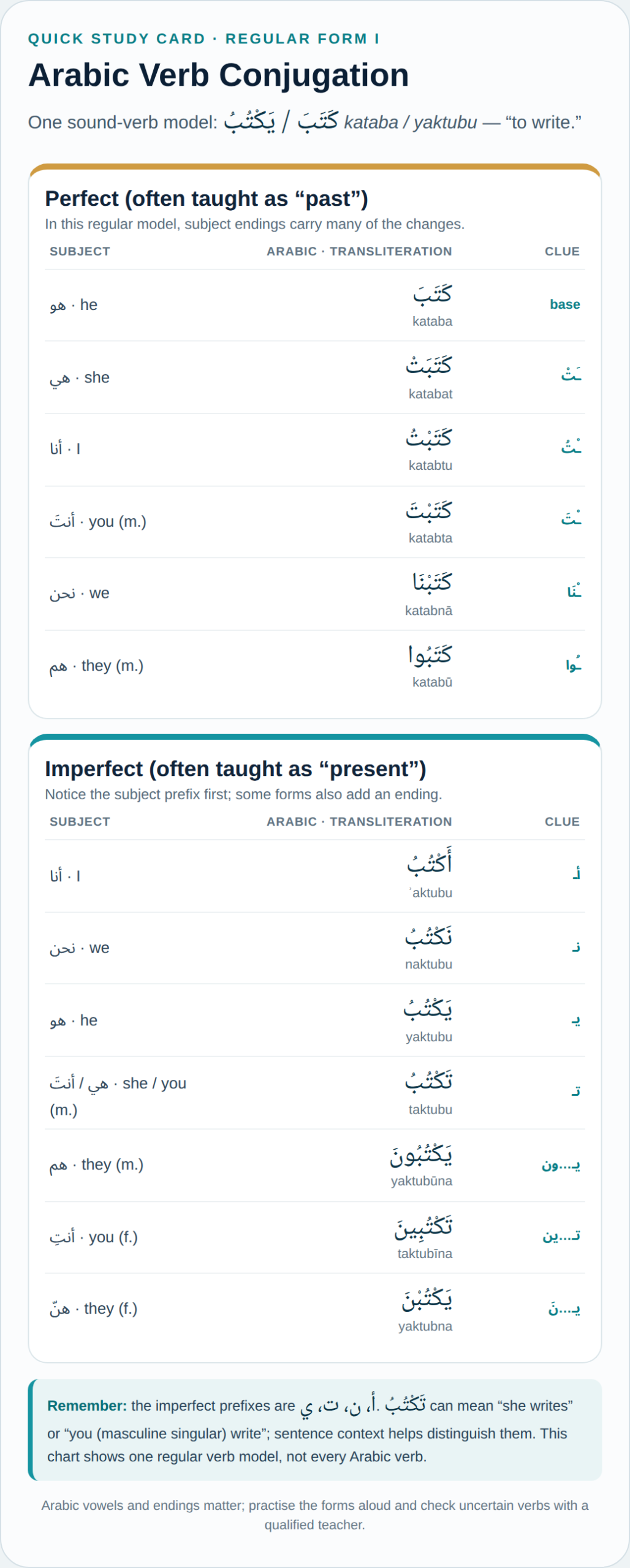
With many regular sound verbs, the past/perfect chart keeps a stable stem and changes the ending. Compare كَتَبَ (kataba, “he wrote”), كَتَبَتْ (katabat, “she wrote”), كَتَبْتُ (katabtu, “I wrote”), and كَتَبُوا (katabū, “they wrote,” masculine plural). These endings are not decorative: they help identify the doer.
When reading, look at the final letters before guessing the subject. A final ـتُ may mark “I,” while ـتَ can mark “you” masculine singular; the vowels matter. The dual and feminine plural forms have their own endings too. A printed chart is a useful reference, but reciting each form aloud with a teacher’s correction helps you hear the differences as well as see them.
Imperfect forms: notice the prefix, then the ending
The imperfect usually starts with one of four subject-marking prefixes: أ (ʾalif), ن (nūn), ت (tāʾ), or ي (yāʾ). In a simple model, أَكْتُبُ (ʾaktubu) means “I write,” نَكْتُبُ (naktubu) “we write,” تَكْتُبُ (taktubu) “you write” or “she writes,” and يَكْتُبُ (yaktubu) “he writes.” The ending can then distinguish forms such as يَكْتُبُونَ (yaktubūna, “they write”) and تَكْتُبِينَ (taktubīna, “you” feminine singular write).
Use the prefix as a first clue, not the whole answer. For example, tāʾ can appear with “you” and with “she”; the rest of the word, the sentence, and the surrounding context help decide which. The same visible form can have different meanings when the subject is implicit. If a separate pronoun is written, it may clarify or emphasize the subject rather than being required by the verb. See the companion Arabic pronoun chart for Quranic reading for detached, attached, and understood subjects.
Read the verb in a Quranic phrase
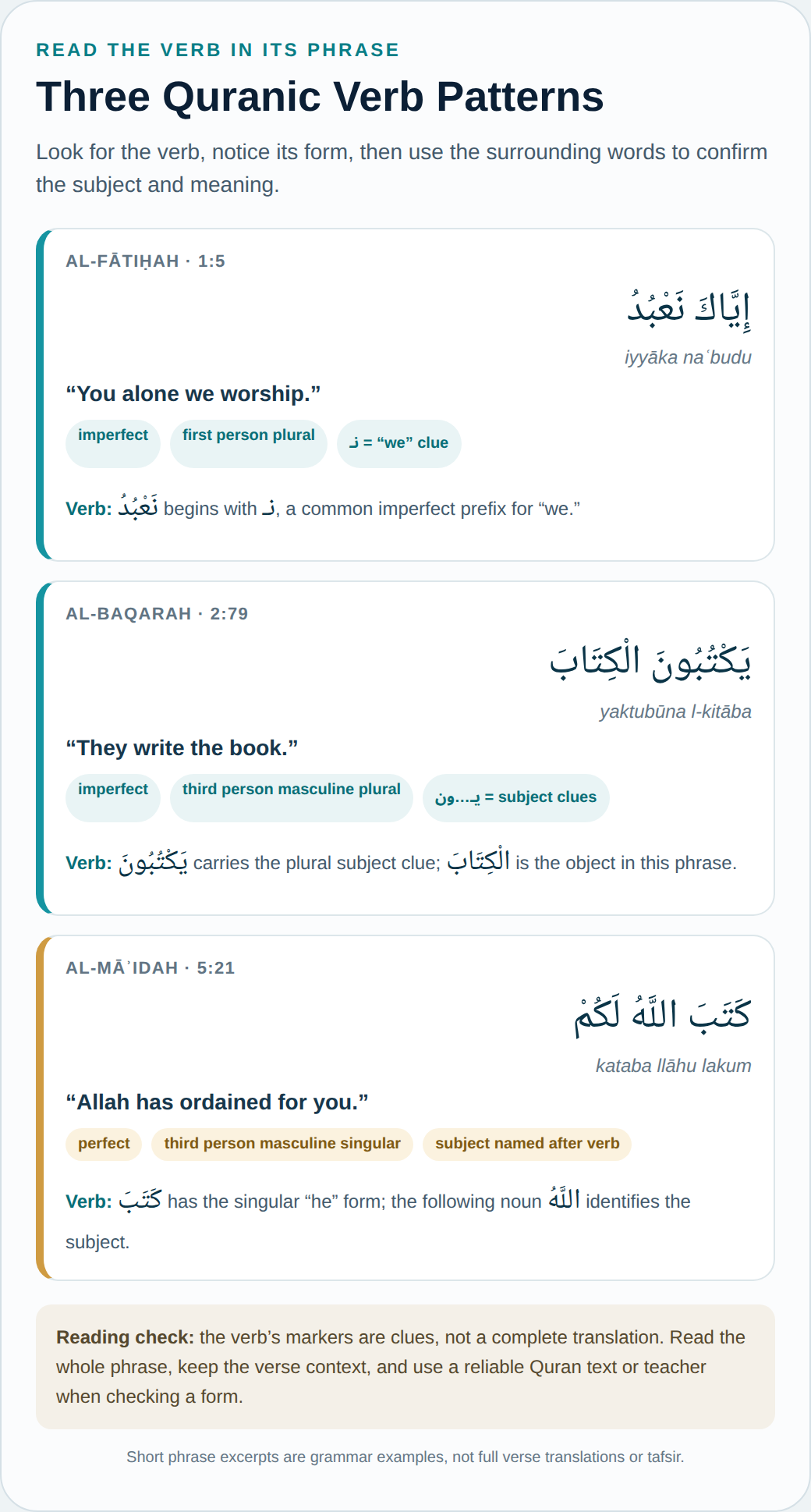
Practice by finding the verb first, then asking what its form tells you. In Al-Fātiḥah 1:5, نَعْبُدُ (naʿbudu, “we worship”) is an imperfect first-person plural verb. In Al-Baqarah 2:79, يَكْتُبُونَ الْكِتَابَ (yaktubūna l-kitāba, “they write the book”) shows a masculine plural imperfect verb followed by its object. The Quranic Arabic Corpus parses yaktubūna as a third-person masculine plural imperfect verb whose form carries the subject clue; its word-by-word entry for Al-Baqarah 2:79 is a useful reference.
A perfect-form example appears in Al-Māʾidah 5:21: كَتَبَ اللَّهُ لَكُمْ (kataba llāhu lakum, “Allah has ordained for you”). Here كَتَبَ is a third-person masculine singular perfect form, and the following noun اللَّهُ makes the subject explicit. The example helps distinguish a verb’s agreement from the subject’s meaning; grammar labels are a reading aid, not a replacement for the verse’s context or tafsir.
How to study a conjugation chart without memorizing blindly
- Choose one pronoun. Start with “I,” “we,” “he,” or “they,” rather than trying to learn every row at once.
- Say the form aloud. Hear the beginning and ending, then point to the marker you noticed.
- Compare one nearby form. For example, compare يَكْتُبُ with يَكْتُبُونَ. The shared beginning and stem contrast with the plural ending.
- Read a phrase, not an isolated word. Use the object, particles, and neighboring words to check your first guess.
- Review a small set later. A short spaced-review routine is more useful than copying a large table without feedback. Quranytime’s Quranic Arabic vocabulary study plan offers a practical way to organize that review.
A helpful order is to begin with singular forms, then compare a plural, and learn the dual once you can see how the chart is organized. Arabic has separate dual forms, but this lesson’s first goal is simpler: recognize whether a verb points to “I,” “we,” “you,” “he/she,” or a group. Add gender and dual distinctions gradually, and keep a clean chart that includes short vowels. Without the vowels, two forms that look similar in unvowelled text may be harder for a beginner to distinguish.
Try a quick verb-form self-check
Before reading the answers, mark the first and last part of each form. Ask what the letters suggest, then check the phrase for an explicit subject or a clue from context:
- أَكْتُبُ (ʾaktubu): who is the likely subject?
- يَكْتُبُونَ (yaktubūna): what does the ending add to the clue from yāʾ?
- Why should you not decide the subject of تَكْتُبُ (taktubu) from its prefix alone?
Check: ʾaktubu is “I write”; yaktubūna is “they write” in the common masculine plural chart; and taktubu may mean “she writes” or “you (masculine singular) write.” Context or a written pronoun resolves that last choice. This small exercise practises identification, not full sentence translation. When a Quranic verb is unfamiliar, confirm its form and reading instead of forcing it into the kataba model.
What a beginner chart does not show
The imperfect can also change its ending after certain particles or in different grammatical moods. Derived patterns can add letters to the root and change a verb’s usual meaning, while weak roots may alter or drop a letter in some forms. These are important topics, but they are not errors in a simple conjugation chart: they are additional layers. First learn how the core subject markers work on one sound verb, then add moods and derived patterns with examples from a reliable grammar reference. For Quran reading, a morphology label can help you notice a subject marker; it cannot replace the verse’s full context, recitation instruction, or tafsir.
Common beginner mistakes
- Assuming every verb uses the same vowels. The model kataba/yaktubu is one sound Form I pattern; the imperfect vowel can vary among verbs.
- Looking only at the first letter. The imperfect prefix matters, but number and gender can also depend on the ending and context.
- Adding a separate pronoun automatically. Arabic often expresses the subject in the verb. A visible pronoun may be for emphasis or contrast.
- Calling every imperfect verb “present.” It can be present, habitual, ongoing, or future depending on context and particles.
- Confusing conjugation with derived forms. Conjugation changes a verb to match its subject and grammatical use; derivation changes the pattern and can change meaning. Quranytime’s beginner Arabic grammar guide and Quranic Arabic learning roadmap help place these lessons in a broader sequence.
Watch a short verb-pattern lesson
This brief whiteboard lesson introduces a traditional Arabic conjugation table from a root verb and contrasts past, imperfect, and related forms. Use it as a visual companion to this narrower subject-agreement guide; pause at one form and identify its prefix or ending before moving on. For a broader course path, explore Quranytime’s Quranic Arabic course guide.
Quick takeaway
For a beginner, Arabic verb conjugation becomes easier when you read in layers: identify a familiar root, notice the perfect or imperfect shape, check its prefix and ending for person, number, and gender, and confirm the meaning in its phrase. A regular model such as كَتَبَ / يَكْتُبُ gives you a starting point, while Quranic examples show how real verbs carry subject information in context. Keep a short chart nearby, listen to a qualified teacher, and treat each new form as something to verify rather than a rule to force onto every verb.