
The best Al-Azhar Quran teaching online Arabic and Quran classes share three traits: teachers whose Al-Azhar training you can verify, live lessons with real correction, and a free trial that lets you test both before you pay. Quranytime Academy suits families and adults who want one-to-one lessons on a structured path. Al-Azhar Quran Teaching suits learners who want a long course menu with Ijazah programs. Azhar El-Quran suits families who want Arabic, Quran, and Islamic studies at one institute. Al-Azhar Classes suits non-Arab Muslims who want free material first. Al-Azhar Online Quran Institute suits learners focused on Tajweed.
Search for Al-Azhar classes and you will find several academies using the name. Each promises qualified teachers, flexible hours, and a trial lesson. The pages read alike, and it is hard to tell who will actually sit across the screen from you or your child. A name does not prove a credential.
This article reviews five academies through the same lens: what they teach, who they suit, and how their fees and trials work. Then it shows you how to check credentials, compare prices, and read reviews. We run Quranytime Academy, so we list it first and say so. We describe the other four only from what they publish themselves.
1. Quranytime Academy: one-to-one with Al-Azhar graduates
What the classes cover
Quranytime Academy delivers live, one-to-one Quran and Arabic lessons online, taught by Al-Azhar University graduates who hold Ijazah in Quranic and Islamic studies. The academy has more than 10 years of experience in Quranic education. Its programs break down into five paths:
- Quran reading and Tajweed: Arabic letters and vowel signs, then Tajweed rules applied in recitation, with pronunciation correction.
- Quran memorization (Hifz): a structured pace, teacher correction, and regular revision, for the whole Quran or specific chapters.
- Arabic language: reading, writing, vocabulary, grammar, and guided practice.
- Quranic Arabic: Quranic vocabulary, selected grammar, and accurate reading. It is language study, not a substitute for Tafseer.
- Islamic Education: faith, jurisprudence, and history.
The teaching team is named on the site. Maha Gohar has more than 20 years of experience in Quran and Islamic studies, and Aliaa Emeira has 15 years. Wafaa Ahmed has more than 10 years, and Nouralhoda Abdel Basset has six years of online teaching. Students also get interactive tools, such as an Arabic Reading Guide, and achievement certificates that mark progress.
A good academy shows you who will teach, not just which institution its name points to.
Who it suits
Parents get the most from the children’s track. They can book a trial class for a child, and teenagers and adults can request one for themselves. No previous knowledge is required, so an adult who has never opened a Quran can start from the letters without embarrassment.
Busy professionals also fit well, because lessons are scheduled around your time zone and routine. The format is strictly one-to-one. If you want a group class with classmates, this is not that format.
Fees and trial class
The first step is a free assessment class, a live one-to-one session where the team discusses your current level and recommends a path. There is no obligation to continue. The offer listed for first registration is one month free.
Premium learning plans come after the assessment, so ask for the plan details in writing then. Use the questions in the last section of this article to compare them with any other academy.
2. Al-Azhar Quran Teaching: wide course menu with Ijazah options
What the classes cover
Al-Azhar Quran Teaching describes its core model as one teacher for one student, with sessions held over tools such as Skype and Zoom. Its course menu is among the widest of the five:
- Quran reading with Tajweed and Tarteel
- Hifz for children and adults
- Qaida for beginners
- Arabic language courses
- Online Islamic classes
- Ijazah courses for recitation or memorization
For Ijazah, the site says its male and female instructors come from Arab countries such as Egypt, Jordan, and Saudi Arabia. It says students recite the whole Quran to the teacher before receiving the certification. Ask which teacher will issue yours and what chain of transmission it carries.
Who it suits
Sisters who prefer to learn from women will find that the academy lists female tutors. Its teachers are described as fluent in Arabic, English, and Urdu, which helps if you or your child learn better in one of those languages. The site says it accepts students from age 4 to 70.
Learners who already read well and want a certification are the strongest match. The Ijazah track is more developed here than on most pages in this comparison.
Fees and trial class
The site offers free trial classes for two days so you can check the teacher before committing. It also has a dedicated fees page and a family package discount for households enrolling several members.
The site lists phone lines for the UK, Australia, and the US and Canada. That suggests support across time zones, but check which hours a human actually answers.
A two-day trial is generous only if you use it to test the exact teacher you will keep.
3. Azhar El-Quran: an institute for Arabic, Quran, and Islamic studies
What the classes cover
Azhar El-Quran presents itself as an online institute offering Arabic, Quran, and Islamic studies classes for adults and for their children. It says its teachers are highly qualified and experienced. The listing is brief, so treat it as a starting point and request the details yourself.
Before you book, ask for these items:
- A written outline of each course, with levels and the expected pace
- The name and background of the teacher assigned to you
- Whether lessons are one-to-one or in groups
- The platform used and whether lessons are recorded
Who it suits
This institute fits families who want several subjects under one roof. One child might need Arabic reading while a parent starts Quran recitation and another sibling studies Islamic basics. A single provider simplifies scheduling and billing.
It also works as a third quote when you are comparing. Taking one extra trial costs you an hour and often reveals differences that no web page does.
Fees and trial class
Ask for the lesson price and the lessons per week in writing, plus whether a trial class is free. Ask what happens if you want to change teachers, and whether a missed lesson is made up or lost. Those details decide the real cost far more than a headline fee.
4. Al-Azhar Classes: Quran, Tajweed, and Arabic for non-Arab Muslims
What the classes cover
Al-Azhar Classes describes itself as an Islamic educational website dedicated to teaching Quran, Tajweed, Arabic language, and Islamic studies to non-Arab Muslims. That audience focus matters. A course built for non-Arab learners usually starts at the alphabet and sounds, not at assumed fluency.
The site also runs a page called "Learn Quran Online for Free." Open it and note exactly what it contains before you decide anything.
Who it suits
Beginners who want to try learning without paying first are the natural audience. If you are not sure you will stick to a routine, free material is a low-risk way to find out. It also suits adults living outside Arabic-speaking countries who want an explanation in a language they understand.
Free content has a limit. It can teach letters and rules, but only a live teacher hears your mistakes. Plan to move to live correction once you can read the letters.
Fees and trial class
Check whether "free" means recorded or written lessons or live time with a teacher. Then ask what the paid live option costs, how many lessons a week it includes, and whether a trial class is offered.
Free material teaches you the rules, but only a live teacher corrects how you pronounce them.
5. Al-Azhar Online Quran Institute: live classes built around Tajweed
What the classes cover
Al-Azhar Online Quran Institute promotes online live classes for pure Tajweed and accurate pronunciation, with Quran study explained in an easy-to-follow way. Its emphasis is recitation quality, which is the right priority for anyone who can already read the script but wants to sound correct.
A Tajweed-focused course should cover the points of articulation of the letters, the characteristics of letters, and rules such as Madd, Ghunnah, and Noon Saakin. Ask the institute how it sequences them.
Who it suits
Learners who read slowly but correctly and now need refinement will benefit most. Adults who learned the Quran as children and never studied the rules also fit. So do parents who want a child’s recitation corrected before habits set in.
Complete beginners should confirm that the institute teaches the alphabet and basic reading first. Tajweed on top of shaky letter recognition wastes lessons.
Fees and trial class
Ask whether a trial class exists and whether it is live with the teacher you will keep. Request the price per lesson and the lesson length. Then ask how the teacher tracks your errors from one lesson to the next, because progress in Tajweed depends on repeated correction of the same mistakes.
How to compare fees, trials, and reviews
Side-by-side comparison
Online Arabic and Quran classes with Al-Azhar teachers differ less in what they teach than in how they confirm credentials, run trials, and price lessons. This table summarizes what each academy states about itself. Everything marked "confirm" is something to ask before enrolling.
| Academy | Format | Trial | Focus |
|---|---|---|---|
| Quranytime Academy | Live, one-to-one | Free assessment class | Tajweed, Hifz, Arabic, Quranic Arabic, Islamic Education |
| Al-Azhar Quran Teaching | One teacher, one student | Two free days | Tajweed, Hifz, Ijazah, Arabic, Islamic studies |
| Azhar El-Quran | Confirm | Confirm | Arabic, Quran, Islamic studies |
| Al-Azhar Classes | Confirm | Free learning page | Quran, Tajweed, Arabic, Islamic studies for non-Arab Muslims |
| Al-Azhar Online Quran Institute | Live online | Confirm | Tajweed and accurate pronunciation |
How to check an Al-Azhar credential
Start by asking for the teacher’s name and what they studied. A real Al-Azhar graduate can say which faculty, roughly when, and who taught them. An academy with a strong team will share that without hesitation.
For Ijazah, ask who granted it and for the chain of transmission, called the sanad. An Ijazah is permission to recite or teach with a connected chain of narrators back to the Prophet, peace be upon him. A teacher who holds one can name the person who gave it to them.
Also note that using the Al-Azhar name is a separate matter from studying at Al-Azhar University itself. Each academy sets its own fees. The university’s tuition is a different question, and you would need to ask the university directly.
How to compare fees fairly
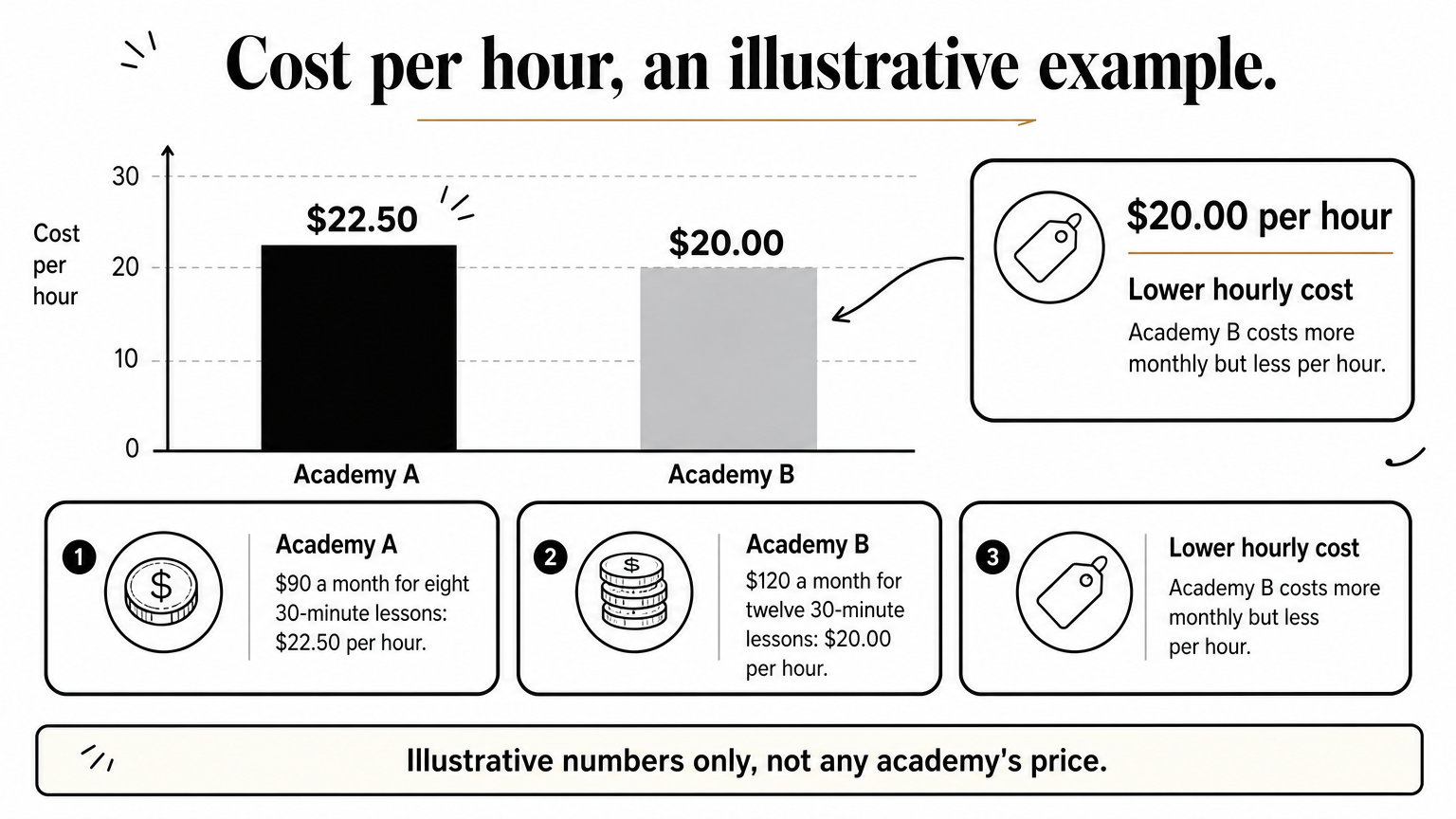
Compare cost per lesson and cost per hour, not the monthly total. The numbers below are illustrative only, not any academy’s price. Suppose Academy A charges $90 a month for two 30-minute lessons a week, and Academy B charges $120 for three.
| Lessons per month | Hours per month | Cost per lesson | Cost per hour | |
|---|---|---|---|---|
| Academy A | 8 | 4 | $11.25 | $22.50 |
| Academy B | 12 | 6 | $10.00 | $20.00 |
Academy B costs more each month but less per lesson and per hour. If you are enrolling two children, double the monthly total and ask whether a sibling or family discount applies. Also ask how missed lessons, teacher changes, and cancellations are handled.
How to read reviews
Weight reviews that name a specific teacher, a specific result, and a time frame. "Great academy" tells you nothing. "My daughter fixed her Qalqalah in six weeks with her teacher" tells you something. Look on independent platforms as well as on the academy’s own page.
Treat a trial class as your best review. Book it at the time you would actually study, and test three things: whether the teacher corrects errors at once, whether the lesson matches your level, and whether you or your child want a second one.
A trial with the actual teacher beats any review, because it measures the one thing you are paying for.
Choosing your class
Online Arabic and Quran classes with Al-Azhar-trained teachers are easy to find and hard to tell apart. Judge each academy by its teachers’ verifiable training, live correction in a one-to-one format, a trial that uses the real teacher, and a price you can compare per lesson. Any of the five above can pass that test, but only a trial will show you.
If you are not sure which path fits you or your child, start with an assessment. Quranytime Academy matches new learners to a teacher and a path in one live session, and you can book a free assessment class with no obligation to continue.