
The rules of stopping in Tajweed, called waqf, tell you where you may pause while reciting, how to pronounce the last word before you pause, and where to restart. In short, you stop where the meaning is complete, end the word with a breath and usually a sukoon, and follow the stop signs printed in your mushaf. Waqf means stopping on a word long enough to breathe, with the intention to continue reciting.
This guide covers why waqf matters, how to end a word correctly when you stop, the four types of stops, and what each Quran stop sign means. Printings use different sign systems, so the signs section compares them side by side. It closes with common mistakes and a practice routine.
At Quranytime Academy, our teachers correct stopping errors live in one-to-one Tajweed lessons. Many of these mistakes are hard to hear in your own voice, so you will also get a checklist you can use before a teacher listens to you.
Why the rules of stopping matter in recitation
Stopping rules matter because a pause in the wrong place can change what a verse says, and because every reciter has to breathe somewhere. Waqf decides where.
A wrong pause can reverse the meaning
Take Surah An-Nisa, verse 43. It begins "do not approach the prayer." If you stop there, you have dropped the condition that follows, "while you are intoxicated." The words are correct, but the message you recited is not. The same risk exists wherever a sentence depends on its next phrase.

Waqf is also practical. Nobody recites Surah Al-Baqarah in one breath. The rules give you planned places to breathe, so that your lungs never decide where a sentence ends. Done well, your recitation also becomes easier for listeners to follow.
Waqf is the discipline that makes sure breath never decides the meaning.
Where waqf fits among the Tajweed rules
Teachers group Tajweed differently, so lists of "four" or "seven" essential rules vary from one source to another. Stopping and starting is a core branch of full Tajweed courses, next to letter articulation, noon sakinah, and madd. Four terms often get confused:
- Waqf: stopping on a word with a breath, intending to continue.
- Sakt: a short pause with no breath.
- Qat’: ending the recitation, such as finishing a session.
- Wasl: connecting one word to the next with no pause.
How to stop on the last letter of a word
When you stop on a word, you remove its final vowel and end on a sukoon, with a few exceptions. This is the part of the waqf rules in Tajweed that you apply on every single stop.
What happens to vowels, tanween, and the round taa
| Word ending | What you do when stopping | Example |
|---|---|---|
| Fathah, kasrah, or dammah | Replace the vowel with sukoon | الْعَالَمِينَ → al-ʿālamīn |
| Dammatan or kasratan | Drop the tanween and end on sukoon | أَحَدٌ → aḥad |
| Fathatan | Replace with a long alif, held 2 counts | حَكِيمًا → ḥakīmā |
| Round taa (ة) | Pronounce it as a sukoon haa | الرَّحْمَةُ → ar-raḥmah |
| Fathatan on a round taa | Sukoon haa, with no alif | رَحْمَةً → raḥmah |
The round taa is where beginners slip most often. You never say "t" at the end of a stopped word like "rahmat." You say a soft "h."
Madd, qalqalah, and other effects at the stop
A madd letter before the final letter follows the rule of madd ‘arid lis-sukun. In الْعَالَمِينَ you may hold the long vowel for 2, 4, or 6 counts, but you stay consistent through the recitation. If the word ends in a qalqalah letter (ق ط ب ج د), the echo is at its strongest when you stop, as in الْفَلَقِ.
Advanced reciters also learn rawm, a faint partial vowel, and ishmam, rounding the lips for a dammah. Both are optional techniques that you should learn by listening to a teacher.
When you stop, the final vowel goes and a sukoon takes its place, with only a few exceptions.
The four types of waqf in Tajweed
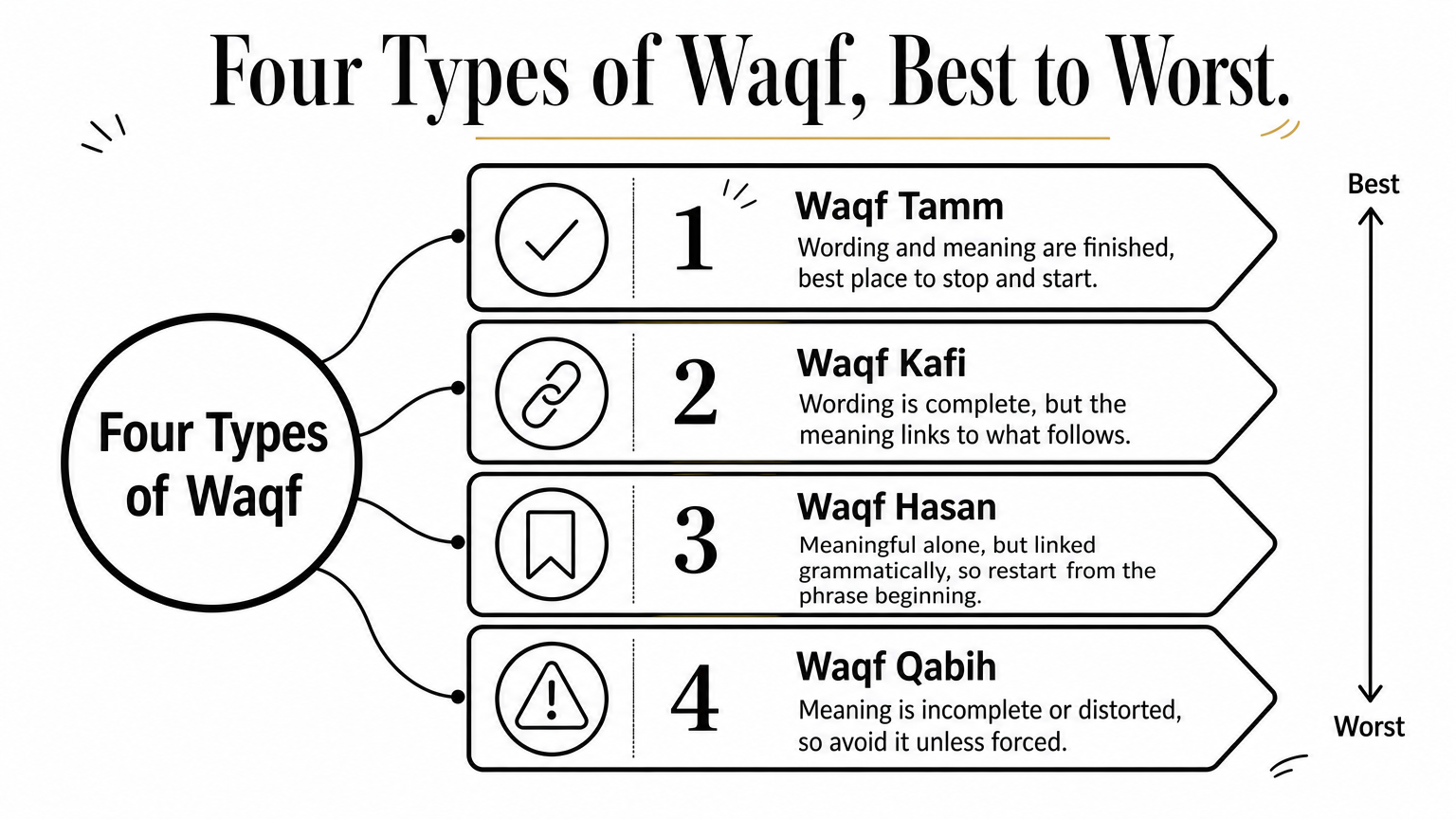
Scholars classify stops by how complete the meaning is at that point. The four types are tamm, kafi, hasan, and qabih, and they run from the best stop to the one you avoid.
Complete, sufficient, and good stops
| Type | Meaning | What to do | Example |
|---|---|---|---|
| Waqf tamm (complete) | Wording and meaning are finished, and nothing after depends on it | Best place to stop and to start | End of 2:5, أُولَٰئِكَ هُمُ الْمُفْلِحُونَ |
| Waqf kafi (sufficient) | Wording is complete, but the meaning links to what follows | Stop, then continue from the next word | End of 2:3, يُنفِقُونَ |
| Waqf hasan (good) | Meaningful on its own, but linked to the next words in grammar | Stop, then restart from the beginning of the phrase | الْحَمْدُ لِلَّهِ inside 1:2 |
| Waqf qabih (improper) | Meaning is incomplete or distorted | Avoid unless forced | Stopping on لَا إِلَٰهَ |
Hasan has one exception. When it falls at a verse ending, you may restart from the next verse. Stopping at the end of each verse is the Sunnah, as Umm Salamah described the Prophet’s recitation. Mid-verse, you go back instead.
The improper stop and what to do when breath runs out
Stopping on "lā ilāha" in verse 47:19 says "there is no god" and leaves out "except Allah." That is why qabih stops are avoided. If a cough or a lack of breath forces you to stop at one, go back to the start of the phrase and recite it again. Do not continue from the broken point.
Choose your stop by asking one question: does the listener have the full meaning here?
Quran stop signs and what each one means
Stop signs are small letters or marks above the text that tell you to stop, continue, or choose. Printings use two main systems, the Madinah style and the South Asian style, so check which one your mushaf uses.
The common signs side by side
| Sign | Name | What it tells you |
|---|---|---|
| م or ۘ | Waqf lazim | Stop. Continuing risks changing the meaning |
| ط | Waqf mutlaq | Stop is preferred (South Asian style) |
| ۗ (قلى) | Qila | Stopping is better (Madinah style) |
| ۖ (صلى) | Sila | Continuing is better |
| ج or ۚ | Jaiz | Stop or continue, both are fine |
| ز | Mujawwaz | Stopping is allowed, continuing is better |
| ص | Murakhkhas | Stopping is allowed only out of necessity |
| لا or ۙ | Do not stop | Do not stop inside a verse here |
| ۛ ۛ | Mu’anaqah | Stop at one of the two marked spots, not both |
| س or ۜ | Saktah | Pause briefly with no breath |
This answers a common question: yes, you stop at ط in a South Asian mushaf, because it marks a preferred stop.
Reading the signs in your own mushaf
Surah Al-Baqarah 2:2 shows mu’anaqah. You may stop after "rayb" or after "fihi," but not at both. Hafs has four places of saktah: 18:1, 36:52, 75:27, and 83:14. A small circle marks the end of a verse, where stopping is the default unless a sign says otherwise.
Signs sit on top of the four types, they do not replace them. If your mushaf shows no sign at a spot where you need breath, choose a tamm or kafi point and check it against the key printed in your mushaf.
The sign tells you what the printer’s scholars decided, and the key in your mushaf tells you how to read it.
Common waqf mistakes and how to practice
Most waqf errors come from rushing, from mixing up the final-letter rules, or from not knowing the signs. Fixing them takes a short routine, not more theory.
Mistakes to watch for
- Stopping mid-phrase because you waited too long to breathe.
- Pronouncing the final vowel, such as saying "al-ʿālamīna" when stopping.
- Saying the round taa as "t" instead of "h."
- Dropping the alif after a fathatan, or adding one after a fathatan on a round taa.
- Ignoring a lā sign or treating ج as an order.
- Restarting on the word you stopped on, rather than going back to the phrase start.
A practice routine you can follow
- Find the sign key in your mushaf and learn its sign system.
- Choose a short surah and mark each stop, naming its type.
- Recite and apply the final-letter rules at each stop.
- Record yourself and listen for final vowels and breath.
- Ask a teacher to check your stops.

Surah Al-Ikhlas is a good first test. Every verse ends in a stop. The last word of the first verse becomes "aḥad," with a strong qalqalah on the dal. The second verse ends in "aṣ-ṣamad," the third in "yūlad," and the fourth again in "aḥad." The Quran reading and Tajweed lessons at Quranytime follow this same step-by-step approach, with live correction on your stops.
Putting the rules of stopping into practice
Stop where the meaning is complete, end the word with a sukoon and a clean breath, and let the signs in your mushaf guide the choice. Treat tamm and kafi stops as safe places, hasan as acceptable if you restart correctly, and qabih as an emergency only. Remember the three final-letter rules you will use most: vowels become sukoon, fathatan becomes a long alif, and the round taa becomes a soft haa.
Reading about waqf only takes you so far, because stopping habits show up in your voice. If you want a teacher to hear you recite and point out exactly where you stop well and where you do not, book a free assessment class and we will match you with a teacher and a learning path that fits your level.