
Do you recognize the Arabic recited in Salah but want to understand what its words are doing? A few repeated words can make the prayer feel less like a string of sounds and more like connected language. This beginner’s guide follows selected expressions through standing, bowing, rising, prostration, and sitting, with Arabic script, a simple transliteration, and a short meaning for each.
Scope note: These are familiar wordings used in a common form of Muslim prayer, not a complete prayer manual or a ruling about which recitations are required. Wording, additions, and transliteration can vary. Follow your own teacher and tradition for recitation practice. Encyclopaedia Britannica describes salat as a ritual prayer whose rakʿahs combine physical postures with Quranic recitations; this guide focuses only on the language you may hear within that structure.
Start with the prayer map
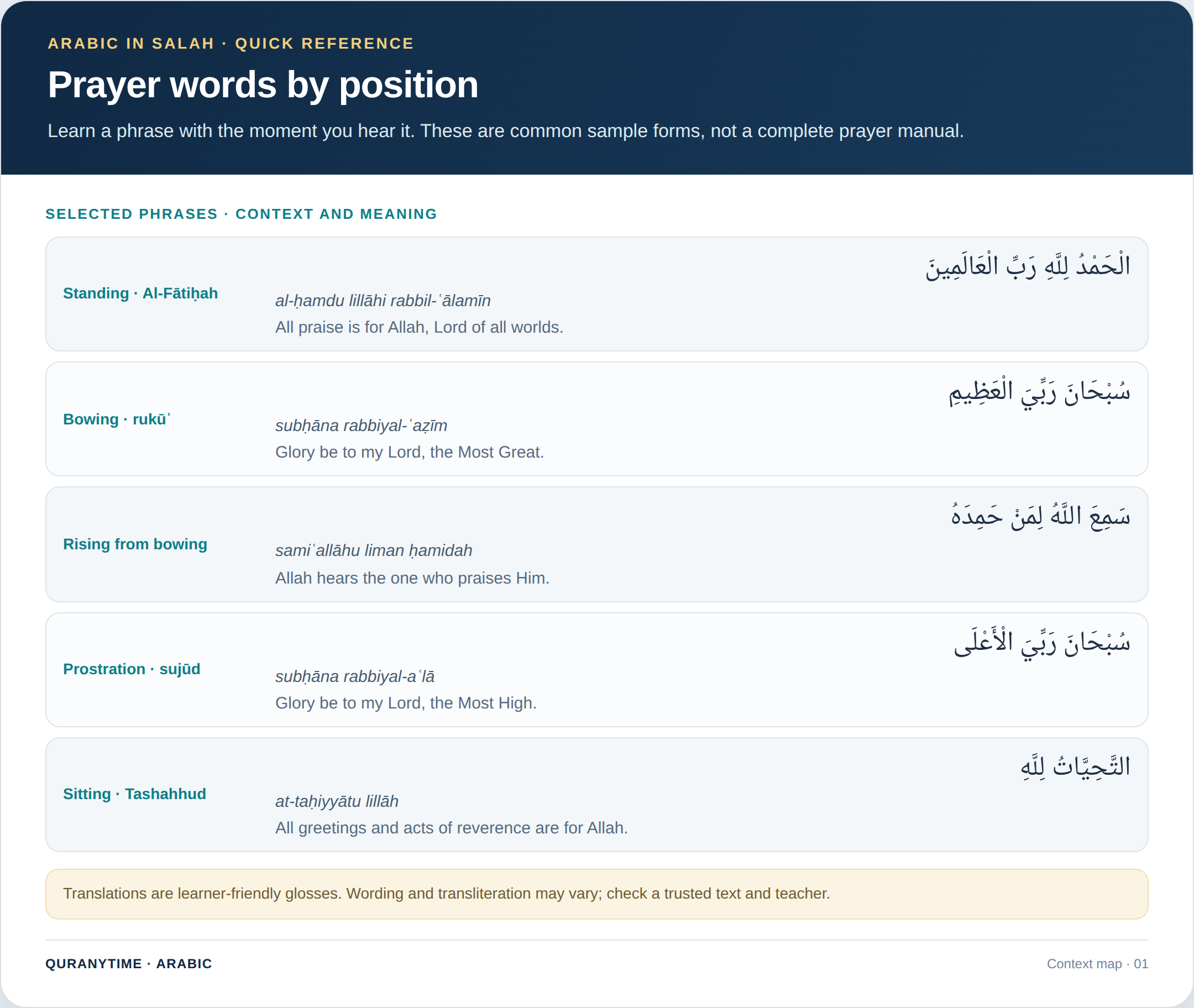
It helps to learn a phrase together with the moment in which it appears. Qiyām is standing; rukūʿ is bowing; sujūd is prostration; and a rakʿah is one unit of prayer. The same short words return across units, so you can learn a small vocabulary set and notice it repeatedly instead of memorizing every line as unrelated material.
Use the map below as a language aid, not as a diagram of prayer rules. It names a few common phrases and their contexts; it does not list every optional supplication or every recognized wording.
Two Al-Fātiḥah phrases to recognize
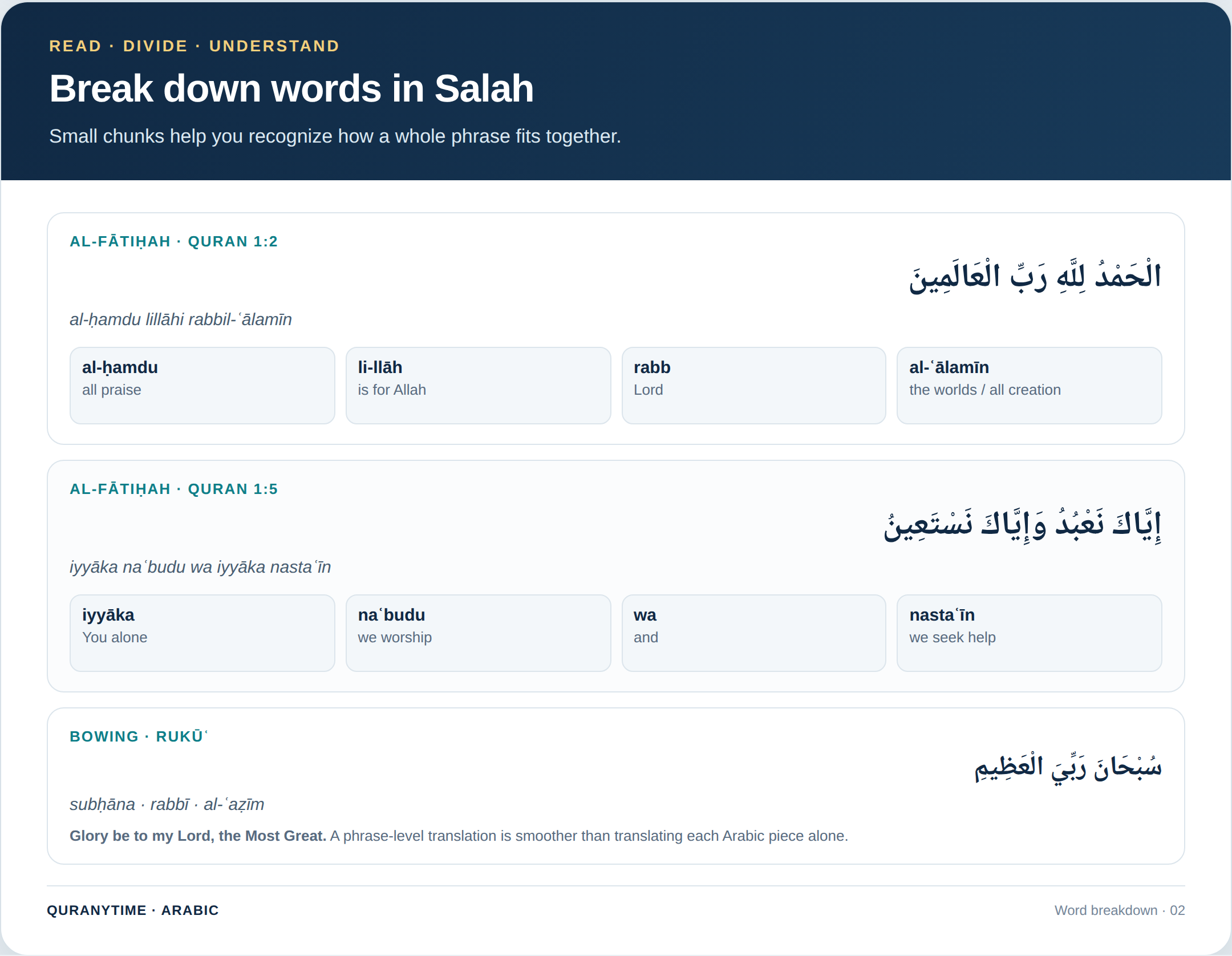
Many learners first meet Salah vocabulary through Al-Fātiḥah. In the familiar phrase الْحَمْدُ لِلَّهِ رَبِّ الْعَالَمِينَ (al-ḥamdu lillāhi rabbil-ʿālamīn, Quran 1:2), the words form a compact statement: al-ḥamdu means “all praise” or “praise”; li-llāh means “is for Allah”; rabb is “Lord”; and al-ʿālamīn refers to the worlds or all creation. A smooth translation is “All praise is for Allah, Lord of all worlds.” The word-by-word gloss helps you notice the structure, but the full sentence carries more meaning than a set of one-word substitutions.
Another key phrase is إِيَّاكَ نَعْبُدُ وَإِيَّاكَ نَسْتَعِينُ (iyyāka naʿbudu wa iyyāka nastaʿīn, Quran 1:5): “You alone we worship, and You alone we ask for help.” Naʿbudu means “we worship,” while nastaʿīn means “we seek help.” The repeated iyyāka is “You”; placing it before the verbs gives the line its emphasis. The attached and detached pronouns used in Quranic Arabic are easier to follow after reviewing a beginner chart of Arabic pronouns in Quranic reading.
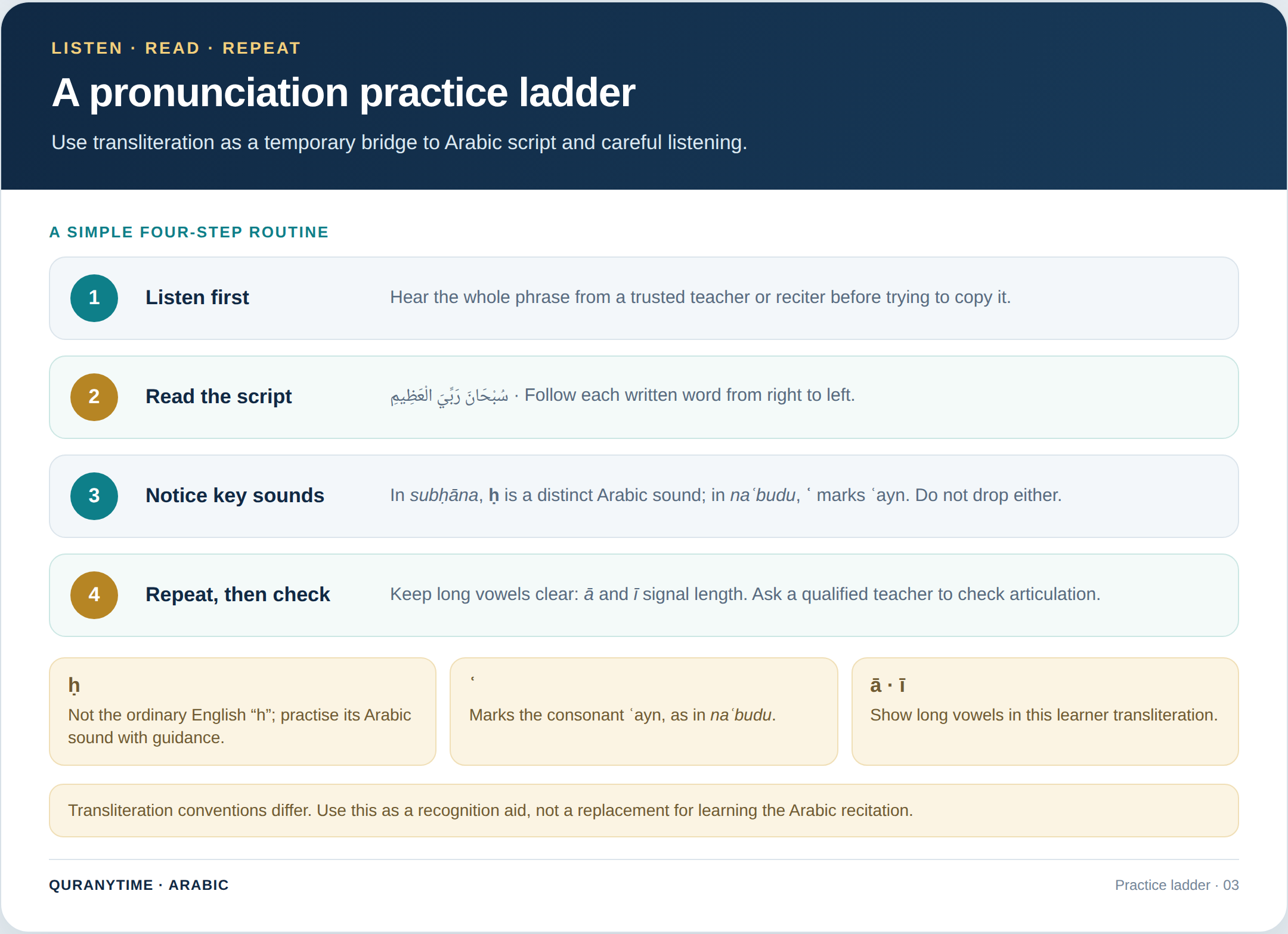
Notice one practical point: the transliteration marks sounds that English spelling cannot represent exactly. In naʿbudu, the small mark ʿ represents ʿayn, a consonant produced in the throat. Transliteration is a memory aid, not a substitute for hearing and learning the Arabic sound.
Rukūʿ: “my Lord, the Most Great”
A widely taught phrase for bowing is سُبْحَانَ رَبِّيَ الْعَظِيمِ (subḥāna rabbiyal-ʿaẓīm), often rendered “Glory be to my Lord, the Most Great.” Break it into three pieces: subḥāna expresses declaring Allah free of imperfection; rabbī means “my Lord”; and al-ʿaẓīm means “the Magnificent” or “the Most Great.” The possessive ending -ī is the same kind of “my” marker you will see in many Arabic words.
Rising from the bow: hearing and praise
One common phrase heard as the worshipper rises is سَمِعَ اللَّهُ لِمَنْ حَمِدَهُ (samiʿallāhu liman ḥamidah): “Allah hears the one who praises Him.” Samiʿa means “heard” or “hears” in this formula; liman means “the one who” or “whoever”; and ḥamida means “praised.” A common accompanying response is رَبَّنَا وَلَكَ الْحَمْدُ (rabbana wa laka al-ḥamd): “Our Lord, and to You belongs all praise.” You may see the last phrase written together in transliteration as rabbana wa lakal-ḥamd; the Arabic words remain the same when pronunciation joins them.
Compare al-ḥamdu in Al-Fātiḥah with al-ḥamd here. Both involve praise, but the surrounding words shape the English translation. That is why a word list alone cannot replace reading a phrase in its full sentence and prayer context.
Sujūd: “the Most High”
During prostration, a familiar phrase is سُبْحَانَ رَبِّيَ الْأَعْلَى (subḥāna rabbiyal-aʿlā): “Glory be to my Lord, the Most High.” The frame is similar to the bowing phrase: subḥāna rabbī, followed by a description of the Lord. The contrast is useful for memory: al-ʿaẓīm is “the Great/Magnificent,” while al-aʿlā is “the Most High.” Both use the article al- (“the”), though connected Arabic pronunciation may change how that article sounds before a letter.
Another short expression sometimes learned with the movements between prostrations is رَبِّ اغْفِرْ لِي (rabbighfir lī): “My Lord, forgive me.” Here rabb is “Lord,” ighfir is “forgive,” and lī means “for me.” Treat this as one familiar wording among transmitted variants rather than the only possible phrase.
Sitting: greetings and peace
The sitting portion includes the Tashahhud. Its opening words are often taught as التَّحِيَّاتُ لِلَّهِ (at-taḥiyyātu lillāh), meaning “All greetings and acts of reverence are for Allah.” Taḥiyyāt is related to greetings or salutations; li-llāh means “for Allah.” The full Tashahhud has longer wording and recognized transmitted forms, so use a checked text and teacher when learning it. Quranytime’s Tashahhud pronunciation and meaning guide focuses on that sitting text in more detail.
At the close, learners may hear السَّلَامُ عَلَيْكُمْ وَرَحْمَةُ اللَّهِ (as-salāmu ʿalaykum wa raḥmatullāh): “Peace be upon you, and the mercy of Allah.” A useful recognition set is salām, “peace”; ʿalaykum, “upon you” addressed to more than one; wa, “and”; and raḥmah, “mercy.” The spelling ʿalaykum has the same ʿayn sound discussed above.
Read the phrase, then listen
The card below separates Arabic script, transliteration, and a learner-friendly gloss. Use it to check what you recognize, then listen to a teacher or reliable reciter and repeat at a comfortable pace. Keep the transliteration as a temporary support while your eyes and ears become familiar with Arabic script.
Pronunciation: three checks for English speakers
First, distinguish the two throat sounds you meet in naʿbudu and ʿaẓīm. The symbol ʿ marks ʿayn, not an apostrophe you can skip; the letter ḥ in subḥāna is a distinct Arabic sound, not the ordinary English “h.” Second, keep long vowels long: ā and ī signal length in this learner transliteration. Third, listen for connected pronunciation. A written word boundary may sound less obvious when a phrase is recited continuously, and the article al- is pronounced differently before sun letters than before moon letters.
For clear short-vowel and tanwīn foundations, review Arabic harakat for Quran reading. If the sound of al- is confusing, this guide to sun and moon letters explains why the written article and spoken sound do not always match letter for letter. English speakers who want more focused listening and articulation practice can use the Quran pronunciation practice guide.
A five-minute practice routine
Choose one short phrase, not the whole prayer. Read the Arabic slowly, listen to a checked model, and point to one word at a time. Cover the transliteration and try to recall the meaning from the Arabic script; then cover the Arabic and test whether you can recognize the sound. Finally, say the phrase in its prayer-position context and explain its broad meaning in your own words without treating that explanation as a complete translation.
When you meet an unfamiliar form, write down the word as it appears, its likely base form, and the attached ending. A dictionary can help with possible roots and meanings, but always return to the full phrase. Quranytime’s guide to using a Quran dictionary explains how to check a word in context. For a repeatable weekly routine, see the Quranic Arabic vocabulary study plan.
Watch a guided Salah demonstration
This separate video walks through a two-rakʿah prayer using Arabic wording with English explanations and transliteration on screen. It is a listening and recognition aid, not a substitute for learning your own recitation with a qualified teacher.
Common learning mistakes to avoid
Do not assume every Arabic word has one English equivalent. A gloss is a small clue; grammar, phrase order, and context matter. Do not read an apostrophe or ʿ as decoration: the latter represents an Arabic consonant. Do not rely on transliteration alone, especially for ḥ, ʿayn, long vowels, and emphatic letters. And do not generalize one familiar wording into a claim that every Muslim recites every optional phrase identically. When you are unsure, use a reliable printed text and ask a qualified teacher rather than guessing at sacred wording.
It can also help to separate language questions from recitation questions. A dictionary can explain a likely word meaning; a teacher can check your articulation, vowel length, and connected recitation. A broad Salah guide can help you revisit the prayer sequence, while this article stays focused on Arabic vocabulary. If you would like personal feedback on reading and pronunciation, you can book a free Quran and Arabic trial class and ask which practice step fits your level.
Keep the words connected to their context
Start with a handful of repeated words: rabb (Lord), ḥamd (praise), subḥān (declaring perfection), salām (peace), and ʿalaykum (upon you). Recognize them in a phrase, then in the prayer position where you hear them. Over time, compare related forms and note what changes when pronouns or particles attach. The goal is not to turn a prayer into a vocabulary quiz; it is to notice enough Arabic to follow familiar meanings with greater attention, while learning recitation accurately and respectfully.