
Nature vocabulary in Arabic is easier to remember when you learn it as part of a scene: sky, water, land, river, and plants. This guide groups useful Modern Standard Arabic words, then follows several through a Qur’anic passage. You will practise noticing forms and context—not treating every English gloss as fixed or turning grammar notes into a full interpretation.
Some entries are everyday MSA vocabulary; others occur in Qur’anic settings. A word may have more than one translation: arḍ can mean “earth” or “land,” while jannah can mean “garden” or Paradise in different contexts. Learn the Arabic form, read the phrase around it, and check the passage before choosing a meaning.
Group nature vocabulary in Arabic by scene
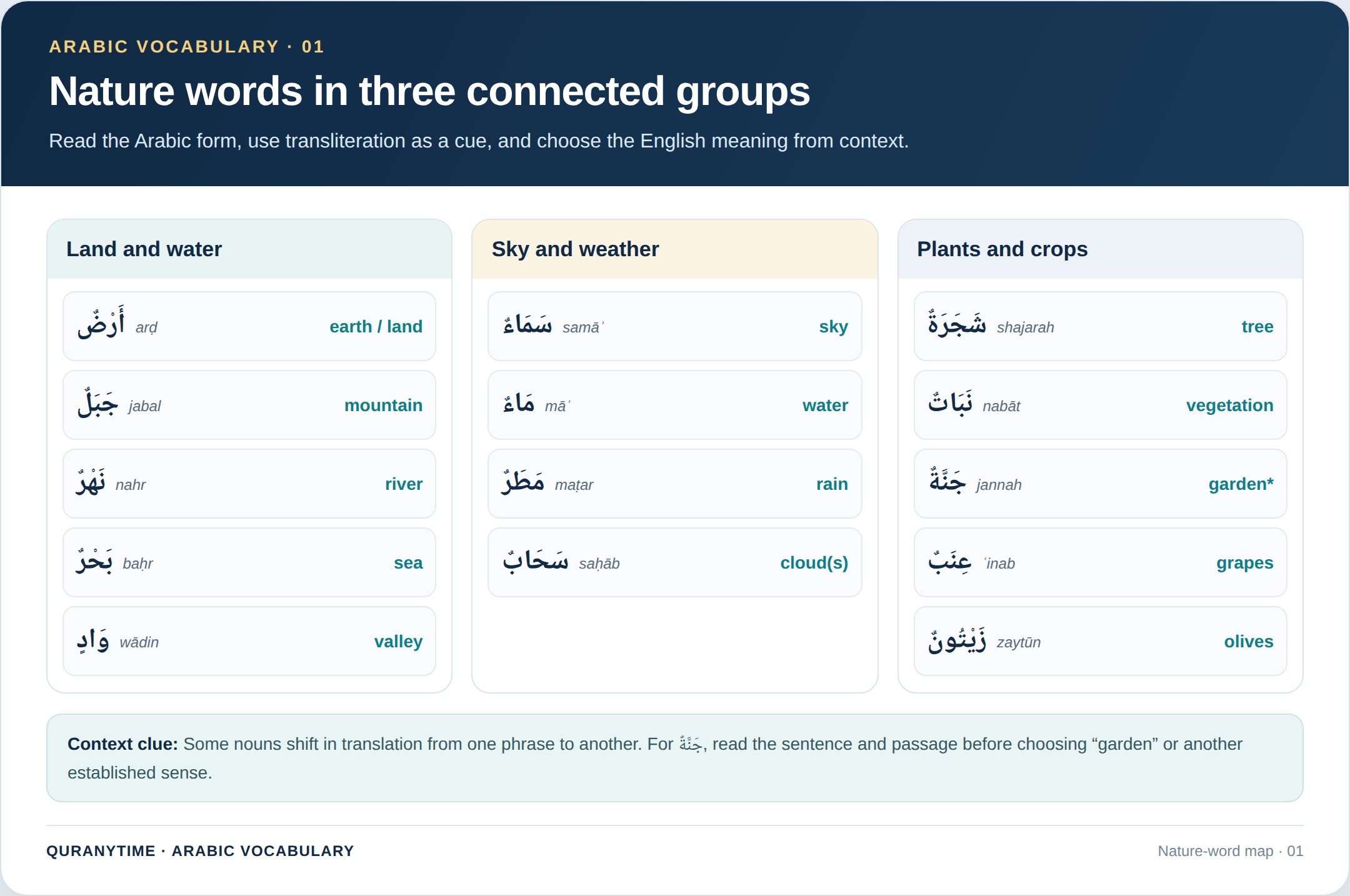
Start with three connected groups. Say the noun aloud, notice its short vowels, and attach it to a picture or phrase. The image below is a quick review map, not a substitute for reading the words in sentences.
Land and water
- أَرْضٌ (arḍ) — earth or land.
- جَبَلٌ (jabal) — mountain; جِبَالٌ (jibāl) — mountains.
- نَهْرٌ (nahr) — river; أَنْهَارٌ (anhār) — rivers.
- بَحْرٌ (baḥr) — sea.
- وَادٍ (wādin) — valley; the definite form is الْوَادِي (al-wādī).
Sky and weather
- سَمَاءٌ (samāʾ) — sky.
- مَاءٌ (māʾ) — water; مَطَرٌ (maṭar) — rain.
- سَحَابٌ (saḥāb) — cloud or clouds collectively.
Plants and crops
- شَجَرَةٌ (shajarah) — tree; أَشْجَارٌ (ashjār) — trees.
- نَبَاتٌ (nabāt) — plant growth or vegetation.
- جَنَّةٌ (jannah) — garden in some contexts.
- عِنَبٌ (ʿinab) — grapes; زَيْتُونٌ (zaytūn) — olives or olive trees.
- رُمَّانٌ (rummān) — pomegranate.
Notice endings, gender, and plurals
Record both the dictionary form and the form you meet in a sentence. Arabic endings change with grammar: مَاءٌ (māʾ) may appear as مَاءً (māʾan) without becoming a different word. The preposition مِنْ (min, “from”) is followed by a genitive noun in a fully inflected phrase.
Gender affects agreement. جَبَلٌ is masculine; شَجَرَةٌ is feminine. The ending ة is a useful clue, not a complete test; see the guide to Arabic noun gender for the form-and-grammar distinction.
Compare جَبَلٌ → جِبَالٌ and نَهْرٌ → أَنْهَارٌ: these plurals change the inner pattern rather than adding one ending. Qur’anic Arabic learners can review Arabic broken plurals. Roots can connect related forms, but a root is a clue rather than a definition; the guide to Arabic roots and patterns explains how to use that clue carefully.
Pronunciation matters too. The emphatic ḍ in arḍ differs from the plain d in English “day,” and māʾ ends with a hamza. Use transliteration as a temporary aid, then return to the Arabic letters and vowel marks. When a gloss seems uncertain, use a Quran dictionary to check the word’s range instead of guessing from one English equivalent.
Hear a short nature-word lesson
This picture-led lesson offers extra listening practice with Arabic landscape and nature words. Listen for a few familiar items such as mountain, valley, rain, and water; then return to the Qur’anic example below, where the same broad topic appears in a different sentence and register.
Read a Qur’anic example as a connected phrase
Al-Anʿām 6:99 describes rain and plant growth. Read this excerpt as a sentence, not as a row of unrelated flashcards:
وَهُوَ الَّذِي أَنْزَلَ مِنَ السَّمَاءِ مَاءً فَأَخْرَجْنَا بِهِ نَبَاتَ كُلِّ شَيْءٍ
A simple study gloss is “And He is the One who sent down water from the sky; then We brought forth by it the growth of every kind.” Translations may phrase the clause differently. مِنَ means “from,” السَّمَاءِ is “the sky,” and مَاءً is “water.” The verb أَنْزَلَ (“sent down”) helps explain water’s role; the clause then continues with فَأَخْرَجْنَا (“then We brought forth”) and نَبَاتَ (“growth” or “vegetation”). The construct كُلِّ شَيْءٍ completes the phrase as “of every thing.” Notice the sequence: source, water, action, growth.
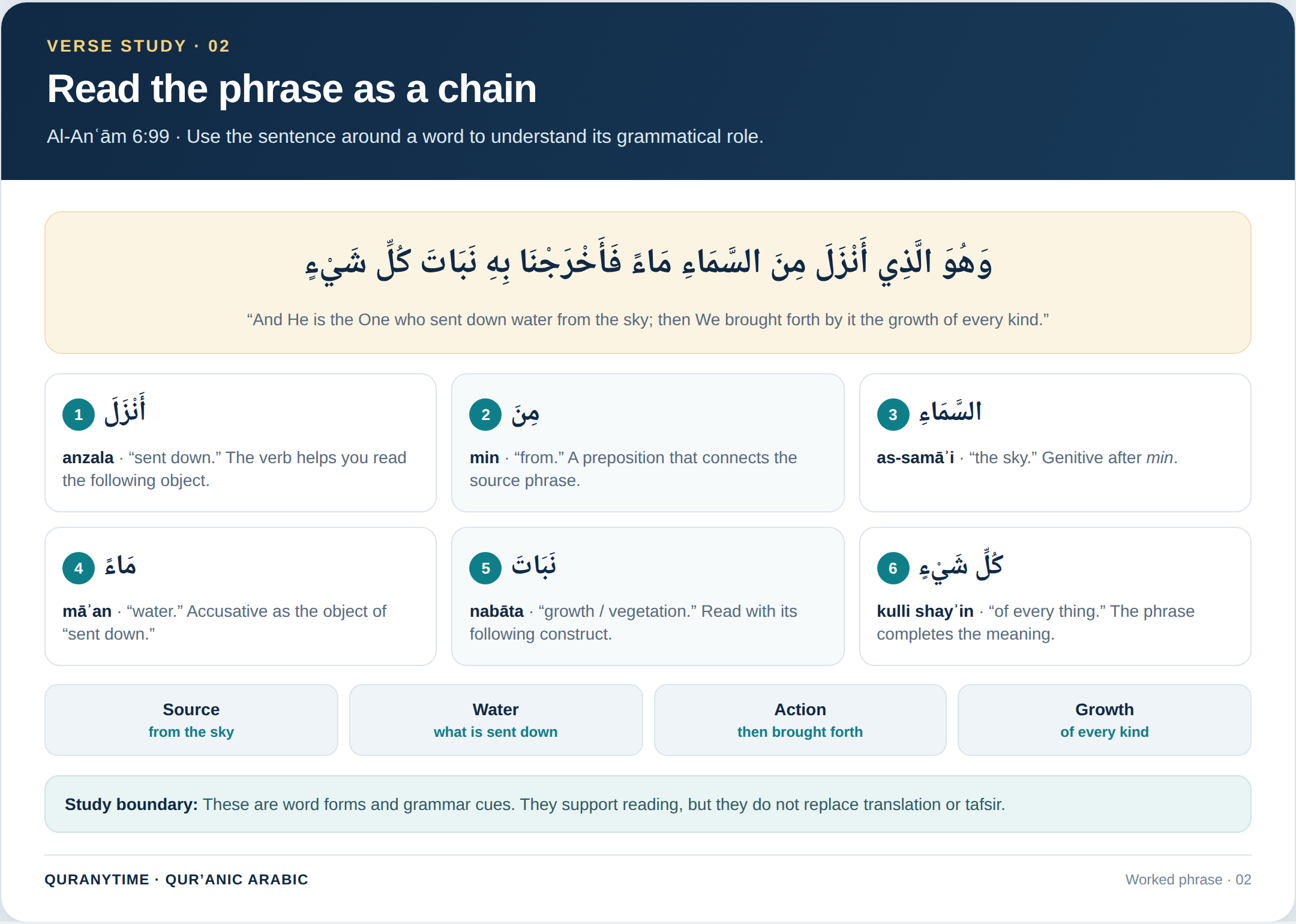
The Quranic Arabic Corpus word-by-word analysis of Al-Anʿām 6:99 lists the verse’s word forms and grammatical roles. It confirms, for example, the genitive relation after min and the forms used for water and vegetation. This is a morphology reference—not tafsir, and not a substitute for a reliable translation or teacher when you need interpretation.
Reading the particle with the noun gives more than memorizing two tokens: مِنَ السَّمَاءِ means “from the sky,” and min helps explain the genitive form. Review Arabic case endings when you want to understand why a noun changes after a preposition or inside a phrase. The vocabulary is also tied to a specific register; the overview of Qur’anic Arabic and Modern Standard Arabic explains why a word list may combine everyday forms with text-specific usage.
Use a five-step context check
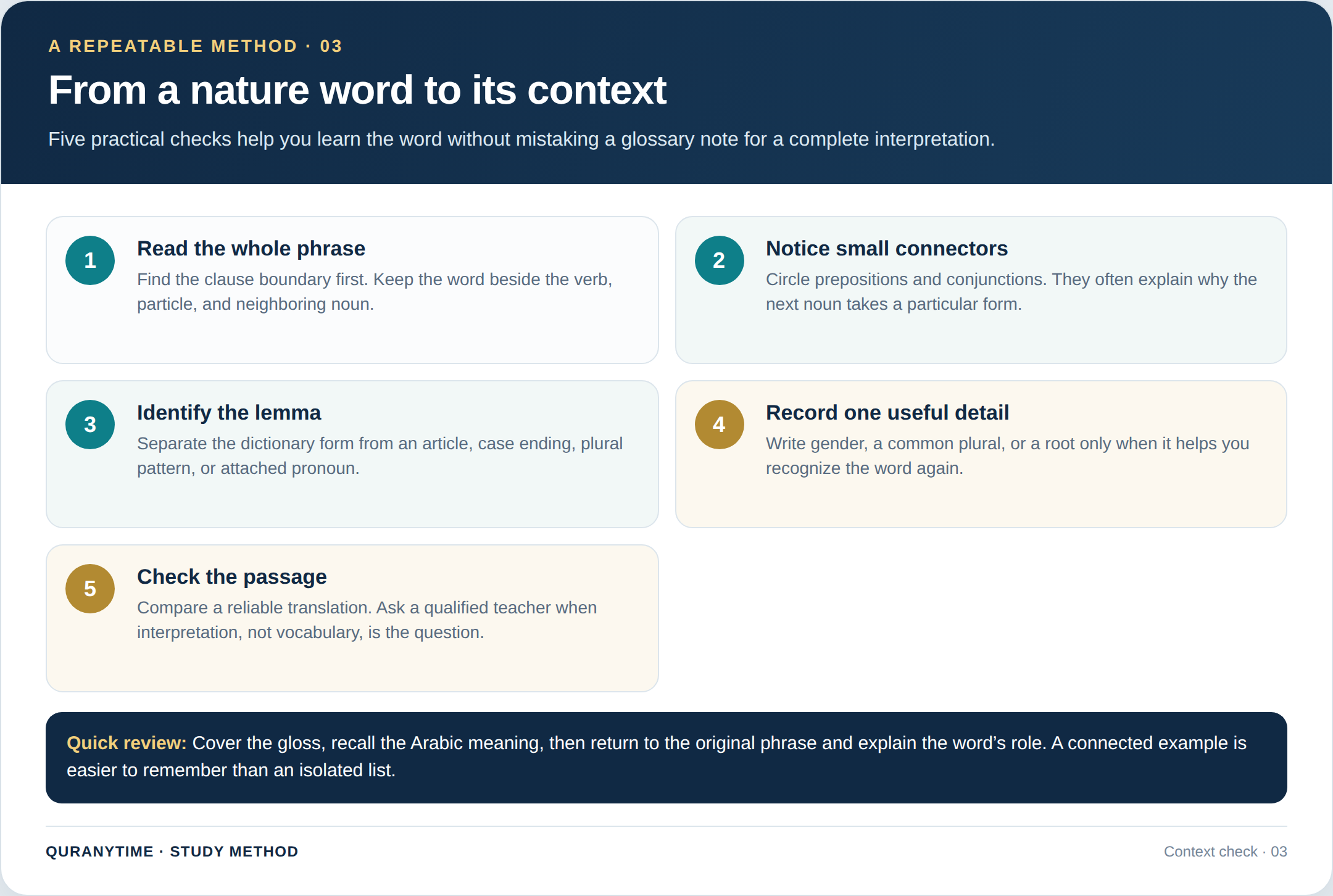
For a new nature word, repeat these checks before you save a translation. They keep the word attached to the phrase that gives it meaning.
- Read the whole phrase. Mark its clause boundary before opening a glossary.
- Notice connectors. Circle prepositions, conjunctions, and attached pronouns.
- Find the lemma. Separate the noun from an article, case ending, or possessive ending.
- Record one useful detail. Add gender, plural, or root only when it helps recognition.
- Check the passage. Compare a reliable translation; ask a qualified teacher when your question is interpretation.
Practise with simple sentences
These short MSA examples move the words from recognition into a phrase. They are practice sentences, not quotations from the Qur’an.
- هَذَا جَبَلٌ مُرْتَفِعٌ. — “This is a high mountain.” The noun and adjective are masculine singular.
- هَذِهِ شَجَرَةٌ كَبِيرَةٌ. — “This is a big tree.” The demonstrative and adjective agree with the feminine noun.
- الْمَاءُ فِي النَّهْرِ. — “The water is in the river.” The noun after fī is genitive.
When an adjective describes a nature noun, check gender, number, and case instead of copying an English word order. The guide to Arabic adjective agreement explains the pattern in more detail.
Four mistakes to avoid
- One gloss for every context: “earth,” “land,” or “sky” depends on the phrase. Keep a small range of meanings in your notes.
- Ignoring endings: case endings show how a noun relates to a verb, preposition, or construct.
- Assuming every plural is regular: learn the singular and the useful plural together.
- Mixing registers: label a word as MSA, Qur’anic usage, or a local dialect when that distinction matters.
Most importantly, a vocabulary gloss does not settle tafsir. Read the complete passage and consult qualified sources for interpretive questions.
A short review routine
Choose five words. Write the Arabic on one side of a card and a short meaning range plus one useful form on the other. The next day, cover the gloss and recall it from the Arabic. A few days later, reread Al-Anʿām 6:99 and identify the particle, noun, and verb before checking your notes. Add the verse reference beside any word you learned from scripture so you can return to its surroundings instead of relying on memory alone. For a staged routine beyond this topic, follow the Quranic Arabic vocabulary study plan for beginners.
For pronunciation, listen to one clear model and repeat each word slowly inside a short phrase. Focus on one sound you find difficult, such as the final hamza in māʾ; do not rush to imitate a speaker’s speed. Transliteration can help at first, but gradually shift attention to Arabic letters and vowel marks. Five careful words reviewed over several days are more useful than rushing through a long list once.
Frequently asked questions
Are all the words above Qur’anic words?
No. The list includes useful standard Arabic nature vocabulary, and some entries also occur in the Qur’an. The worked example focuses on Al-Anʿām 6:99; check the form and meaning of each word in its own passage.
Should I memorize roots first?
No. Learn the word and phrase first. Add a root or pattern when it helps connect forms, but verify the actual meaning and grammar in context.
Does جَنَّةٌ always mean “garden”?
No. “Garden” suits some contexts, while the word has another established religious sense in others. Use the sentence and passage to choose, rather than applying one gloss everywhere.
Study nature words as a connected scene, but keep each Arabic form and its context visible. If you want help choosing a suitable next step for Arabic or Quran reading, book a free trial class and discuss your level and goals.
A nature notebook that keeps observation separate from interpretation
Try this two-page notebook project to connect vocabulary with something you can describe. One page records an ordinary scene; the other records a word in a Quranic passage. Keeping the pages separate prevents a learner from treating an everyday description as though it were an explanation of a verse.
Page one: describe what you can see
Choose a photograph, garden view, or simple drawing. Select only three objects that you can name using the vocabulary above. Label a tree, water, or a mountain if those things are present. Do not add an object merely because you remember its Arabic word. The task is accurate description, not collecting as many labels as possible.
Under the labels, write one short sentence using a pattern already modelled in this lesson. You might describe a tree as big or place water in a river. Check that a demonstrative or adjective matches its noun. Next, cover your labels and describe the scene to a partner. Let the partner point to the object you mean. If the pointing is wrong, discover whether the problem was the noun, pronunciation, or the relationship you described.
Page two: record a word inside its passage
Return to the cited Al-Anʿām example and choose one familiar word. Record its verse reference, the form on the page, and a short phrase containing it. Add a dictionary form separately if it differs. For example, do not discard a visible ending simply because your vocabulary card presents the noun without it. That ending may be part of the grammatical information you are learning to recognise.
Add two columns headed “I can observe” and “I need to check.” In the first, record an identifiable feature, such as a preposition preceding a noun. In the second, record an unanswered question about a translation or grammatical role. A question about what a passage ultimately teaches belongs with reliable tafsir and qualified guidance; a small vocabulary notebook cannot settle it.
Check your method
- Does recognising the root prove which English meaning applies in this verse?
- If a noun has a different case ending, must it be a different dictionary word?
- Can a modern practice sentence be labelled as a Quran quotation because it contains Quranic vocabulary?
- What reference makes it possible to return to the complete passage later?
Answers: 1) No; context and established usage matter. 2) No; grammar can change the ending. 3) No; label it as an original practice sentence. 4) Record the surah and verse number, together with the phrase you studied.
Revisit the two pages after a few days. Can you describe the ordinary scene without the labels and locate the recorded word inside its passage? These are two different achievements. Tracking them separately gives a clearer picture of learning than a single total of memorised words.