

When you meet قُلُوبِهِمْ (qulūbihim, “their hearts”) in the Quran, the word does not look much like its singular قَلْبٌ (qalb, “a heart”). The plural changes the inside of the word, not just its ending. This kind of form is called an Arabic broken plural, or jamʿ taksīr (جمع التكسير).
For Quranic-Arabic readers, the useful goal is recognition: notice a familiar root or word shape, check the surrounding meaning, and learn the plural alongside its singular. This guide compares broken and sound plurals, introduces common patterns, and works through Quran examples. The patterns are clues—not a formula that lets you invent every plural reliably.
What is a broken plural in Arabic?
A plural refers to more than two; the dual is a separate form for two. In a sound plural, the main word shape stays intact and a plural ending is added. A sound masculine plural commonly appears with ـونَ or ـينَ, depending on grammatical case. A sound feminine plural often ends in ـات.
A broken plural changes the noun’s internal pattern: vowels may shift, letters may be added or removed, or the word may take a different template. “Broken” is a traditional grammar label, not a judgement that the word is defective. Compare مُؤْمِنٌ ← مُؤْمِنُونَ (muʾmin → muʾminūn, “believer → believers”), where a suffix is added, with كِتَابٌ ← كُتُبٌ (kitāb → kutub, “book → books”), where the internal vowels change.
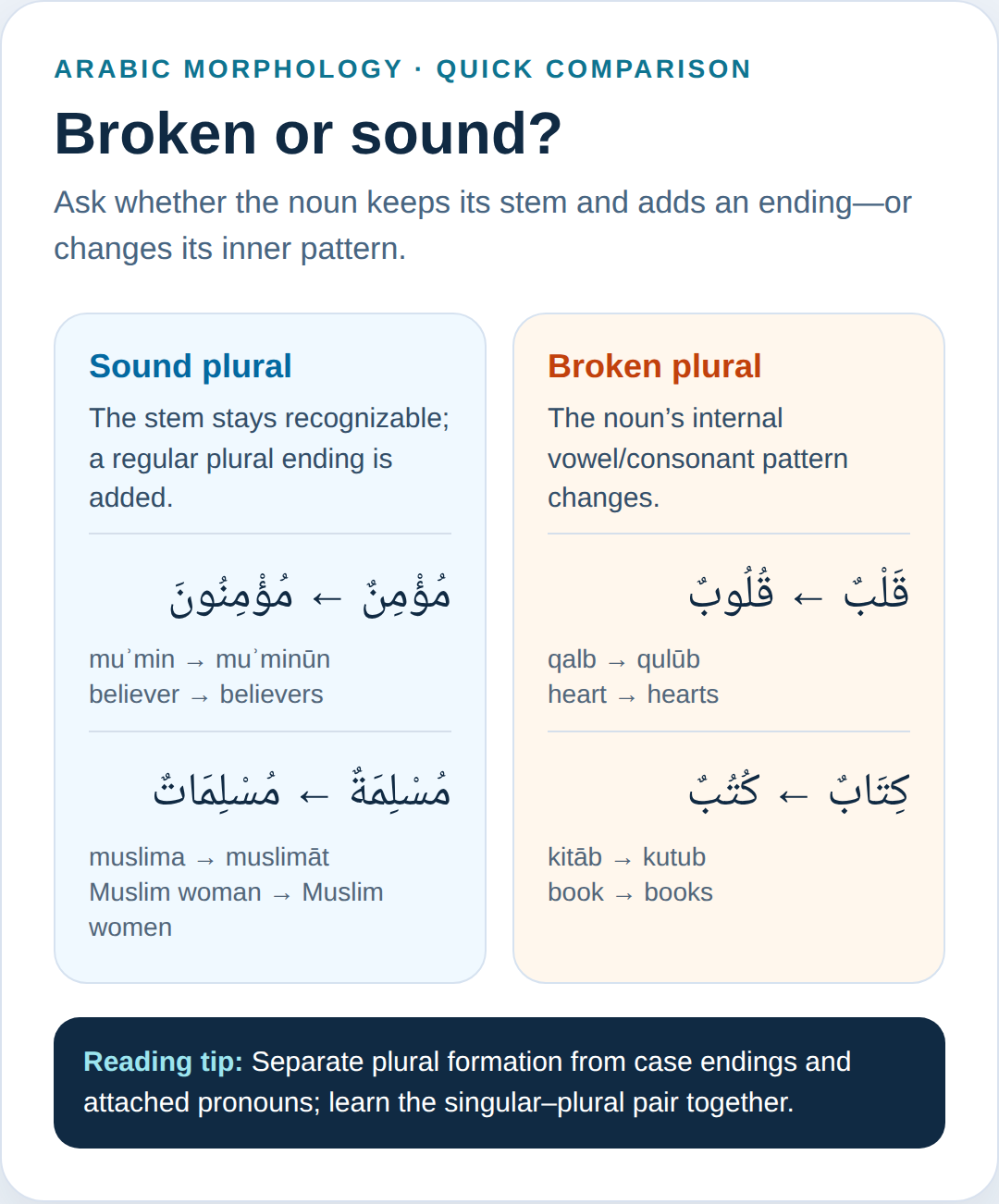
The spelling gives you a first clue, but do not classify a word from its final letters alone. Case endings, attached pronouns, and pause forms can affect what you see or hear. First identify the base noun; then ask whether the plural ending was added to an otherwise stable stem or whether the stem pattern changed.
It helps to read a written Arabic word in layers. In قُلُوبِهِمْ, the plural base is qulūb; the attached -him means “their.” In أَبْوَابُهَا (abwābuhā), the plural base is abwāb; -hā supplies “its.” Those possessive endings do not make either noun a sound plural. Separating the noun from what attaches to it prevents a common misreading.
Common Arabic broken-plural patterns
Arabic has many broken-plural templates, and a singular can have more than one plural in some cases. You do not need to memorize a long pattern list before you can read. Start with familiar singular–plural pairs and observe the shape change. A pattern can help you recognize a word you have met before, but it does not always predict the plural of a new noun.
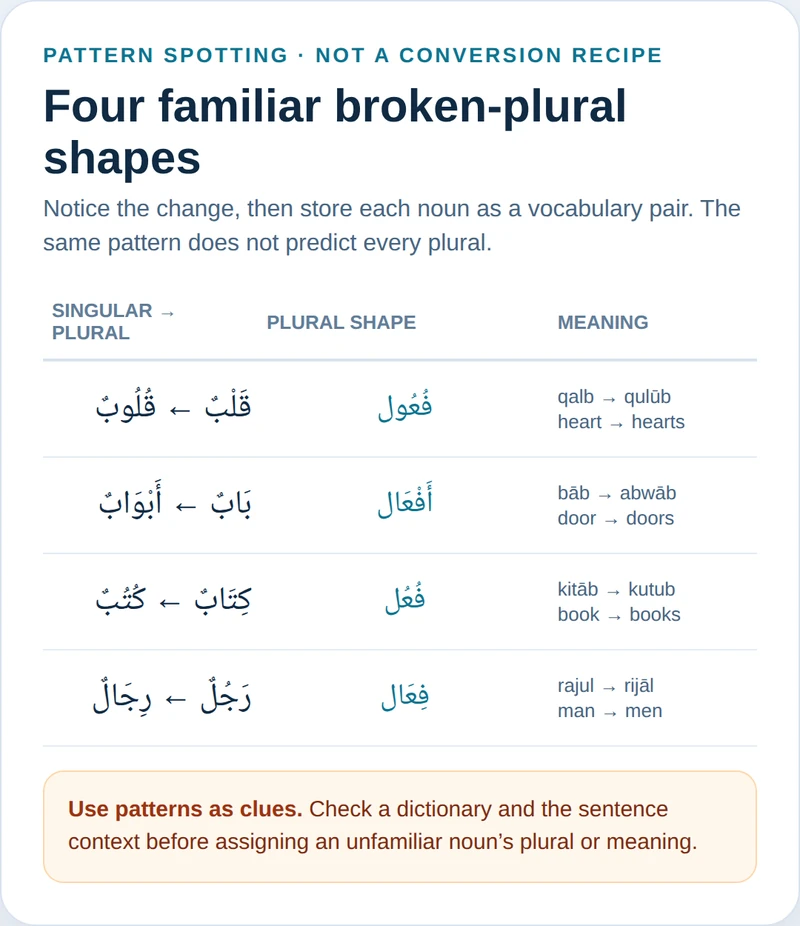
For example, قَلْبٌ ← قُلُوبٌ has the plural qulūb, which follows a fuʿūl-type shape; بَابٌ ← أَبْوَابٌ has abwāb, an afʿāl plural; and رَجُلٌ ← رِجَالٌ has rijāl, a fiʿāl plural. These are examples to learn as pairs, not instructions for converting every word with the same singular shape.
Why are there so many forms? Arabic nouns are built from familiar patterns, but plural formation is also part of a word’s established vocabulary. The word’s history and usage matter, and the same-looking singulars do not always behave alike. Treat a pattern chart as a recognition aid: it can make a word feel familiar, but a dictionary, teacher, or reliable Quranic-Arabic reference should confirm an unfamiliar form.
Broken plurals in Quranic Arabic
Seeing a plural inside a verse helps connect form and meaning. In Al-Baqarah 2:10, the phrase فِي قُلُوبِهِمْ مَرَضٌ includes qulūb, “hearts,” from qalb, “heart.” The attached ending ـهِمْ means “their.” Do not treat the suffix as part of the plural pattern: the plural is qulūb, and the possessive pronoun is attached afterward. The Quranic Arabic Corpus labels qulūb as a plural noun in its word-by-word analysis of Al-Baqarah 2:10.
Other examples make the recognition skill more concrete. In An-Nur 24:37, رِجَالٌ (rijāl, “men”) is the plural of رَجُلٌ (rajul, “man”). In Az-Zumar 39:73, أَبْوَابُهَا (abwābuhā, “its gates”) combines the plural abwāb with the suffix “its.” In Al-Hadid 57:25, رُسُلَنَا (rusulanā, “Our messengers”) combines rusul with the suffix “Our.” In Ta-Ha 20:51, الْقُرُونِ (al-qurūni, “the generations”) is the plural of qarn, “a generation.” The ending attached to a noun can mark possession or case; it does not necessarily turn the word into a sound plural.
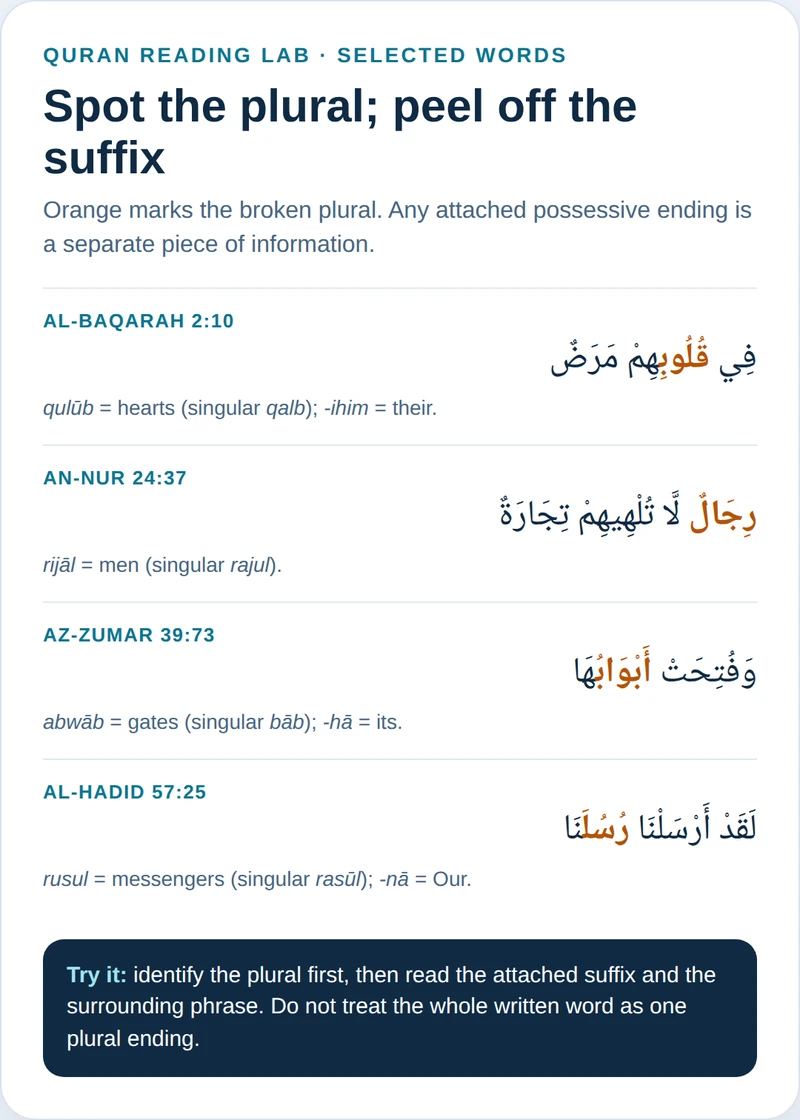
When you meet a plural in a verse, keep the task modest: identify the word, locate its likely singular if you know it, and read the phrase in context. Do not build a translation from morphology alone. A word may have more than one meaning, and a plural form can be lexicalized in ways a pattern chart cannot settle.
Try a quick “peel back the layers” check with qulūbihim: remove the attached possessive ending -him to reveal qulūb, then connect that plural to qalb. Do the same with abwābuhā: remove -hā, then recognize abwāb. This is not a translation trick; it is a way to keep plural formation, possession, and sentence meaning from blending together.
What broken plurals do—and do not—tell you
Many non-human plural nouns are followed by agreement that looks grammatically feminine singular, especially with adjectives and pronouns. Human plurals often take plural agreement. This is a useful reading tendency, not a shortcut for interpreting every construction; Arabic grammar has exceptions and context matters. For more on matching adjectives to nouns, see our guide to Arabic adjective agreement.
A broken plural does not tell you by itself whether a noun is definite, who owns it, or what role it plays in a sentence. The article الـ, a case ending, an attached pronoun, and the surrounding syntax each do a different job. For a broader foundation in Arabic roots and word patterns, continue with our Quranic Arabic roots-and-patterns introduction. If you are building a study routine, our beginner Quranic-Arabic vocabulary plan can help you review each new pair over time.
Common mistakes to avoid
- Guessing a plural from one pattern. A familiar shape can be a useful clue, but it is not a reliable rule for making up the plural of an unfamiliar noun. Check the form before you memorize or translate it.
- Counting attached letters as a plural marker. A possessive ending such as -him or -hā tells you who something belongs to; it is separate from the noun’s singular-or-plural pattern.
- Ignoring case and context. The visible ending can change with a word’s grammatical role, and the same noun may appear with a prefix or suffix. Read the phrase, not just an isolated string of letters.
- Assuming every plural behaves alike. Human and non-human plural agreement can differ, and a dictionary meaning may not match a learner’s first guess. Verify both grammar and meaning in context.
How to learn broken plurals without guessing
Use a small, repeatable routine. First, note the singular and plural together in a vocabulary list. Second, mark the changed letters or vowels, but do not assume that the same change works for every noun. Third, copy a short Quran phrase with its verse reference and a simple meaning. Finally, cover one side of the pair and recall the other, then check a trusted dictionary or grammar resource.
When reading, try this sequence:
- Read the whole phrase once, without stopping at every unfamiliar word.
- Circle the noun that seems to refer to more than one person or thing.
- Look for a familiar singular, root, or pattern, while treating it as a hypothesis.
- Separate attached endings such as ـهُمْ (“their/them”) from the noun’s plural form.
- Confirm the meaning in context, and record the singular–plural pair for review.
This kind of careful repetition works well alongside a steady Quran-reading fluency routine. You can also connect morphology practice with our beginner guide to Arabic verb forms; verbs and nouns change in different ways, so keep their pattern notes separate.
Quick practice: identify the changed noun
Try these pairs before looking back at the chart: كِتَابٌ / كُتُبٌ, قَلْبٌ / قُلُوبٌ, and بَابٌ / أَبْوَابٌ. Which form is singular? Which form changes internally rather than adding a regular plural ending? Then look at فِي قُلُوبِهِمْ and separate the plural noun from the attached “their.” Answers: the first word in each pair is singular; the second is a broken plural; in the Quranic phrase, qulūb is the plural and -ihim marks possession.
Keep the goal practical: recognize common forms and verify unfamiliar ones. Broken-plural patterns are valuable clues, but vocabulary, context, and a reliable dictionary remain essential. To see how these forms fit into a wider course of study, follow our Quranic-Arabic learning roadmap.
Continue learning with a lesson
This separate lesson reviews Arabic broken plurals and common examples. Watch it as a supplement, then return to the Quran examples above and see whether you can identify the plural noun before reading its translation.