

How Much Quran Should You Memorize Each Day?
If you are asking, “How many verses should I memorize a day?”, the honest answer is not a fixed number. One verse may be brief while another takes much longer; a printed line or page also changes with the mushaf. A useful daily target is the amount you can recite accurately, recall after a delay, and keep reviewing without older memorization becoming neglected.
So begin with a testable portion, not a deadline borrowed from someone else. Keep the same mushaf during your trial, listen for errors in recitation, and count revision as part of the day’s work. If you want to estimate a longer plan, use the Hifz calculator as a planning aid—not as proof that a chosen pace will fit every learner.
Choose a unit that means something to you
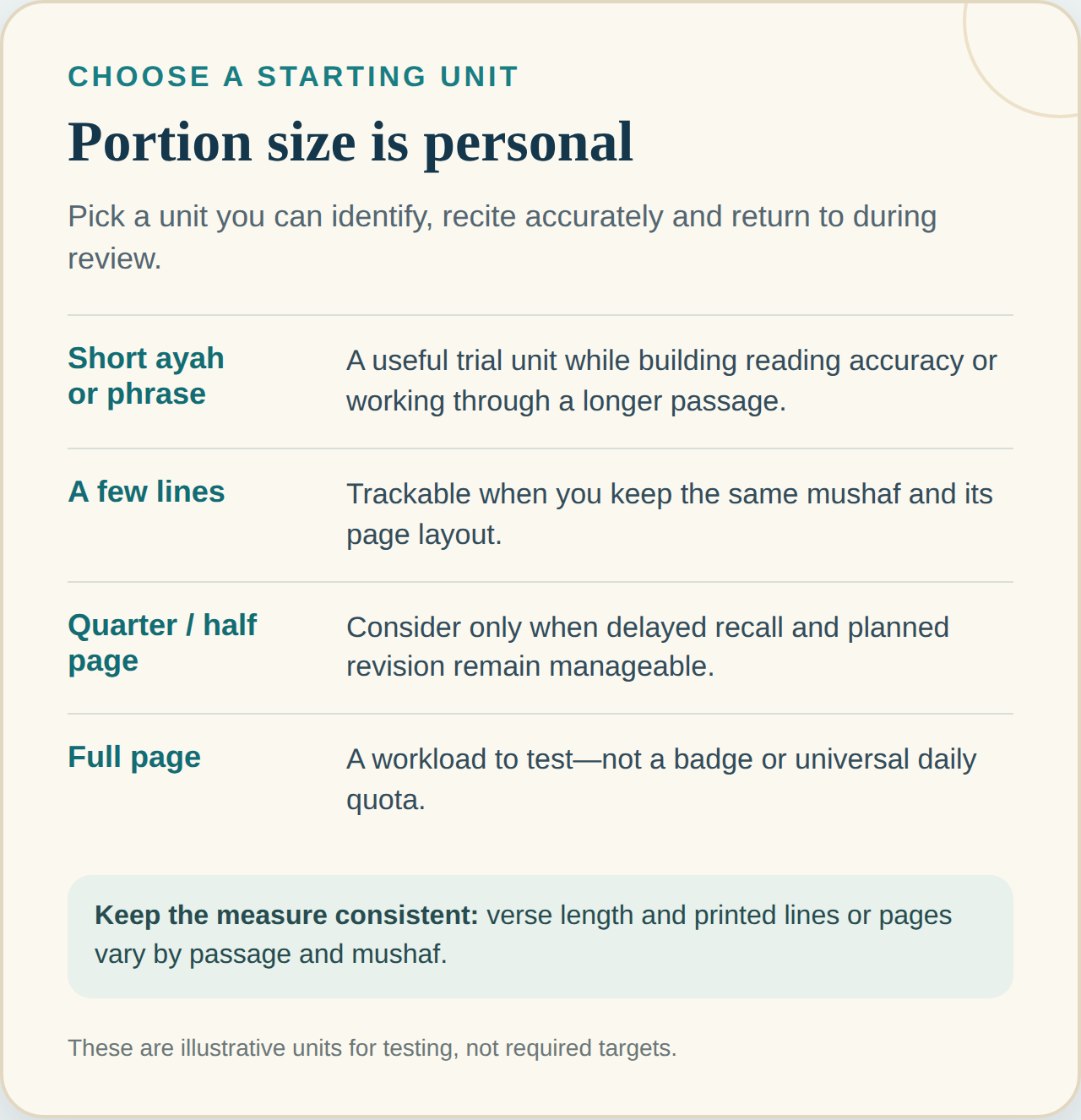
“One verse” sounds precise, but verse lengths vary. A short ayah and a long ayah are very different amounts of new material. Lines can be easier to measure, yet their length depends on the mushaf edition and page layout. A page is a consistent unit only when you keep using the same copy.
For that reason, choose the unit you can track reliably: an ayah or a connected phrase, a set of lines in your regular mushaf, or a portion of a page. A unit is useful when you can identify its beginning and end and return to the same text during revision. Do not switch between a phone layout, a printed mushaf, and a different edition halfway through a comparison; the numbers will no longer describe the same workload.
There is no need to treat one unit as superior. A learner building reading accuracy may begin with a short passage. Someone with steady recitation and a dependable revision habit may test a larger portion. A full page can be a reasonable challenge for one person and too much for another. The difference is not character or seriousness; it is the fit between the portion, current skill, available attention, and review load.
Set a starting amount from your current reading
Before adding new memorization, check how comfortably you can read the passage. Can you pronounce the words in order without frequent guessing? Do you know where to stop and resume? If the reading itself is uncertain, the first task is not to memorize a larger quantity. Work on accurate reading and ask a qualified teacher to correct pronunciation and tajweed where needed. Quranytime’s guide to Hifz techniques can help you compare study approaches, but it cannot replace correction from a teacher who listens to your recitation.
Choose a modest starting unit that leaves room for both new work and review. Read it carefully, then try to recite it without looking. If you can only continue while your eyes follow the text, you are still practising the passage rather than testing recall. That is normal; it simply means the portion is not yet ready to be counted as secure memorization.
Audio can support attentive listening, but hearing the passage again is not the same as retrieving it from memory. A structured listen–pause–check practice can help you notice where you lose the sequence. After listening, close the mushaf and recite; then compare carefully and correct the exact words that were missed.
Use three checks before increasing the portion
First, check recitation accuracy. A target is too large if you repeatedly carry an uncorrected pronunciation or sequence error forward. If a sound, word ending, or stop is unclear, mark it and ask a teacher rather than trying to memorize the mistake more firmly.
Second, check delayed recall. After practice, leave the passage and return to it later without looking. A next-day check is more informative than repeating it many times in one sitting and feeling familiar with it. The U.S. Department of Education’s What Works Clearinghouse practice guide recommends spacing learning over time and using quizzes to revisit key material. Those are general study principles, not a Quran-specific finding or a prescribed daily Hifz amount.
Third, check the review load. Can you review yesterday’s material and keep older memorization in rotation while learning the new portion? If today’s target regularly pushes revision aside, it is not yet a sustainable daily amount. A Hifz revision schedule can help you see how review changes as the amount of memorized material grows.
Run a one-week amount test
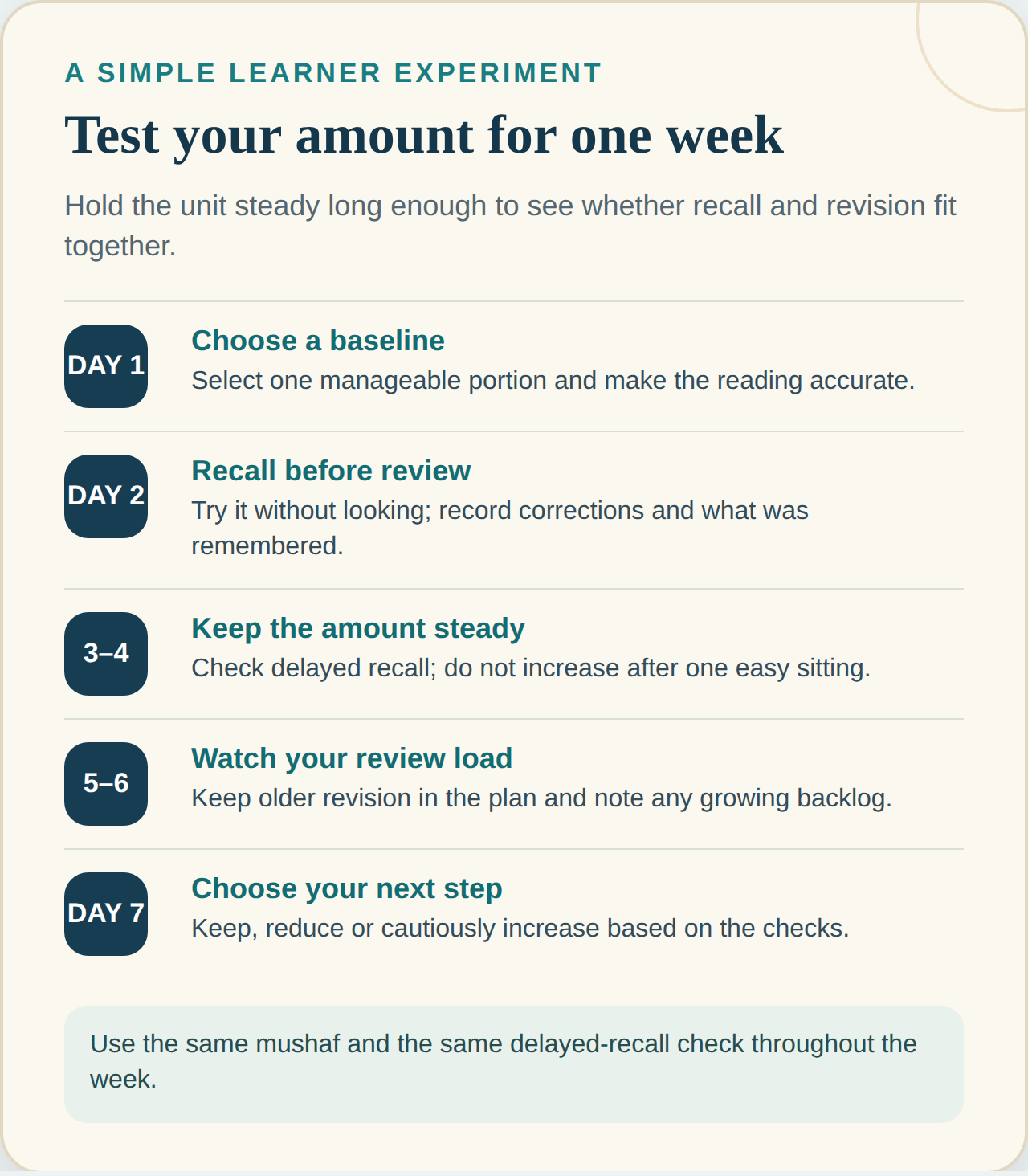
Use one week to learn whether your starting unit fits. This is not a contest and it does not promise a particular completion date. Keep the unit steady long enough to observe it. Record the new portion, whether you recited it without looking, what needed correction, and whether your planned revision was completed. Use the same check each day so you can compare like with like.
On the first day, select a manageable unit and recite it accurately with the mushaf. On the next day, try to recall it before reviewing it. Continue with the same approximate amount rather than increasing after one easy session. Midweek, check whether your review work is still on track. At the end of the week, decide whether to keep, reduce, or cautiously increase the amount. The 30-day Quran memorization planner offers a separate way to organize ongoing practice once you have a starting unit.
What do verse, line, half-page, and page targets mean?
A verse-based target is easy to describe but can hide a large difference in length. A line-based target is more comparable only if you use the same mushaf. A quarter-page or half-page target may suit a learner who already reads fluently and has enough time to revise. A full page should be treated as a workload to test, not a badge that proves stronger commitment.
Ask what the number requires from you. If a new portion takes the whole session and leaves no time for review, the target may be too large. If you can recite it accurately after a delay, complete revision, and still keep a normal routine, the amount may be worth continuing. The yearlong memorization plan can help with broader pacing questions; this article’s narrower question is how to choose the amount you begin with each day.
Some learners prefer a small portion of one long ayah; others find several short ayahs easier to connect. These choices should follow the structure and meaning of the passage, not an arbitrary line break. If you are unsure where to divide a passage or how to link sections, ask a teacher. When several similar passages are causing confusion, pause the increase in new material and work on one difficult transition at a time.
Know when to hold, reduce, or increase
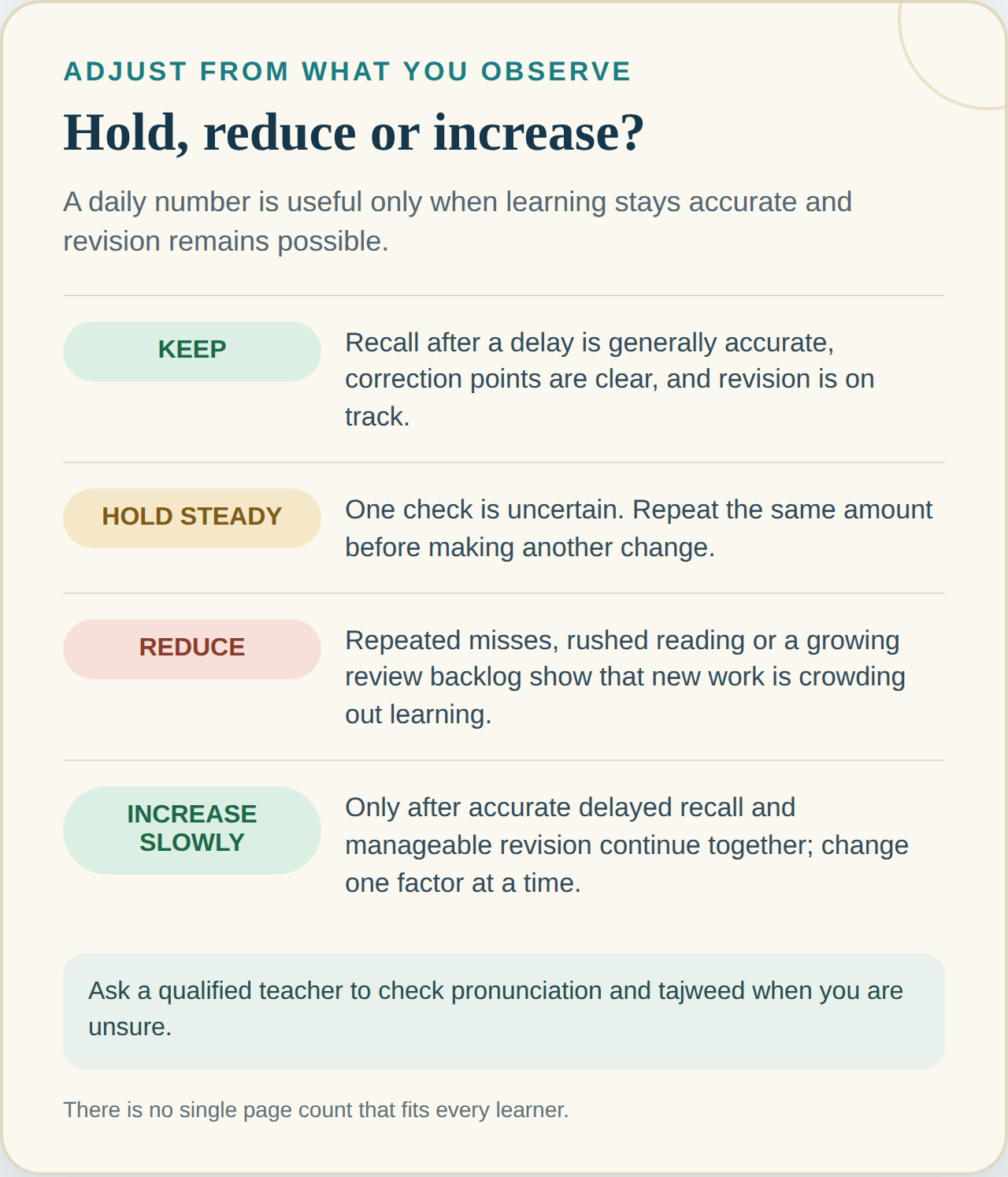
Keep the same amount when your delayed recall is generally accurate, correction points are getting clearer, and review remains manageable. Hold steady when one of those checks is uncertain. Repeating a stable amount for another week is a sensible decision, not a lack of progress.
Reduce the new portion when you repeatedly miss the same passage, when your review queue grows, or when you have to rush through reading just to meet a number. Return to accurate recitation, repair the specific weak joins, and protect your older memorization. A short self-test from a cue in the middle of a passage can reveal whether you know the sequence or only the opening; Quranytime’s random-start retrieval practice explains that kind of check.
Increase only after the current amount remains accurate across delayed checks and your review plan is still being completed. Make one small change at a time so you know what caused a difference. If you change the portion, study time, mushaf, and review method all at once, it becomes difficult to tell which part helped or made the work harder.
Keep the target connected to revision
New memorization is only one part of Hifz. As the memorized portion grows, review also takes more attention. Plan new work and revision together, rather than choosing a daily amount first and hoping the older material will fit around it. The general Quran memorization resource and the revision schedule can help you explore the wider practice. If you prefer to work with someone who can listen and help correct a manageable pace, you can book a free Quran and Arabic trial class.
The best daily amount is not the biggest amount you can attempt once. It is the portion you can learn carefully, check after a delay, and revisit without steadily neglecting what came before. Start small enough to be accurate, measure what happens across several days, and adjust from evidence in your own recitation—not from someone else’s page count.