

How to Stay Consistent with Quran Memorization
Hifz practice does not always fit neatly into the same part of every day. A work shift changes, a family responsibility takes longer than expected, or a passage needs more careful review. After one missed session, it can be tempting to wait until life feels settled before beginning again. A more useful definition of consistency is the ability to return. If you are wondering how to stay consistent with Quran memorization, start by identifying what interrupted your practice, then choose one realistic next step—without trying to repay the missed time.
This guide focuses on everyday obstacles and a calm restart. It does not prescribe a universal daily amount, study time, or finish date. Those decisions depend on your recitation, the strength of your review, and guidance from a qualified Quran teacher.
Consistency is a return skill, not a streak
A calendar streak can show whether you practiced on consecutive days. It cannot tell you whether the passage was recited accurately, whether older memorization received attention, or whether the plan still fits your life. So when a session is missed, treat it as information about the plan—not a verdict on your commitment. Ask what changed and what would make the next return easier.
It is natural to think, “I missed yesterday, so I should do twice as much today.” But a larger session can turn one interruption into a backlog. If that bigger task also feels difficult, it may be tempting to put it off again. The next session works better as a way back into careful practice, not a penalty for having a busy day.
If you are still deciding where to begin, Quranytime’s guide to starting Hifz and checking readiness covers that earlier step. The broader Quran memorization resource explains the learning process; here, the focus is what to do when your routine gets interrupted.
Name the barrier before changing the plan
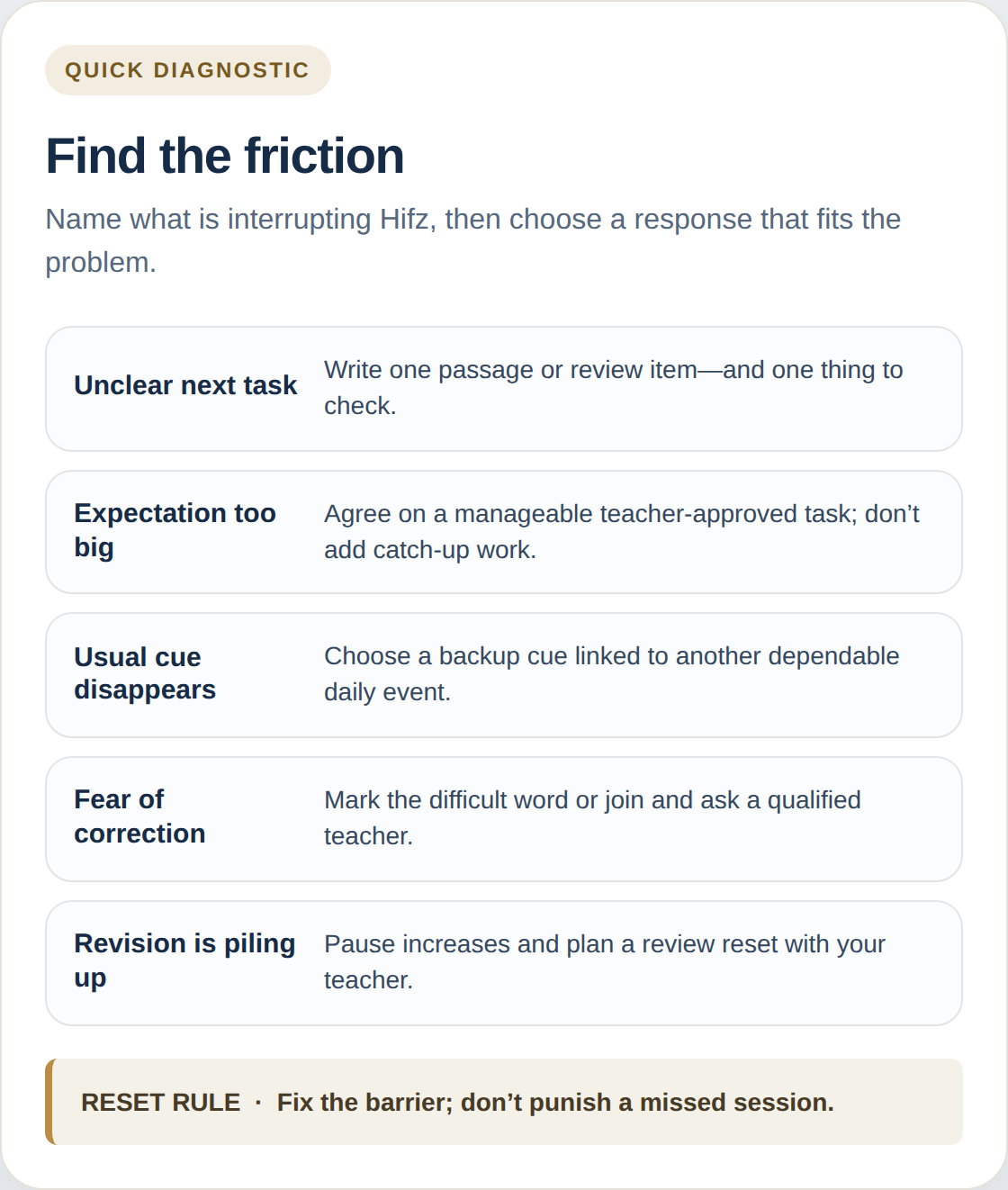
“I’m not consistent” can describe several different problems. The fix for an unclear task is not necessarily the same as the fix for a missing study cue or a growing review load. Before changing your goal, ask what actually got in the way: Was the next task vague? Did it take longer than expected? Did a change in your day remove your usual cue? Were you worried about making a mistake? Had review started to pile up?
- The next task is unclear. “Do Hifz” leaves several decisions for later. Write down the passage or review item you and your teacher chose, along with one thing to check as you recite.
- The expectation is too large right now. If a target repeatedly crowds out revision, it may not fit your current circumstances. Do not increase it to compensate for a missed session. If choosing an amount is the issue, use the separate guide to choosing a daily memorization amount rather than guessing.
- Your usual cue is gone. Work, family responsibilities, or travel can disrupt a routine tied to one specific time or place. Choose a backup cue linked to an ordinary event that still happens. If finding a study window is the main difficulty, see how to find a memorization time that fits.
- You are putting off correction. It can feel uncomfortable to discover an error, but correction is part of learning. Mark the difficult word or transition and ask a qualified teacher to listen, instead of trying to hide the uncertainty from yourself.
- Review is becoming hard to manage. When older passages are slipping, adding new material can make the load heavier. Pause any increase and discuss how to restore review. Quranytime’s Hifz revision guide explains why previously learned material needs deliberate attention too.
Make one if-then plan for the obstacle
Once you know what tends to interrupt practice, decide on a response before it happens again. Keep the plan simple: “If [specific situation] happens, then I will [one small next action].” For example: “If a family responsibility takes my usual study window, then at my next dependable cue I will complete the review my teacher assigned instead of adding new material.” Naming both the situation and the response leaves less to decide when the day becomes busy.
This kind of cue-linked plan is called an implementation intention. Gollwitzer and Sheeran’s 2006 meta-analysis reviewed 94 independent tests and found that these plans supported goal achievement across a range of domains. The research was not about Quran memorization, so it does not show that a particular Hifz routine works for everyone. It supports an if-then plan as a general planning tool, not as a promise or a religious rule. Read the meta-analysis on if-then plans and goal achievement.
Choose one fallback you can manage: review a secure passage, open the assigned text, or note a question for your teacher. It need not clear a backlog; it should make the next step easier to start.
| Plan element | Your prompt |
|---|---|
| If | What specific obstacle tends to interrupt practice? |
| Then, at this cue | What dependable event can remind you to return? |
| I will | What one teacher-approved task will you do next? |
| Afterward | Did the plan help? Adjust it without adding catch-up work. |
Missed a session? Restart without catch-up debt
After missing a session, resist the urge to move every unfinished task into the next one. Doubling the work can turn a short interruption into a queue that feels harder to face. Instead, use a reset that brings you back to careful, supported practice:
- Drop the penalty. A missed day does not create a learning debt that must be repaid with an oversized session. Take your time with recitation; rushing to clear a checklist is not the goal.
- Reconnect with something secure. Begin with a passage you can recite carefully, or follow your teacher’s review assignment. If listening helps, try the deliberate listen–pause–check method, then see what you can recite without looking.
- Choose one next task. Pick a passage or correction point rather than tackling the whole backlog. If new memorization is suitable, return to what your teacher agreed; if review needs attention, protect that first.
- Make the next return easy to locate. Write down the task and link it to a dependable cue. Your teacher can also help check recall from a different starting point; the random-start retrieval guide describes one way to do that.
The aim is sound practice, not recovering an imagined streak. After a longer break, begin with what you can currently recite accurately and ask your teacher what needs review before adding anything new.
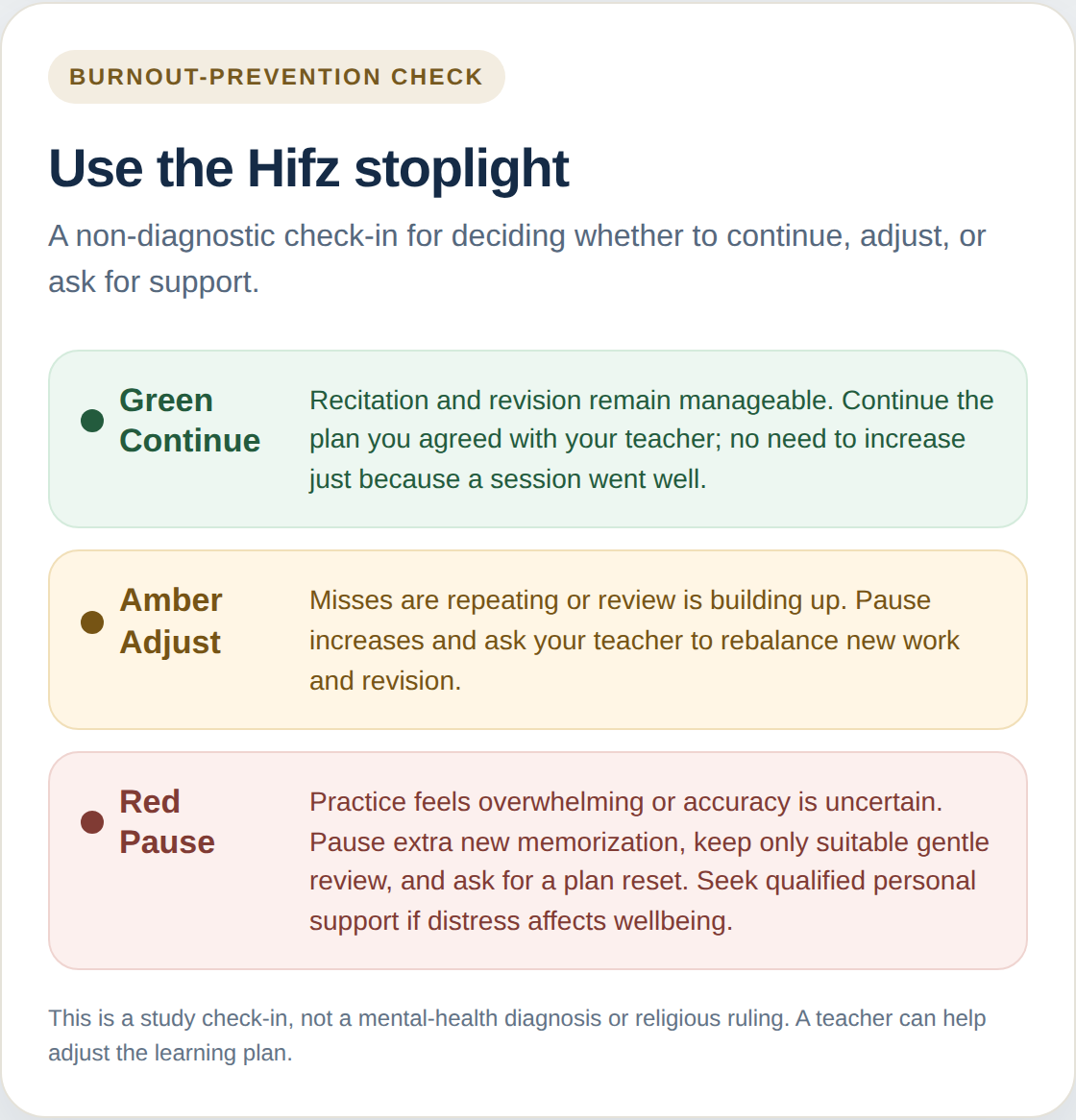
If you are unsure whether to continue, reduce, or pause new memorization, use the stoplight below as a check-in—not a diagnosis or religious ruling. If distress keeps affecting your wellbeing, seek support from someone qualified to help.
Protect revision when life becomes crowded
A demanding week may call for a different balance than a quiet one. If review has begun to slide, ask whether to pause new memorization, keep a manageable connection with revision, or request a temporary reset. A smaller, accurate session may help you stay connected better than repeatedly setting a longer target that does not fit. This is not a formula for every learner; a teacher who knows your recitation can help choose an appropriate balance.
If you need help choosing a study window, the time guide above compares options; the amount guide covers what to learn. Quranytime’s overview of Hifz techniques can support a discussion with your teacher. Before changing methods, check whether the real obstacle is time, task clarity, correction, or review load.
As you return to a passage, notice which lines come confidently and where you hesitate. A passage may feel familiar with the Mushaf open yet be harder to start from memory. Use that as a cue to slow down and ask for feedback.
Know when to ask your teacher to reset the plan
Ask your teacher for help if the same obstacle keeps returning, you are unsure whether a mistake is in the wording or pronunciation, or new work leaves no time for revision. Share which task was hard to start, where you stumbled, and what changed in your routine. That gives you both something specific to adjust.
Before the conversation, note the passage, what you recalled without looking, where you hesitated, and the question you want to ask. This is not a score; it gives you both a clear starting point.
If you would like help checking your reading and choosing an appropriate next step, you can book a free Quran and Arabic trial class. A supportive assessment should clarify what to work on without promising a fixed pace or treating every learner alike.
Build a practice you can return to
When Hifz becomes difficult to keep up with, make the next task clear, fit it to your circumstances, and decide what you will do when a familiar obstacle appears. If you miss a session, return without creating catch-up debt. If the same problem continues, adjust the plan with a qualified teacher instead of blaming yourself or increasing the load blindly.
Consistency in Quran memorization does not require a perfect calendar. It comes from careful recitation, honest review, and knowing how to begin again. Choose one barrier to address today and prepare one response. The next workable return—not an unbroken streak—is a better sign that your plan is starting to fit.