
If you are over 40 and thinking about Hifz, it is easy to wonder whether you have left it too late. A more useful question is: what is a sensible place for me to begin, given my reading, responsibilities, and the time I can actually protect? “Hifz for adults over 40” is not one single learning situation. Some adults are opening the Qur’an with a teacher for the first time; others read fluently but are new to memorization; some are returning to passages they learned years ago.
Your age alone cannot answer how quickly you will progress or which routine will suit you. This guide is not a promise of a finish date or a medical assessment. It is a calm way to choose your next learning step, ask for useful teacher feedback, and make room for Hifz alongside the life you already have.
Start with your current learning point—not a comparison
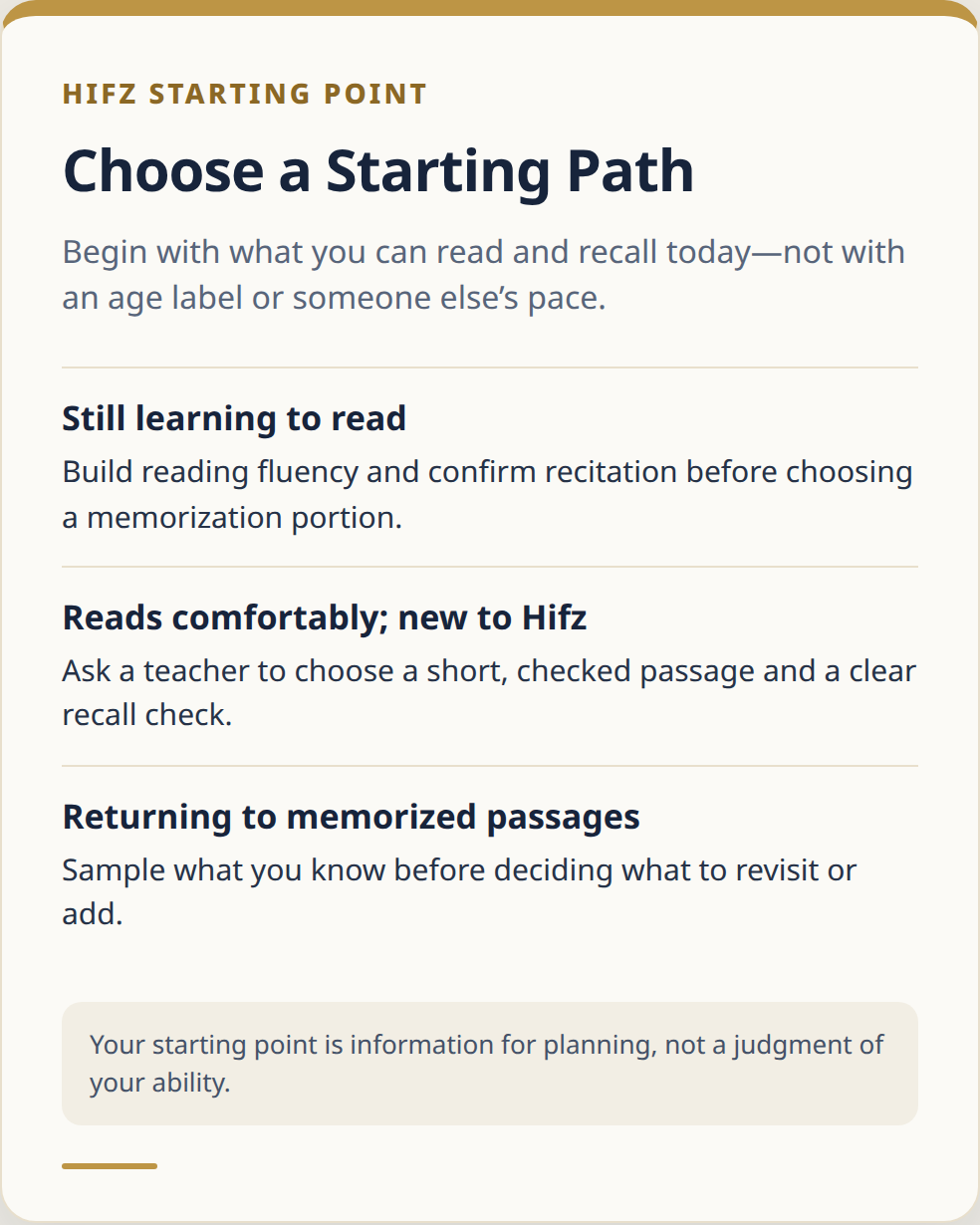
Before choosing a target, separate three skills that are easy to blend together: reading the Arabic text, reciting it accurately, and recalling it without looking. A learner may be comfortable with one and still need support with another. That is not a failure; it simply changes what the first step should be.
If you are still learning to read, or often pause to work out a word, it may help to strengthen reading and recitation first while your teacher identifies suitable small passages. If you can read comfortably but have not memorized before, you can ask for a teacher-confirmed first portion and a clear way to check it. If you are returning after a long break, take a gentle sample of what you already know before assuming you must start from zero. Quranytime’s guide to checking readiness and taking first Hifz steps explains how to discuss that starting point with a teacher.
If reading comfort is your first concern, see the accessible Quran study guide for seniors. For adult support in reading, Tajweed, or memorization, review Quranytime’s adult Quran classes.
Make the first assessment small and specific
A helpful first conversation with a teacher does not need to be a test of your worth or potential. Bring a short sample of what you can read now, mention any passages you already know, and explain what tends to interrupt practice. Ask the teacher to help you distinguish reading corrections from memory gaps. Those are different problems and should not be solved by simply adding more repetition.
If you are unsure what you remember, mark passages in three simple groups: “comfortable,” “needs a prompt,” and “not sure yet.” These are working notes, not grades. The aim is to avoid spending all your effort reviewing material that is already secure while overlooking the passages that need guidance. A teacher can check whether your sample is accurate and help you choose what to revisit first.
Some adults worry that they must become a perfect reader before they can begin memorizing anything. In practice, the right sequence depends on the learner and on the passage. Ask a qualified Quran teacher to confirm the reading and pronunciation needed for your next step, especially where you are unsure. If reading errors are taking most of your attention, strengthening that foundation first can make later Hifz less frustrating. If your reading is steady, the teacher may suggest a modest memorization portion while you continue correcting details.
Plan around real responsibilities, not an imaginary free week
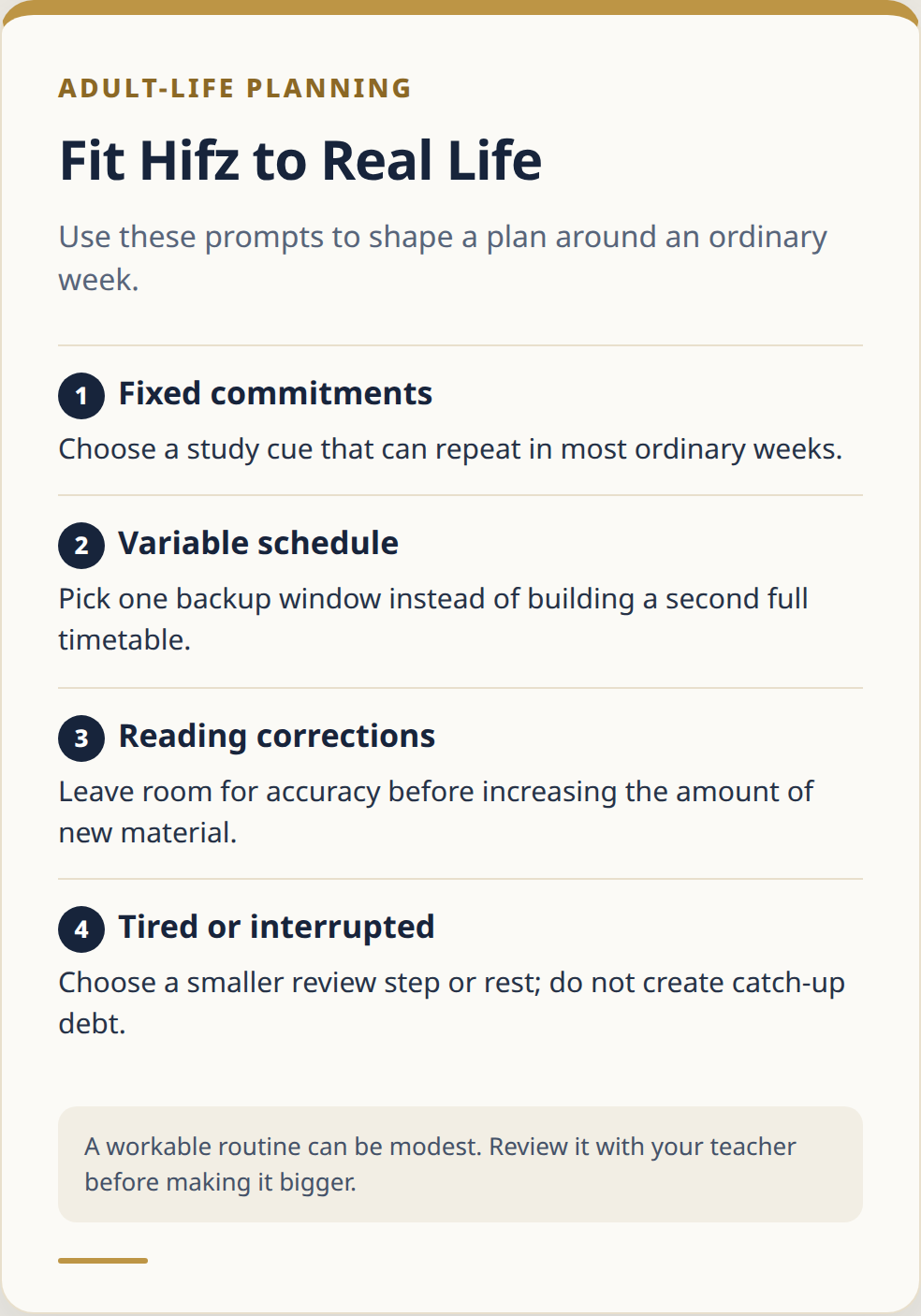
Many adults are balancing work, caregiving, health appointments, travel, or several responsibilities at once. A Hifz routine does not become more sincere because it ignores those commitments. Instead of waiting for a completely quiet season, look at a normal week and ask which window survives most often. If the week changes from day to day, choose a dependable cue—after a regular prayer, before a familiar task, or at the end of a workday—and keep one backup option.
Write down the practical limits that affect you: fixed commitments, the times you can concentrate, whether reading corrections slow a session, and what happens when family needs interrupt. Then decide what kind of session fits. A short, focused lesson may be more workable than setting a large amount that only fits on an unusually quiet day. Do not copy someone else’s pages-per-day figure. If you want help choosing an initial amount, use the separate guide to selecting a daily memorization portion as a companion, not as a rulebook.
For the structure of new learning, recent review, and older review, adapt the weekly Hifz plan for beginners with your teacher. It is a framework to adjust, not a schedule everyone must copy. If you are deciding when a practice window fits, the article on finding a Hifz time that suits your day offers a way to compare options without claiming that one hour is best for every learner.
Let the learning method stay simple
When your teacher has confirmed a passage and its reading, give new memorization and review separate attention. Read the passage accurately, learn a manageable part, then try to recall it without the page before checking. Return to it on later days rather than relying only on one long session. If you are unsure what “manageable” means, start with the teacher’s recommendation and use your own recall and correction notes to decide whether to hold, reduce, or gradually increase it.
A 2022 review in Nature Reviews Psychology summarizes research on spacing and retrieval practice across learning domains and across the lifespan. That research is not a Quran memorization study and does not give a fixed Hifz pace for adults over 40. It can support a modest general principle: space practice over time and include attempts to recall, then check and correct, rather than treating rereading alone as proof of memory. The review is available here: The science of effective learning with spacing and retrieval practice.
Keep the working record uncomplicated. Note the passage, the date you revisited it, and the one thing you need to check next time. A record can save you from spending the whole session deciding where to begin. If tracking feels helpful, the article on measuring Hifz progress beyond page counts offers a separate method for recording recall and correction signals.
What to ask your teacher before you settle into a routine
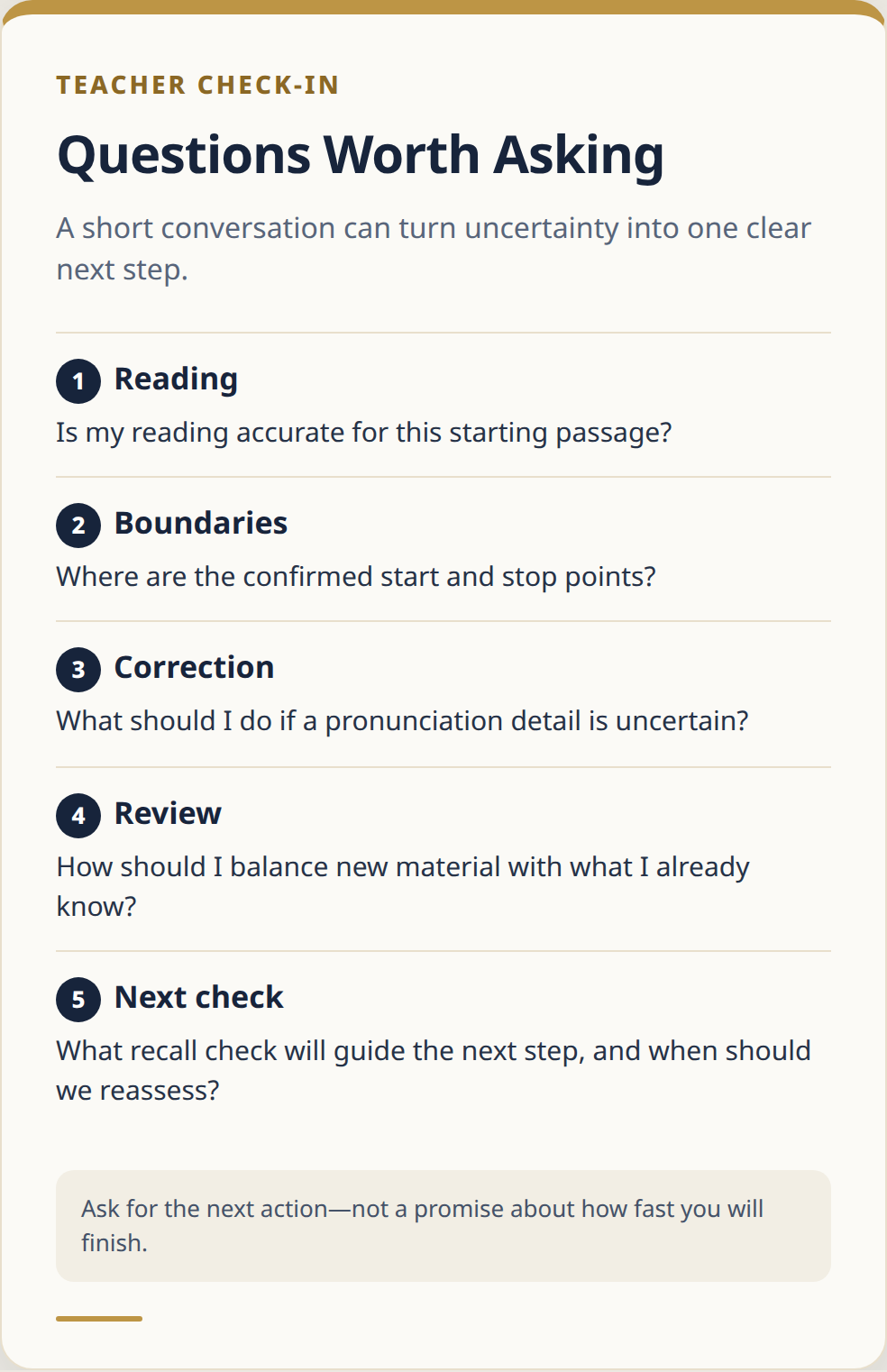
Good teacher guidance matters at every age, but adults sometimes hold back questions because they worry they should already know the answer. You do not need a perfect plan before you start. Bring practical questions and agree on one next step. For example, ask which passage is appropriate to begin with, where to start and stop, which pronunciation detail to watch, and how you will know when it is ready to be reviewed again.
If your schedule is interrupted, avoid treating every missed session as a debt to repay. Return to the smallest useful next step, and ask whether review or new memorization should come first. Quranytime’s guide to staying consistent with Quran memorization focuses on restarting without turning a missed day into an oversized catch-up session.
Common worries—and a grounded response
“Is it too late to start Hifz after 40?”
Age by itself cannot tell you what is possible for a particular person or how long a goal will take. Your reading, prior experience, available time, teacher support, and review needs are more useful things to assess than a comparison with another learner. Begin with a teacher-confirmed next step and reassess from what you can actually recall.
“How much should I memorize each day?”
There is no single amount that fits every adult. The starting portion should be small enough for accurate reading and review to remain possible. If it repeatedly crowds out revision or leaves the passage uncertain, ask your teacher whether to reduce it before increasing again.
“What if I already know some surahs?”
Do not assume you have to relearn everything, and do not assume every familiar passage is secure. Sample what you know, note where you hesitate, and ask a teacher to help sort stable material from passages that need focused revision. Your first goal may be to strengthen a foundation rather than add new pages.
“What if my memory worries me beyond Hifz?”
Normal study mistakes are not a diagnosis. If a change in memory worries you in daily life as well as during memorization, discuss that concern with a qualified health professional instead of trying to solve it by increasing study time or changing your target alone.
Choose one next step
Starting Hifz after 40 does not require an ambitious announcement or a perfect timetable. Begin by identifying your current reading and memorization point. Ask a qualified teacher to confirm the next passage and the support you need. Choose a study cue that survives an ordinary week, then review what actually happened before making the plan bigger. The aim is not to race another learner; it is to build a careful practice that respects your responsibilities and keeps the Qur’an learning itself at the center.
If you would like help identifying a suitable starting point, you can book a free Quran and Arabic trial class and discuss your reading, recitation, and Hifz goals with a teacher.