
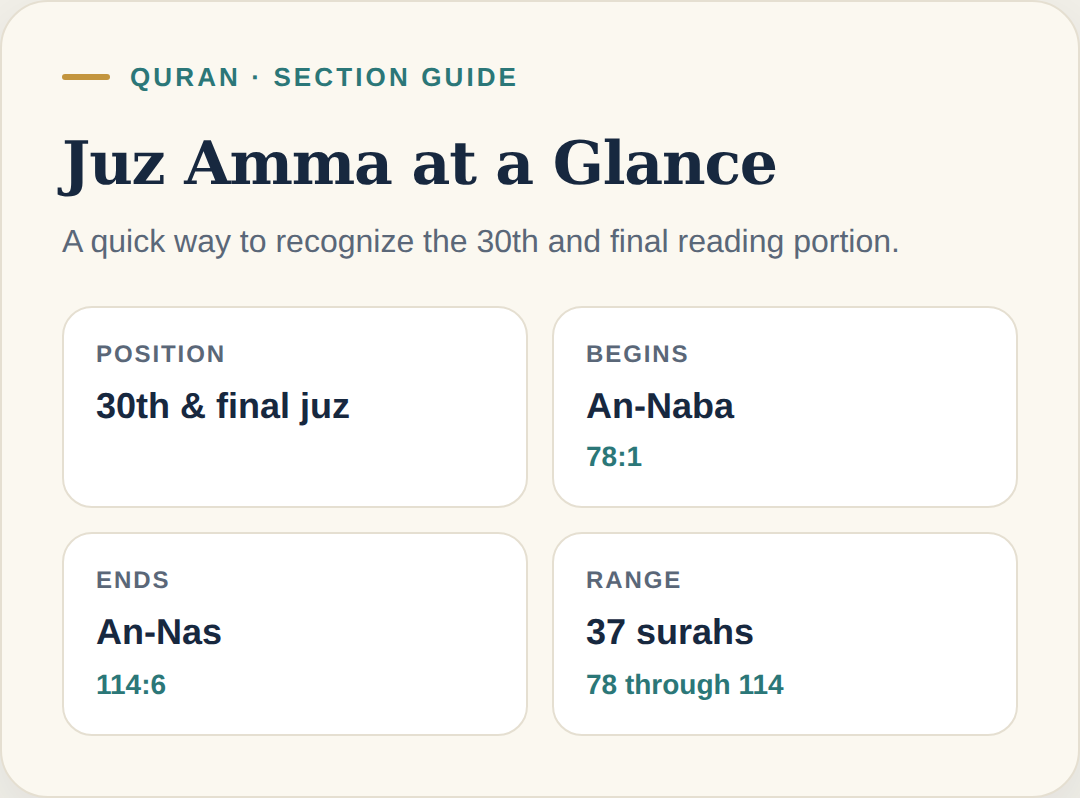
If you have heard Juz Amma mentioned in a class, a Quran app, or a study plan, you may wonder whether it is the name of a surah. The quick answer to “What is Juz Amma?” is that it is the thirtieth and final juz, or reading section, of the Quran—not a separate surah. It begins at Surah An-Naba (78:1) and ends at Surah An-Nas (114:6). Those references help you find the same section even when page numbers differ between Mushafs or apps.
The familiar name comes from the opening word of An-Naba. The section includes the surahs numbered 78 through 114, a total of 37 chapters. That range is more useful than memorizing a page number: in another printed edition, the page layout may change while the surah and ayah references stay clear. Tanzil’s Quran metadata reference explains how its dataset records surah names, numbers, verse counts, and starting positions, which are useful for checking these chapter references.
What Juz Amma is—and what it is not
The Quran is divided into 30 traditional reading portions called ajza’ (singular: juz). Juz Amma is the last of those portions. A surah, by contrast, is a chapter with its own name and number. A juz can include whole surahs, parts of surahs, or a combination. Juz Amma is easy to locate because its first boundary is at the start of An-Naba, and its last boundary is at the end of An-Nas.
It is not a thirty-first surah, a separate book, or a promise about how quickly someone can memorize it. It is a way to identify a portion of the Quran. That distinction matters when you hear “read one juz,” “revise Juz Amma,” or “memorize a surah from Juz Amma.” The first phrase refers to a reading division; the latter phrases may describe different study tasks. The division itself does not prescribe a daily amount, a memorization order, or a finish date.
Nor does “Juz Amma” mean a fixed number of printed pages. Page counts depend on the Mushaf’s script, size, margins, and edition. If a teacher gives you a page range, note which Mushaf or app they mean. When you want to find a passage again—or explain it to another learner—surah and ayah numbers are usually the more dependable reference.
Where does Juz Amma start and end?
Its opening point is the first ayah of Surah An-Naba: 78:1. The final surah in the section is An-Nas, number 114; Juz Amma finishes at its sixth and final ayah, 114:6. Put together, the span is often written as 78:1–114:6. The familiar word “Amma” comes from the start of An-Naba, not from the name of a separate chapter.
There are 37 surahs in that numbered range. Their lengths and page appearances vary, so the number “37” is a count of chapters, not a measure of how much time a learner needs. It is also a mistake to assume that every surah in this juz is equally short, equally familiar, or equally easy for every reader. If you are choosing a passage, look at the specific surah and ayat rather than relying on a broad label.
This range gives you two reliable landmarks. If you are starting at the beginning, look for An-Naba 78:1. If you are checking the final boundary, look for An-Nas 114:6. A bookmark, lesson note, or digital search can then point to the same location without depending on page numbering.
How to find Juz Amma in your Mushaf
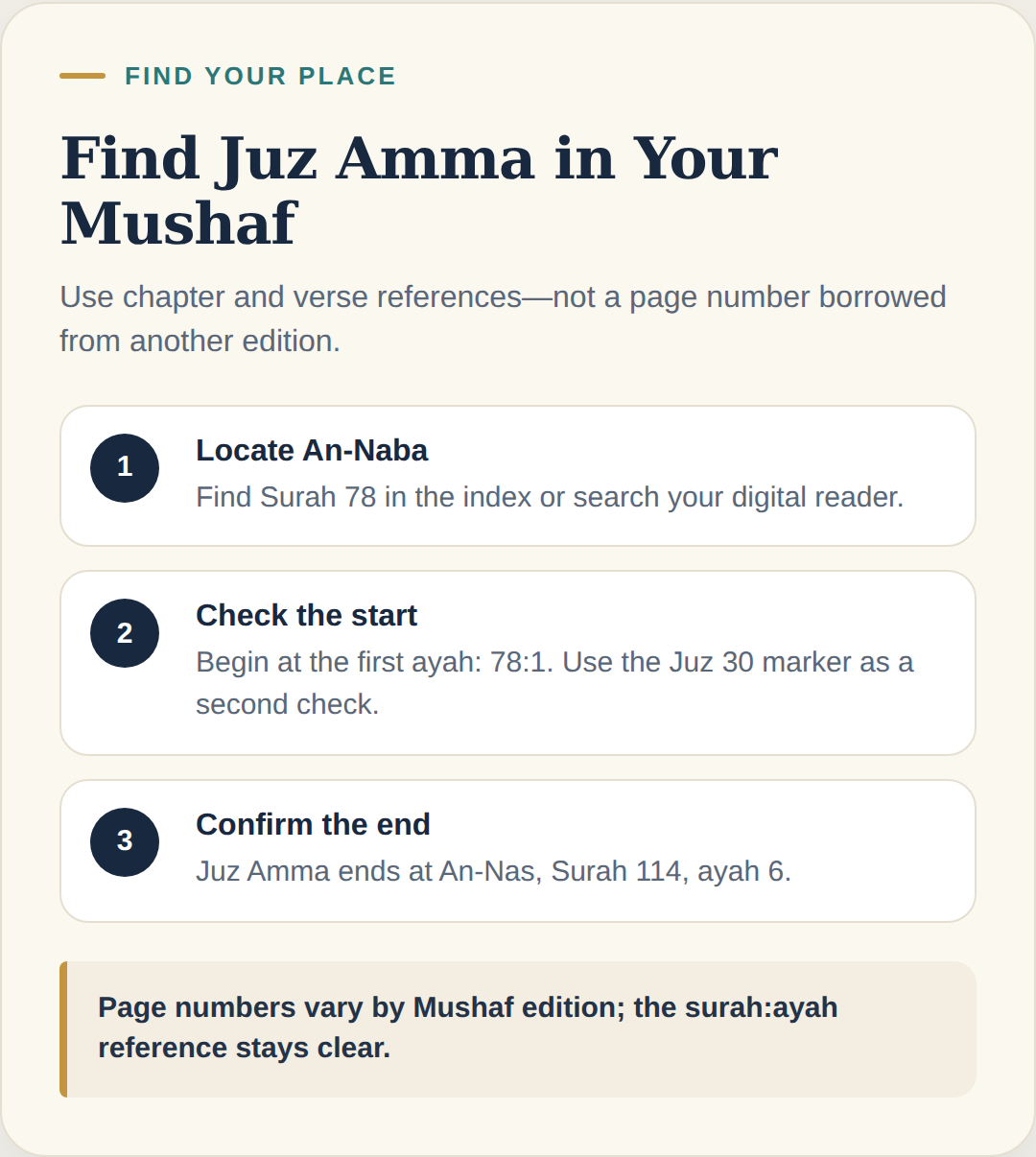
In a printed Quran, begin with the surah index or table of contents and find An-Naba, chapter 78. Open to the surah heading and check that you are at its first ayah, 78:1. Many Mushafs also mark juz divisions in the margin, but the design and placement of those signs can differ. If your copy has a marker for Juz 30, use it as a second check rather than relying on decoration alone.
In a digital reader, you can often search for “An-Naba,” enter the reference 78:1, or choose Juz 30 from a navigation menu. To confirm where the section ends, navigate to An-Nas (114) and its sixth ayah. If you are following a teacher’s page-based assignment, check the edition or app version before copying the same page numbers into a different Mushaf.
New readers may find it useful to learn the parts of a page before following a longer plan. Quranytime’s guide to reading a Quran Mushaf page explains common page features, while the guide to juz, hizb, and rubʿ divisions explains how those reading markers relate to one another. You do not need to identify every symbol at once; start by being able to locate the surah name and ayah number.
Juz, surah, and hizb: a simple distinction
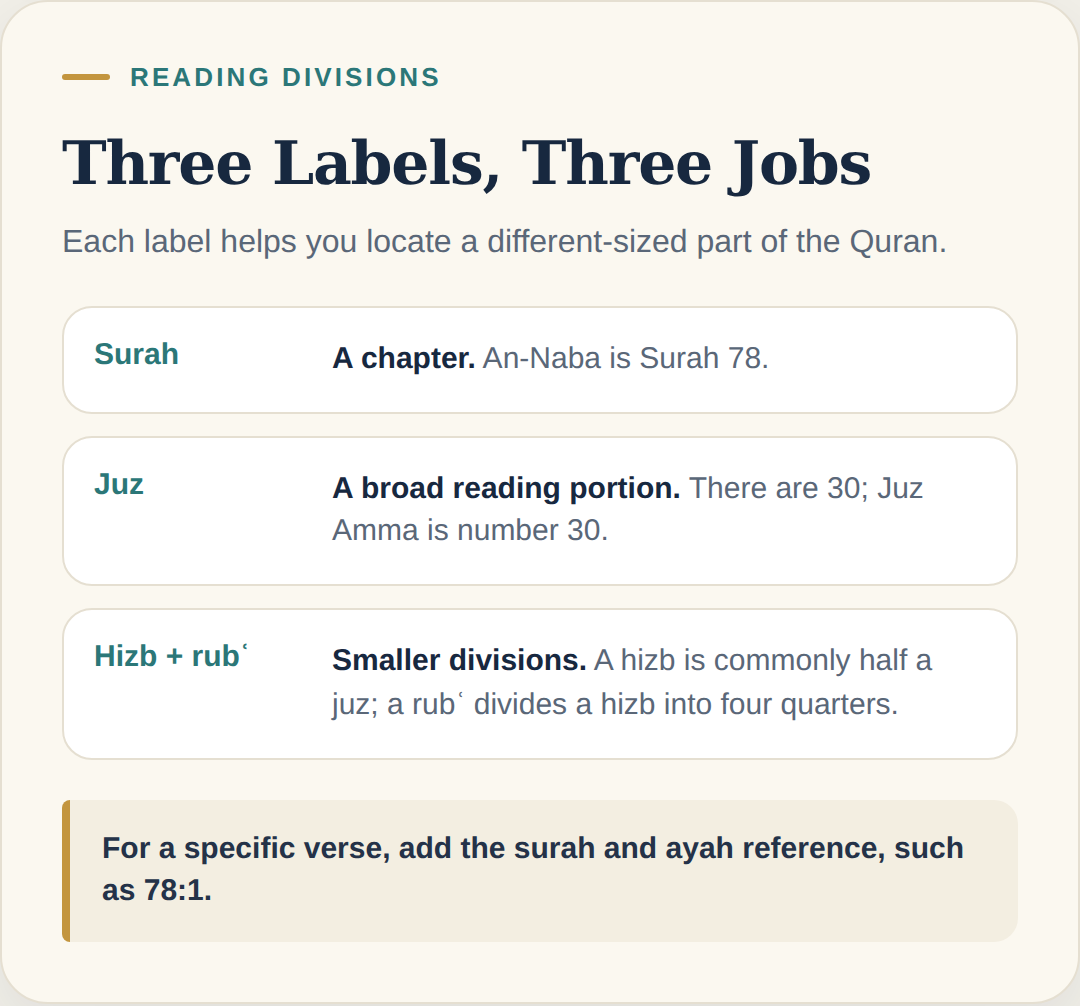
These labels answer different questions. A surah tells you which chapter you are reading. A juz identifies one of the Quran’s 30 broad reading portions. A hizb is a smaller division—commonly one of two sections within a juz—and a rubʿ al-hizb divides a hizb into quarters. The exact visual marker may look different between printed copies, but the labels refer to different levels of organization.
For example, “An-Naba” names a surah, “78:1” identifies a specific starting ayah, and “Juz 30” identifies the broader reading section that contains it. If a schedule says “read a quarter hizb,” that is a smaller portion than a whole juz. Knowing which label your teacher or app used can prevent a common mix-up: confusing a chapter reference with a page or section marker.
Juz and hizb divisions are practical navigation tools, not a statement that every reader must study in the same-sized daily portions. A learner may use a surah boundary, an ayah range, or a printed page for a session. In your own notes, write both the surah:ayah reference and any page range your teacher assigned.
Can you use Juz Amma as a memorization goal?
You can use it as a clear long-term boundary, but the label alone does not tell you how much to memorize in a week or which surah to learn first. Learners differ in reading fluency, available practice time, previous memorization, and the amount of revision they need. Before setting a large target, make sure you can read the chosen passage accurately and ask a qualified teacher to advise on recitation and Tajweed questions.
If you do choose Juz Amma as a portion to work through, identify what you already know and decide how you will track new material separately from revision. A manageable plan should leave room to revisit earlier passages; a fast calendar target is not the same as reliable retention. Quranytime’s Hifz calculator lets you enter a target that matches the page layout in your own Mushaf. Its estimate is a planning aid, not a guarantee. You can then adapt a sustainable memorization plan or a weekly Hifz routine to your actual schedule.
Listening can also help you follow a passage, but it should not replace checking your own recitation. Quranytime’s Quran recitation listening practice offers a structured way to listen, pause, and repeat; the Quran Tajweed learning path is a next step when you need guidance with reading rules. When you test what you have learned, use a clear reference and a fair recall method, as described in how to test Quran memorization accurately.
If you are unsure whether to begin with reading fluency, Tajweed, or Hifz, you can discuss your starting point in a free Quran and Arabic trial class. The useful question is not whether everyone should memorize Juz Amma in the same way; it is what portion you can read, understand, and review carefully with the guidance available to you.
Common questions about Juz Amma
Is Juz Amma the 30th juz?
Yes. Juz Amma is the final, or 30th, juz in the common 30-part division of the Quran. It begins at An-Naba 78:1 and ends at An-Nas 114:6.
How many surahs are in Juz Amma?
It includes 37 surahs, numbered 78 through 114. That number counts chapters in the range; it does not tell you how many pages your edition uses.
How many pages is Juz Amma?
There is no single page count that applies to every Mushaf. Page size, script, and layout vary. Use the surah and ayah references to locate the portion, and note the edition when you write down page numbers.
Is Juz Amma always the easiest place to start memorizing?
Not for everyone. Some learners already know several short surahs, while others need to strengthen reading or Tajweed first. Choose a starting passage with a teacher or a plan that fits your current ability; the section name by itself does not set an ideal order or timetable.
In short, Juz Amma is a helpful way to name the Quran’s final reading section. Remember its two landmarks—An-Naba 78:1 and An-Nas 114:6—and use those references when page numbers do not match. Once you can find the section, you can decide whether you want to read it, revise familiar surahs, or work toward a longer memorization goal at a pace that allows careful practice.