
Quran recitation listening practice can be more active than pressing play and reading along. Try a short, audio-first cycle: listen without looking, write a careful attempt, reveal a checked text, compare one detail, then listen again. The aim is to connect heard sounds with written Arabic—not to guess a translation or grade your own tajweed.
This differs from listening to everyday Arabic conversation and from repeating a recitation aloud. For spoken dialogue, try Quranytime’s Arabic listening practice for beginners. For reciting along, see Quran audio repeat practice. This guide is for learners who want to make a written attempt before seeing the words.
Choose a short passage and a reliable text
Begin with a passage you know or are studying. One ayah, a phrase, or 10–20 seconds of audio is enough. A longer recording makes it harder to locate the sound that caused confusion. Keep normal speed at first. If the words are unfamiliar, replay the same small section rather than changing several things at once.
Decide what you will write. If you can read Arabic, make a rough Arabic-script transcript and mark uncertain letters with a question mark. If spelling is still new, note sound groups or use temporary transliteration as a memory aid. Do not treat transliteration as exact Quranic text; the goal is to compare what you heard with a verified written form.
Use a trusted mushaf or reference for the reveal. The Quranic Arabic Corpus documentation explains that its Quran text is vowelized and linguistically annotated. It can help check a written form or grammar question, but it does not certify pronunciation or replace a teacher. Quranytime’s Quranic Arabic Corpus guide explains how to keep text and morphology checks in context.
Before you start, write down the clip’s location and the time range you plan to practise. Keep separate space for what you heard and what the text shows. That makes it easier to compare one detail at a time and reduces the chance that the revealed Arabic will overwrite your first impression.
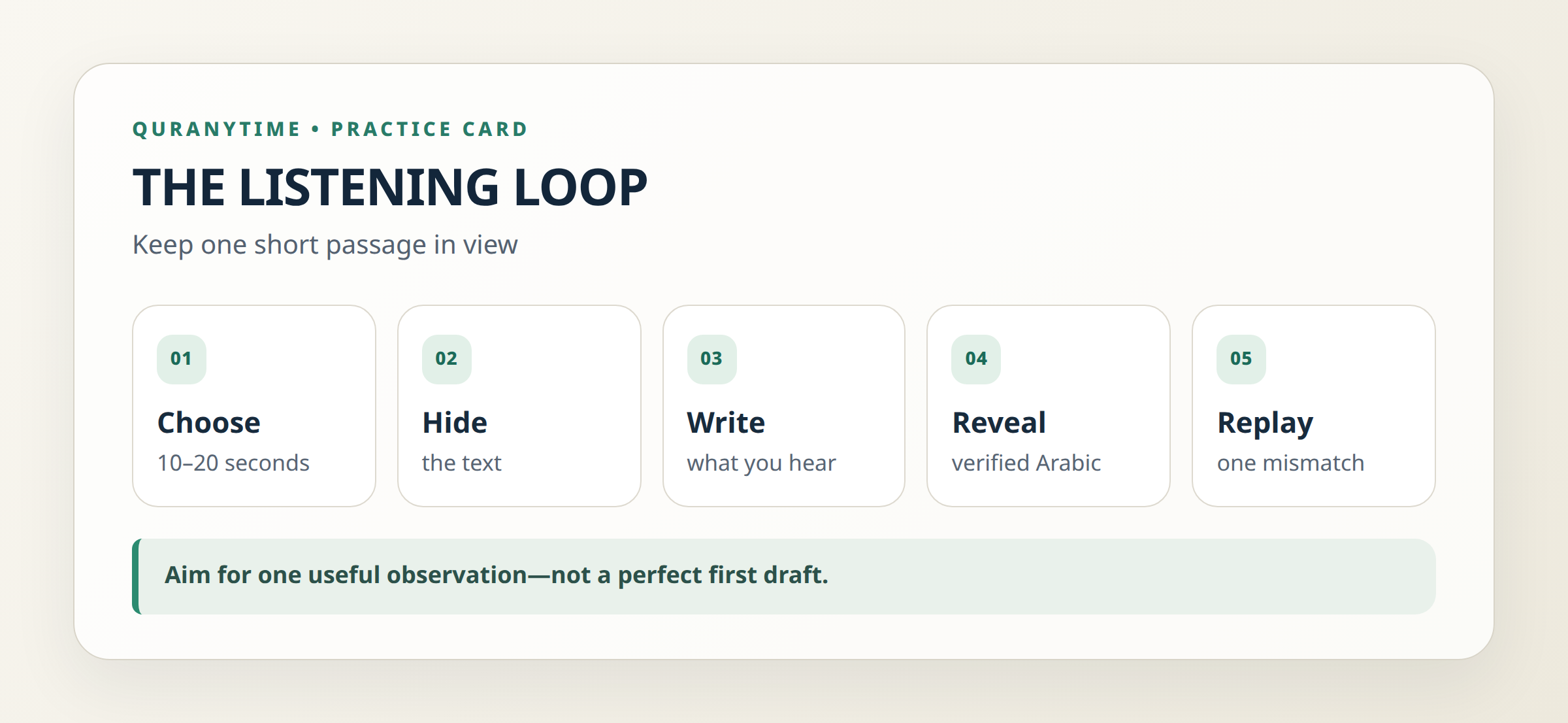
Use the listen–write–reveal cycle
- Listen once for the whole sound. Hide the screen or turn the device face down. Notice where the phrase seems to divide, which sounds you recognize, and where you lose the thread. This is a listening snapshot, not a test of your ability.
- Replay one small piece. Focus on a consonant, a long sound, a repeated word, or a pause. Leave unfamiliar parts blank. Replaying the whole passage may help you remember its general sound without identifying the part you want to check.
- Write a rough attempt. Use Arabic script if you can. Otherwise, jot down temporary sound chunks. Put a question mark where you are unsure; this separates observation from guess and gives you one place to revisit.
- Reveal the written text. Compare exact letters and word boundaries first, then look at vowel marks and other written signs. Keep your attempt visible so you can see what your ear supplied and what the text contains.
- Listen again while following the text. Connect each sound group to its written word. Note one mismatch, such as “I joined two words” or “I missed a consonant.” Then close the text and try the phrase once more.
If you are unsure where a word begins, mark a slash at your best guess. When you reveal the text, compare those boundaries first; connected recitation may not pause between every written word. Keep each replay on the same short section so you can compare the same sound, not a different part of the passage.
The goal is not a perfect transcript on the first try. You may recognize a familiar phrase but miss a word boundary, or hear a sound without knowing how to spell it. Record what happened without turning one example into a rule for every Quranic word.
Try the short video as a listening prompt
The clip below presents Ayat al-Kursi with Arabic text, an English translation, and transliteration. Hide the screen for your first listen, write a cautious attempt for a small section, then reveal the video and compare. The English can help check the broad topic afterward; it is not a word-by-word grammar explanation or a substitute for a trusted translation.
Check sound, spelling, and meaning separately
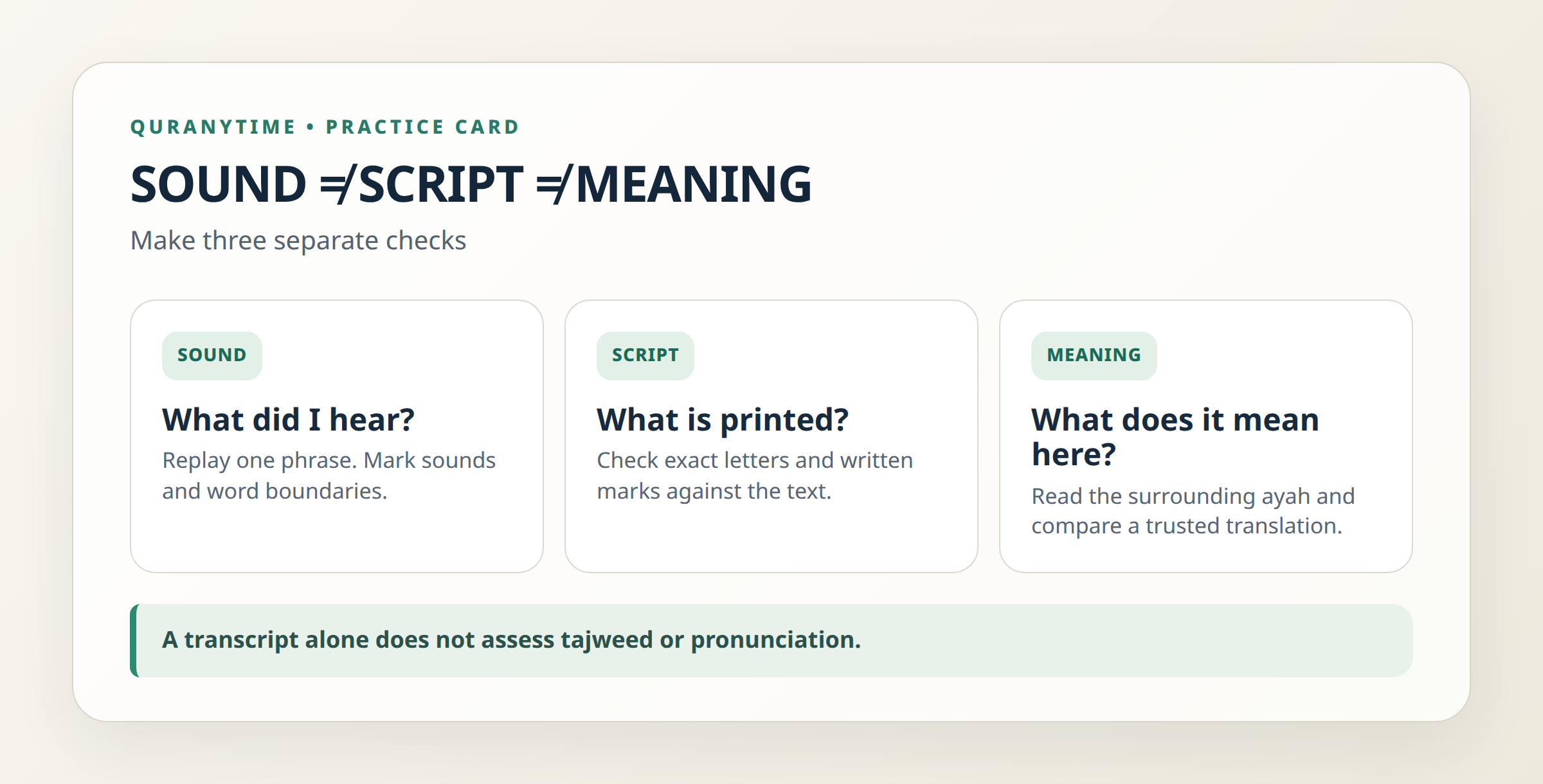
A listening attempt can reveal different questions. “Did I hear one word or two?” is about sound. “Which letters and marks are printed?” is about writing. “What does this phrase mean here?” is about context. “Am I articulating this sound correctly?” is about recitation. Each needs a different check; solving one does not settle the others.
Quranic Arabic is written with explicit vowel marks, while a learner’s notes may omit or represent them inconsistently. A recording also cannot show every visual convention in the mushaf. Do not infer every written detail from sound alone. Compare the word as printed, then replay to connect it with what you hear. If the form remains unclear, consult a suitable reference and return to the full phrase rather than treating one label as a complete interpretation.
For vocabulary, record only a word you can place in context. A Quranic Arabic vocabulary notebook can keep the verse reference, exact form, cautious gloss, and audio question together. For sentence structure, keep the surrounding words visible. The aim is to hear the phrase more accurately and understand it responsibly, not to build a final translation from a short clip.
Use translation as a later check
After comparing your writing, check the broad meaning with a translation you trust. Connect the phrase with its surrounding ayah rather than matching one English word to one sound. A translation can show that your first guess went in the wrong direction, but it does not represent every grammatical detail. Quranytime’s side-by-side method for choosing a Quran translation explains how to compare wording without treating a translation as the Arabic text.
To test comprehension, read the same ayah without playing the recording and explain what you recognize. Then try Quranytime’s Arabic reading-comprehension practice. This follow-up is text-first: it checks whether the words make sense in context after your listening attempt.
Keep a small review log
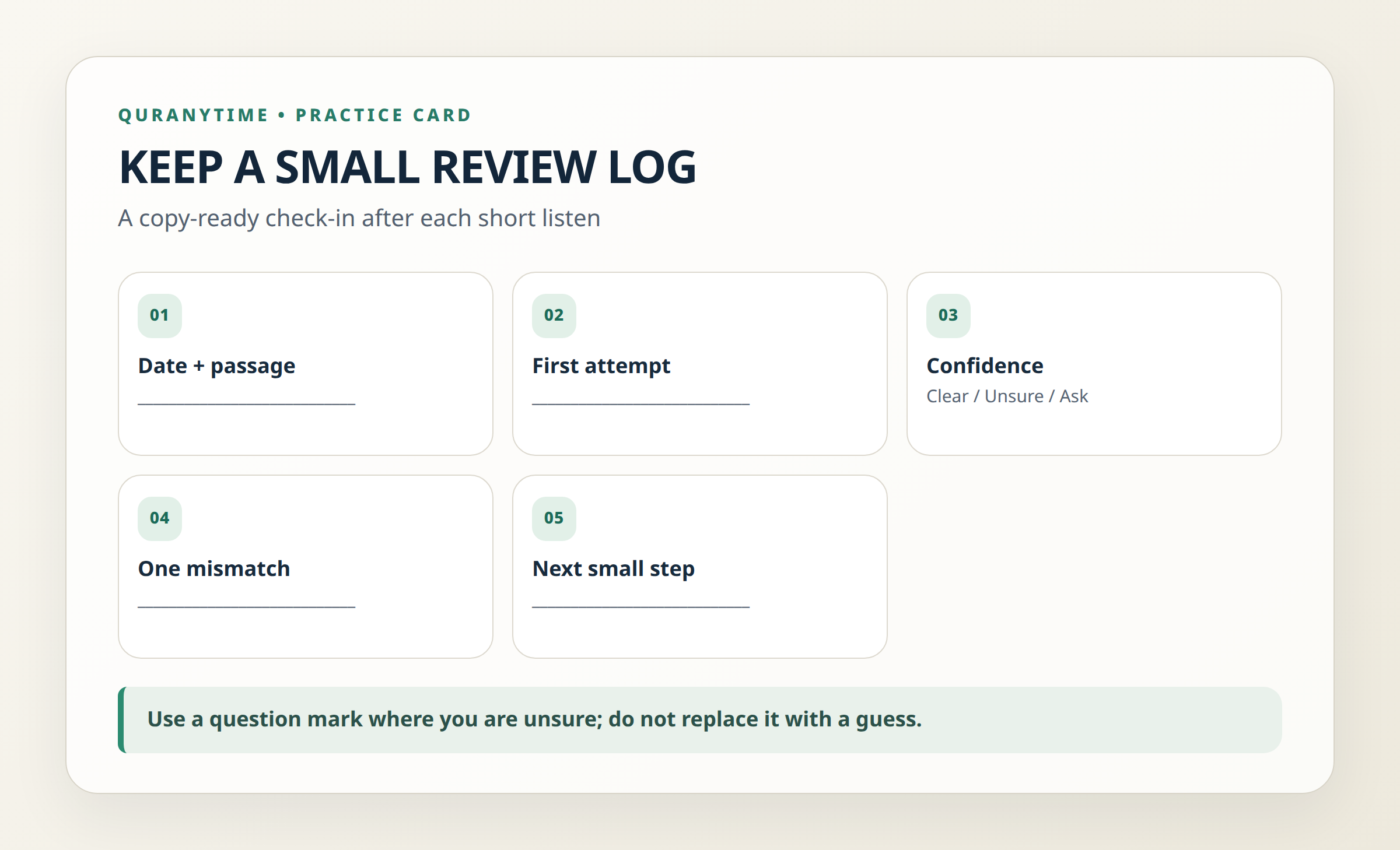
Record the date, passage, clip length, first attempt, and one mismatch. Add a confidence mark such as “clear,” “unsure,” or “need help.” At your next session, listen once before opening the note. If you repeat the same writing error, choose that feature for your next comparison. A short log helps you notice a change instead of merely copying the answer.
Use a simple note label: S for sound, W for writing, M for meaning, and T for a teacher check. If you missed a word boundary, focus on it next time. If you heard the sound but cannot write it confidently, keep the listening note and treat spelling as a separate question.
Use the log to choose what to do next, not to score yourself. If the issue is a familiar word, add it to your vocabulary notes. If it is spelling, check the written source. If it is a sound, ask a qualified teacher. A transcript cannot show by itself whether your articulation or tajweed is correct.
A practical ten-minute session
- Minute 1: choose a short passage and mark the audio segment.
- Minutes 2–3: listen without text, then write what you hear and mark uncertain parts.
- Minutes 4–6: reveal a checked text and compare one phrase, separating sound notes from spelling notes.
- Minutes 7–8: replay while following the Arabic, then listen once more without looking.
- Minutes 9–10: record one mismatch and one next step. Move on only if the first segment feels clear enough.
Keep the clip short enough to remember its sound while checking the text. If your goal changes to reading aloud, use a separate practice and avoid rushing. Quranytime’s guide to improving Quran reading fluency without rushing focuses on that different task.
Common mistakes to avoid
- Reading along on the first pass: the text can cue your ear. Hide it, then reveal it.
- Guessing a full word from one sound: leave a question mark and listen again.
- Treating transliteration as the answer: it is a temporary aid, not an exact record of Arabic spelling or Quranic marks.
- Confusing hearing with tajweed: a transcript checks writing, not articulation or recitation rules.
- Using translation to decide exact Arabic grammar: return to the Arabic and its context for a linguistic question.
- Practising too much at once: choose a short phrase you can compare carefully.
When to ask for feedback
Ask a qualified Quran teacher about a sound, articulation point, vowel length, pause, or tajweed rule. Bring the exact segment and your marked attempt. Quranytime’s guide to recording Quran recitation for useful teacher feedback can help you prepare a focused question. If you are unsure which level fits, book a free Quran and Arabic assessment class.
Keep the routine modest: listen first, write cautiously, compare with a checked text, and replay one small section. One clear observation—such as a word boundary you missed—is a better next step than assuming you understood the passage because it sounded familiar.