
Start with the kind of help you need
Searching for tafsir books for beginners can quickly become a debate about which title is “best.” A better first question is what you want a book to help you do. A reader still learning Arabic needs different support from someone who can read the text but wants context, vocabulary, or a closer look at scholarly discussion.
There is no single starter for every language, background, and study goal. Look for a book you can understand, identify who prepared it, and see what kind of explanation it offers. Then try a short passage before committing to a long series or large volume.
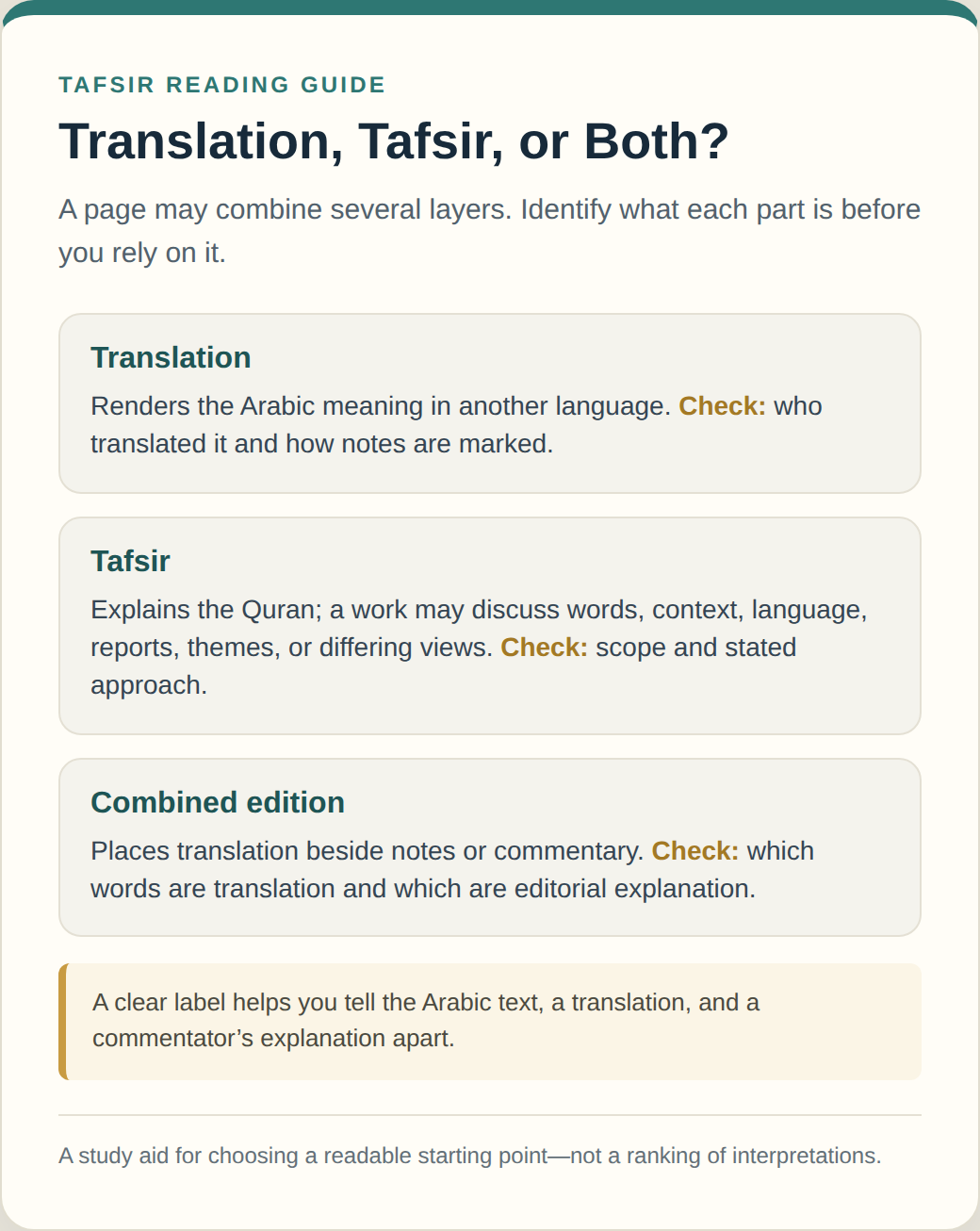
Translation, tafsir, and a combined edition are different
A translation renders the Arabic meaning in another language. It helps you follow a passage, but an English line is the translator’s rendering, not the Arabic Quran itself. If you compare translations, notice how each handles a difficult word or phrase. Quranytime’s guides to the role of Quran translation and English Quran editions can help you separate the text from its rendering.
Tafsir is explanation of the Quran. Depending on the work, it may discuss a word’s meaning, context, language, reports, themes, or differing interpretations. A University of Washington Libraries research guide describes tafsir as ranging from simple word definitions to complex discussions of differing views, and lists English-language resources without naming one universally best book. That range is a reason to check the scope of the edition in front of you: the university library’s Quran tafsir guide.
Some editions combine a translation with explanatory notes or commentary. That can be convenient, but check whether the page tells you which words are translation, which notes are editorial, and which passages are a commentator’s explanation.
What makes a tafsir beginner-friendly?
“Beginner-friendly” is not a mark of religious authority. It usually means the language, length, layout, and explanations suit your current level. A short text can still be difficult if it assumes prior knowledge; a longer one can be approachable if it defines terms and labels its notes clearly.
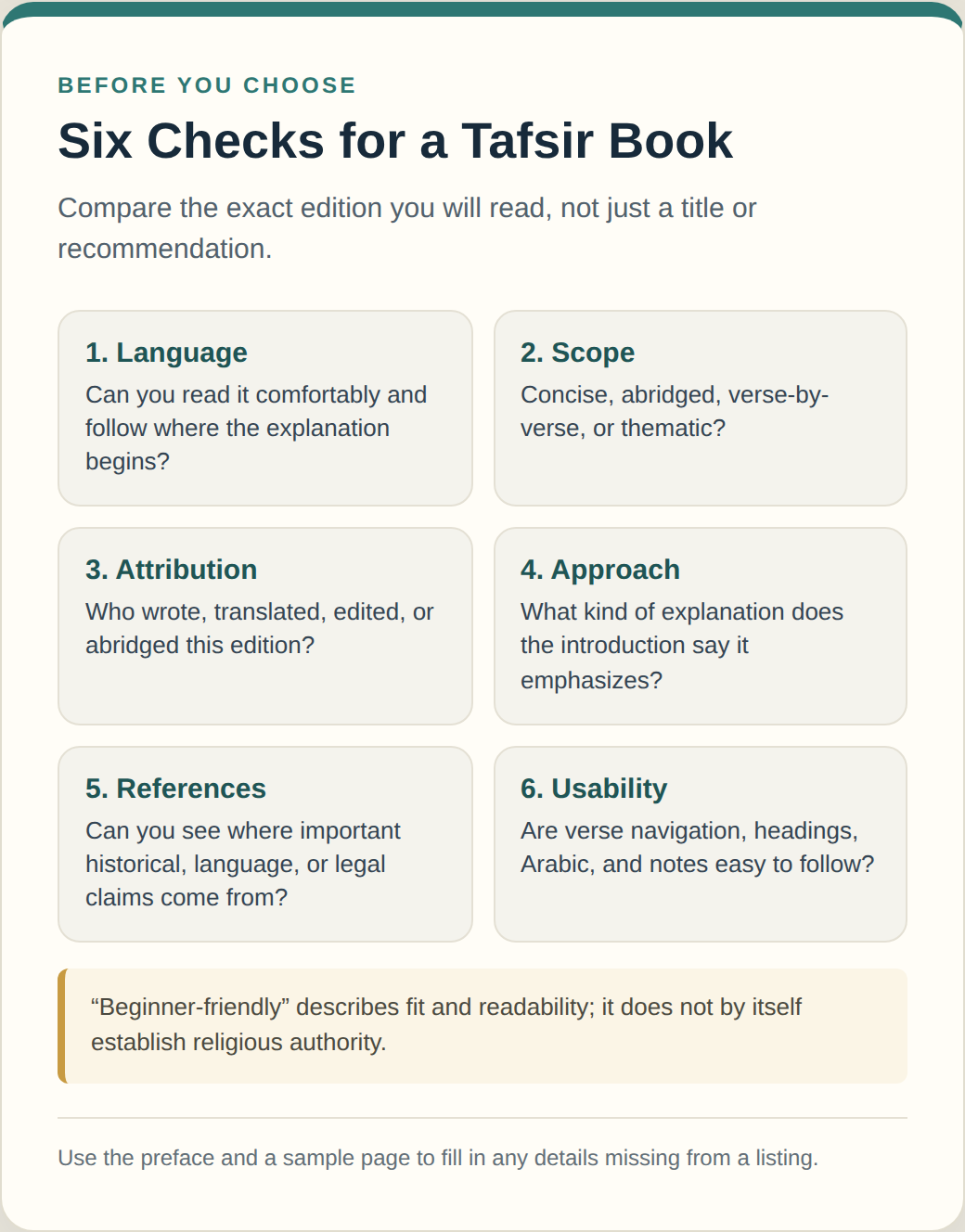
Before choosing, check six things:
- Language. Can you read it comfortably and tell where an explanation begins? If you are learning Arabic, a side-by-side layout may help; see Quranytime’s translation-selection method for Arabic learners.
- Scope. Is it concise, abridged, verse-by-verse, or thematic? An abridgement condenses a larger work, so look for an introduction explaining what was shortened.
- Edition and attribution. Check the author, translator, editor, and—if relevant—abridger. Two editions under a familiar title can differ in translation, notes, and editorial decisions.
- Approach. Read the book’s own description. Does it emphasize language, reports, legal questions, themes, or a combination? This helps you know its stated lens; it does not rank traditions.
- References. When a book makes a historical, linguistic, or legal point, does it show where the claim comes from? Notes help you investigate; they do not settle a question automatically.
- Usability. Can you find a verse quickly? Are headings, footnotes, and Arabic text readable? A crowded layout can make careful study harder.
Use catalogues to discover, not rank
A university library guide or catalogue can help you discover what kinds of translated resources exist, but its listing is not a personal recommendation. Before borrowing or buying, write down the exact title and edition, language, translator or editor, and stated scope. Then scan the preface and a sample page to see whether the text separates translation from commentary and explains its approach. If the edition is abridged, check who prepared the abridgement and whether it explains what was selected. Similar titles can appear in different translations and formats, so compare what is on the page, not only the name on a recommendation list.
To keep the choice practical, finish this sentence: “I want help with ___, and I can comfortably read ___.” Use those answers to narrow your sample. You can always explore a more detailed work later if your questions outgrow the first one.
Try a book on one short passage
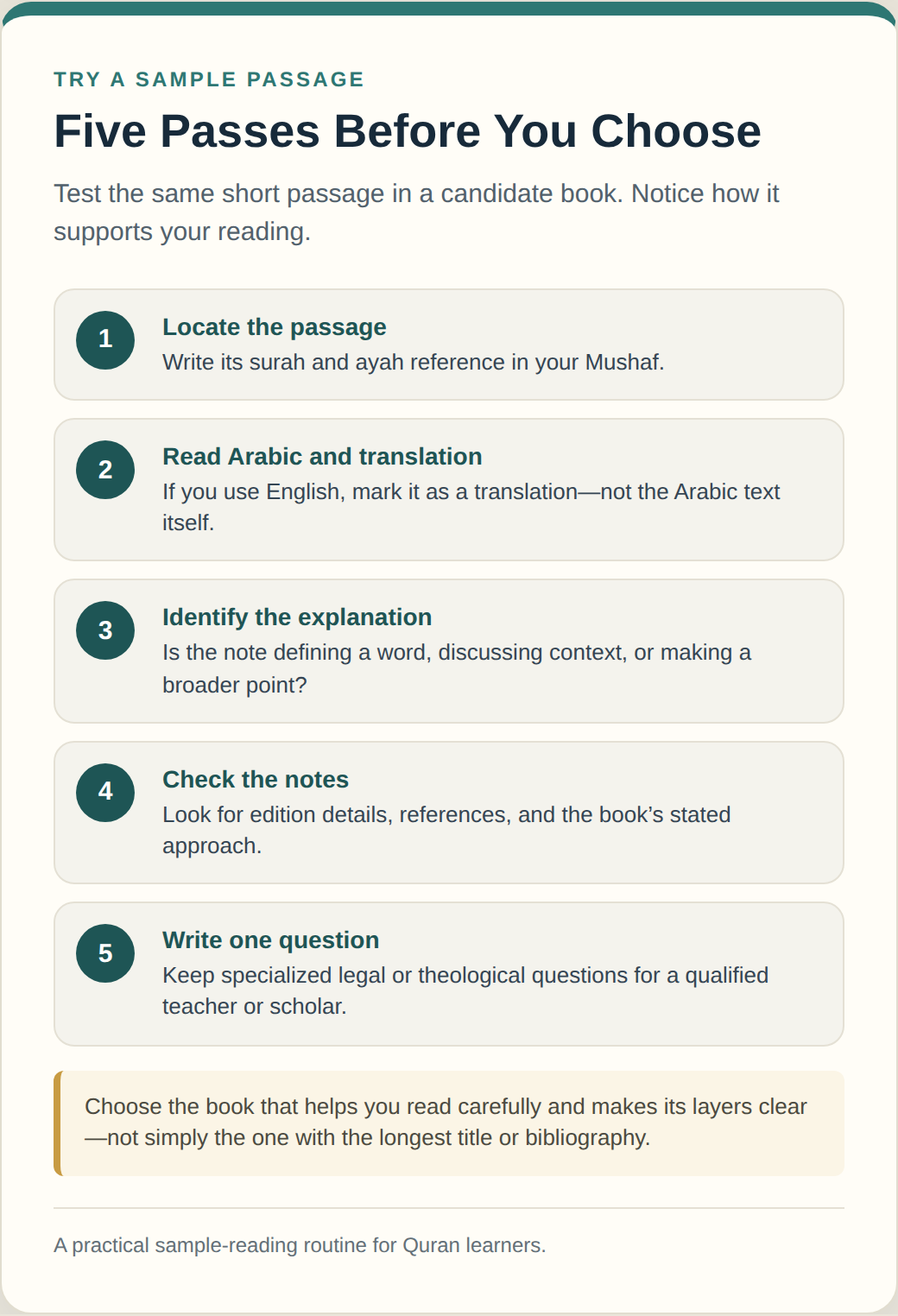
A contents page and a sample spread tell you more than a cover blurb. Pick a short passage you already know or are studying. Try the same routine in two candidate books. The point is not to settle an interpretation in five minutes; it is to see whether the book helps you read carefully and whether its layers are clear.
- Locate the passage. Note its surah and ayah in your Mushaf. Quranytime’s guide to reading a Mushaf page explains common navigation marks.
- Read the Arabic, if you can, then a translation. If Arabic is still developing, mark the English as a translation. For a learner-focused comparison, see this Quranic Arabic vocabulary notebook method.
- Read the tafsir note. Ask what it is doing: defining a word, describing context, mentioning a report, explaining grammar, or drawing a broader lesson? Summarize the type of explanation in your own words.
- Check a note or reference. A Quranic Arabic corpus can help with word-form lookup. That can support a language question; it is not a replacement for tafsir or qualified religious guidance.
- Write down one question. Note what remains unclear and whether it is about language, differing interpretations, or law and belief. For specialized questions, ask a qualified teacher or scholar rather than treating one beginner book as a personal ruling.
After the sample, ask: Could I tell what was translation and what was commentary? Did the book define its terms? Do I know which edition I used? Those are better early tests than fame or page count.
Choose for your current learning path
If you are new to Quran explanations, start with clear language and notes that do not assume specialist background. A concise book can be easier to use regularly, provided its introduction explains its scope. Keep a notebook of unfamiliar terms and questions; you do not have to solve every point in one sitting.
If you can read Arabic but use English for nuance, a bilingual or parallel layout may suit you. Compare a few passages because wording varies. A steady Quran study routine makes room for reading, reflection, and follow-up without trying to cover too much at once.
If you already have a foundation and want detailed discussion, look for an introduction, references, and a clearly stated approach. You can compare two explanations on one passage while recording the book, edition, and translator. Comparing is not collecting opinions at random: keep the passage in context and ask a qualified teacher when a difference matters for belief or practice.
Red flags worth slowing down for
Pause if a listing does not identify who translated or edited the text, if “complete” or “definitive” appears without a clear scope, or if translation and commentary are blended with no labels. Be cautious when an excerpt makes a sweeping claim about what all scholars believe but offers no references. These signs do not prove a book is unusable; they mean you should seek more information.
Also check whether a sentence is presented as the Quran or as an explanation. Look for the Arabic text and translator’s name when it is a rendering, and for an author or editor attribution when it is commentary. Quranytime’s overview of what tafsir means returns to that basic distinction.
Common questions
Is tafsir the same as translation?
No. A translation renders meaning in another language; tafsir explains the text. One edition may include both, so check its page design and introduction.
Is there one tafsir every beginner should read?
There is no universal answer for every reader. Language, edition, level, and your goal all matter. A university or library bibliography can help you discover titles, but it is a starting point—not a ruling on which interpretation to adopt.
Can I use an online explanation instead of a book?
Different formats can help, but use the same checks: who prepared it, what method it describes, whether it separates translation from explanation, and where important claims come from. A book or digital tool does not remove the need for care when a question is specialized.
A sensible first choice is one you can read carefully
Choose a tafsir that is clear about its language, edition, scope, and editorial approach. Test a sample passage, keep translation and commentary distinct in your notes, and bring difficult questions to someone qualified. If you would like teacher guidance as you read Quran passages, you can book a free Quran and Arabic trial class.