

Can I listen to Quran while studying? The practical answer depends on what “studying” involves and whether you can give the recitation attention. Reading closely, writing, solving problems, or memorising usually requires sustained focus; when those tasks absorb you, recitation may become background sound rather than something you are actively listening to. A lighter task or a separate break may leave more room to attend. A considerate approach is to match the audio to the moment: choose focused listening when you can follow it, and choose quiet when competing demands make that difficult.
This is practical guidance, not a fatwa. Muslims may seek different scholarly guidance about the religious details of listening in particular situations. The aim is to help you think through attention, surroundings, and respect without declaring a universal ruling. If you need an answer about what is required in your own circumstances, take the specific question to a trusted qualified scholar.
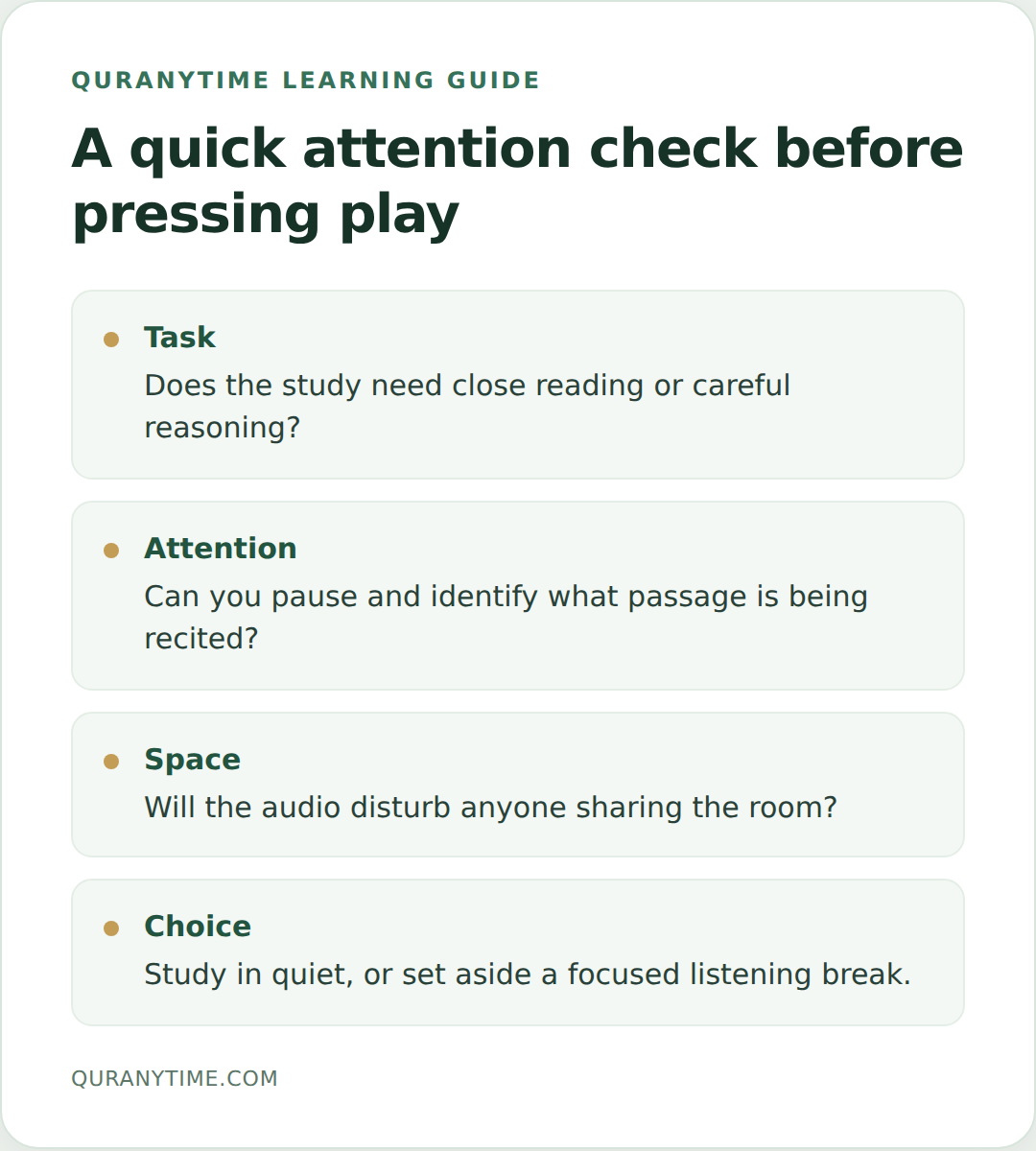
Start with the question of attention
Try asking yourself: Could I stop what I am doing for a moment and tell you what passage is being recited? If the answer is no because the task is absorbing, the audio is probably not receiving your attention. That observation does not by itself settle a religious question. It is a practical check that can help you decide whether to pause, switch off, or save the recitation for a more suitable time. You might also notice whether you keep losing your place in your work or whether you are following both activities in a way that feels deliberate.
Quran 7:204 is commonly translated with an instruction to listen attentively when the Quran is recited and to be silent. You can read the verse and its nearby context at Quran.com’s Al-A‘raf 7:204 page. This article does not use one verse to issue a ruling about every private study situation. Questions about how the verse applies to a particular setting, or what is required in a specific school of thought, belong with a trusted qualified scholar who can consider the details.
Respect is more than keeping the volume on
It is easy to confuse “the recitation is playing” with “I am listening.” Respectful listening is not measured by how long a track runs or how loud a speaker is. Consider the context: are you able to attend, have you chosen an appropriate place and device setting, and are you treating the recitation as more than incidental sound? These questions are prompts for thoughtful choices, not a formula that decides religious status.
Also consider people around you. Headphones may reduce disruption in a shared room, but they do not solve the attention problem if you are deeply absorbed in another task. If someone else is studying, resting, or working nearby, ask before playing audio aloud. Be aware of whether headphones are appropriate and safe for what you are doing. Avoid leaving a device playing unattended in a setting where the sound may continue without anyone listening. Small decisions about volume and timing help keep shared spaces considerate.
Which study tasks compete most with listening?
Reading and writing
When you are reading a textbook, writing an essay, or following detailed instructions, language is already central to the task. The words in the recitation and the words on the page may compete for your attention. If you notice that you keep losing your place, rereading paragraphs, or missing the recitation, pause one activity and decide which deserves your focus at that moment. This is not a judgement about your devotion; it is a way of acknowledging that attention has limits in a given situation.
For example, imagine you are drafting an assignment and a recitation is playing. You might find yourself turning the volume down whenever you need to think, then raising it again without really listening. A simpler plan is to finish a short writing section in quiet, then take a separate break to listen attentively. You can decide in advance when the work interval ends, giving each activity a clearer place in your routine.
Memorising or revising
Learning material by heart also uses verbal attention. If you are trying to memorise a poem, vocabulary list, or exam answers while recitation plays, it may be difficult to keep both streams distinct. It can help to separate them: do the memorisation in quiet, then take a dedicated listening pause, or make recitation itself the focus of a later session. If your aim is to learn a passage of Quran, set aside a period for that purpose rather than expecting unrelated background playback to do the work.
Routine tasks and breaks
Some tasks leave more room to listen than others. Tidying a desk, taking a familiar walk in a safe place, or organising materials may demand less language-based concentration than reading or calculation. But people and environments differ. A routine task can still require care, and someone may find any background sound distracting. Notice your own attention instead of relying on a fixed list of tasks that are supposedly “fine.” If the activity needs you to hear other people, traffic, or instructions, account for that too.
A practical choice guide
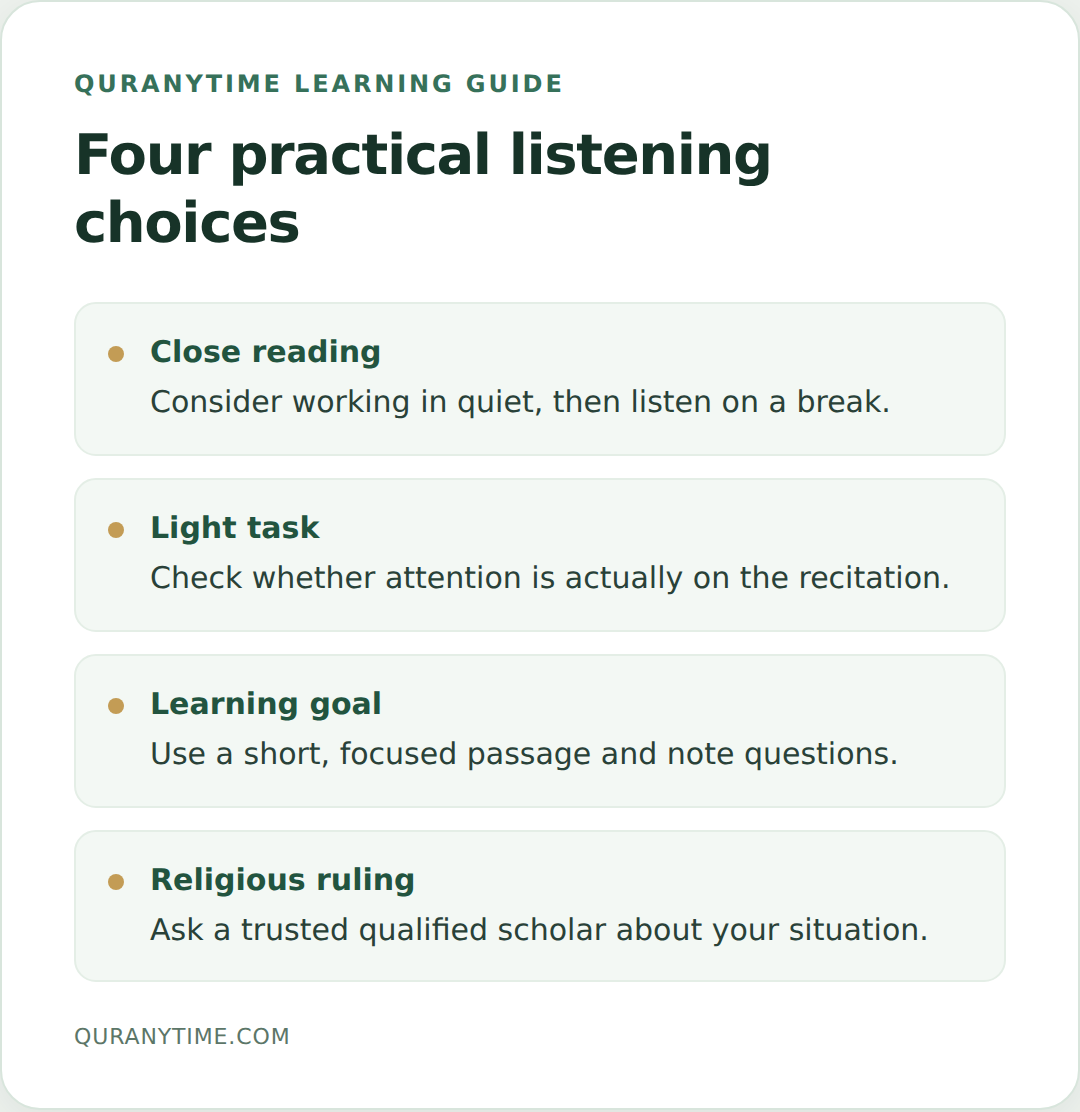
Use this as a decision aid, not as a religious checklist. It can help you plan an ordinary study session while leaving religious rulings to qualified guidance:
- If your study needs close reading or careful reasoning: consider working in quiet, then listening during a separate break. You can reassess after the demanding part is finished.
- If the study activity is light and you can follow the recitation: you may choose to listen, but check whether your attention is actually on the audio and whether the sound suits the setting.
- If you want to learn the recitation: make that the main task. Follow the text or listen to a short section with a clear learning purpose rather than expecting background playback to teach you.
- If you are in a shared space: consider others and avoid imposing audio on them. Use headphones only where appropriate and safe, and respect requests for quiet.
- If you feel uncertain about the religious ruling: ask a trusted scholar who understands the situation you are asking about rather than relying on a general practical article.
You can also make an uncomplicated personal rule for your study routine: “I work in quiet during demanding tasks, then listen during my break.” Another learner may make a different practical arrangement because their task or surroundings differ. The important thing is not to confuse a personal concentration strategy with a binding religious ruling. A routine is useful when it helps you make the choice intentionally, not when it becomes a standard you impose on everyone.
Background listening is not the same as listening practice
If your aim is to improve Quran reading or become familiar with a particular passage, focused listening is more purposeful than leaving audio on while attention is elsewhere. Choose a short segment, listen with the text if that suits your level, and note a question for a teacher if something is unclear. Quranytime’s Quran recitation listening practice guide covers a structured listen-and-check activity; it is a different task from deciding whether to play recitation during unrelated study. For related questions, see whether listening alone can teach the Quran and this guide to Quran reading fluency.
Make a simple routine that fits real life
A realistic routine can be very small. Before a demanding study block, decide whether you want quiet. When you finish, close or put aside the study material, choose a recitation, and give it a little undivided attention. If you are using the recitation to practise, choose a passage and a question in advance. If you are listening for reflection or connection, you do not need to turn the moment into a lesson or a performance test. The point is simply to be present for the kind of listening you have chosen.
For instance, a university student could study for a while in silence, then listen to a short passage during a screen-free pause. A parent working at home might wait until the children are settled rather than compete with a noisy room. Someone who enjoys audio during a simple household task might still pause it when a conversation or safety-sensitive activity needs attention. These are examples, not prescriptions; adjust them to the task and your surroundings.
If attention is difficult to manage, experiment gently: shorter sessions, fewer open tabs, a quieter place, or a planned break may help some people. Treat these as options to test, not guarantees or medical advice. Do not assume that one setup works for all learners. The site’s flexible guide to Quran learning with ADHD discusses adapting learning supports to the individual rather than imposing one routine.
If you are taking lessons, you can write down what helps you focus and ask your teacher about a practice plan. Useful Quran lesson notes can help you separate an instructor’s confirmed guidance from your own questions, so you do not mistake a personal study habit for a religious instruction. Keep practical learning questions distinct from questions about religious rulings, which may need a qualified scholar.
Common questions
Is it disrespectful to listen to Quran while doing homework?
This article cannot give a ruling for every person or situation. As a practical matter, homework that needs close attention may leave little attention for listening. You could pause the audio while working and listen during a break. For a religious answer about what is required in your circumstances, consult a trusted qualified scholar and describe the situation rather than assuming a general answer covers every case.
Can I keep Quran recitation on quietly in the background?
Quiet volume does not automatically mean that you are listening attentively; it only changes the volume. Think about whether the audio is welcome in the space, whether anyone is being disturbed, and whether you can give it attention. If not, pausing it is a straightforward practical option. The question of a religious ruling is separate and should be put to a trusted scholar if you are unsure.
Does listening while I study help me learn Quran?
It may create familiarity for some people, but background playback is not the same as focused reading practice or receiving feedback. If learning is your goal, set aside time to follow a passage and ask a teacher about specific uncertainties. Consider whether you can hear and attend to the material rather than counting the time audio is switched on as practice.
What if I cannot concentrate on both?
You do not have to force two activities together. Choose one at a time: study in quiet, then listen; or, if appropriate, make listening the main activity and return to study later. A choice that reflects your actual attention is more useful than pretending to do both equally. You can revisit the plan if the task changes.
Who should I ask about the religious ruling?
Ask a trusted qualified scholar, and explain the details that might matter, such as whether you are alone or in a group, what kind of study you are doing, and why the audio is playing. Do not treat a general blog post as a substitute for a personal religious answer. This article offers practical ways to think about attention; it does not determine what is required in your circumstances.
Choose attention over autopilot
Listening while studying is not one uniform situation. A demanding language-heavy task may compete with recitation, while a quiet break can make room for attentive listening. Consider your task, your surroundings, the people nearby, and whether you can actually attend to the audio. When you want to learn recitation, give it a focused practice of its own. When you want a specific religious ruling, take that question to a trusted scholar. In between, choose a practical arrangement that is considerate and realistic for the moment.
If you would like guidance on your Quran or Arabic learning goals, Quranytime offers a free Quran and Arabic trial class. You can use it to discuss a learning plan with a teacher; it is not a substitute for a scholar’s ruling on a religious question.