

Quran lesson notes are most useful when they help you recover one clear instruction at the moment you need to practise it. They are not a copied page, a second transcript, or a timetable for memorisation. They are a reliable learning record: what the teacher confirmed, what you understood, what is still open, and what you will do next.
That distinction matters for adult learners especially. A lesson can contain a precise correction, a suggested way to approach an approved passage, and a small reminder about the next meeting. If all of it is written in one hurried block, a later glance may not tell you which words came from the teacher and which were your own interpretation. This system gives each kind of note a visible home.
Build one reusable page for Quran lesson notes
Use one page per session, whether it is paper or digital. Choose the format by retrievability: can you find the page quickly, read it comfortably, and keep older versions available? There is no need to treat one medium as universally best. Put these five fields at the top:
- Session: date, course or class name, precise passage or lesson location, and workbook edition if one is being used.
- Teacher-confirmed instruction: the instruction as accurately as you can record it. Keep this section close to the teacher’s meaning; do not fill gaps by inventing a ruling, example, or explanation.
- My understanding: a short paraphrase in your own words, clearly labelled as your understanding rather than a quotation.
- Question not yet confirmed: anything uncertain, incomplete, or worth checking next time. Make this visibly separate from confirmed guidance.
- Next practice action and reference: the next small action, plus the page, timestamp, message, or lesson location that lets you return to the source.
Add a search key such as 2026-10-25 / course / passage-location. File pages chronologically and keep the workbook edition and date in the record. If a teacher later revises an instruction, do not overwrite the old confirmed note with your new guess. Add the revision date and context, then mark the earlier entry as superseded or needing review. The page should preserve the learning trail, not leave you guessing which instruction is current.
Before, during, and after: a concise notes flow
Before: prepare the page, not a script
Write the date, course, precise passage or location, and edition before the call or classroom begins. Leave generous space under each of the five fields. If you have an open question from the previous lesson, place it in the question field. A useful question is easier to ask when it is already visible; guidance on asking your Quran teacher better questions can help you turn a vague worry into a specific prompt.
During: capture the decision, then listen
Write short meaning-bearing phrases rather than trying to copy every sentence. Record the passage or location, the teacher’s key instruction, and any condition attached to it. If you cannot write and listen at once, stop writing. Ask, “Could you pause for a moment while I note that?” or request the instruction once more. Listening well is part of accurate note-taking; a fuller page is not automatically a better record.
When the teacher gives an instruction, place it under Teacher-confirmed. If you immediately restate it for yourself, put that restatement under My understanding. Do not blend the two. If you are unsure whether a detail was confirmed, use Question not yet confirmed instead of guessing. Your notes belong to your learning record. Do not record a teacher or class audio/video without permission; written notes can preserve the useful instruction without creating an unapproved recording. If your teacher gives feedback on an approved practice recording, keep its reference with the written instruction; this guide to recording recitation for teacher feedback covers that separate task.
After: close the page while the context is fresh
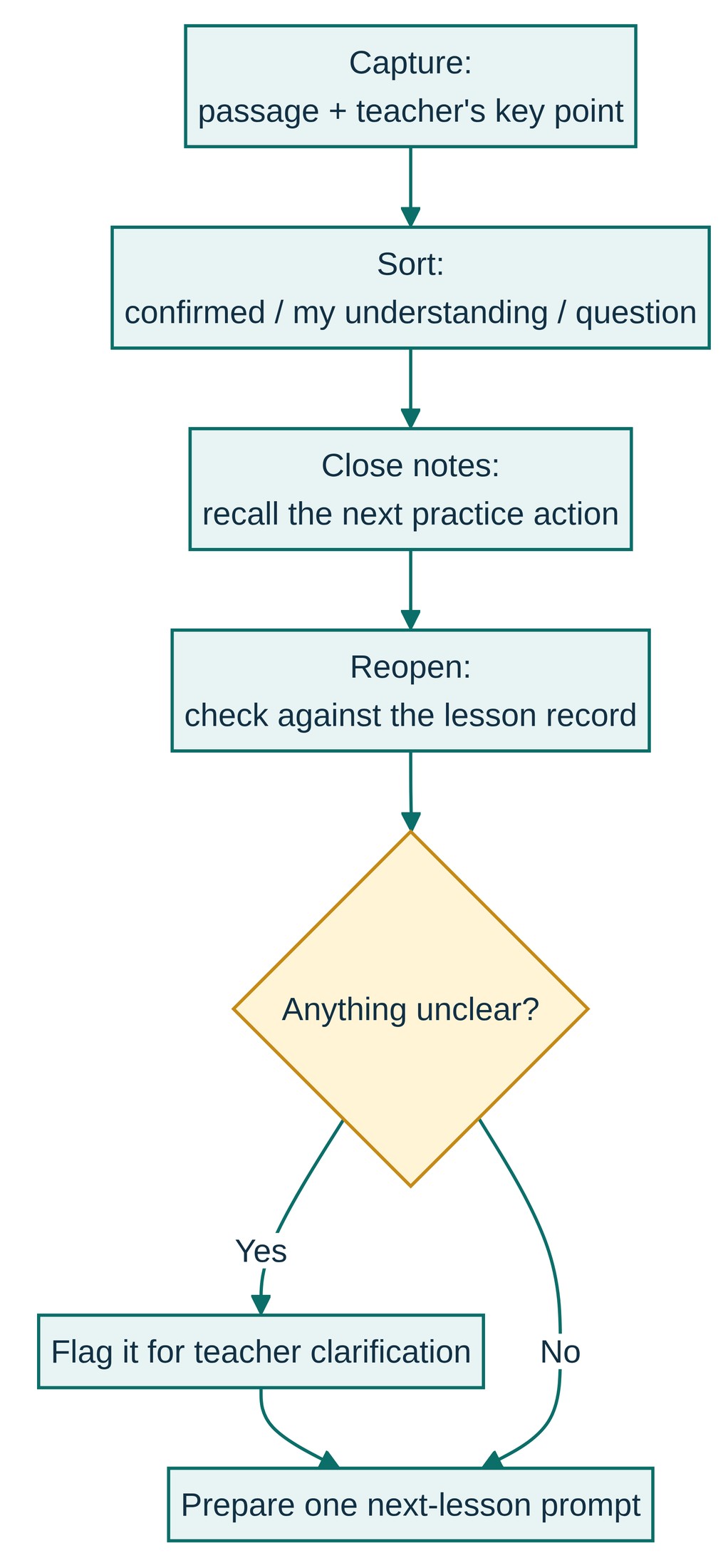
Within a practical interval after class, read the page once. Fill a missing reference, shorten a tangled sentence, and write one next practice action. Then close the page and try to recall the action without looking. Reopen the page and check your recall against the lesson record. This is not an assessment of Quran pronunciation from memory; it is a check that you can reconstruct the practice instruction you meant to follow. General note-taking advice also recommends reviewing after class, keeping main points rather than a transcript, and testing yourself; the UNC Learning Center note-taking guide is a general study reference, not a religious authority.
Review the instruction, not just the page
Use this short close-and-reopen routine:
- Close: put the notes away and state the next practice action in your own words.
- Reopen: compare what you recalled with the teacher-confirmed section and its reference.
- Sort: move no uncertain detail into the confirmed section. Leave it flagged as a question.
- Prepare: write one prompt for the next lesson, such as “Please confirm whether my understanding of this instruction is correct.”
Where possible, compare the page with a trusted lesson record or a message from the teacher. A memory, including your own memory of what a teacher said, can be wrong. If the teacher’s instruction changes, add the date and the context of the change. Your job here is to preserve what was said and what remains to be checked, not to settle an issue by confidence alone. Use the note to choose a manageable activity for your between-lesson tajweed practice, rather than treating documentation as practice itself.
Worked example: an adult learner’s fictional page
This fictional page shows how the fields can work without trying to document a full lesson:
Session: 25 October 2026 · Adult online course · approved lesson passage, section B · workbook edition 3
Teacher-confirmed instruction: Read the assigned section once at the lesson pace, then repeat the marked location slowly and bring the same location to the next class. The teacher confirmed that the marked location is the one to review.
My understanding: I should keep today’s practice focused on the marked location instead of adding a new section.
Question not yet confirmed: Should I send a short practice sample before the next lesson, or wait for class? Ask at the start of the next meeting.
Next practice action and reference: Review the marked location once tomorrow and once before class; reference workbook edition 3, section B, marked location. Follow-up prompt: “Please confirm whether I followed the assigned focus.”
Common note problems and simple repairs
| Note problem | Repair |
|---|---|
| A page copies everything but hides the instruction. | Reduce the record to the precise passage, confirmed key point, and one action. |
| Your paraphrase looks like teacher guidance. | Put it under “My understanding” and label it plainly. |
| You are unsure but write a confident sentence. | Move it to “Question not yet confirmed” and prepare a prompt. |
| A later message seems to change an older note. | Add the date and context; preserve the older entry instead of overwriting it. |
| You cannot find last week’s page. | Use chronological filing, a consistent search key, and the workbook edition. |
A five-field template to reuse
SESSION — date | course | precise passage/location | workbook edition
TEACHER-CONFIRMED INSTRUCTION — accurate key point; source/reference
MY UNDERSTANDING — my paraphrase, labelled as mine
QUESTION NOT YET CONFIRMED — uncertainty or follow-up prompt
NEXT PRACTICE ACTION + REFERENCE — one action | where to verify it
Keep the template stable so your attention can stay with the lesson. A reflection journal can support meaning-making and personal responses, but it does not replace this factual lesson record; see this gentle introduction to a Quran reflection journal for that different purpose. Likewise, a recurring mistake log can reveal patterns across sessions, but it should not replace the dated instruction page; use a dedicated recitation mistake log when you need that separate view. If you are new to live online learning, knowing what to expect in online Quran classes may make the before-and-during flow feel more familiar.
FAQs
Should I write every word the teacher says?
No. Capture the precise location, the confirmed instruction, its conditions or reference, and anything you must check. If a sentence matters but you cannot write it fully, ask for a pause or repeat.
What if I am not sure I heard the instruction correctly?
Do not promote it to confirmed guidance. Put it in the question field and ask the teacher to confirm it. That small label protects the usefulness of the page.
Paper or digital notes?
Use whichever lets you retrieve the right dated page quickly and preserve older versions. A searchable digital folder is helpful for some learners; a dated binder is better for others. The system matters more than the medium.
Can this page include my feelings or reflections?
Yes, if you want, but keep them in a separate area or journal. The five fields should remain easy to scan for teacher instructions and practice actions.
A good lesson-notes page answers four questions at a glance: what was confirmed, what did I understand, what is still open, and what will I practise next? Keep those answers dated, attributable, and easy to retrieve. Then your notes become a dependable bridge between lessons rather than another page you have to decode.