

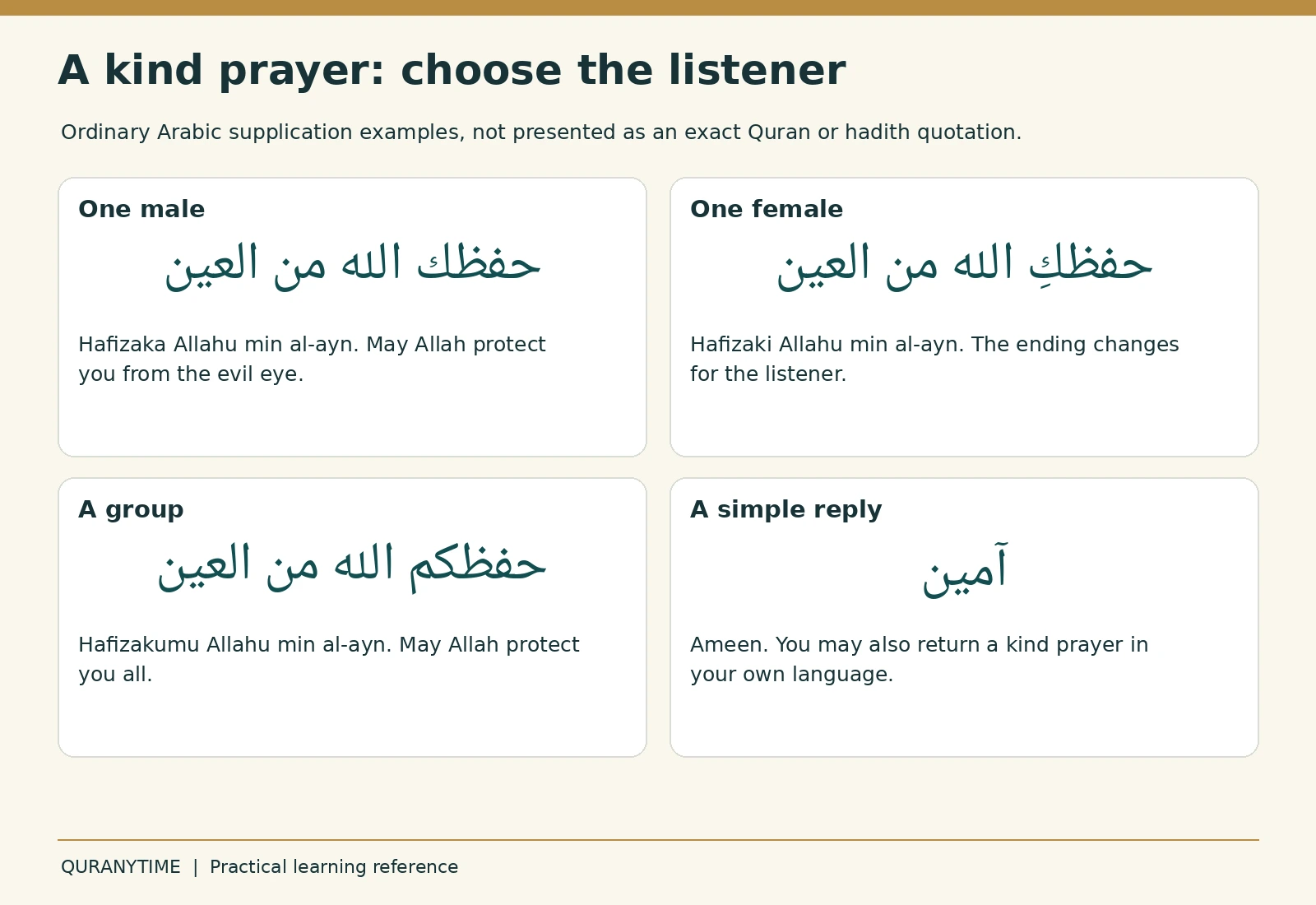
“May Allah protect you from the evil eye” is a prayer asking Allah to preserve someone from harm. A natural Arabic expression is حَفِظَكَ اللَّهُ مِنَ الْعَيْنِ, transliterated hafizaka Allahu min al-ayn when addressing one male. For one female, use hafizaki. These are ordinary Arabic supplications; this particular English phrase is not being presented here as a Quran verse or as the exact wording of a hadith.
People often use the expression when congratulating someone, admiring a child or wishing a family well. Understanding its meaning makes it easier to respond warmly without turning every compliment into a source of worry. This guide separates everyday wording from specifically sourced religious texts, explains the Arabic forms and offers practical examples for conversation.
What does the phrase mean?
The phrase combines a request for protection with an acknowledgement that protection belongs to Allah. In Arabic, al-ayn literally means the eye; in this context it refers to the evil eye. The expression is a supplication, not a prediction that harm will happen and not a guarantee that a particular event has been prevented.
In ordinary conversation, someone may say it after noticing a child’s confidence, a new home or a happy family moment. The kind intention is usually to wish the person safety and goodness. Context matters: a supportive blessing should leave the listener feeling cared for, rather than pressured to diagnose every difficulty as envy or hidden harm.
Our broader article on duas for protection from the evil eye discusses related supplications. This page has a narrower purpose: it explains what to say, how the wording changes according to the listener, and how to recognize whether a phrase is ordinary prayer or a quotation from a named source.
Arabic wording for a man, woman or group
The table uses a common Arabic prayer construction. Although the verb has the form of a past-tense expression, it functions here as a wish or supplication. The difference between ka and ki belongs to the person being addressed. It does not change the basic intention of the prayer.
| Listener | Arabic | Beginner transliteration | Meaning |
|---|---|---|---|
| One male | حَفِظَكَ اللَّهُ مِنَ الْعَيْنِ | Hafizaka Allahu min al-ayn | May Allah protect you from the evil eye |
| One female | حَفِظَكِ اللَّهُ مِنَ الْعَيْنِ | Hafizaki Allahu min al-ayn | May Allah protect you from the evil eye |
| A group | حَفِظَكُمُ اللَّهُ مِنَ الْعَيْنِ | Hafizakumu Allahu min al-ayn | May Allah protect you all from the evil eye |
Transliteration is a pronunciation aid, not a perfect substitute for Arabic sounds. The letter ع in ayn has no exact English equivalent, and ظ in hafiza needs a carefully modelled emphatic consonant rather than an ordinary English z. English spellings vary; a teacher’s audio model is more useful than arguing over one informal spelling.
For learners who want to understand why the endings change, the guide to attached Arabic pronouns provides further practice. Learn each expression as a complete unit first, then study the grammar when the phrase feels familiar.
What can you say in reply?
A simple reply is آمين, ameen, meaning that you are asking for the prayer to be accepted. You can also return a kind prayer: “Ameen, and may Allah protect you too.” In Arabic, آمين، وإياك is a familiar response to one male, with وإياكِ when addressing one female. The short written form often appears without vowel marks.
Another natural response is جزاك الله خيرًا, jazaka Allahu khayran to a male or jazaki Allahu khayran to a female: a prayer that Allah reward the person with good. These examples are useful conversational options, not a compulsory script that must be repeated exactly after every blessing.
If Arabic is unfamiliar, reply sincerely in English. “Ameen, thank you for your kind prayer” communicates appreciation clearly. There is no need to pretend fluency, and a beginner should not feel embarrassed about asking what the phrase means. A helpful speaker can explain its intention without turning the exchange into an examination.
Asking for blessing when you admire something
When you see something pleasing, praying for blessing is especially relevant. Sunan Ibn Majah 3509 recounts the Prophet’s instruction to pray for blessing when admiring another person. The practical lesson here is to combine admiration with a sincere wish for the person’s good, rather than treating praise itself as something suspicious.
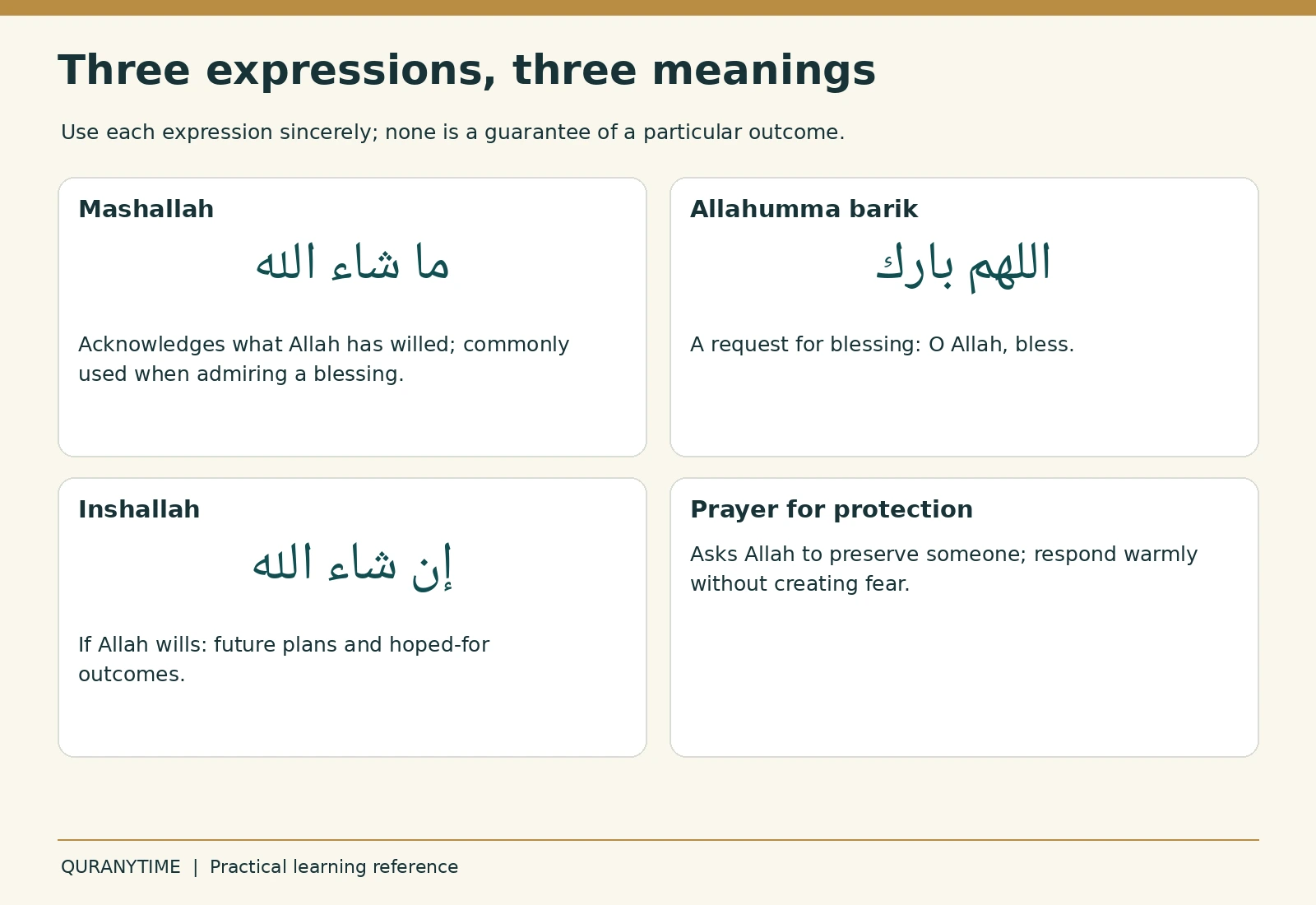
A familiar wording is اللهم بارك, Allahumma barik, meaning “O Allah, bless.” It can be expanded according to the context, such as asking Allah to bless a child or a family’s home. Saying mashallah acknowledges what Allah has willed; asking for barakah explicitly asks for blessing. They are related expressions, but their literal meanings are different.
Avoid telling someone that one casual wording automatically guarantees a result. The purpose is sincere remembrance and prayer, not a verbal mechanism that operates independently of Allah’s will. It is also unhelpful to accuse a visitor of causing harm merely because they did not say the phrase a family expected.
Mashallah, inshallah and a prayer for protection
Mashallah is commonly used when acknowledging an existing blessing. Inshallah relates to a future intention or hoped-for outcome. A prayer for protection asks Allah to preserve someone. These expressions may occur in the same conversation, but they do different jobs.
Imagine a parent saying that a child will begin reading lessons next week. A reply might include inshallah because the event is in the future. When the child later reads a familiar passage confidently, someone may say mashallah and ask Allah to bless the achievement. A separate prayer for protection can express care without implying that the achievement itself is dangerous.
For more examples of future-oriented language, read the meaning and use of inshallah. Learning the distinctions helps new Arabic learners use the expressions naturally rather than inserting them at random into every sentence.
Everyday examples with a gentle tone
For a child finishing a reading exercise, try: “Mashallah, you worked patiently. May Allah bless you and help you keep learning.” This praises effort and offers a prayer without pressuring the child to perform perfectly. If the family uses a prayer for protection, it can be added calmly rather than delivered as a warning.
For a friend sharing good news, say: “I am happy for you. May Allah bless this opportunity and protect you.” For a new home: “May Allah bless your home and make it a place of peace.” These are original conversational examples, not quotations attributed to the Prophet.
In a message, a short sincere sentence often feels warmer than a long copied paragraph. Use the person’s preferred language and avoid implying that you know the unseen cause of their circumstances. A blessing is an expression of goodwill; it should not become a demand for private information or an instruction to avoid ordinary happiness.
Keep sourced texts distinct from personal wording
Muslims can make ordinary supplications in their own words. However, attributing a phrase to the Quran or a hadith requires a reliable reference. A decorative image, a popular caption or repeated social-media wording does not establish that attribution. Before sharing an exact quotation, check the Arabic, the translation and the source.
Quran 113:5 refers to seeking refuge from the harm of an envier when they envy. Surah Al-Falaq has its own revealed wording and should not be replaced in quotation marks by a casual English phrase. Likewise, when a hadith teaches a particular supplication, keep its wording and reference clear rather than blending it with an unsourced caption.
Our guide to verifying Quran quotations before sharing offers a useful checking routine. Label a personal prayer as a personal prayer. This small habit protects readers from confusing a helpful expression with a claim about an exact religious text.
Teach the phrase without creating fear
Children learn the emotional meaning of religious language from the adults around them. Introduce protection and blessing through reassurance, gratitude and kindness. Explain that we ask Allah for good and continue sensible everyday care. Avoid presenting every headache, lost toy or disappointing result as proof of an evil eye.
If a person has concerning symptoms, a blessing should accompany appropriate care rather than replace it. This guide does not diagnose the cause of illness or offer a test for the evil eye. It also does not justify blaming a particular relative, teacher or friend for an unexplained problem. Questions about individual religious practice can be taken to a trusted qualified scholar.
For language learning, keep the activity concrete. Read the Arabic expression, identify who is being addressed, and choose a kind reply. A child can practise the exchange with a parent using imaginary everyday scenarios. The purpose is comprehension and respectful speech, not memorizing alarming stories.
Downloadable phrase and conversation worksheets
Download the free three-page practice worksheets and answer guidance (PDF). No registration is required.
The worksheet pack contains a phrase reference, male-and-female matching practice, short conversation prompts and a source-checking activity. Learners first match a phrase to its meaning, then select wording appropriate for the listener. The answer guidance explains the intended endings without requiring advanced grammatical terminology.
One activity asks you to distinguish a personal prayer, a Quran reference and a hadith reference. Another invites you to write a supportive message for a friend’s achievement. Keep the message short, avoid promises about unseen outcomes and include a sincere wish for good. A teacher can then check the Arabic pronunciation and the conversational tone separately.
For families studying faith and language together, online Islamic studies can provide a broader setting for questions about everyday expressions. A worksheet is a learning aid; it does not turn its sample wording into a prescribed devotional routine.
A short message-writing exercise
Imagine that a friend shares a happy achievement. Write one sentence acknowledging the effort, one prayer for blessing and one warm closing. Then inspect the message for claims you cannot support. Does it present a personal prayer as a quotation? Does it imply that you know a hidden cause of harm? Does it make the recipient anxious about sharing good news? Revise those parts into ordinary sincere language. If writing in Arabic, check the listener ending separately from the meaning. A message can be grammatically imperfect and still kindly intended, so correction should preserve the warmth rather than making the speaker afraid to communicate.
Frequently asked questions
Is “May Allah protect you from evil eye” a Quran verse?
No. The English sentence is an ordinary prayer. Quranic passages about seeking refuge have their own wording and references. Do not label the conversational sentence as a direct quotation from the Quran.
Is ameen a suitable reply?
Yes. It is a natural way to respond to a kind supplication. You may also thank the speaker or return a prayer for their well-being. The exchange does not require a long formula to be sincere.
Can I say the prayer in English?
Yes, ordinary personal supplications can be expressed in understandable language. This article’s Arabic examples support language learning; they do not imply that English expressions of goodwill are invalid or that a beginner must master every ending before praying.
Does mashallah mean exactly the same thing?
No. Mashallah acknowledges what Allah has willed. A prayer for protection asks for preservation, and Allahumma barik asks for blessing. They may appear together, but their meanings should not be collapsed into one translation.
How can I practise the pronunciation?
Listen to a clear model, repeat a short segment and ask for correction, especially for ع and ظ. To practise these expressions alongside Arabic reading, book a free trial class and tell the teacher which phrases you want to understand and pronounce confidently.
References
See Sunan Ibn Majah 3509 for the instruction to pray for blessing when admiring someone, and Quran 113:5 for the verse about seeking refuge from the envier’s harm. The conversational wording, examples and worksheet prompts here are teaching examples unless a specific textual reference is explicitly identified.