
The Arabic writing system is a connected script written primarily from right to left. Its standard alphabet has 28 letters. Most letters change appearance according to their connections within a word, while dots distinguish several related shapes. Short vowels can be written as additional marks and are often omitted in ordinary adult reading material. Learning the system means understanding these layers together rather than memorizing a poster alone.
This guide explains how the script works, why a familiar letter can look different in a word, and how to approach your first examples. It focuses on readable everyday Arabic and beginner Quran reading. Handwriting styles, regional pronunciation and Quranic spelling conventions introduce further details, so a single printed chart should be treated as a starting reference rather than a complete language course.
Why Arabic is often called an abjad
An abjad is a writing system organized primarily around consonant letters, with vowel information represented differently from the full consonant-and-vowel spelling pattern familiar from English. Arabic fits this broad description, although long vowels and optional short-vowel marks make its practical system richer than the simple label might suggest.
For a beginner, the useful point is that an unmarked word may not show every short vowel explicitly. Readers use vocabulary, grammar and context to interpret it. Fully vowelled learning material supplies more of that information, helping a new reader decode examples before they can infer the missing vowels independently.
Start with the complete Arabic alphabet guide when you need the individual letters and sound clues. This article explains the wider system that makes those letters function in words, including connections, vowel marks, direction and the relationship between printed and handwritten forms.
Direction: words, lines and numbers
Arabic text runs from right to left across a line. A paragraph normally begins at the right margin. If you are used to English, deliberately start your visual scan on the right rather than looking for the first letter on the left. Following the correct sequence is essential when comparing an isolated spelling with a connected word.
Numerals create an additional layer. A multi-digit number is read in its usual digit order within the surrounding right-to-left text, and Arabic pages may use Western digits or Arabic-Indic digits. Mixed Arabic and English text can therefore look confusing on a screen even when the underlying words are correct.
For practice, begin with one short Arabic line without embedded English. Add mixed-direction material later. In digital editing, use the appropriate paragraph direction rather than manually inserting spaces to push text into position. A visual alignment problem and a spelling error are different issues and should be corrected separately.
The 28 letters and the role of dots
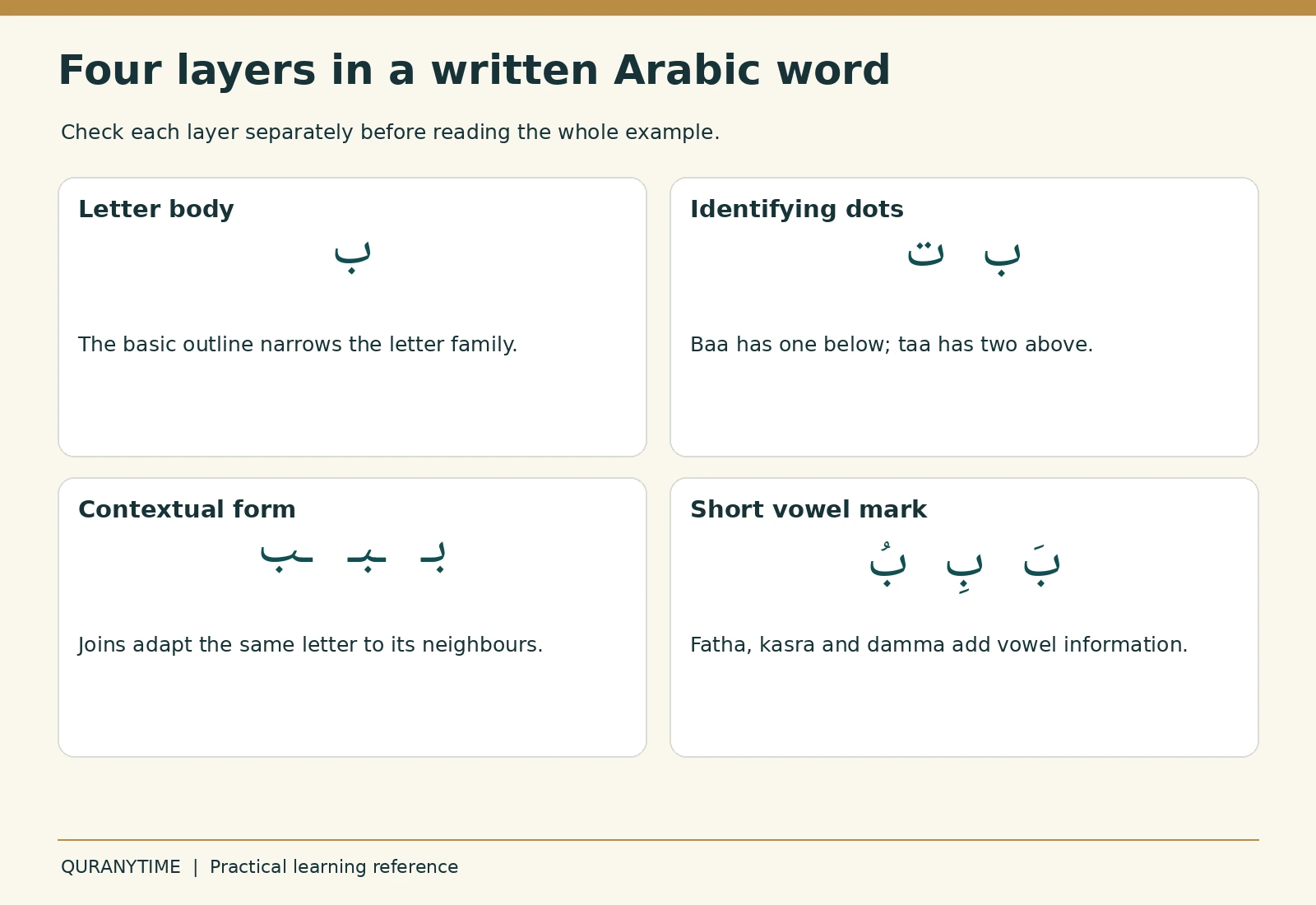
Many letters share a basic outline. The families ب ت ث and ج ح خ make this visible immediately. Their dots are not optional decoration: they distinguish different letters. Likewise, د and ذ or ر and ز differ in a small feature that changes identity. Train yourself to inspect the body and then the dots.
The usual alphabet list contains 28 letters. Hamza is also taught explicitly because it represents a glottal stop and may appear independently or on a carrier. Special written forms such as taa marbuta and alif maqsurah require attention without being treated as unrelated additions to every beginner alphabet count.
A useful first task is matching letters by shared body and then separating them by dot pattern. This builds visual attention. However, do not assume that letters sharing a body have similar sounds. Sound learning needs listening and correction alongside the visual comparison.
How letters connect inside words
Most Arabic letters can connect to the preceding and following letters in the right-to-left sequence. Their appearance changes with that context. The terms isolated, initial, medial and final describe the common positions. Some forms look very similar, and not every letter has four dramatically different shapes.
For example, ب can appear as ب, بـ, ـبـ or ـب. The basic identity remains, especially the single dot below, while the joining strokes adapt. Learn the relationship through examples rather than trying to memorize four unrelated pictures. This makes a new word feel less like a completely new drawing.
The guide to Arabic letter forms inside words offers focused practice. When reading, first identify the letter body and dots, then check how it joins. When writing, follow a consistent model and keep the connections clear enough that individual letters remain recognizable.
Six letters that stop the next connection
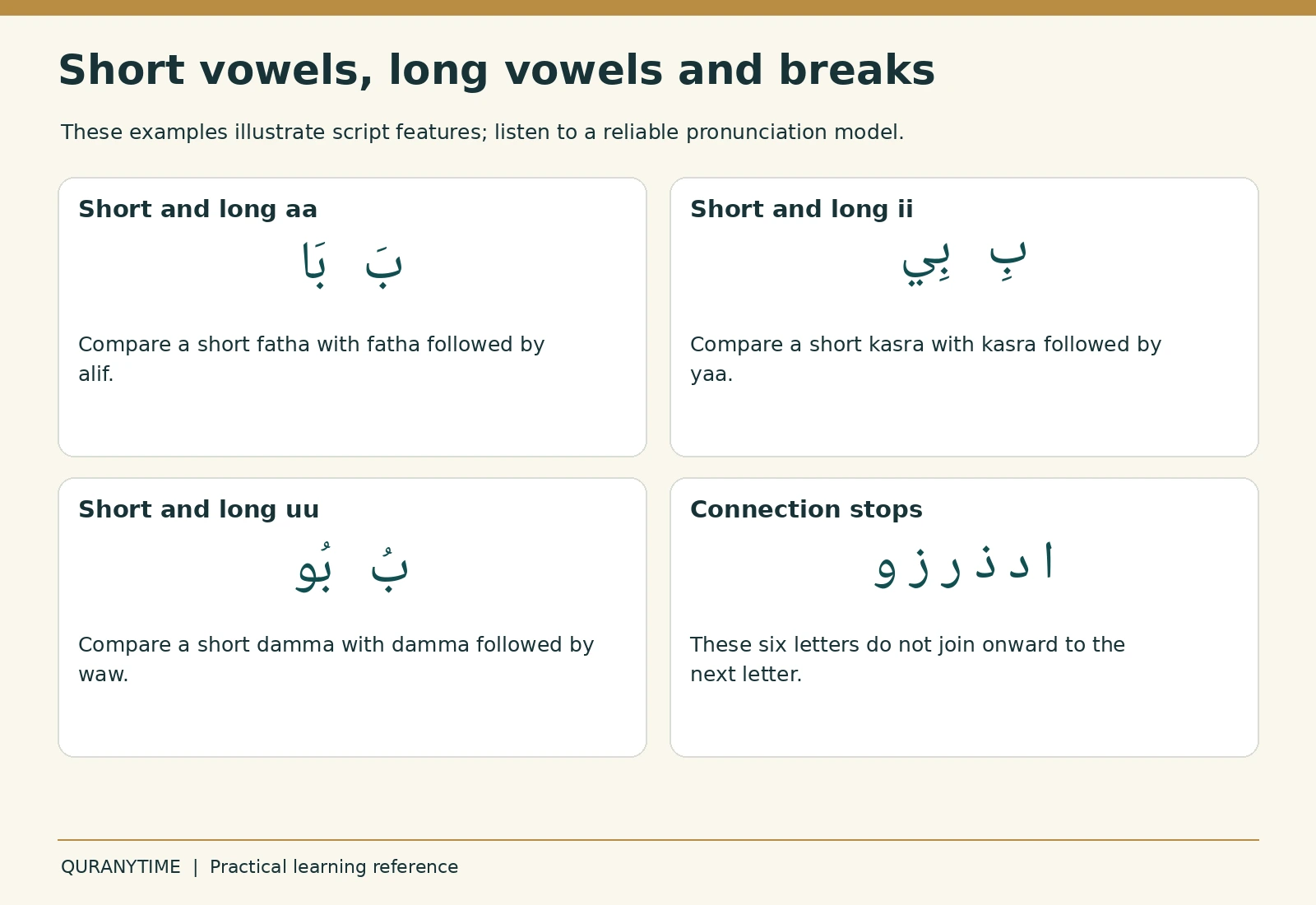
The letters ا د ذ ر ز و connect to a preceding letter when permitted, but they do not connect onward to the following letter. Because the line runs right to left, that means the break appears after them as you progress leftward through the word. The next letter begins a fresh connected group.
In نور, the noon connects to waw, but waw does not connect to raa. In كتاب, alif stops the connection before baa. These internal gaps do not automatically create separate words. A beginner who assumes every gap is a word boundary will split many ordinary Arabic words incorrectly.
Mark the six letters in a short printed passage and inspect the breaks that follow. This turns a memorized rule into a reading habit. Avoid calling them letters that never connect at all; that wording hides their ability to receive a connection from the preceding letter.
Short vowels: fatha, kasra and damma
The three basic short-vowel marks are fatha above the consonant, kasra below it and damma above it. With baa, بَ, بِ and بُ provide the familiar beginner patterns ba, bi and bu. English transliteration gives only an approximate sound cue, so listen to the examples rather than relying entirely on English spelling.
The vowel marks are additional information placed around the consonants. They should not be confused with the identifying dots of the letters. A kasra below a letter is not another letter dot, and a fatha above it does not turn baa into taa. Keep these layers separate when learning to inspect a word.
For a detailed introduction, use the Arabic harakat reading guide. Begin with a small set of known consonants, add the three marks and read simple combinations. A large chart of every possible sign can wait until those basic contrasts are secure.
Long vowels, sukun and shaddah
Alif, waw and yaa participate in common long-vowel patterns, while waw and yaa can also function as consonants. Compare بَ with بَا, بِ with بِي and بُ with بُو. The contrast is not simply a larger printed symbol; it changes the vowel duration in pronunciation.
Sukun indicates that no short vowel follows a consonant in the relevant reading. Shaddah marks consonant doubling. These signs affect how a word is pronounced even when its underlying letter sequence looks familiar. Learn them through short examples and careful listening rather than treating them as punctuation that can be ignored.
The guide to short and long vowels in Arabic develops the duration contrast. For Quran recitation, additional conventions and rules need teacher guidance. Recognizing a sign is one step; applying it accurately in connected recitation is another.
Why ordinary Arabic often has no vowel marks
Adult newspapers, messages and many books omit most short-vowel marks because readers can usually interpret familiar words through language knowledge and context. This does not mean vowels disappear from speech. It means the writing expects the reader to supply information that a fully marked beginner text makes explicit.
A new learner should not be pushed directly from letter recognition into complex unvowelled material without support. Build vocabulary, sentence patterns and confidence with graded examples. Then compare a familiar marked sentence with the same sentence unmarked. You can focus on inference because the meaning and structure are already partly known.
Our guide to reading Arabic without vowels explains that transition. Do not guess a word from its overall silhouette alone. Check the consonants, possible forms, grammar and context, and confirm uncertain readings with a reliable reference or teacher.
Printed Arabic, handwriting and calligraphy
Computer fonts, beginner handwriting and decorative calligraphy can present the same letters differently. Naskh-based print is common in learning materials, while everyday handwriting may use Ruqah conventions. Some shapes become more compact or connect differently in a handwritten model. A beginner benefits from being told which model is being used.
Do not copy a highly ornamental design as your first spelling reference. Decorative composition may stretch letters or arrange them in ways that require experienced reading. Choose a clear learning font and a consistent handwriting demonstration. Once recognition is secure, exploring other styles becomes more productive and less confusing.
The line’s right-to-left direction also does not mean every individual pen stroke travels leftward. Formation is letter-specific. Watch the start point, curve and pen lifts in the selected model. Judge early handwriting by readable identity, dot placement and correct joins before worrying about artistic elegance.
Quranic script and ordinary spelling
The Quran uses the Arabic alphabet, but printed mushafs can include orthographic and recitation conventions that beginners do not encounter in ordinary messages. Extra reading marks, particular spellings and edition choices require explanation. There is no need to invent a separate set of Quran letters to account for those features.
Learn to distinguish a letter, a vowel sign, a verse number and a recitation marker. They carry different kinds of information. A decorative verse separator should not be pronounced as a word, while a small reading sign may affect the recitation. Ask about unfamiliar marks rather than deleting them mentally or treating all of them as decoration.
When your goal is accurate recitation, pair script study with a qualified teacher’s correction. General Arabic literacy helps, but it does not automatically establish mastery of tajweed. Keeping the two learning goals visible allows a lesson to address both without confusing their assessment.
A practical first-reading routine
Choose a short, clearly printed example with letters you know. Scan from right to left and identify the consonant bodies and dots. Next, locate connection breaks and vowel marks. Sound out the sequence slowly, then listen to a reliable model and compare. Finish by reading the whole example again without rushing.
If you make an error, identify its source. Was it a missed dot, an unfamiliar connected form, an overlooked vowel or an incorrect sound? Each problem suggests a different exercise. Repeating the entire alphabet is unnecessary when the actual issue is one specific join or a vowel-duration contrast.
Write a short note about the correction and revisit it in another example. That final step checks whether you learned the feature rather than memorizing the appearance of one word. Gradual transfer into new examples is a stronger sign of reading progress than a flawless performance on a single familiar card.
Downloadable script worksheets
Download the free three-page practice worksheets and answer guidance (PDF). No registration is required.
The pack includes a script-layer reference, non-joining-letter practice, vowel comparison tasks and a first-reading checklist. Try the exercises before looking at the answer guidance. In the direction task, follow the Arabic letter sequence rather than the order of English labels on the page.
Use the blank lines to write one corrected example after each task. A parent can ask the learner to explain the dot pattern or connection break in their own words. This makes the worksheet a conversation about how the script works rather than a page completed by copying without attention.
Build a readable example collection
Keep a small notebook with one example for each script feature: a dot-family contrast, a non-joining letter, a short vowel, a long vowel and a doubled consonant. Write where each example came from and what it demonstrates. When an unfamiliar word appears, compare it with one relevant example rather than searching the entire notebook. The collection should remain small enough to use. Replace an unclear sample with a better one when your teacher explains it. Over time, these examples become practical reference points that connect the abstract rules to words you can actually recognize and read.
Frequently asked questions
Is Arabic written from right to left?
Yes, the main text direction is right to left. Numerals and embedded foreign-language text introduce mixed-direction details. Start with a simple Arabic line before practising complicated bilingual layouts.
Are all Arabic letters joined?
No. Six letters stop the next connection, and word spaces separate words. Dots, marks and some additional strokes also require pen lifts. Connected script does not mean every word is one uninterrupted line.
Does Arabic have vowels?
Yes. Spoken Arabic has vowels, and writing represents long vowels and optional short-vowel marks in different ways. Ordinary unmarked text expects readers to use language knowledge to interpret many short vowels.
How can I get help with my first reading?
If you want feedback on letter recognition, vowels and connected words, book a free trial class. Explain whether your goal is everyday Arabic literacy, Quran reading or both so the teacher can choose suitable examples.
Reference
Madinah Arabic’s connecting-letters lesson provides a reference for contextual forms and the six non-joining letters. Practice routines and worksheet activities here are original teaching suggestions, and simplified transliterations are aids rather than exact phonetic transcriptions.