
If you are learning how to read Arabic without vowels and hesitate when tiny marks disappear, you have reached a normal next step—not a dead end. Short-vowel marks can disappear in ordinary Arabic writing, so the reader uses familiar word forms, grammar, vocabulary, and the sentence around each word to choose a likely reading. This guide gives you a safe way to practise that skill without turning every word into a guess. It is for Arabic learners, including Quran students who want to connect the script they read in the mushaf with Arabic books, messages, and simple prose.
What changes when the vowel marks are missing?
Arabic is written with consonant letters, and the letters alif, wāw, and yāʾ can also represent long vowels in suitable words. The short sounds /a/, /i/, and /u/ are usually shown by small marks rather than full letters. In many everyday texts those marks are omitted; they appear more often in the Quran, children’s books, primers, and passages where pronunciation needs extra clarity. A useful reference from the Lebanese Arabic Institute explains the difference between short-vowel marks and long-vowel letters. The important consequence is that an unmarked word may allow more than one reading when viewed alone.
“Without vowels” is a convenient phrase, but an unmarked line still carries clues: dots distinguish letters such as ب، ت، ث; long-vowel letters remain; and prefixes, suffixes, familiar words, and surrounding grammar constrain the reading.
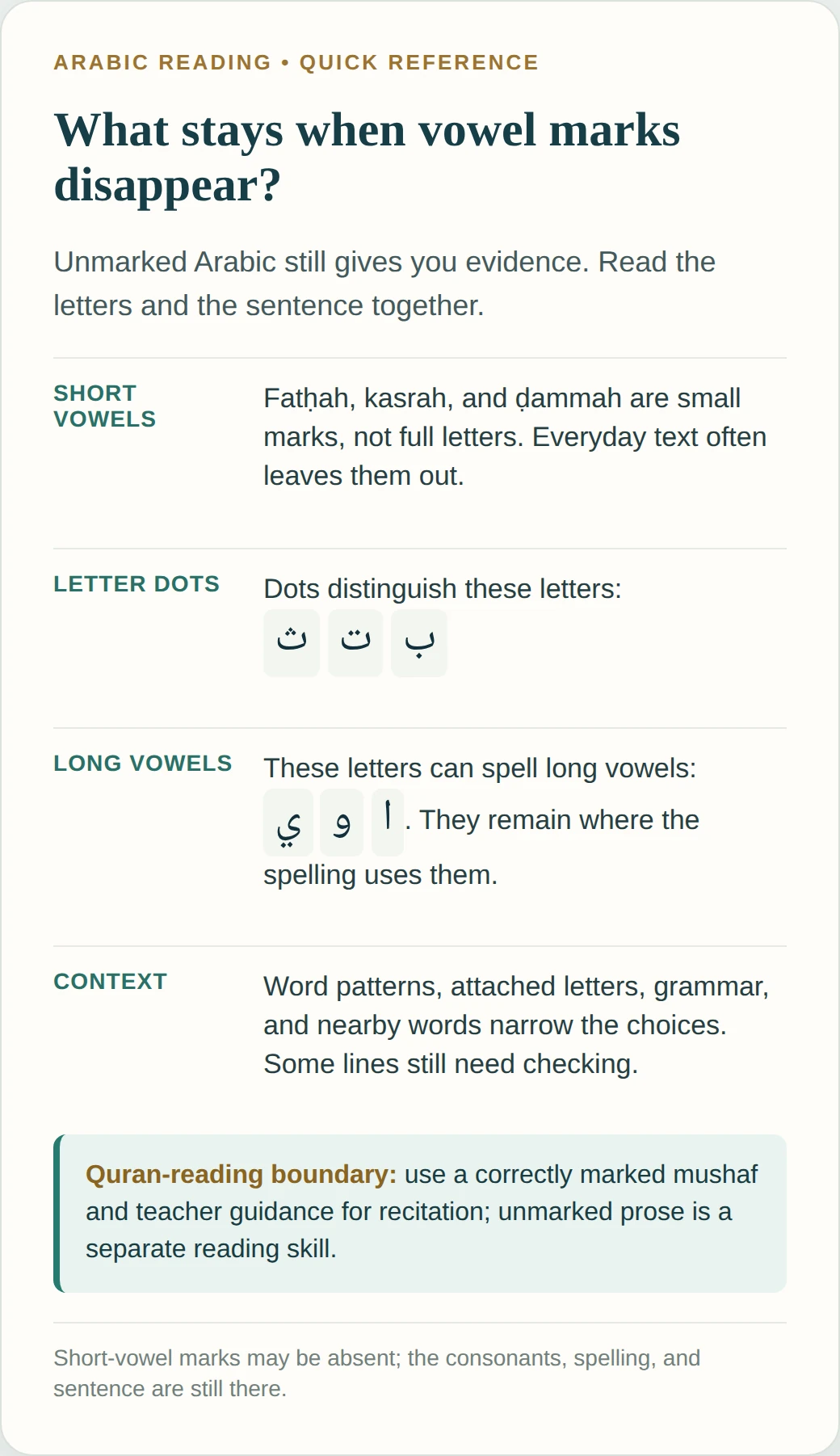
For Quran recitation, do not remove marks from the mushaf and improvise. The printed Quran is commonly fully vocalized precisely to guide pronunciation. Use its marks, a qualified teacher, and the established recitation you are learning. Reading unvocalized prose is a related literacy skill, not a replacement for Quran recitation instruction. If the names of fatḥah, kasrah, ḍammah, sukūn, and tanwīn are still new, first review this site’s practical guide to Arabic harakat for Quran reading.
One set of letters can have more than one reading
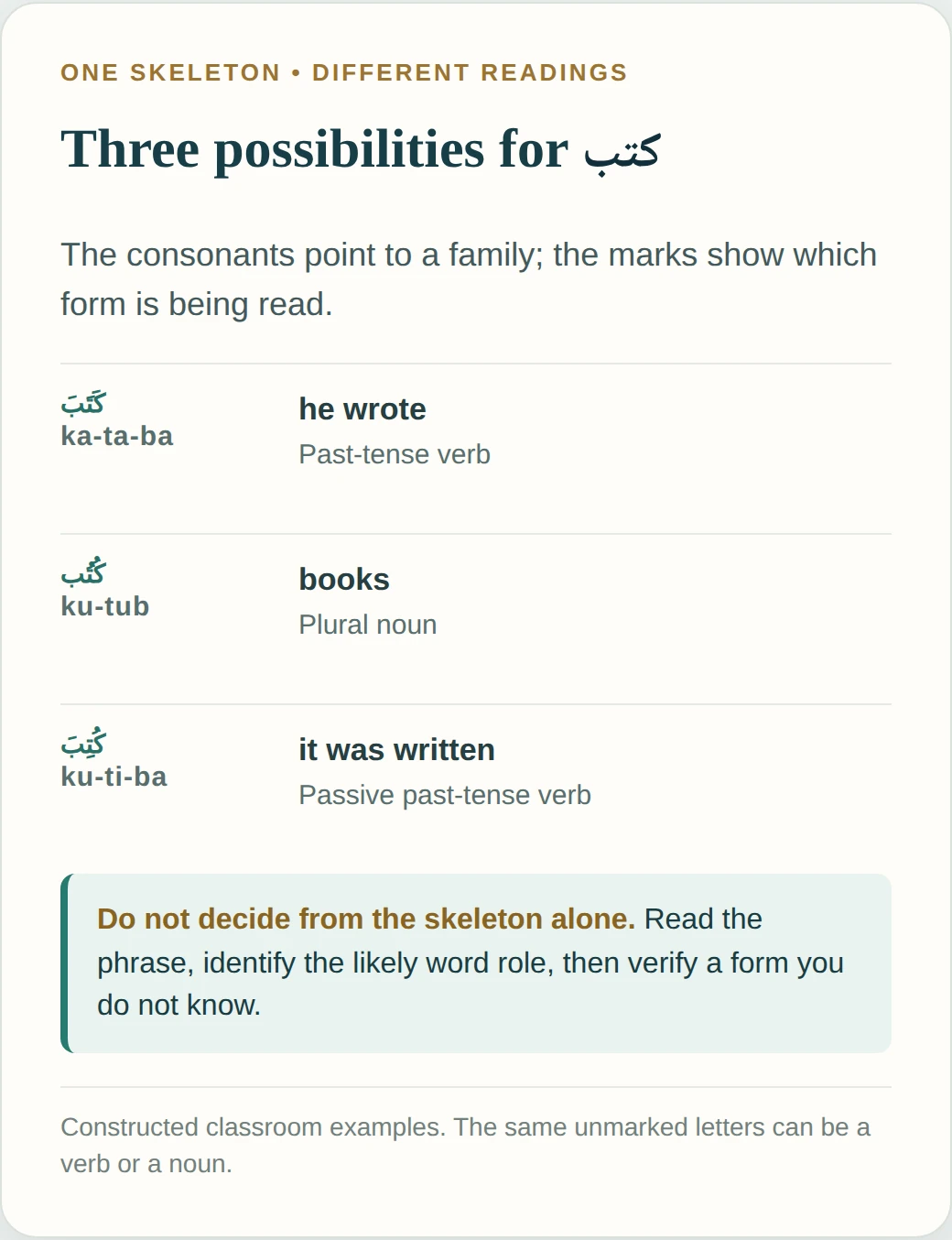
Look at the unmarked spelling كتب. Depending on its vowels and its job in a sentence, it can represent kataba (he wrote), kutub (books), or kutiba (it was written). The consonants narrow down the possibilities, but they do not settle the word by themselves. Do not memorize this as a trick with one magic answer; use it to notice why you need the sentence.
When you meet an unfamiliar form, first ask whether you recognize a common word or grammatical pattern. A three-letter root can point toward a related family, but roots are clues, not a substitute for identifying prefixes, suffixes, and the particular word pattern. A verb may have an added prefix; a noun may have an ending or a plural pattern; a small attached preposition can change what the next word is doing. Quranytime’s introductions to Quranic Arabic roots and patterns and Arabic verb forms can help you build those clues in a structured way.
Let the whole sentence do some of the work
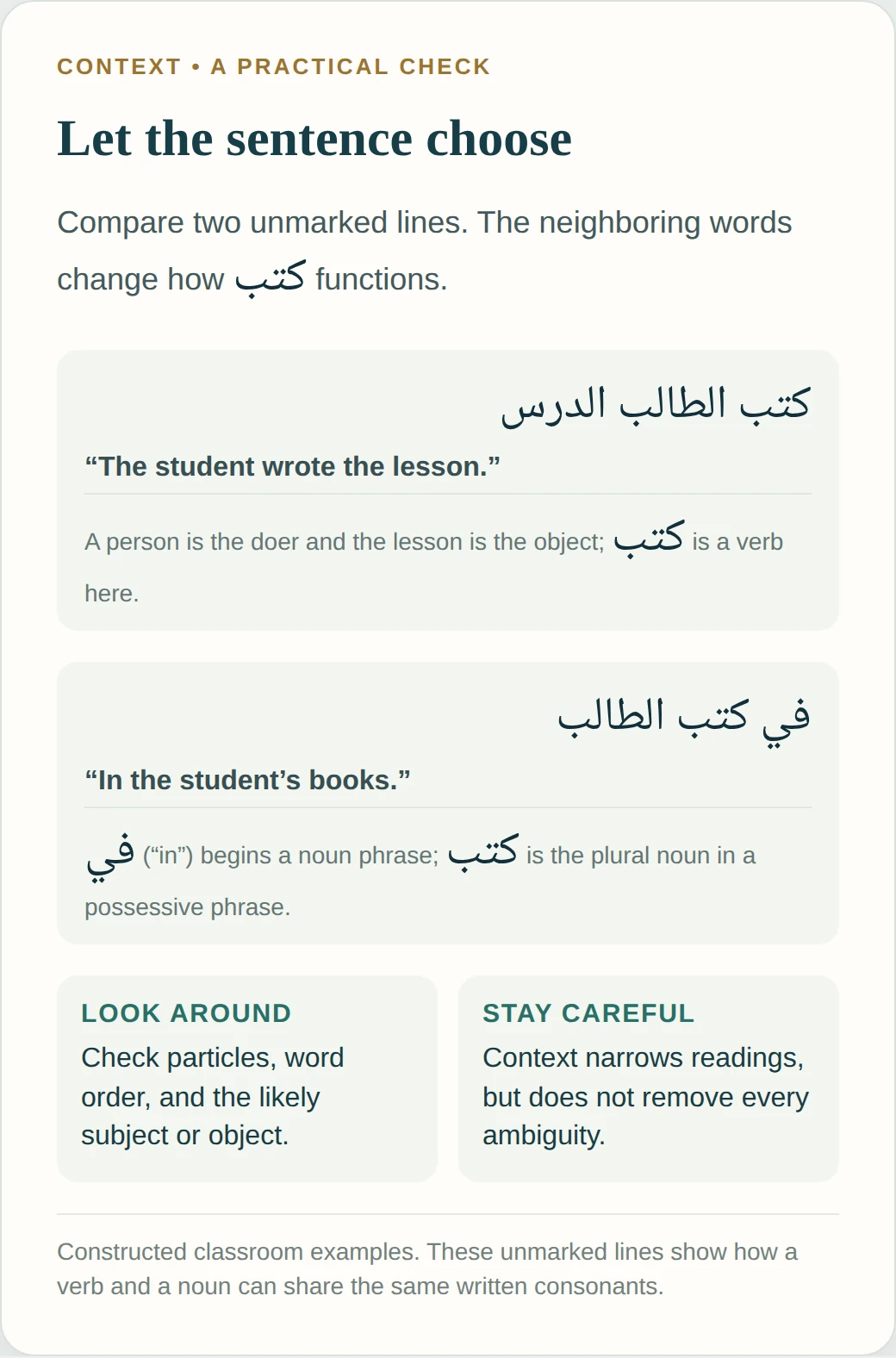
Compare these unvowelled classroom examples: كتب الطالب الدرس and في كتب الطالب. In the first, the sentence means “the student wrote the lesson”: الطالب is the doer, الدرس is what was written, so كتب is read as the verb kataba. In the second, في (“in”) expects a noun phrase; كتب الطالب is a possessive phrase, “the student’s books.” Here كتب is the plural noun kutub. The same three consonants make sense in both examples because the surrounding words provide a grammatical frame.
Read from right to left, looking at the phrase rather than sounding out isolated letters. Ask whether each position needs a noun, action, description, or particle, then check word order and agreement. Context narrows options; it will not always resolve a genuinely ambiguous line.
If a word still has two plausible readings, read the sentence before and after it. Topic matters: a paragraph about a classroom makes one vocabulary family more likely than a paragraph about books or travel. A familiar collocation may solve a problem that a root alone cannot. When you cannot justify a choice, mark it as uncertain and consult a vowelled edition, a reliable dictionary, audio, or a teacher. Quranytime’s guide to using a Quran dictionary to find roots and word meanings shows how to check a candidate rather than treating a first guess as fact.
How to read Arabic without vowels: a five-step method
- Read the entire short phrase once. Do not stop at the first word you cannot vocalize. Let the sentence create a small amount of context.
- Keep every written letter visible. Notice dots, long-vowel letters, attached conjunctions, the definite article ال, and familiar suffixes. Do not add a short vowel mark to the page as though it were certain.
- Identify likely word type and pattern. Ask whether the item behaves like a noun, a verb, or a particle. If it resembles a known root or form, use that as one clue, not the whole answer.
- Use grammar and meaning together. Check what the neighboring words require. A preposition, possessive link, subject, object, or adjective can make some readings more natural than others.
- Verify before you read aloud confidently. Check a trusted vocalized example, dictionary, audio model, or teacher. If sources disagree or the context is insufficient, keep the reading tentative instead of rehearsing a mistaken pronunciation.
Keep a short note: the unmarked form, your reading in context, and the clue that confirmed it. This turns each check into useful vocabulary rather than an isolated transliteration.
How to practise without building bad guessing habits
Start with familiar text: a graded reader, easy dialogue, or short paragraph on a known subject. If you are learning letter shapes, review the Arabic alphabet guide first. Read silently, underline only unresolved words, and check answers after applying the five-step method.
Use a gradual bridge. First read a fully vowelled line and understand it. Next cover the marks on familiar words and try to retrieve their reading from memory. Then use a partially vowelled exercise, where some marks remain as support. Only later move to short unmarked passages at your level. The best text is not the most difficult one; choose a passage where you can follow the meaning and investigate a manageable number of new words.
Try a ten-minute session: review known vocabulary, read a few easy sentences for meaning, investigate one or two uncertain forms, and check a model or teacher. The site’s Arabic listening practice for beginners can help connect print with sound.
Common mistakes to avoid
- Giving every consonant a vowel immediately. Pause for the phrase first; a word-by-word guess can block useful context.
- Assuming a root decides the full word. Several forms can share a root. Look at the pattern, attached letters, grammar, and meaning together.
- Confusing ordinary reading with Quran recitation. Use the fully marked Quran text and appropriate instruction when reciting; do not erase guidance to make a harder exercise.
- Expecting every ending to be written. Everyday Arabic often leaves short vowels unmarked, and final case vowels may not be shown. Follow the reading level and convention your teacher is using instead of inventing marks.
- Using a difficult newspaper as your first exercise. Dense vocabulary and unfamiliar syntax add separate challenges. Build accuracy on graded, short passages first.
Frequently asked questions
Do I need to memorize every Arabic word with all of its vowels?
No. Build common vocabulary and patterns, then practise reading them in context. Memorizing a new word’s vowelled form helps; the goal is not to store every possible vocalization of every consonant string.
Can I practise this skill with Quranic Arabic?
Yes, you can learn vocabulary, roots, and patterns from Quranic Arabic, but read the Quran from a correctly marked text and learn recitation with suitable guidance. You might study how a familiar word relates to a dictionary entry, then practise the same reading strategy in a graded prose exercise. This keeps literacy practice and recitation accuracy connected without confusing their purposes.
What if I cannot tell which reading is correct?
Sometimes the written consonants and the small amount of context are not enough. Check a dependable resource or ask a teacher; do not pretend certainty. A guided class can help you work through a short passage, hear a model, and see why one reading fits. You can book a free Quran and Arabic trial class and bring one sentence you found difficult.
Build accuracy before speed
Reading without short-vowel marks is not a test of instant intuition. Preserve the letters, consider the word’s forms, use its sentence, and verify. Begin with easy material, and accept that some isolated words need more context. For Quran recitation, continue to follow the marked text and your teacher’s guidance.
Watch: learning to move from vowelled to unmarked text
This English lesson discusses a gradual path from vowelled reading through grammar and vocabulary toward unmarked Arabic. Use its suggestions as a study framework, and check any Quran-specific recitation question with a qualified teacher.