
If you are wondering how to memorize Surah Al-Kahf, its 110 verses can feel like a project without an obvious first step. A workable plan makes the first step small, keeps the story-and-theme sequence visible, and gives revision as much space as new learning. You do not need to race through the surah or use a fixed number of repetitions. You need a portion you can recite accurately, a way to connect it to what you already know, and a steady return to earlier verses.
This guide offers a flexible framework for adults and younger learners. Adjust the pace to your reading, available time, and teacher’s advice. The section ranges below are navigation aids based on the surah’s flow, not prescribed memorization boundaries. Check every start, stop, and recitation with a reliable mushaf and, where possible, a qualified Quran teacher.
Start with a map, not a deadline
Al-Kahf (Quran 18) moves through several memorable passages: the opening description of revelation and the people of the cave; the owner of two gardens; reminders about worldly life and Iblis; Musa’s journey with the wise servant; and the account of Dhul-Qarnayn. A high-level map helps you remember what comes next without replacing the words themselves. Quran.com provides the complete Arabic text, translation, and verse-by-verse navigation for Surah Al-Kahf.
- 18:1–8: praise of Allah for the Book, warning and good news, and a reminder about the world’s adornment.
- 18:9–26: the people of the cave, their refuge, awakening, and the instruction to leave knowledge of their number to Allah.
- 18:27–31: hold fast to revelation, keep company with those who call upon their Lord, and the contrast between the consequences for belief and disbelief.
- 18:32–44: the parable of the two gardens and the owner’s loss.
- 18:45–59: worldly life compared to rain-grown vegetation, the gathering, the record, Iblis, and warnings through earlier communities.
- 18:60–82: Musa’s journey with his young companion and the events involving the ship, the boy, and the wall, followed by their explanation.
- 18:83–98: Dhul-Qarnayn’s journeys and the barrier built against Ya’juj and Ma’juj.
- 18:99–110: the gathering, the loss of deeds, the promise for believers, and the closing call to righteous action and worship of Allah alone.
These divisions indicate broad narrative and thematic turns; they are not claims that each passage has a single universally agreed “topic.” Within them, smaller chunks should follow connected phrases and sensible recitation stops, not just the end of a printed line. For help choosing a manageable amount and shaping connected sections, see Quranytime’s guides to chunking Quran memorization and choosing a daily memorization amount.
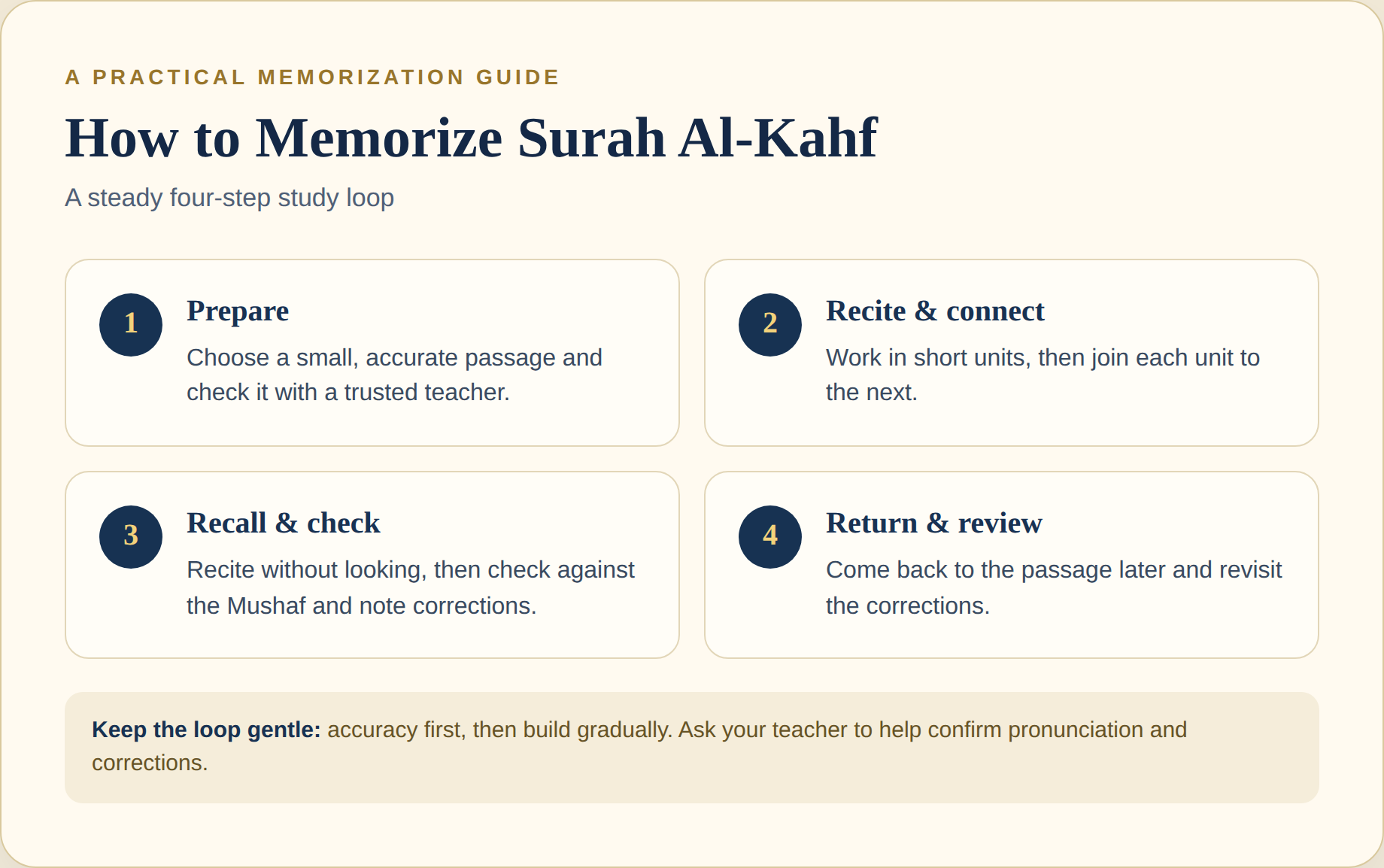
A practical learn–connect–review cycle
1. Set up the passage
Choose one mushaf edition and keep using it where possible. Read the next portion while looking at the text. Listen to a trusted reciter if audio helps you hear the rhythm, then recite yourself rather than letting the recording carry the passage. If a word, vowel, stopping point, or pronunciation is uncertain, ask a teacher before repeatedly practising it. Repetition can make a mistake familiar; it cannot certify that the mistake is correct.
Pick a short, connected section that suits your current ability. It may be a few verses or less, depending on the text and your reading. Do not force a break in the middle of a phrase merely to hit a target. The chunking guide’s useful principle is flexibility: the unit is a practice aid, not a universal verse count.
2. Learn for accurate recall, not a repetition quota
Read the selected unit attentively, then cover the text and attempt it from memory. When you hesitate, stop and locate the exact point. Check the mushaf, correct the word or transition, and try that part again in context. You might repeat a short phrase and then connect it to the preceding phrase; choose the amount of repetition from what needs repair rather than from a magic number.
Pay particular attention to the start of the next chunk. Knowing two parts separately does not always mean you can move smoothly from one to the next. Practise the join by reciting the end of the earlier section into the beginning of the later one. Keep the verse reference beside your notes so you can find the same place next time.
Worked example: connecting 18:1–3. Suppose you have learned these opening verses and want to make the transition into them dependable. First, check the exact wording and your recitation in a mushaf, and ask a teacher about any pronunciation or stopping uncertainty. For meaning-based orientation only, notice the progression: the passage opens by directing praise to Allah for the revealed Book; it then describes the Book as upright and warns of severe consequence while giving good news to believers who do righteous deeds; the next verse continues that good news by referring to their lasting reward. This is a neutral study summary, not a replacement for the Arabic or a quotation.
Now close the mushaf and try the passage from its beginning. If you recall the first verse but hesitate at the move into the warning and good news, mark that transition rather than restarting the whole surah repeatedly. Check the text, recite the affected part accurately, then practise from the end of the first verse into the start of the next; afterwards join the second into the third. On a later session, attempt all three in order without looking, then verify. If you lose the sequence, use the broad progression as a cue, reopen the text, and repair the exact wording. Meaning can help you orient recall, but it cannot authorize changing, filling in, or guessing Quran wording.
3. Return after a gap
Do not make every session new memorization. At the next practice, first try to recall yesterday’s passage before opening the mushaf. Revisit it again later in the week and keep older passages in circulation as the surah grows. The Australian Education Research Organisation’s explainer on spacing and retrieval describes spacing learning across sessions and retrieval practice as actively recalling learned material. That is general educational guidance; it supports returning to material and testing recall, but it does not establish a Quran-specific schedule, chunk size, or repetition count.
A simple review sequence might be: a brief recall later the same day if useful, a check the next day, another within the week, and then ongoing review. Treat those as options, not scientifically exact intervals or religious prescriptions. If recall is shaky, shorten the gap or reduce new material. If it is secure, continue to revisit it as part of a sustainable routine. Quranytime’s weekly Hifz plan explains how new work, recent review, and older revision can share a week.
One flexible timetable
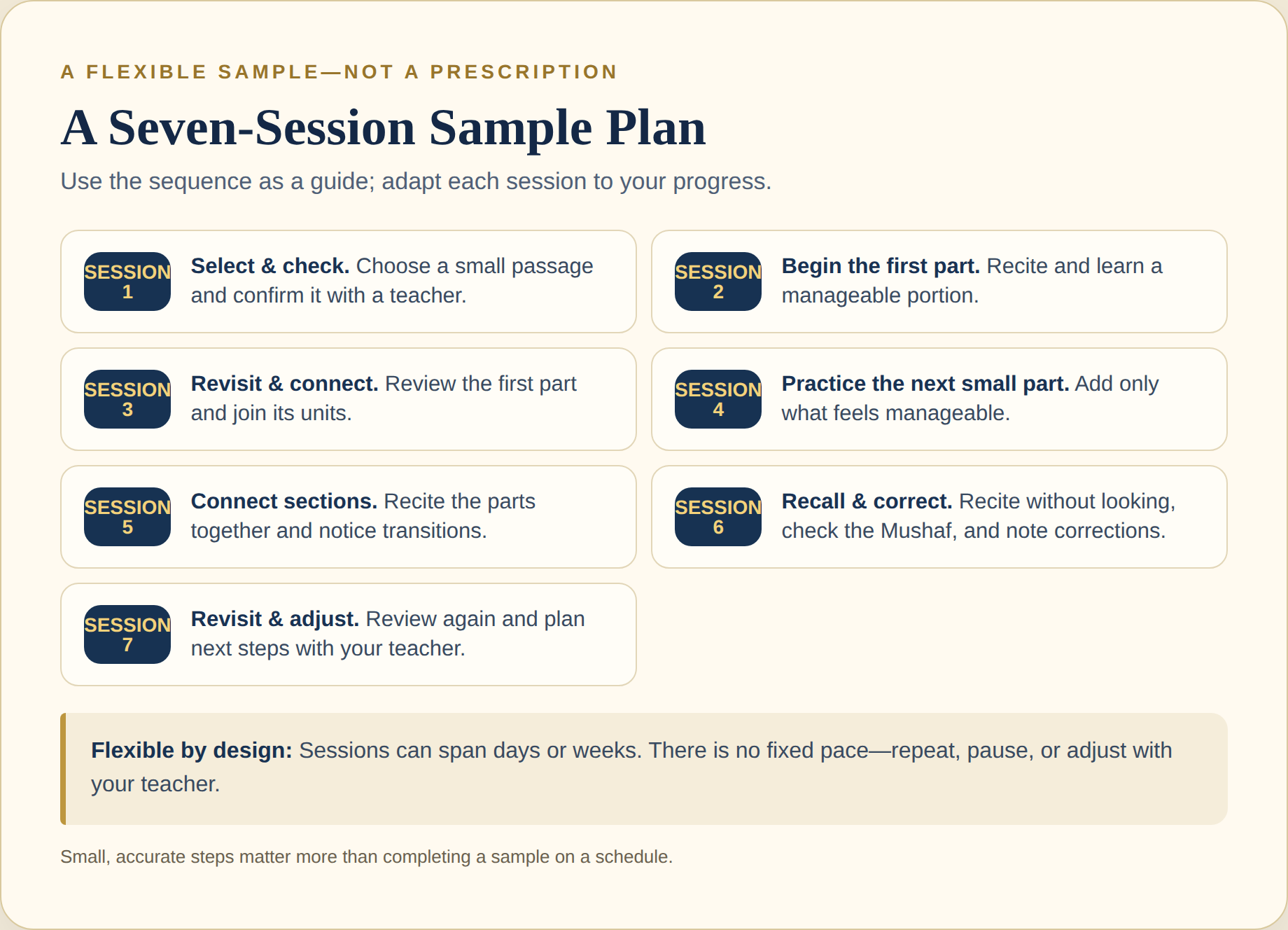
Here is an example for someone who can practise most days. It is a structure, not a promise that the whole surah will be memorized in a particular number of weeks.
- Choose a daily window. Start with 15–25 focused minutes, or a shorter period you can protect. A regular, calm session is usually more useful than an occasional marathon.
- Begin with revision. Recite yesterday’s new section and a small portion from earlier in the plan. Check uncertain points against the mushaf.
- Add a modest new unit. Work only on a portion you can read accurately and attempt without looking. Stop adding new material if careful recall is deteriorating.
- Connect the sections. Recite the new unit from its start, then join it to the section immediately before it.
- Reserve one or two sessions each week for review. Use these to revisit accumulated material, repair weak joins, and ask a teacher about persistent errors. A missed day is a reason to resume, not to double the workload automatically.
Some learners will need several sessions for a small passage; others may be ready to move on sooner. Progress is not measured only by how many verses are newly covered. A slower plan that protects accuracy and revision can be more sustainable than a fast plan that leaves a long repair job.
Special note: the first and last ten verses
A narration in Sahih Muslim, also reproduced in Riyad as-Salihin 1021, says that whoever commits to memory the first ten verses of Surah Al-Kahf will be protected from the trial of the Dajjal; another narration mentions the last ten. Read the narration and its references at Sunnah.com. It is reasonable to give these passages focused attention, but do not present them as a substitute for learning the rest of the surah or as a guaranteed timetable. The narration itself is not a memorization schedule.
This is distinct from reports about reciting the whole surah on Friday. IslamQA’s answer on when to read Surah Al-Kahf on Friday discusses reports concerning recitation during the night or day of Jumu’ah, describing that interval as sunset Thursday to sunset Friday. A separate IslamQA answer on protection from the tribulation of the Dajjal cites the ten-verse memorization report and the opening-verses recitation report. These are different reports with different wording and scope. For personal religious rulings, consult a trusted scholar; this article does not infer additional rulings from them.
How to check whether the plan is working
Once a passage has had some time to settle, close the mushaf and recite the agreed range aloud. Note the exact place you paused, skipped, or needed a prompt. Then check the text rather than relying on a vague sense that it “sounded right.” Try the passage again later, and ask a teacher about pronunciation, tajwid, or a stop that you are unsure about.
As the surah grows, test both connected recitation and the transitions between your chosen sections. A teacher may also suggest appropriate starting points for checking recall. Do not choose arbitrary mid-phrase starts or treat a self-test as a judgment of your worth. Quranytime’s guide to testing Quran memorization offers a practical way to record errors and follow up. If the workload starts to feel heavy, its Hifz burnout guide suggests recognizing overload early and resetting with care.
A compact note can include the verse range, whether you recalled it without looking, the specific point needing correction, and when you plan to revisit it. This makes progress visible without turning memorization into a competition or a page-count exercise.
Frequently asked questions
How do I memorize Surah Al-Kahf?
Use a consistent mushaf, choose a short connected passage, learn it with accurate recitation, test yourself without looking, practise its join to the previous passage, and return to it over later sessions. Keep revising older verses as you add new ones, and ask a qualified teacher to check uncertain recitation.
How long does it take to memorize Surah Al-Kahf?
There is no single reliable duration. It depends on your reading fluency, available practice time, chunk size, revision needs, and how securely you retain earlier passages. Set a routine first and let accurate recall—not a deadline—determine the pace.
Should I memorize ten verses a day?
No fixed daily quota is required by the method in this guide. The ten-verse narration concerns the first ten verses (with another narration mentioning the last ten) and their virtue in relation to the Dajjal; it does not state that learners must memorize ten verses every day.
Can I memorize without understanding Arabic?
You can work on memorization while still learning Arabic, but understanding a passage’s broad meaning may help you keep its sequence in view. Use a dependable translation as a study aid, not as a replacement for the Arabic text or a teacher’s correction. Keep the learning process manageable and accurate.
What if I forget a passage I already learned?
Return to the exact verse range, check it against the mushaf, identify the point of weakness, and rebuild the passage in context. Add it to your revision cycle. Forgetting is a signal to adjust review, not evidence that you cannot learn the surah.
Keep the goal steady and the method flexible
Begin with a connected passage you can read carefully. Learn it, retrieve it without looking, connect it to what comes before, and revisit it after a gap. Use the surah’s verse ranges as landmarks, not as compulsory daily portions. If you preserve accuracy and make room for revision, your plan can grow at a pace that fits your life—and keep the whole surah, not just its newest verses, in view.