
When you begin memorizing the Quran, the Mushaf in your hands becomes part of your learning routine. Which Mushaf is best for Quran memorization? You may wonder whether to choose a 15-line edition, a particular script, or a specific publisher. The practical answer is not that one format is best for everyone. Choose a clear, reliable Mushaf whose script and recitation tradition match what your teacher teaches, whose layout you can comfortably read, and whose page design you can keep using consistently.
This guide focuses on selecting an edition—not on a memorization schedule or a page-by-page reading method. If you already have a teacher, ask them to help you compare copies before you buy. Your teacher’s guidance on the recitation tradition and reading conventions matters more than a product label or a popular online recommendation.
Start with the recitation you are learning
Before comparing covers, page counts, or line numbers, confirm which riwayah (transmitted mode of recitation) you study. Learners in many communities commonly study Hafs ‘an ‘Asim, while other communities and teachers may teach Warsh ‘an Nafi‘ or another riwayah. The point is not to rank them: use the one your qualified teacher is teaching you.
Printed editions can differ in orthographic conventions, signs, and other visual details associated with their reading tradition. Those differences can be confusing if you are a beginner and switch without guidance. Check the title and edition information, then show the actual copy to your teacher. Do not assume that a familiar cover, country of sale, or the word “standard” proves that it matches your lesson.
The King Fahd Glorious Quran Printing Complex’s official site describes editions in multiple riwayat and lists separate Madinah Mushaf applications for Hafs and Warsh. That is useful evidence that the reading tradition is a real selection detail, not merely a branding variation. It does not mean that this institution is the only suitable source or that any particular edition is right for every learner.
What IslamQA says about keeping one copy
In its answer “How to memorize the Holy Quran”, IslamQA includes a recommendation to adhere to one style of writing in the Mushaf used for memorizing. The answer explains that the learner may remember the visual pattern of verses and their positions on pages, and that changing among copies with different verse positions may cause confusion. It also stresses learning correct pronunciation from someone who reads well and reciting to another person who can identify mistakes.
That answer supports a practical preference for consistency when page layouts vary. It is not a product comparison, does not name a universally best edition, and does not establish that everyone must own a particular printed Mushaf. It also does not identify one riwayah as preferable for all learners. Apply its advice within its stated scope, and ask your teacher about your own study context.
Compare the page layout you will actually use
Page design shapes how easily you can find a place, follow a line, and return to a passage. Some editions use a familiar, repeated line structure; others have different numbers of lines, page dimensions, margins, or verse placement. A fixed line count can be helpful if your teacher refers to page and line positions or if you find a stable visual map useful. But a particular number of lines—15 included—is not a universal requirement or a guarantee of easier memorization.
Compare a few representative pages rather than judging only the cover. Look at a short surah, a page with longer verses, and a page where a surah begins or ends. Notice whether the line spacing gives your eyes room to track Arabic from right to left, whether verse endings are easy to distinguish, and whether the page feels crowded. Ask whether your teacher’s references rely on a layout you can access consistently.
Do not select an edition because a seller promises that its page arrangement will make memorization effortless. Page positions can support orientation, but the reliable choice is the one that suits your reading and instruction. If two editions differ substantially in where verses fall, settle on one with your teacher before building a routine around page locations.
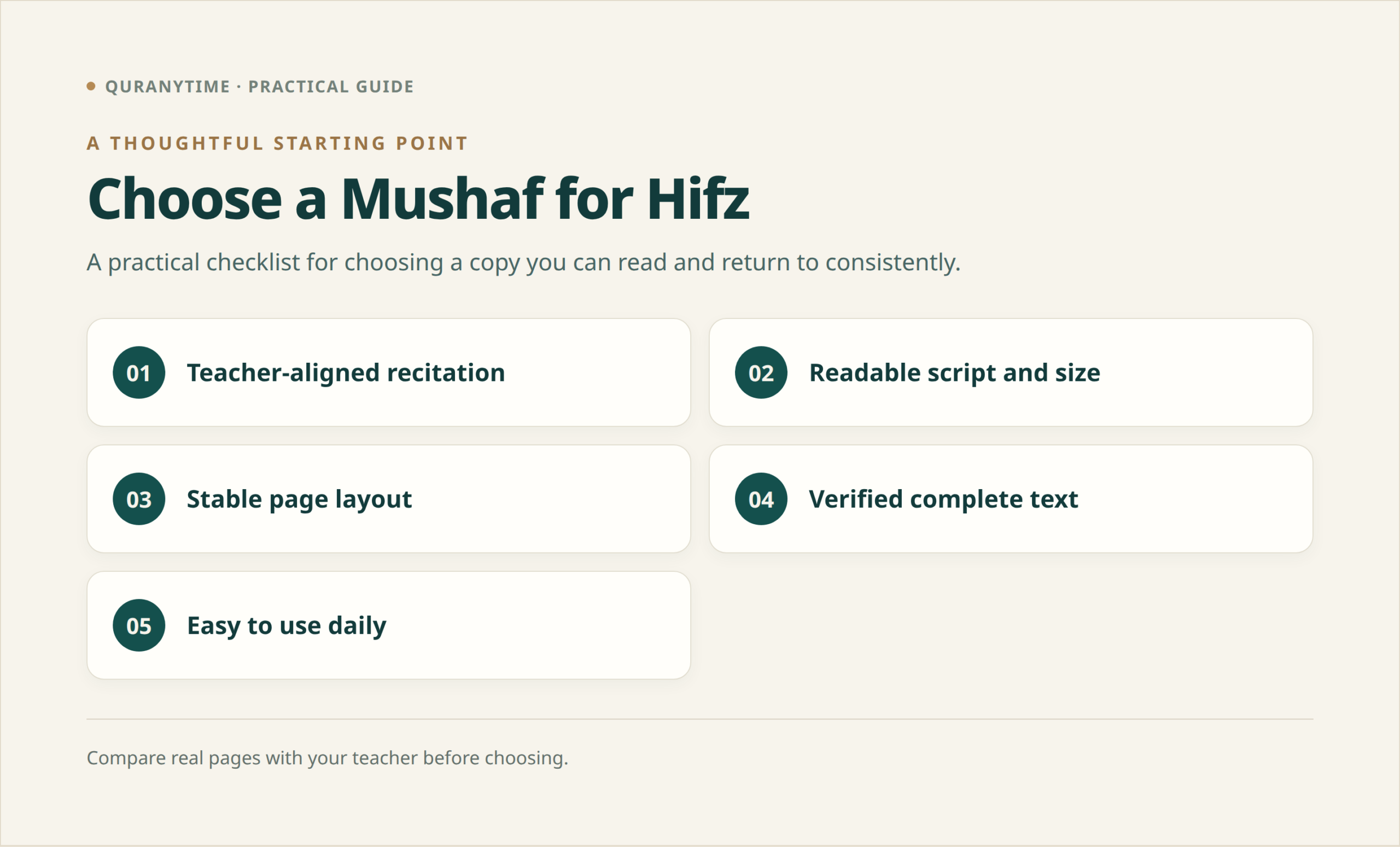
Choosing a Mushaf for hifz: five practical checks, from teacher alignment to daily usability.
Script and orthography: recognize what you are comparing
Learners may encounter Uthmani-script editions and editions using Indo-Pakistani conventions, among other familiar print styles. These terms describe differences in how Arabic text and reading signs appear on the page; they are not simple labels for “better” and “worse.” Some learners find the script used in their family, local mosque, or class easier to recognize because they have read it for years. Others are learning a different convention for the first time.
Examine the actual Arabic text rather than relying on a thumbnail or a vague online description. If signs, letter shapes, or notation look unfamiliar, take the copy to your teacher and ask whether it matches the class. The official King Fahd Complex website also describes a digital Quran font designed to support multiple riwayat, including Hafs, Warsh, Qalun, Shu‘bah, al-Duri, and al-Susi. This supports the limited point that digital text resources may distinguish among reading traditions; it is not a substitute for checking a specific printed edition with your teacher.
For a beginner learning Arabic reading, pairing the Mushaf with structured instruction may be more useful than trying to decode unfamiliar print conventions alone. Quranytime’s Arabic reading guide and teacher information are starting points for exploring reading support. They do not replace your own teacher’s decision about the edition for a particular class.
Prioritize comfortable, accessible print
There is no benefit in choosing a beautiful copy that is hard for you to read. Compare font size, contrast, line spacing, paper glare, and the amount of text on a page under the lighting where you usually study. Try reading several lines at a normal distance. If you use glasses, use them as you normally would. Large-print editions, a reading stand, or a digital zoom option may make study more comfortable for some people.
Comfort varies. A compact Mushaf may be easier to carry but have smaller text; a larger page may feel easier to follow but less convenient to transport. If holding a book or turning pages is difficult, consider a stable stand or accessible digital format. If you use assistive technology, test whether the digital option works with your screen reader, magnification, or preferred controls before relying on it.
These are practical accessibility considerations, not medical advice. If visual or physical access is a concern, choose the format that allows you to participate comfortably and ask a relevant teacher or accessibility professional about options suited to you.
Check print quality and publication details
Choose a copy with legible, clean printing and identifiable publication information. Inspect whether letters and diacritical marks are crisp, ink is not smudged, pages are intact, and the binding opens comfortably without obscuring text near the gutter. If purchasing in person, compare the same page across copies. If buying online, look for photographs of interior pages and clear product details, and ask the seller for specifics when the listing is vague.
Prefer a reputable publisher or distributor and verify that the edition’s stated riwayah and text match what your teacher recommends. “Verified” should mean you have checked the actual product and its publication details—not that an online listing uses reassuring words. Avoid assuming that an unofficial scan or reprint is accurate merely because it resembles a familiar edition. If anything looks unusual, pause and have a knowledgeable teacher check it.
The official King Fahd Complex describes its work as printing and publishing Quran editions and provides services for digital versions. Its site can help identify institutional resources, but it does not certify every product sold under a similar name elsewhere. Confirm the specific copy, not only the name in an advertisement.
Printed Mushaf or digital copy?
A printed copy offers a consistent physical page, easy visual orientation, and no notifications or changing screen brightness. A digital Mushaf can be portable, enlargeable, searchable, and available with accessibility features or audio depending on the app. Some official digital sources provide specific reading traditions: the King Fahd Complex’s official site lists separate Hafs and Warsh applications. Check the app’s source, settings, and displayed text before using it for memorization, and confirm it with your teacher.
Digital layout is not always identical to a printed edition. Page breaks may change with screen size, font setting, or app mode. If you memorize by visual page location, use a fixed page-image or layout mode where possible and avoid changing display settings mid-course. If you memorize by verse sequence and recite to a teacher, a changing reflowed display may matter less—but still ensure the text and reading conventions are appropriate for your lesson.
You do not necessarily need to choose only one format. You might keep a main printed Mushaf for regular study and use a digital copy for travel or enlargement, provided both match your teacher’s guidance. Quranytime’s article on testing memorization discusses checking recall; the relevant point here is to keep your chosen text available when reviewing so that mistakes can be identified accurately.
Should you ever change your Mushaf?
Consistency is helpful, but real life changes. A copy may be unavailable, damaged, difficult to read, or poorly matched to the teacher’s instruction. A move, accessibility need, or change in course may also make a different edition more practical. IslamQA’s answer describes how differing page positions can confuse a learner; it does not say that changing is forbidden or impossible.
If you need to switch, avoid treating the new copy as interchangeable without checking it. Compare the reading tradition and text with your teacher, then identify the passages or page breaks that look different. For a period, keep both copies available if possible, and ask your teacher how to refer to places when page numbers no longer match. The goal is clarity and sound recitation, not loyalty to a product.
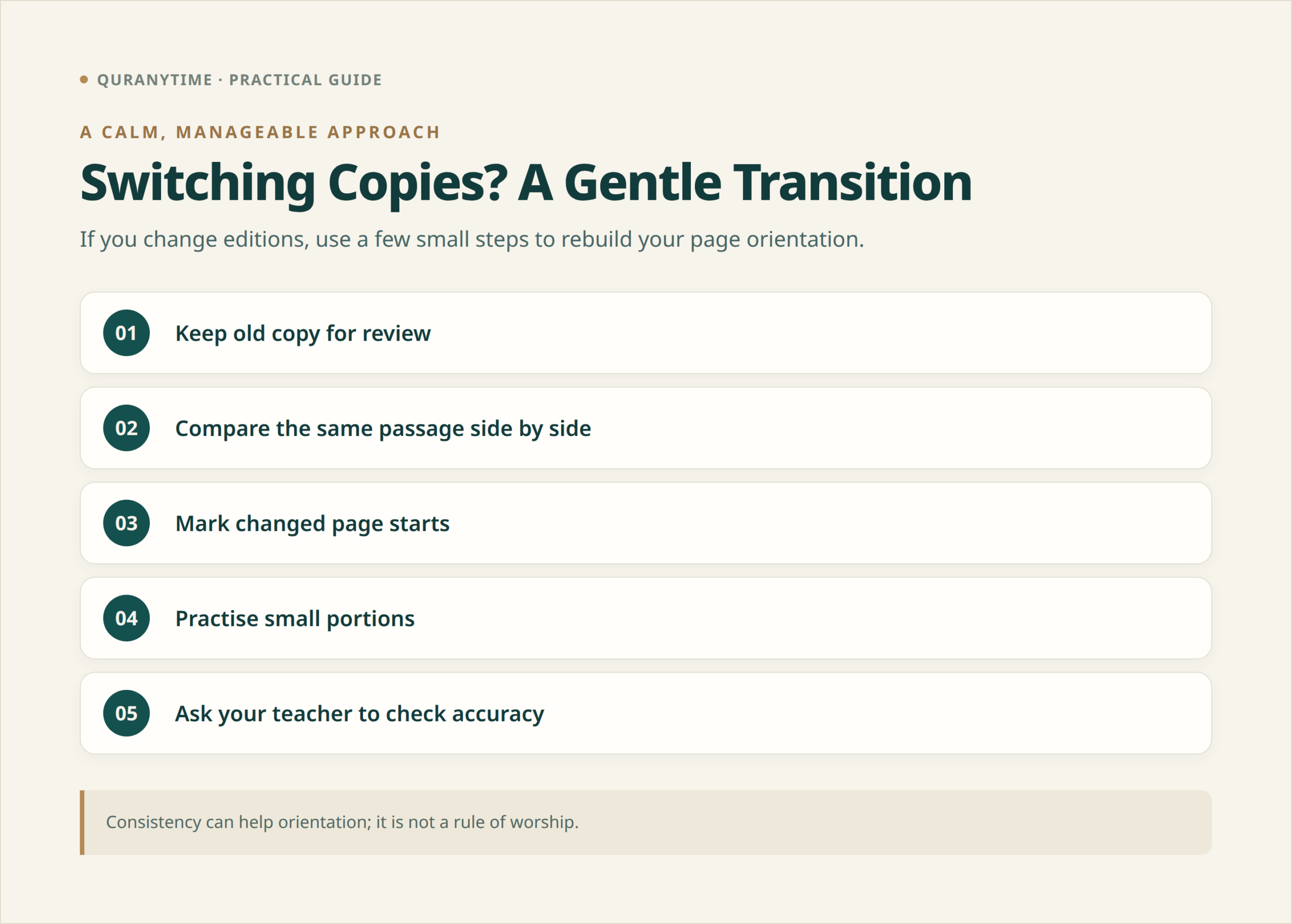
A gentle transition when changing copies: compare pages, rebuild orientation, and ask your teacher to check your recitation.
A non-authoritative checklist for choosing
- Ask your teacher first: Which riwayah and print conventions are used in class? Does the teacher refer to a particular page layout?
- Check the actual edition: Read the title and publication details; do not infer the text from the cover or seller’s country.
- Test readability: Read several lines on different kinds of pages. Consider font size, contrast, spacing, and glare.
- Compare layout: Note page size, line count, verse placement, and whether you can find your place easily. Treat line count as a preference, not a rule.
- Inspect print and binding: Look for crisp marks, clean pages, and a binding that does not hide text.
- Consider access and use: Will you study at home, travel with it, use magnification, or need a screen reader? Test the format before committing.
- Plan for consistency: Can you keep this same copy or fixed digital layout available for regular study? If not, agree with your teacher on a practical alternative.
- Ask again if uncertain: Take a sample or product link to someone qualified to check the reading tradition and text.
The practical answer
The best Mushaf for your Quran memorization is not a universal product category. It is a reliable, legible edition in the reading tradition your teacher teaches, with a layout and format you can use comfortably and consistently. A 15-line layout may suit one learner; another may prefer a different page size, script, or accessible digital display. Decide with a sample page in front of you, verify the copy, and let your teacher’s feedback guide the final choice.
If you are also building a wider study routine, explore Quranytime’s guides to memorizing a surah and memorization for learners who are new to Arabic. Those are separate questions from choosing an edition; for this decision, start with your teacher, compare the copy itself, and choose the one you can read and return to with confidence.