

مُعَلِّمُونَ and مُعَلِّمِينَ both mean “male teachers.” The change does not normally turn one group into another; it shows how the group fits into a sentence. A sound masculine plural uses wāw in its nominative ending and yā in its accusative and genitive endings. To read it accurately, you need more than the final nūn’s vowel.
This lesson follows a set of fictional teachers through an attendance note, an invitation, and a staff description. Its focus is the sound masculine plural, جَمْعُ الْمُذَكَّرِ السَّالِمِ, including what happens to nūn in idafa. The composed examples are practice sentences, not Quran quotations. A short verified Quran example appears later, with its reference and grammatical source.
Two visible endings, three grammatical cases
Start with مُعَلِّمٌ, “a male teacher.” In a transparent sound plural, the stem is retained and an ending is added: مُعَلِّمُونَ in a nominative position, مُعَلِّمِينَ in an accusative or genitive position. In simplified transliteration these endings are often written -ūn and -īn, or -un and -in without length marks. Read the long vowel; do not confuse them with singular tanwin.
The full connected forms have a final nūn with fathah: -ūna and -īna. That fathah is not what distinguishes nominative from accusative here. The case letter is wāw or yā. If you look only at the nūn’s vowel, you will assign the wrong case to many perfectly ordinary phrases.
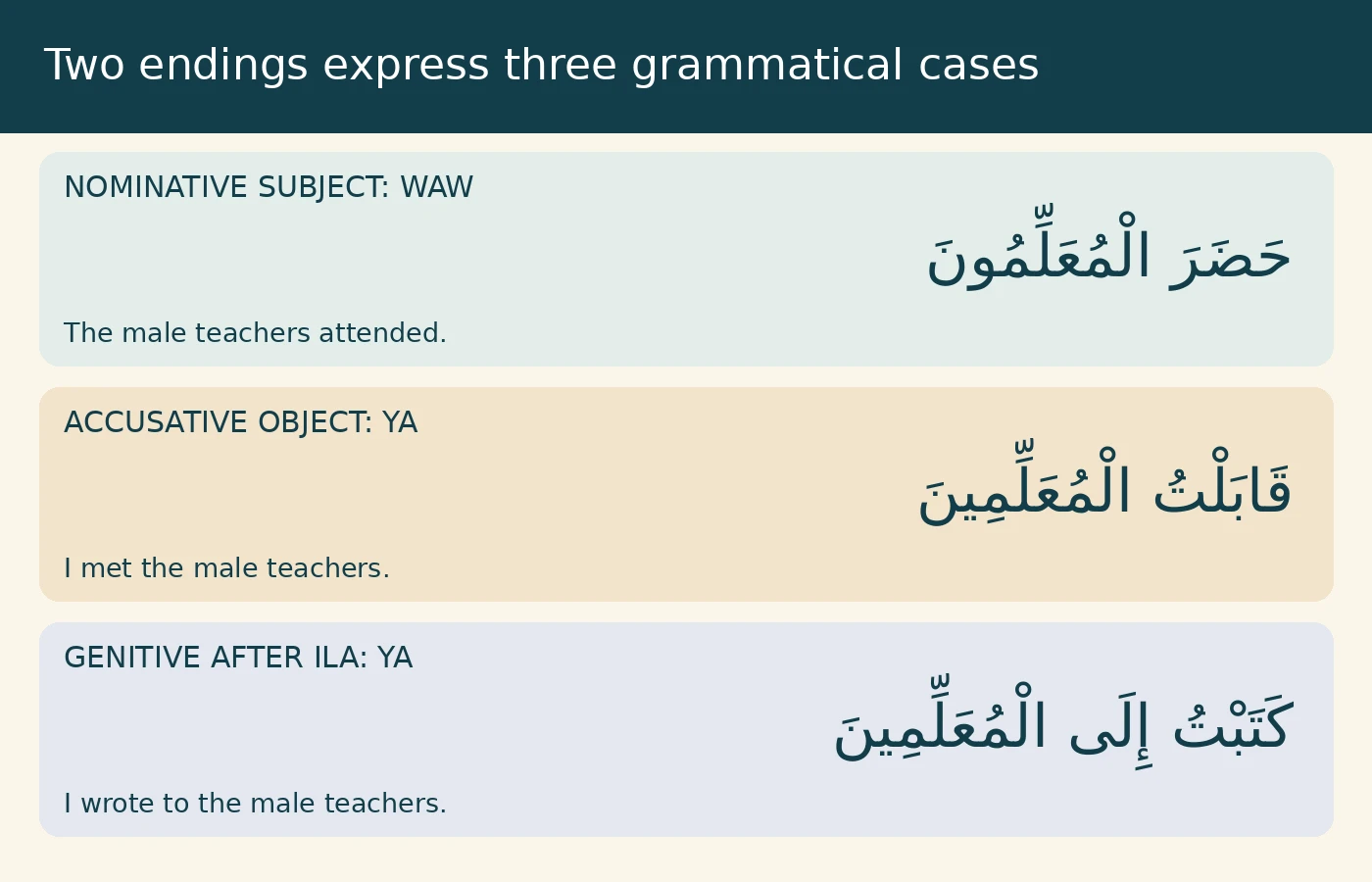
Compare حَضَرَ الْمُعَلِّمُونَ, “The male teachers attended,” with قَابَلْتُ الْمُعَلِّمِينَ, “I met the male teachers.” In the first, the teachers are the subject, so the noun is nominative with wāw. In the second, they are the object, so it is accusative with yā. The Arabic case guide explains the role-and-marker distinction that makes this pattern intelligible.
The invitation tells you what the ending cannot
Now read كَتَبْتُ إِلَى الْمُعَلِّمِينَ, “I wrote to the male teachers.” The same الْمُعَلِّمِينَ that was an accusative object in the meeting sentence is genitive here after إِلَى. Its spelling alone cannot choose between those cases. The preposition supplies the decisive relationship.
A useful annotation is “إِلَى → genitive → sound masculine plural → yā.” In the object sentence, write “قَابَلْتُ → direct object → accusative → yā.” The shared marker is not a contradiction. Two grammatical cases can use the same form in this noun category.
Read the preposition lesson when the preceding word is unfamiliar. Do not invent an unspoken preposition merely to explain an -īn ending. An object can already have that ending without any preposition at all. Likewise, a genitive noun does not have to follow a preposition; it can be an idafa dependent.
Which nouns can use the pattern?
Common transparent examples include مُعَلِّم → مُعَلِّمُونَ, teacher → teachers; مُهَنْدِس → مُهَنْدِسُونَ, engineer → engineers; and مُسْلِم → مُسْلِمُونَ, Muslim → Muslims. The sound masculine pattern is associated with suitable masculine personal names and descriptions of rational beings under traditional conditions. It is not an automatic pluralizer for every grammatically masculine noun.
كِتَاب, “book,” is grammatically masculine, but its common plural is كُتُب, not a newly invented form made by attaching ـون. رَجُل, “man,” normally has رِجَال as its familiar plural. A noun can refer to male people without using the sound masculine plural. Learn the established plural with the noun rather than assigning a suffix from meaning alone.
The broken-plural guide explains the contrasting strategy. Also distinguish grammatical gender from the exact people included in a particular plural reference: masculine plural agreement can be used for mixed groups in standard Arabic. The ending is grammatical evidence, not a complete description of every person in the group.
Singular tanwin is not plural nūn
Compare مُعَلِّمٌ and مُعَلِّمُونَ carefully. The singular indefinite form has tanwin; the sound plural has a written nūn as part of its inflectional ending. Their sounds can look superficially similar in loose English transliteration, especially when vowel length is omitted, but the Arabic spelling and grammatical pattern differ.
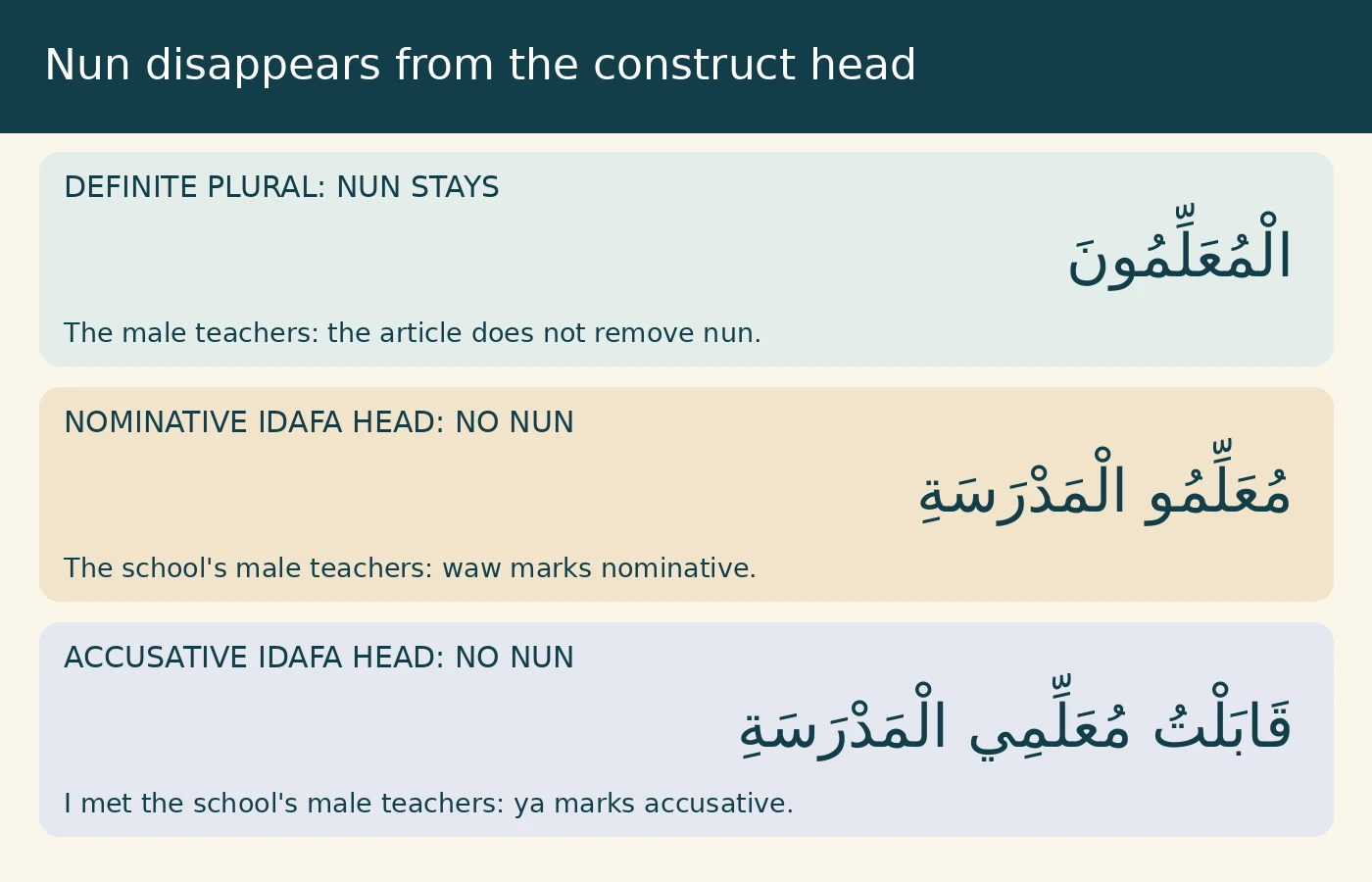
Now add the definite article: الْمُعَلِّمُ and الْمُعَلِّمُونَ. The singular loses tanwin, while the sound plural retains its nūn. Therefore “the article removes every final n sound” is false. It removes tanwin in the regular noun pattern, not the written nūn of this sound plural.
Use the definiteness lesson if those two types of ending are getting mixed in your notes. For a listening task, say each singular and plural pair in a complete sentence. Hear the long ū or ī and inspect the written nūn; do not rely on an English spelling such as “un” to show all the distinctions.
The staff description removes nūn for a reason
مُعَلِّمُو الْمَدْرَسَةِ means “the school’s male teachers” in a nominative position. The plural’s nūn is removed because the noun is now the first member of an idafa. The wāw remains as the nominative marker. Do not add the article to the construct head in this ordinary idafa pattern.
Move the phrase into an object sentence: قَابَلْتُ مُعَلِّمِي الْمَدْرَسَةِ, “I met the school’s male teachers.” The head is accusative with yā, and the nūn remains absent because of idafa. After a preposition, كَتَبْتُ إِلَى مُعَلِّمِي الْمَدْرَسَةِ also has yā, now for genitive case. الْمَدْرَسَةِ remains genitive as the dependent in all three.
Compare this with الْمُعَلِّمُونَ in a non-construct definite phrase: the article alone did not remove nūn. The idafa guide explains why the head and dependent have different restrictions. The missing nūn is not evidence that the teachers have become singular.
A spelling trap: the noun’s wāw is not a verb’s wāw
In مُعَلِّمُو الْمَدْرَسَةِ, the nominative sound plural construct head ends in wāw without an extra silent alif after it. Do not copy the spelling convention from a plural past-tense verb such as كَتَبُوا, “they wrote,” into this noun. Similar final sounds do not make the word classes interchangeable.
A second trap concerns mood. Some imperfect plural verbs lose nūn after certain governing particles. Sound masculine plural nouns lose nūn in idafa for a different reason. In both cases you may see a missing nūn, but you must identify whether you are reading a noun construction or an inflected verb.
You do not need to explain every verb-mood rule to solve the noun exercise. Ask whether the word names people or presents an action, and inspect the dependent phrase that follows it. If the phrase is “teachers of the school,” the relevant explanation is nominal idafa. This keeps two useful rules from being merged into one inaccurate “delete nūn” shortcut.
Add a description without changing the group
الْمُعَلِّمُونَ الْمُجْتَهِدُونَ means “the diligent male teachers.” Both expressions are nominative sound masculine plurals. In قَابَلْتُ الْمُعَلِّمِينَ الْمُجْتَهِدِينَ, “I met the diligent male teachers,” both are accusative with yā. The adjective follows the noun’s grammatical case as well as its appropriate agreement features.
The ending match is a check on an analysis, not a substitute for one. First establish that the teachers are the object, then make the adjective follow. The adjective agreement lesson gives the wider framework. If the two words have different case endings in this controlled exercise, identify which relationship you changed unintentionally.
Word order adds another independent decision. حَضَرَ الْمُعَلِّمُونَ has a singular verb before its explicit plural subject in the standard pattern. الْمُعَلِّمُونَ حَضَرُوا starts with the plural topic and has a plural verbal predicate. The verbal-sentence guide explains that contrast. Do not diagnose every verb-agreement difference as an error in the noun’s plural ending.
Read the ending in a verified Quran example
Quran 23:1 reads قَدْ أَفْلَحَ الْمُؤْمِنُونَ. The Quranic Arabic Corpus identifies الْمُؤْمِنُونَ as a nominative masculine plural active participle. The sound plural’s wāw marks the nominative case. Its final nūn carries fathah in connected reading, but that does not make the noun accusative.
See the Corpus analysis of 23:1:3 for the morphology. Read the full passage with a reliable translation to understand the qualities that follow in the surah. This short grammatical observation identifies the noun’s form and role; it does not replace the passage’s broader meaning.
Proofread a fictional attendance note
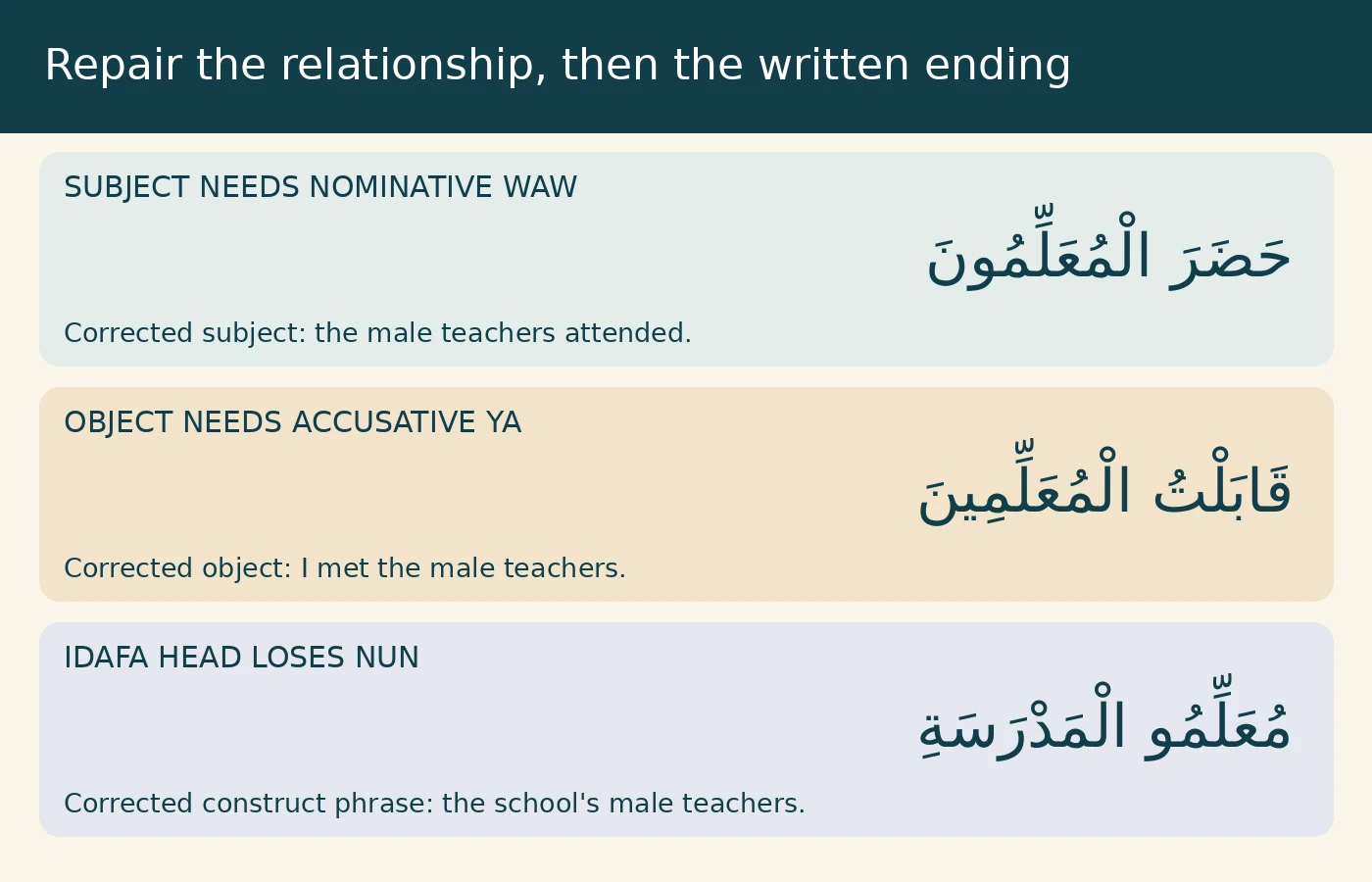
Here are three deliberately faulty items for correction: حَضَرَ الْمُعَلِّمِينَ; قَابَلْتُ الْمُعَلِّمُونَ; and مُعَلِّمُونَ الْمَدْرَسَةِ when the intended meaning is “the school’s teachers.” Explain what each writer misunderstood before changing a letter.
The corrections are حَضَرَ الْمُعَلِّمُونَ for a nominative subject; قَابَلْتُ الْمُعَلِّمِينَ for an accusative object; and مُعَلِّمُو الْمَدْرَسَةِ for a nominative idafa head with nūn removed. The first two require a different case marker. The third requires a different construction form, while keeping the head nominative.
When an unvocalized form hides more than one possibility
Without vowel marks, معلمي can be less transparent than a beginner’s chart suggests. In the right construction it can represent مُعَلِّمِي as an accusative or genitive plural construct head. In a different sentence, مُعَلِّمِي can mean “my teacher,” with a singular noun and the speaker’s possessive yā. The letters alone do not guarantee plural meaning.
Use the surrounding reference to test your reading. Does the paragraph discuss one teacher or several? Is a dependent noun completing an idafa? Does an adjective or a later pronoun supply a number clue? A dictionary form helps identify the noun, but the sentence determines how its ending is functioning. Write down an uncertainty rather than silently choosing the first meaning that comes to mind.
In fully vocalized teaching material, use the marked long vowels and the construction as combined evidence. In ordinary prose, ask for enough context to settle the intended group. This is especially useful when reading a school notice, where a short heading may omit the larger sentence. A heading can contain a noun phrase without showing every relationship that a complete sentence would make explicit.
One construction, two different head positions
Compare مُدِيرُ الْمُعَلِّمِينَ, “the teachers’ director,” with مُعَلِّمُو الْمَدْرَسَةِ, “the school’s teachers.” In the first phrase, the teachers are the dependent of another noun. They are genitive and retain nūn. In the second, the teachers are themselves the construct head; their nūn is removed. Merely being somewhere inside an idafa phrase does not delete every nūn you see.
Now put both phrases after إِلَى. You get إِلَى مُدِيرِ الْمُعَلِّمِينَ and إِلَى مُعَلِّمِي الْمَدْرَسَةِ. The outer preposition changes the head’s case. The inner dependency remains. Explain why الْمُعَلِّمِينَ keeps nūn in the first phrase while مُعَلِّمِي lacks it in the second. This comparison checks whether you understand the head/dependent distinction rather than merely associating the word “idafa” with deletion.
Make the reading decision reusable
Keep a short record with four spaces: noun type, governing relationship, case, and visible marker. Fill it for a new noun such as مُهَنْدِسُونَ rather than repeating the teacher example indefinitely. Then put the noun into an idafa and explain the missing nūn. Successful transfer to a different word is more informative than remembering one familiar translation.
For a neutral reference on nominative wāw and nūn deletion in the construct form, consult Al Jazeera Learning Arabic’s lesson on nominative markers. To practise your own examples with a tutor, Book a Free Trial Class. Bring one -īn form whose case you cannot explain and one construct phrase where the nūn has disappeared.