
Arabic demonstrative pronouns are the words that point to “this,” “that,” “these,” or “those.” In Quranic reading, recognizing a form such as هَٰذَا (hādhā) or أُولَٰئِكَ (ulāʾika) helps you see what a phrase is pointing to—whether the noun comes next or the reference is already present in the verse. The forms are easier to learn when you read them in real phrases instead of memorizing a list alone. This guide maps the common forms, checks them against Quranic examples, and gives you a short routine for identifying their referents. It is a grammar aid, not a substitute for tafsīr or a qualified teacher.
What a demonstrative does in Arabic
Arabic grammar calls a demonstrative ism al-ishāra (اسم الإشارة), literally a “noun of pointing”; asmāʾ al-ishāra is the plural name for the class. English learning materials may call these words demonstratives, demonstrative pronouns, or demonstrative nouns. The label can vary because a demonstrative may appear with a noun or may stand as the pointer in a complete clause. Its core job is to direct attention: “this book,” “that message,” or “those people.”
Many learners first meet demonstratives in a simple near/far chart. That is a useful start, but Quranic reading asks one more question: what exactly does the word point to? Sometimes a noun follows immediately. Sometimes the demonstrative points back to a group or statement described earlier. Sometimes the phrase is a complete sentence rather than a noun phrase. Identifying the word and locating its referent are related but separate steps.
Demonstratives also differ from personal pronouns. A personal pronoun such as “he” or “they” identifies a person or group; a demonstrative directs the reader to something in the text or situation. Quranytime’s Arabic pronoun chart for Quranic reading covers personal pronouns, while its guide to Arabic relative pronouns such as alladhī and allatī explains words that introduce a relative clause. Keeping the jobs distinct prevents a common mistake: assuming every Arabic word translated “who,” “which,” or “that” belongs to the same grammatical category.
A quick map of common Quranic demonstratives
The first distinction to learn is near versus far, followed by gender and number. These English glosses are a starting point, not a promise that every verse will translate word-for-word the same way:
| Arabic form | Transliteration | Basic guide |
|---|---|---|
| هَٰذَا | hādhā | Near, masculine singular: this |
| هَٰذِهِ | hādhihi | Near, feminine singular: this |
| ذَٰلِكَ | dhālika | Far, masculine singular: that |
| تِلْكَ | tilka | Far, feminine singular: that; the natural English wording may differ |
| هَٰؤُلَاءِ | hāʾulāʾi | Near plural: these |
| أُولَٰئِكَ | ulāʾika | Far plural: those |
For a first reading, note the form and its noun or idea, then read the complete clause. The English gloss may differ while Arabic gender and number remain clear. Quranytime’s guide to Arabic adjective agreement explains how these features can appear across a noun phrase.
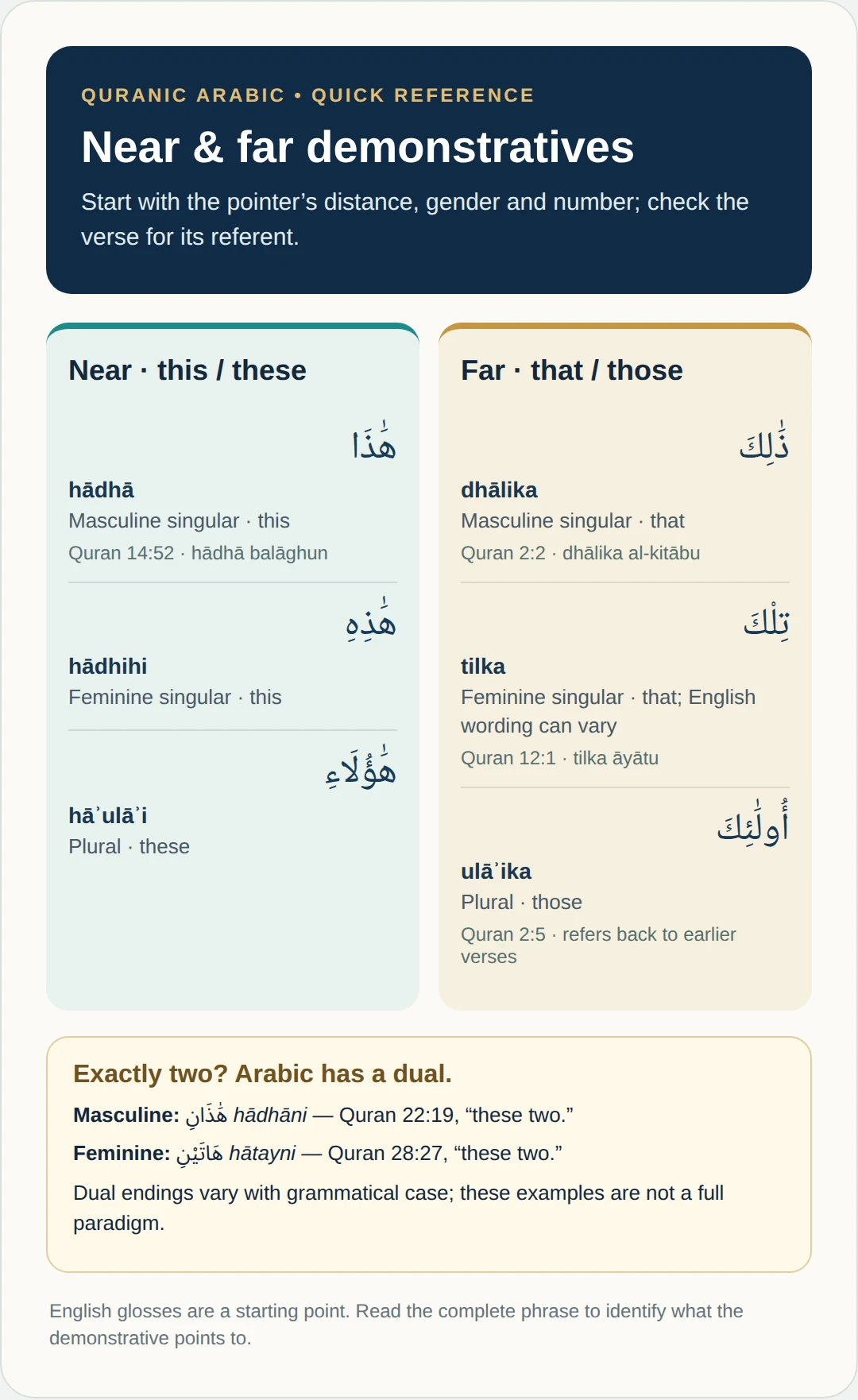
Arabic also has a dual, used for exactly two. In Quran 22:19, hādhāni is a masculine dual demonstrative, glossed “These two”; Quran 28:27 uses feminine dual hātayni, “these two.” The ending of a dual form changes with grammatical case, so a form heard in one verse is not a complete paradigm. If you are learning the dual, compare its role in the full sentence rather than memorizing one ending as universal.
Read the pointer inside the verse
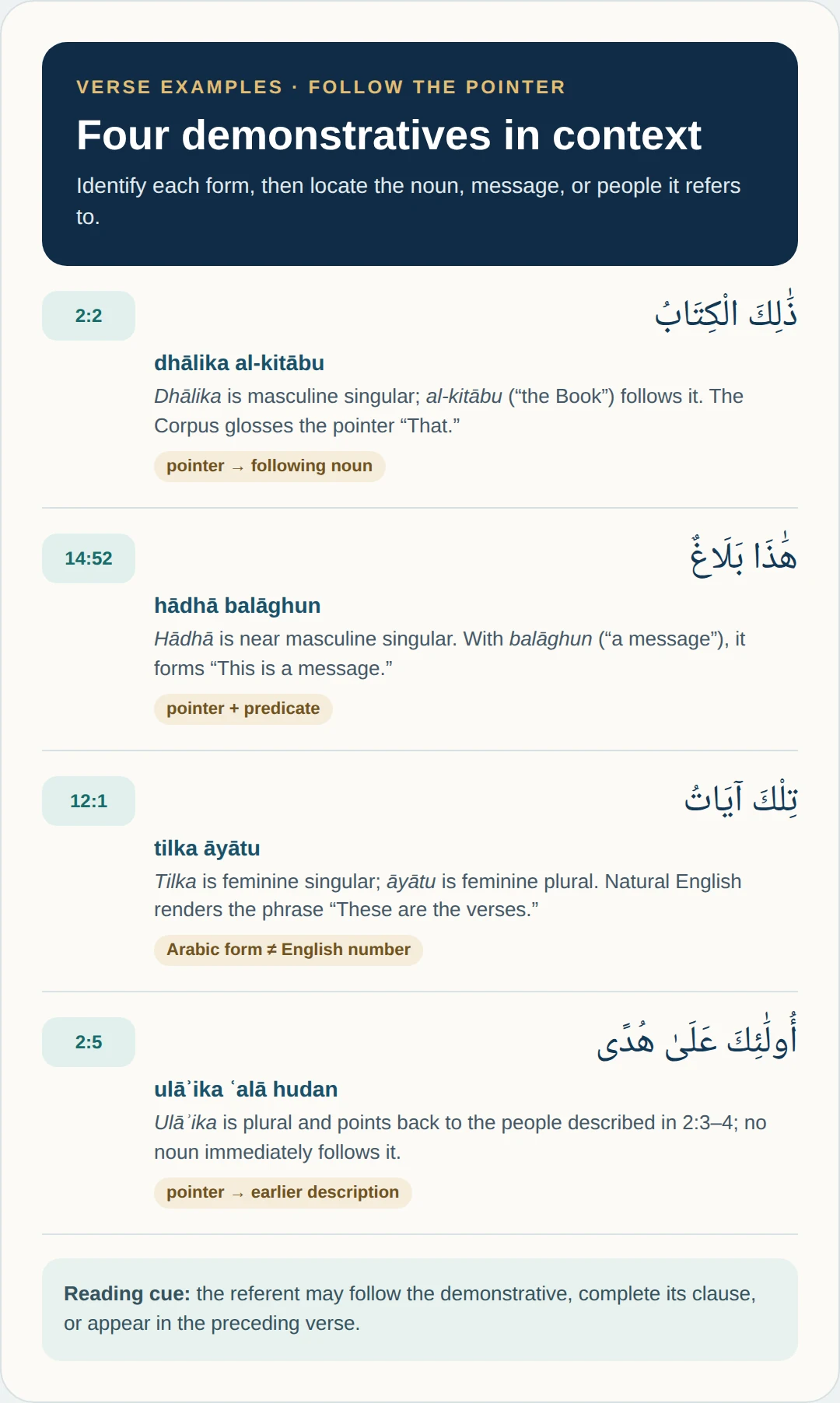
Quran 2:2 begins ذَٰلِكَ الْكِتَابُ (dhālika al-kitābu). Here the demonstrative comes before the noun al-kitābu (“the Book”). The Quranic Arabic Corpus tags dhālika as a masculine singular demonstrative and gives the gloss “That.” Its word-by-word analysis of Quran 2:2 is a useful model for checking the form and its grammatical label; use a trusted translation and the surrounding verse when you need a natural English rendering.
Now compare Quran 14:52: هَٰذَا بَلَاغٌ لِلنَّاسِ (hādhā balāghun lil-nāsi), “This is a message for mankind.” The demonstrative hādhā points to the message, and balāghun supplies the predicate. The phrase is not merely a word list: reading the sentence relationship tells you how the words work together.
Quran 12:1 offers an instructive contrast: تِلْكَ آيَاتُ الْكِتَابِ الْمُبِينِ (tilka āyātu al-kitābi al-mubīn), rendered “These are the verses of the clear Book.” The Arabic form tilka is feminine singular, while āyātu is a feminine plural noun. English uses “these” for the complete phrase. This is why translating every form by matching the nearest English singular or plural word can mislead a beginner.
In Quran 2:5, أُولَٰئِكَ عَلَىٰ هُدًى مِّن رَّبِّهِمْ (ulāʾika ʿalā hudan min rabbihim) means “Those are upon guidance from their Lord.” The demonstrative points back to the people described in the preceding verses—those who believe, establish prayer, and give from what they have been provided. No separate noun immediately follows ulāʾika; the referent comes from the discourse before it.
Where to find the referent
Scan in both directions: al-kitābu follows dhālika in 2:2, while ulāʾika in 2:5 points back to an earlier description. A demonstrative can precede a noun or form part of a complete clause; syntax and the wider passage decide which reading fits.
Separate three questions: What is the form? What does it point to? What role does it play? Case endings help answer the last question; see Quranytime’s guide to Arabic case endings and iʿrāb. For noun definiteness, its guide to maʿrifah and nakirah explains forms such as al-kitābu.
Gender and number are clues, not a replacement for syntax. In 12:1, feminine singular tilka appears with plural āyātu, while English renders the whole phrase as plural. When agreement is unclear, check a trusted grammar and then read the complete clause. Quranytime’s guide to Arabic broken plurals is a useful companion.
A four-step Quran-reading routine
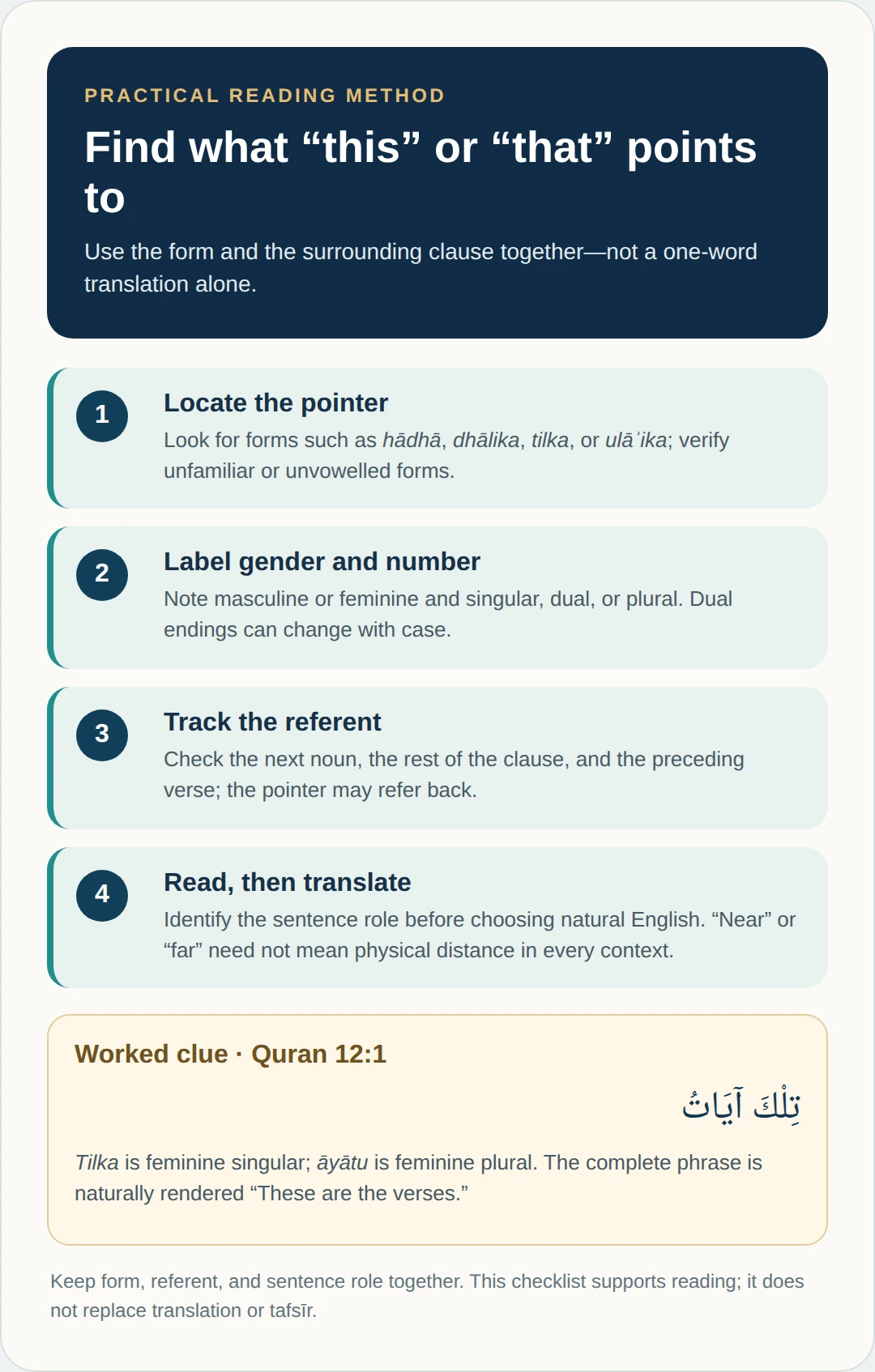
- Circle the pointer. Look for a common form such as hādhā, dhālika, tilka, or ulāʾika. If the text is unvowelled or the form is unfamiliar, verify it rather than relying on shape alone.
- Label gender and number. Start with masculine or feminine and singular, dual, or plural. Treat the case ending as part of the word’s grammatical form; it may vary in the dual.
- Find what is being pointed to. Check the next noun, the rest of the clause, and the previous sentence. The referent may be explicit, or it may be a group or statement already described.
- Read the sentence, then translate. Identify whether the demonstrative stands with a noun or forms part of a clause. Use the surrounding verse for a natural English gloss, and avoid claiming that “near” or “far” must mean physical distance in every context.
Try it with Quran 12:1: find tilka, label it feminine singular, notice plural āyātu, and then read the full phrase. English renders it “These are the verses.” This sequence keeps you from translating an isolated word before you know its role.
Common mistakes to avoid
- Memorizing “near = this, far = that” as a complete translation rule. The chart helps identify a form, but an English translation may use a different word or phrase. Follow the Arabic syntax and verse context.
- Assuming the pointer always names the next noun. Quran 2:5 shows a demonstrative referring back to a group already described. Search the surrounding discourse, not only the next token.
- Reading the English number as the Arabic number. The phrase in 12:1 uses feminine singular tilka with plural āyātu and is naturally translated “These are the verses.” Check the Arabic form before drawing conclusions about agreement.
- Confusing a demonstrative with a relative pronoun. A demonstrative points to a noun or idea; a relative pronoun such as alladhī introduces a clause that describes its antecedent. They can both appear in a passage, but they do different jobs.
- Forgetting the dual. Arabic distinguishes exactly two from more than two. Notice Quranic forms such as hādhāni and hātayni, and learn their case-sensitive endings from a complete grammar lesson.
Keep learning with real Quranic examples
Once the common forms are familiar, collect short examples from the verses you already study. Write the demonstrative, its gender and number, the word or idea it points to, and the full phrase together. Compare a trustworthy translation only after noting those features. A teacher can help you check whether your reading follows the Arabic form without turning a grammar label into an interpretation the grammar alone cannot prove. If you want guided practice in Quran and Arabic, you can book a free Quran and Arabic trial class through Quranytime’s assessment page.
Watch a related lesson
The lesson below introduces Quranic Arabic pointing words and illustrates near and far demonstratives in verse examples. Use it as a listening and visual review alongside the written examples above.