

English usually places one word—not—in many kinds of negative sentences. Quranic Arabic uses several forms, and the word after the negator matters. A reader who recognizes lā, lam, lan, mā, and laysa can see whether a verse denies an action, states “no” before a noun, or uses a particular verb construction. This guide compares those patterns with Quran examples; it is a reading aid, not a substitute for tafsīr or a teacher.
Start with the negator and what follows
Do not translate every Arabic negative form as though it were the same English not. First identify the form; then look at whether it precedes an imperfect verb, a noun, or a nominal clause. The verb’s mood and the surrounding words add evidence. A short English gloss can help, but it cannot by itself identify the Arabic construction.
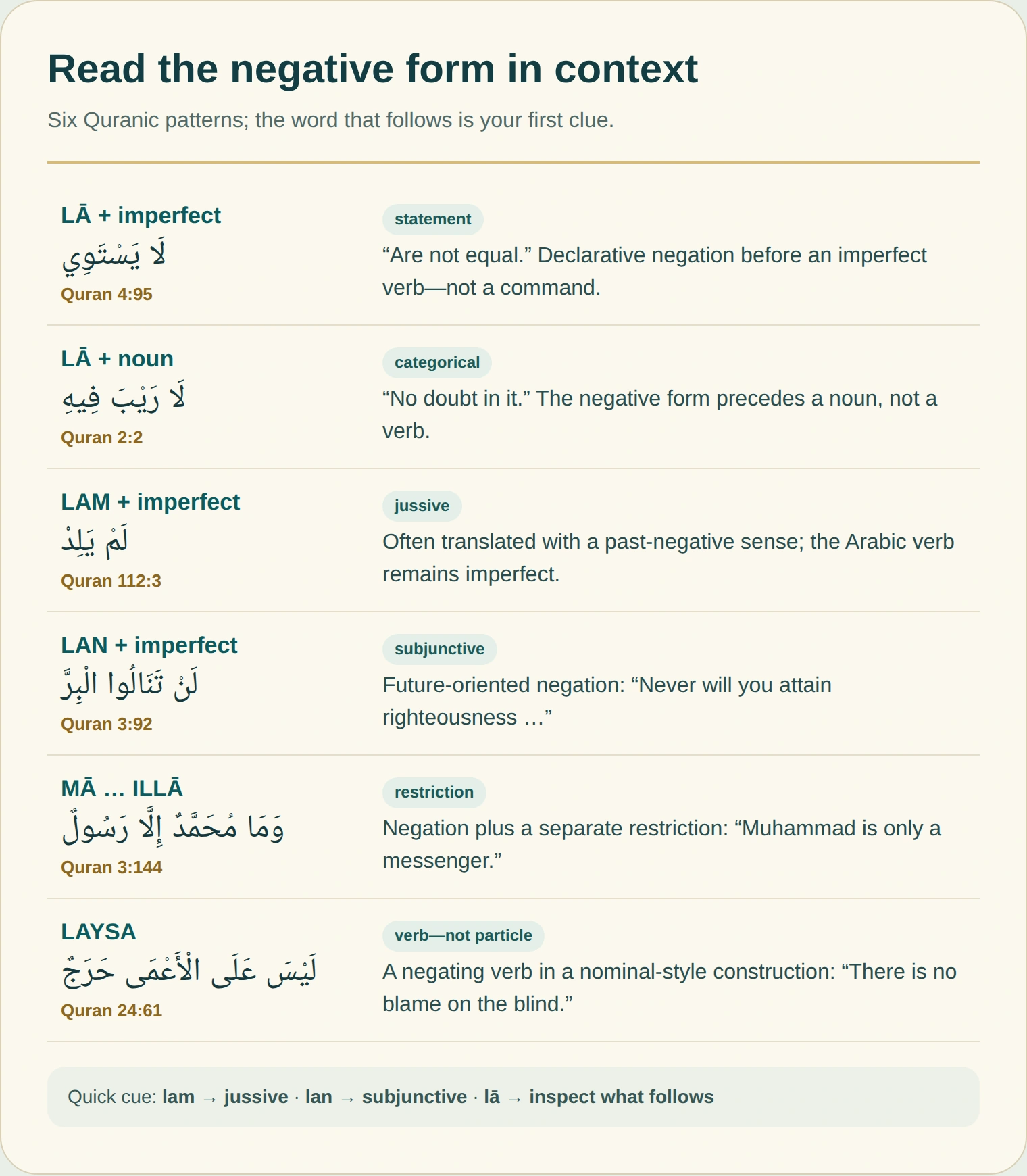
The table below is a quick orientation, not a rule that replaces verse-by-verse analysis. In particular, lā has more than one grammatical use, while laysa is a verb rather than a particle.
Lā: a statement, a prohibition, or “no” before a noun
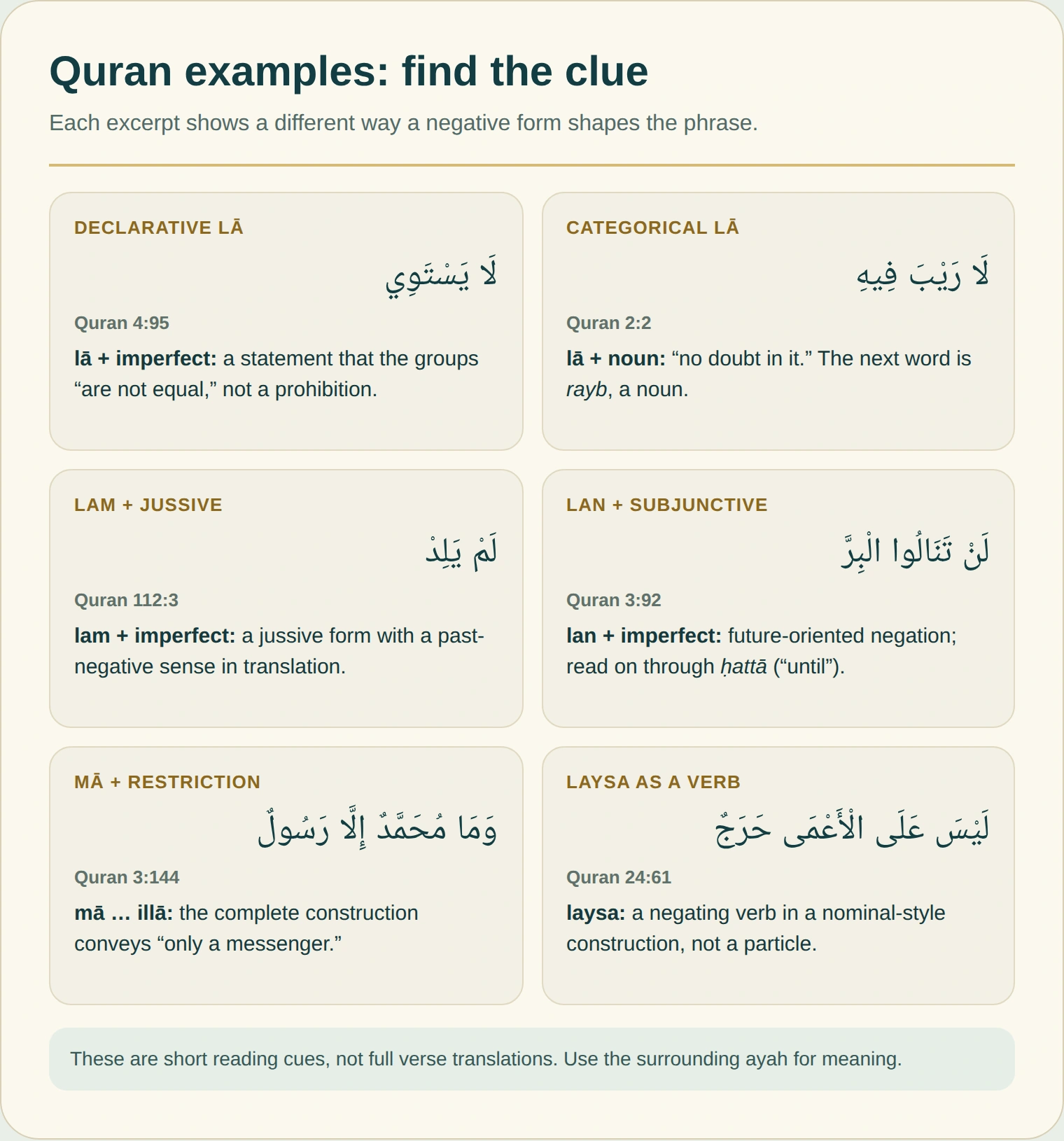
When lā precedes an imperfect verb in a statement, it commonly means “does not” or “is not.” In Quran 4:95, لَا يَسْتَوِي (lā yastawī) begins a statement meaning that the two groups “are not equal.” It is not an instruction to someone, so do not read every lā before a verb as a prohibition.
A prohibitive lā does address someone: lā tafʿal means “do not do [it].” In traditional grammar this use, lā al-nāhiyah, is followed by an imperfect verb in the jussive. Compare the communicative job and verb form with a declarative negative; the Arabic spelling لا alone does not tell you which one it is.
A third pattern appears when lā comes before a noun. Quran 2:2 has لَا رَيْبَ فِيهِ (lā rayba fīhi): “no doubt in it.” Here the negator is followed by the noun rayb (“doubt”), not an imperfect verb. This categorical construction has its own syntax; it should not be forced into the same description as verbal lā.
So when you see lā, ask two questions: what kind of word follows it, and is the phrase reporting a fact or telling someone what not to do? That quick check prevents a common misreading.
Lam and lan: similar-looking forms with different moods
Lam and lan both come before an imperfect verb, but they do not have the same grammatical effect. Lam is followed by a jussive imperfect and commonly gives the clause a past-negative sense in translation. In Quran 112:3, لَمْ يَلِدْ (lam yalid) is the first half of “He neither begets nor is born.” The verb still has an imperfect form in Arabic; the negative particle and its mood help create the English rendering.
Lan is followed by a subjunctive imperfect and usually places the negation in a future-oriented frame. Quran 3:92 begins لَنْ تَنَالُوا الْبِرَّ (lan tanālū al-birr): “Never will you attain righteousness” until you spend from what you love. The Corpus analysis marks lan as a negative particle and tanālū as subjunctive. The Quranic Arabic Corpus’s analysis of Quran 112:3 likewise labels lam as negative and yalid as jussive—useful confirmation when checking a verse, not an interpretation of its meaning.
These are not simply three English tenses attached to three Arabic words. The particles select different grammatical patterns; the wider clause and Quranic context still matter. For a refresher on how Arabic imperfect forms change, see Quranytime’s guide to Arabic verb conjugation in Quranic reading and its explanation of case and inflection clues.
Mā and laysa: do not treat them as one formula
Mā can negate different kinds of clauses, so inspect the construction rather than assigning it one fixed tense rule. Quran 3:144 has وَمَا مُحَمَّدٌ إِلَّا رَسُولٌ (wa-mā Muḥammadun illā rasūl): in natural English, “Muhammad is only a messenger.” Here mā negates, while illā is a separate restriction particle that completes the “not … except / only” sense. Do not translate the pair as a plain negative without reading both parts.
Laysa is different again: it is a defective verb associated with the kāna group, not a negative particle. In Quran 24:61, لَيْسَ عَلَى الْأَعْمَى حَرَجٌ (laysa ʿalā al-aʿmā ḥaraj) means that there is no blame on the blind. The Corpus labels laysa as a verb. Because it belongs to a nominal-style construction, follow the relationship between its parts instead of searching for a finite action verb after it. Quranytime’s lessons on Arabic nominal sentences and preposition phrases in Quranic Arabic offer useful background.
A five-step way to read a negative phrase
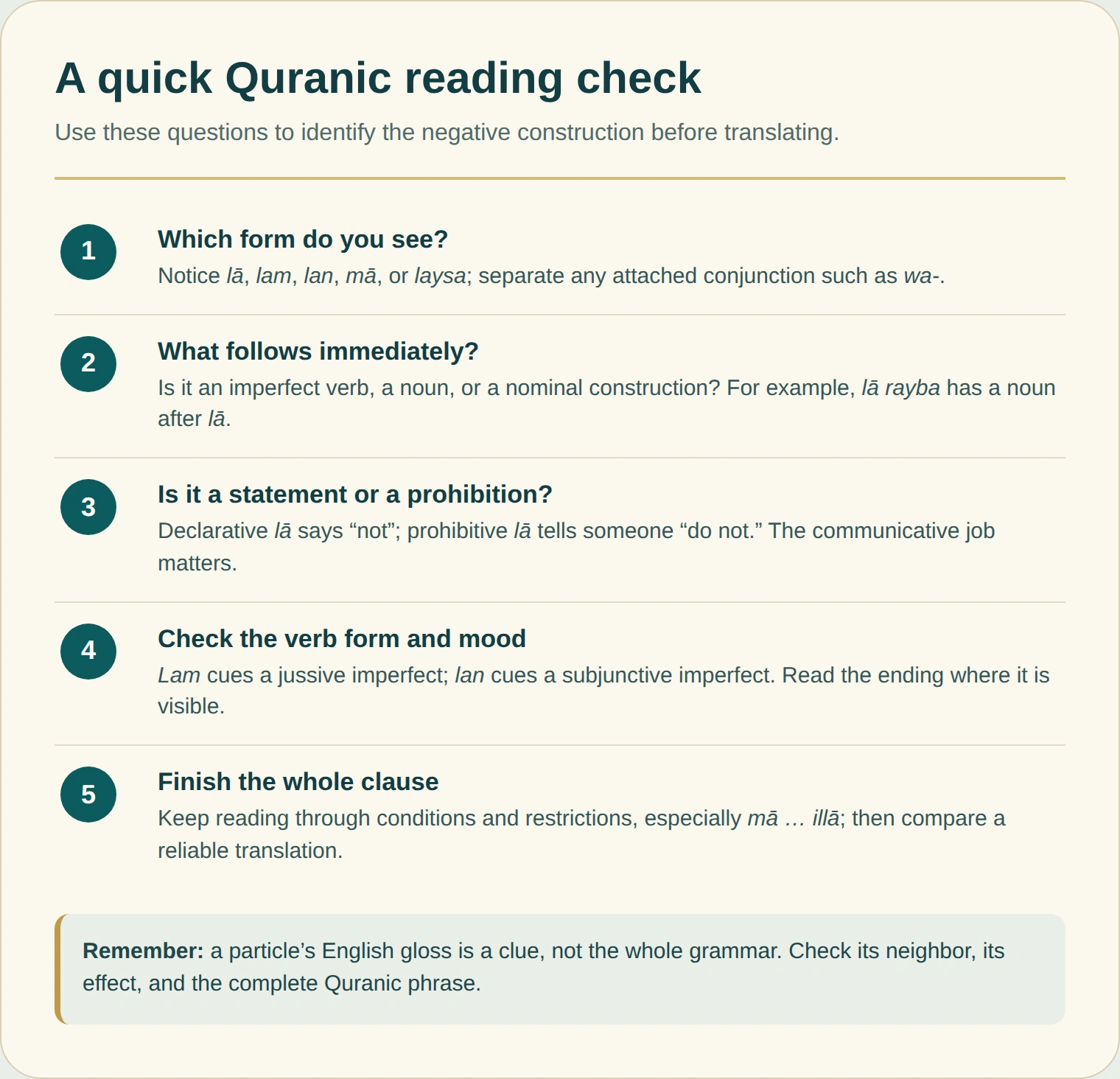
- Find the negative form. Is it lā, lam, lan, mā, or laysa? Also notice attached wa- (“and”) or other prefixes.
- Look immediately to the right. Does the negator introduce an imperfect verb, a noun, or a nominal construction? In a phrase such as laysa ʿalā al-aʿmā, for example, the preposition and its noun phrase are part of the structure.
- Classify its job. With lā, is the phrase stating “not,” or telling someone “do not”? The spelling alone does not decide.
- Check the verb mood if there is one. Lam cues a jussive imperfect and lan a subjunctive one. Read the ending in context rather than deciding from the first word.
- Read through the clause boundary. If you meet illā, ask whether it completes a restriction such as mā … illā. Then read the whole ayah and compare a reliable translation.
This order keeps the work manageable: identify, inspect, test, then interpret. Use Quranytime’s Arabic grammar overview when you need a broader refresher on the terms. The visual checklist below gives you a compact version to use during reading practice.
Try the pattern on a complete phrase
Quran 3:92 is a useful test because lan opens a sentence that continues beyond the first verb. First, recognize lan as the negative form. Next, notice tanālū, a second-person plural imperfect verb in the subjunctive—not a past-tense verb. Then identify al-birr as what is being attained. Finally, keep reading through ḥattā tunfiqū (“until you spend”), which completes the thought. The whole clause says, in a natural rendering, “Never will you attain righteousness until you spend from what you love.” Stopping after tanālū would hide the condition that finishes the sentence.
Now compare Quran 2:2: in lā rayba fīhi, the word immediately after lā is the noun rayb (“doubt”), not a verb. That clue points to a categorical noun-based construction: “no doubt in it.” The same five checks—form, neighbor, communicative job, mood and complete clause—help you distinguish the two patterns without relying on a memorized English tense table.
Common mistakes to avoid
- Assuming every lā means the same thing. A declarative negative, a prohibition, and a categorical negative before a noun are not interchangeable.
- Calling laysa a particle. It is a verb; the distinction helps explain its sentence behavior.
- Translating lam or lan from the English tense alone. Notice their effects on the imperfect verb, then read the whole clause.
- Stopping at mā. In mā … illā, the restrictive element is essential to the meaning.
- Guessing a grammatical ending from an unvowelled text. Use a reliable, fully vocalized Quran text or morphology reference when the ending is not visible.
For a related contrast, the site’s article on Quranic Arabic conjunctions explains how attached connectors such as wa relate to what follows; separating the connector from the negative form can make a long phrase easier to parse.
Quick questions
Does lā always mean “do not”?
No. It may state that something does not happen, form a prohibitive command, or precede a noun in a categorical negative phrase. Identify its grammatical role from the construction.
Are lam and mā interchangeable?
No. Both may appear in English translations with past-negative wording, but their syntax differs. Lam governs a jussive imperfect; mā works in several constructions. Do not swap them based on English alone.
Is laysa a negative particle?
In grammatical classification, it is a verb used for negation. Recognizing that prevents the five forms in this guide from being treated as one uniform list of particles.
Keep the pattern and the meaning together
Arabic negation becomes easier when you connect the negative form to the word or clause it governs. Start with what follows lā; use the mood after lam or lan as a clue; read mā … illā together; and remember that laysa is a verb. These checks help you follow the grammar of Quranic Arabic without reducing a verse to a word-for-word English formula.