
Arabic question words help you move from recognizing vocabulary to understanding what a sentence is asking. The same small set appears in classroom conversation, grammar exercises, and Quran study: who, what, where, when, why, how, how many, and which. This guide explains the common Modern Standard Arabic (MSA) forms, shows each in a fresh learning-focused example, and separates information questions from yes-or-no questions.
The goal is not to memorize a long list in isolation. Match each word to the kind of answer you need, then notice how the rest of the sentence supplies the detail. If Arabic script is still new, review the Arabic alphabet step by step first; you will recognize the question words more quickly when you can track their letters from right to left.
Arabic question words at a glance
OpenLearn’s introductory Arabic lesson lists the core forms as man, mā/mādhā, ayna, matā, limādhā, kayfa, kam, and ayyu, alongside the yes-or-no markers hal and the question hamza. The examples below add a practical distinction: choose the word by the information you want back, not by translating an English sentence word for word. For exact forms and audio in a structured course, see OpenLearn’s Arabic lesson on interrogative particles.
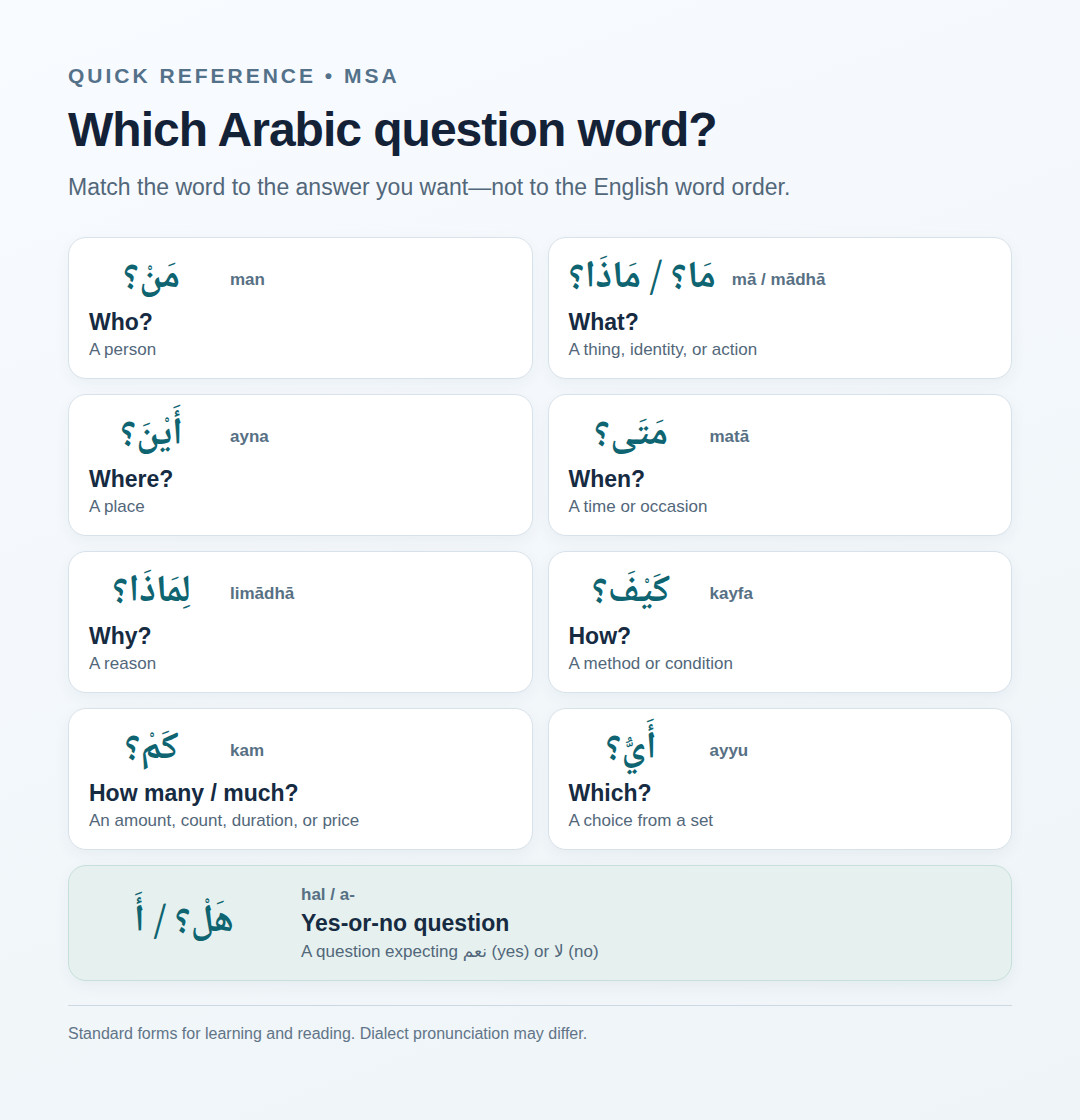
Eight Arabic question words, with examples
The Arabic forms below are standard MSA. Transliteration is a learning aid, not a perfect description of every speaker’s pronunciation; long vowels and sounds such as ʿayn and hamza take practice. Read the word aloud, then cover the English meaning and see whether you can predict the type of answer.
1. مَنْ — man: who?
Use man when the missing answer is a person. For example, مَنْ يَتْلُو هَذِهِ الآيَةَ؟ (man yatlū hādhihi al-āyata?) means “Who recites this verse?” The question word is the same whether you are asking about one person or a group; the surrounding sentence makes the reference clear.
One useful reading note: without full vowel marks, the letters من can also represent min, “from.” The question word man and the preposition min look identical in unvowelled script, so use context and the vowel when reading aloud. This is one reason to combine word recognition with the broader Quranic Arabic vocabulary study plan.
2. مَا / مَاذَا — mā / mādhā: what?
Both forms can ask “what?” A helpful beginner cue is that mā often asks about an identity or description, as in مَا المَوْضُوعُ؟ (mā al-mawḍūʿu?), “What is the topic?” Mādhā often appears before an action: مَاذَا تَقْرَأُ الآنَ؟ (mādhā taqraʾu al-āna?), “What are you reading now?” Treat this as a useful pattern, not an absolute rule: natural MSA allows more than one structure, and the noun or verb after the question word matters.
3. أَيْنَ — ayna: where?
Choose ayna when the answer is a place. أَيْنَ أَجِدُ هَذِهِ السُّورَةَ؟ (ayna ajidu hādhihi al-sūrata?) means “Where can I find this surah?” The word can also combine with a preposition: min ayna means “from where.” In connected reading, listen for the short vowels rather than treating every unvowelled أين as a separate English-like syllable.
4. مَتَى — matā: when?
Matā asks about time. مَتَى يَبْدَأُ الدَّرْسُ؟ (matā yabdaʾu al-darsu?) means “When does the lesson begin?” A time expression can answer it: “after Maghrib,” “tomorrow,” or “at eight.” In a Quran lesson, the question may be about when to begin a passage or when a review session takes place; the question word itself does not tell you whether the answer is a date, clock time, or sequence.
5. كَيْفَ — kayfa: how?
Use kayfa to ask about manner, condition, or method. كَيْفَ أُرَاجِعُ هَذِهِ الآيَةَ؟ (kayfa urājiʿu hādhihi al-āyata?) means “How do I review this verse?” The answer should explain a way of doing something, not simply name a place or time. The verb ending may change with the person addressed, but kayfa stays the question word.
6. لِمَاذَا — limādhā: why?
Limādhā asks for a reason. لِمَاذَا نُكَرِّرُ هَذِهِ الجُمْلَةَ؟ (limādhā nukarriru hādhihi al-jumlata?) means “Why do we repeat this sentence?” A reason may begin with liʾanna (“because”), followed by an explanation. In ordinary conversation, “why?” can sound direct; in a lesson, you can soften the question by adding a brief context or asking your teacher for the learning reason.
7. كَمْ — kam: how many or how much?
Kam asks about quantity, number, duration, or price, depending on what follows. كَمْ مَرَّةً أُكَرِّرُهَا؟ (kam marratan ukarriruhā?) means “How many times should I repeat it?” A beginner can answer with a number, then learn the more detailed agreement rules later. For a quick reference to Arabic number words and digits, use the guide to Arabic numbers from 1 to 100.
8. أَيُّ — ayyu: which?
Ayyu asks you to choose or identify one item from a set. أَيُّ سُورَةٍ نَقْرَأُ اليَوْمَ؟ (ayyu sūratin naqraʾu al-yawma?) means “Which surah are we reading today?” Unlike the other forms in this list, ayy changes its ending according to its grammatical role and is often followed by a noun in a construct phrase. Learn the whole phrase first, then notice the case endings as your Arabic grammar knowledge grows.
Yes-or-no questions: هَلْ and أَ
Not every question asks for a person, place, or reason. To ask something that can be answered “yes” or “no,” MSA commonly uses the separate particle hal or the question hamza a-. For example, هَلْ تَفْهَمُ السُّؤَالَ؟ (hal tafhamu al-suʾāla?) means “Do you understand the question?” The particle hal stands before the sentence; the hamza is attached to the next word, as in a-tafhamu…? (“Do you understand…?”).
The two markers are related but not identical in every context. In reading, notice whether the question expects a simple yes/no response or offers a contrast that needs more than “yes” or “no.” A Quranic question can also be rhetorical: it may emphasize a point rather than request information from a listener. For interpretation, read the surrounding verse and consult qualified explanation instead of treating one particle as a complete translation.
Hear the interrogatives in a lesson
For a spoken walkthrough of Arabic question words and yes-or-no markers, watch Gateway to Arabic Book Four, Lesson 15. It pairs English explanations with Arabic examples.
How to build a question without translating word by word
Start with the answer you want. If you need a person, use man; for a location, use ayna; for a method, use kayfa. Put the question word near the start of the sentence, then use an ordinary Arabic sentence pattern. Arabic does not need an English-style “do” helper: matā yabdaʾu al-darsu? is “When begins the lesson?” in its structure, naturally translated as “When does the lesson begin?”
Next, keep the verb and pronoun consistent. The example mādhā taqraʾu? addresses a masculine singular listener in careful MSA; when addressing a feminine singular listener, the verb form changes to taqraʾīna. The question word mādhā does not change. If you want to write Arabic accurately, practice letter joining and word boundaries with Arabic alphabet writing exercises, then compare the grammar with the broader guide to Quranic Arabic and Modern Standard Arabic.
Some question forms include a preposition: min ayna (“from where”), li-man (“for whom/to whom”), or ʿan mādhā (“about what”). In connected writing, a preposition may attach to the following word, so do not assume each Arabic word will be separated exactly as it is in English. This is where learning recurring Arabic roots and patterns complements memorizing a translation list.
MSA and Egyptian Arabic: keep the labels clear
The table and examples in this guide use MSA, a useful register for formal study, many learning materials, and written Arabic. Everyday Egyptian Arabic often uses different spoken forms: for example, “where?” is commonly fēn, “when?” imta, “why?” lēh, and “what?” ēh. Pronunciation and spelling vary across speakers and contexts, so do not mix these dialect forms into an MSA sentence without noticing the change in register.
If you are learning mainly to understand Quranic Arabic, start by recognizing the MSA/classical forms in this guide; then learn dialect equivalents separately for conversation. For sound distinctions such as hamza and ʿayn, work slowly with a qualified teacher and use the Quran pronunciation guide for English speakers. If you want ready-made everyday exchanges rather than a grammar reference, see the companion Arabic phrases guide for beginners.
A short practice routine
Cover the English meanings on the visual card and choose a question word from the answer you need: a person, a place, a time, a reason, a method, an amount, a choice, or yes/no. Then read the matching example aloud. On a second pass, change one detail—for example, replace “today” with “tomorrow,” or change the person addressed—and check what in the sentence must change.
For a quick self-test, try these prompts: “Who recites this verse?” (person); “Where can I find this surah?” (place); “How many times should I repeat it?” (number); and “Do you understand the question?” (yes/no). The first three need different interrogatives, while the last needs a yes/no particle. Review missed forms the next day instead of rereading the entire list at once.
When you are unsure whether your question is grammatical or whether a Quranic expression is rhetorical, write down the exact Arabic and ask for feedback. The guide on asking your Quran teacher a clear question can help you include the passage, the specific word, and what you have already tried.
Keep the question words together in memory
Link each Arabic form to a single answer type: man for a person, mā/mādhā for what, ayna for place, matā for time, limādhā for reason, kayfa for method or condition, kam for amount, and ayyu for choice. Add hal or the question hamza when you expect yes or no. A few minutes of retrieval practice, accurate vowel listening, and sentence-level reading will make the words easier to recognize in both lessons and Arabic texts.