
Arabic imperative verbs are the direct command forms you meet in words such as اقْرَأْ (iqraʾ, “recite!”). In Quranic reading, however, not every instruction is shaped as a direct imperative: Arabic can also use a command particle before an imperfect verb, or a prohibition meaning “do not.” This guide shows you how to tell those patterns apart, recognize the person and number in common command endings, and read each expression in its full verse. It is a grammar aid, not a substitute for tafsīr or a teacher.
First ask: is it a direct command verb?
The Arabic term fiʿl al-amr (فعل الأمر) names the direct imperative verb. It normally addresses someone as “you,” while the verb ending or its context helps identify whether that addressee is singular, dual, or plural. The form may sound like an order, but its force depends on context: Quranic commands can express instruction, invitation, guidance, or supplication as well as a strict command.
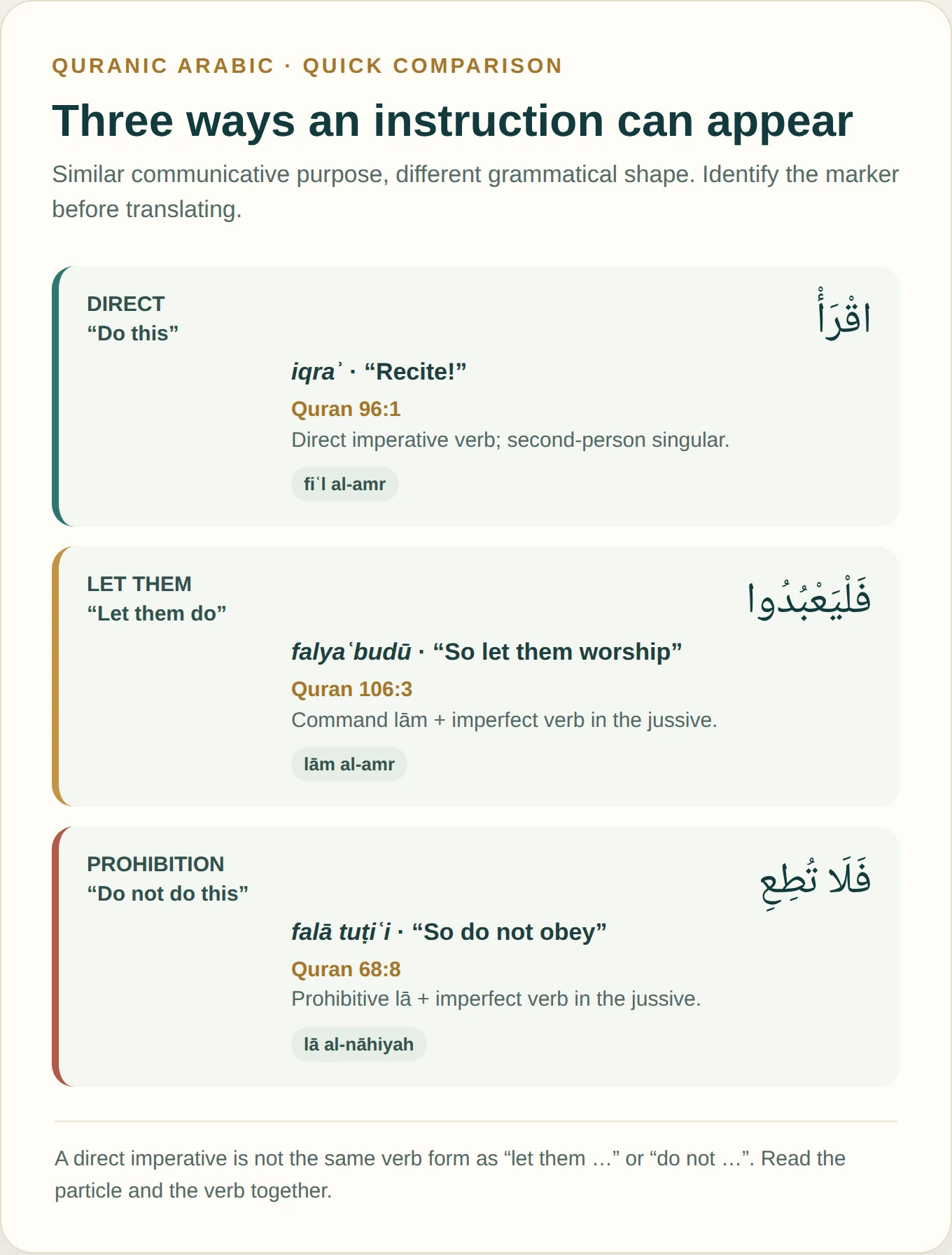
Quran 96:1 opens with اقْرَأْ (iqraʾ, “recite!”). Quranic Arabic Corpus identifies it as a second-person masculine singular imperative. A different pattern appears in Quran 106:3: فَلْيَعْبُدُوا (falyaʿbudū, “so let them worship”). Here lām (“let”) precedes an imperfect verb in the jussive; it is not the same shape as a direct command like iqraʾ. A third construction is the prohibition in Quran 68:8, فَلَا تُطِعِ (falā tuṭiʿi, “so do not obey”), where prohibitive lā comes before a jussive imperfect. The Corpus’s Quranic grammar notes on imperative verbs distinguish these direct, lām-based, and prohibitive constructions.
How a simple Arabic command is formed
For a regular Form I verb, a useful beginner exercise is to start with the second-person present form and observe its jussive shape. For example, تَكْتُبُ (taktubu, “you write”) has a jussive form تَكْتُبْ (taktub). Remove the second-person prefix ta-; because the remaining form begins with a consonant carrying sukūn, a supporting hamzat al-waṣl produces اُكْتُبْ (uktub, “write!”).
This is a starter pattern, not a universal recipe for every verb. Weak roots, doubled verbs, and derived forms can behave differently, and the vowel on the hamza is not guessed from English. Quran 87:1 provides a useful reminder that direct commands also occur in other patterns: سَبِّحِ اسْمَ رَبِّكَ الْأَعْلَى includes sabbiḥ (“exalt”), which the Corpus labels a Form II imperative. The short linking vowel heard before ism should not be mistaken for a different person ending. Quranytime’s guide to Arabic verb conjugation reviews the past and present forms that help you recognize a verb’s pattern.
Some direct imperatives begin with hamzat al-waṣl, which is heard when the word starts a recitation and connects differently after a preceding word. That is a pronunciation clue, not proof by itself that a word is a command: nouns and other forms can also begin with alif. For the sound of this joining hamza, see the site’s guide to hamzat al-waṣl in Quran reading.
The ending can point to the addressee
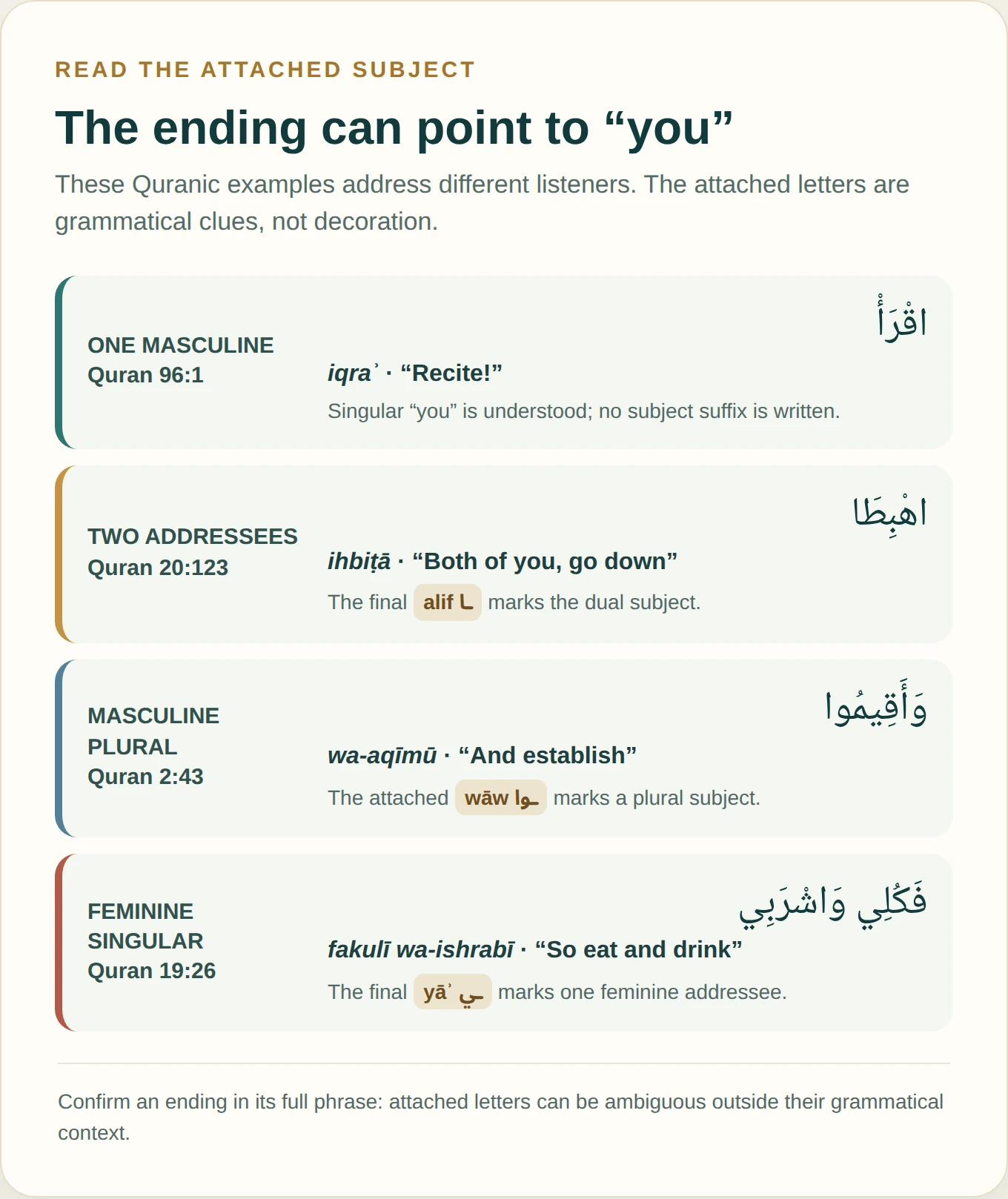
Because a direct imperative addresses “you,” its attached pronoun can carry information that English puts in a separate word. Do not treat every final alif, wāw, or yāʾ as decoration; first ask who is being addressed. The Quran’s examples show why this matters:
- One masculine addressee: اقْرَأْ (iqraʾ, “recite!”), Quran 96:1. The subject “you” is understood rather than written as a separate pronoun.
- Two addressees: اهْبِطَا (ihbiṭā, “both of you, go down”), Quran 20:123. The Corpus identifies the attached alif as a second-person masculine dual subject pronoun.
- A masculine plural group: وَأَقِيمُوا (wa-aqīmū, “and establish”), Quran 2:43. Its attached wāw marks the second-person plural subject.
- One feminine addressee: Quran 19:26 uses فَكُلِي وَاشْرَبِي (fakulī wa-ishrabī, “so eat and drink”). The attached yāʾ marks the feminine singular addressee in both verbs.
Notice the difference between a noun ending and a verb ending: the final letters here are part of the command’s subject marking. In an unvowelled text, a familiar-looking ending can be ambiguous, so check the whole clause and a reliable morphology reference before deciding. Quranytime’s Arabic pronoun chart is a useful companion when attached pronouns make a word feel unfamiliar.
Do not confuse commands with prohibitions
A positive imperative and a negative prohibition are not formed the same way. In Quran 68:8, falā tuṭiʿi is “so do not obey”: lā signals the prohibition, and the following imperfect verb is jussive. It is not a direct imperative with a negative prefix. The distinction is useful because lā can also make a declarative statement rather than a prohibition; the phrase’s function and verb form matter. For a fuller comparison of negative particles, see Quranytime’s guide to Arabic negation in Quranic Arabic.
Likewise, lām al-amr usually expresses “let [someone] do” with an imperfect jussive verb. Quran 106:3 has falyaʿbudū (“so let them worship”): the plural wāw belongs to the subject pronoun, while the command particle is the prefixed lām. This form can address a third-person group in translation, unlike the basic direct imperative that speaks to “you.” Do not identify a word from its English gloss alone; examine the Arabic structure.
A four-step method for reading an imperative
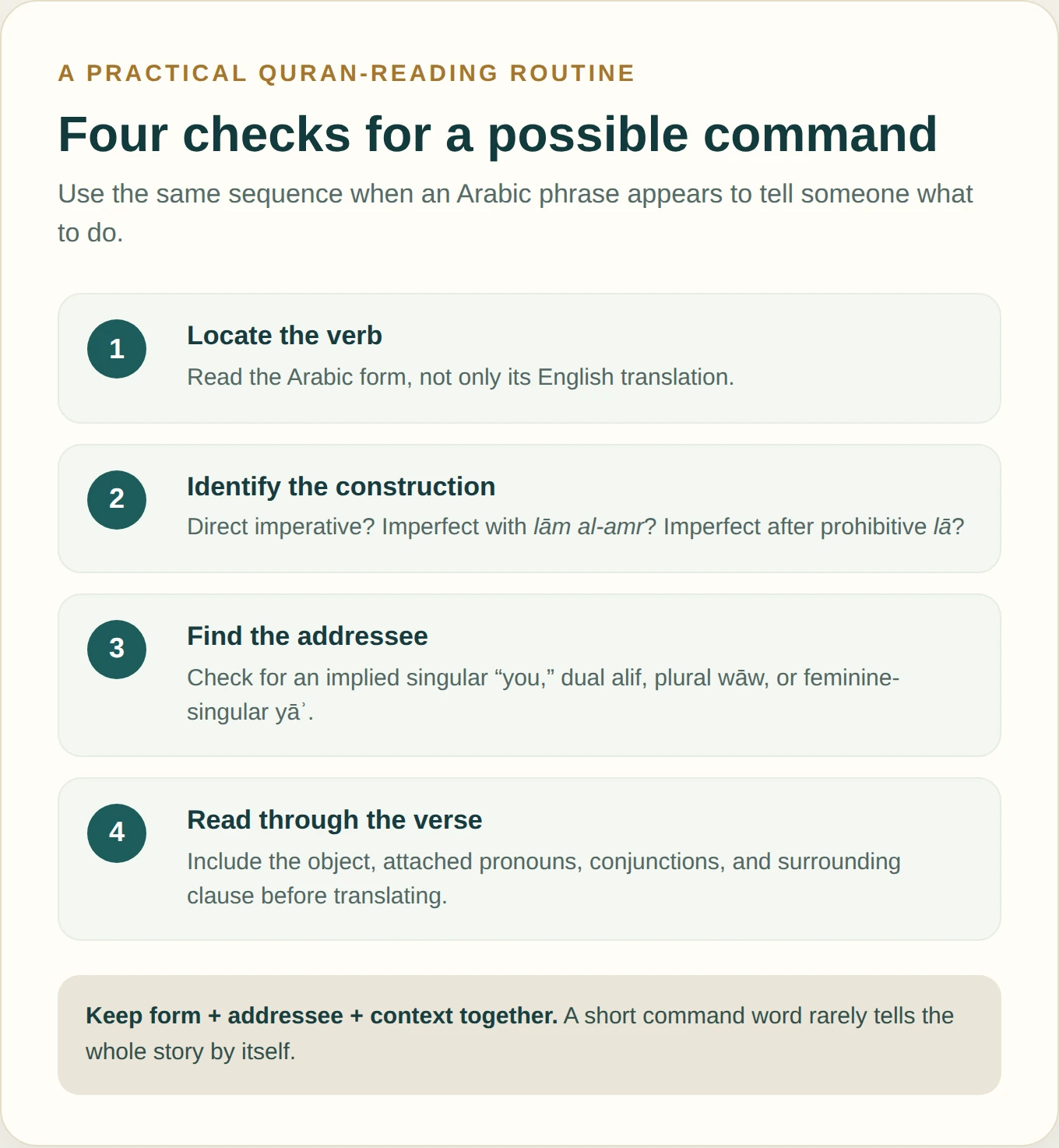
- Find the verb-like word. Read its Arabic letters and vowels; do not classify it from an English translation alone.
- Check for a command marker. Is it a direct imperative, an imperfect verb with lām al-amr, or an imperfect verb after prohibitive lā?
- Look for the addressee. Note a hidden singular “you” or an attached dual, plural, or feminine singular pronoun. Compare with the Arabic case and inflection guide if endings are hard to parse.
- Read the complete phrase and verse. Identify what action is requested, who is addressed, and whether a conjunction or condition links the command to what comes next.
This order keeps morphology and meaning connected. The quick card below is a reading aid—not a substitute for a teacher’s explanation of a difficult verse or a full study of iʿrāb.
Practise with a connected Quran example
Try the method on Quran 2:43, وَأَقِيمُوا الصَّلَاةَ (“and establish prayer”). First locate aqīmū, the imperative verb. Next identify its addressee: the attached wāw marks a second-person plural subject. Then read its object, al-ṣalāh (“prayer”), instead of stopping at the command. In a fully connected passage, the preceding wa- may link this instruction to earlier text, so keep the conjunction in view; Quranytime’s explainer on Quranic Arabic conjunctions can help with that connection.
Now compare Quran 106:3, falyaʿbudū rabba hādhā al-bayt (“so let them worship the Lord of this House”). The prefixed fa and lām are not part of the root of ʿabada; the imperfect verb remains jussive, and its wāw marks the plural subject. The sentence addresses a group in the third person (“let them”), rather than using a direct “you” command. The site’s lesson on Arabic conditional sentences offers a related example of how a command can appear as the response to a preceding clause.
Common mistakes to avoid
- Calling every instruction a direct imperative. The lām construction and prohibitive lā use imperfect verbs and have different markers.
- Assuming every final vowel is a person ending. A short vowel may be needed for connection or may reflect the verb’s form; inspect the morphology.
- Assuming an imperative always sounds harsh. The form requests an action; discourse and context shape its force.
- Applying one command-building rule to every verb. Weak and derived forms require closer attention; a regular Form I example is only a starting point.
- Stopping at the command word. Read the object, attached pronoun, conjunction, and rest of the verse before translating.
Quick questions
Is iqraʾ a Quranic imperative?
Yes. Quran 96:1 begins with iqraʾ (“recite!”), a second-person masculine singular direct imperative.
Is falyaʿbudū the same form as iqraʾ?
No. Falyaʿbudū uses a prefixed command lām with a jussive imperfect verb, while iqraʾ is a direct imperative.
How can I check an unfamiliar command?
Read it in its full verse, identify its prefix and ending, and compare the word with a trusted Quranic Arabic morphology reference. A written analysis can support learning, but recitation should also be checked with a qualified teacher.
Keep the form, addressee, and meaning together
Recognizing Arabic imperative verbs gets easier when you separate the direct command from the related lām and prohibition patterns, then use the ending to identify the addressee. Start with a clear example such as iqraʾ, compare it with aqīmū and ihbiṭā, and read each phrase through to the verse’s end. If you would like personal feedback on Quran reading and Arabic grammar, you can book a free Quran and Arabic trial class.