

The Arabic passive voice changes how you identify the doer and the word that carries the action. In Quranic reading, recognizing a form such as كُتِبَ (kutiba, “was prescribed”) or أُنْزِلَ (unzila, “was revealed”) helps you follow a verse without treating every noun as an ordinary object. This guide explains the common vowel clues, shows three Quranic examples, and gives you a practical method for reading passive verbs in context. It is a grammar aid, not a substitute for tafsīr or a qualified teacher.
What “passive” means in Arabic
In an active sentence, the verb names or implies a doer: “The student wrote the lesson.” In a passive sentence, the clause focuses on what happened: “The lesson was written.” Arabic grammar calls the active pattern mabnī lil-maʿlūm and the passive pattern mabnī lil-majhūl (“built for the unknown”). Here, “unknown” is a grammar label: the verb does not name its doer inside that clause. It does not prove that the doer is actually unknown, or tell you why the sentence was phrased passively. Context supplies those judgments.
Arabic also changes the role of the noun. When a transitive verb becomes passive, the doer is not expressed in the ordinary subject position, and the former direct object commonly takes its place. This word is called nāʾib al-fāʿil (نائب الفاعل), often translated “deputy” or “stand-in for the doer.” It is normally nominative. The change can affect the case ending you hear or see, so a guide to Arabic case endings in Quranic reading is a useful companion. Not every passive construction has an obvious, separately written noun; read the whole phrase before assigning roles.
Spot the vowel pattern, not just the root
Arabic passive voice is usually marked inside the verb. For a sound Form I verb, a common past-tense pattern is fuʿila: compare كَتَبَ (kataba, “he wrote”) with كُتِبَ (kutiba, “it was written”). The root letters k-t-b remain, while the vowels change. A common present-tense Form I contrast is yafʿalu versus yufʿalu, as in yaktubu (“he writes”) and yuktabu (“it is written”). These are learning patterns, not a shortcut for every root.
Derived verb forms have their own templates. One useful Quranic contrast is Form IV: active anzala (“he sent down”) and passive unzila (“it was sent down”). The initial hamza and short vowels are clues, but weak, doubled, and derived verbs can behave differently. In an unvowelled text, the consonants alone may not settle the question. Quranytime’s guide to Arabic verb conjugation and patterns can help you identify a verb’s form before you decide whether it is passive. Check a reliable morphology source when the reading is uncertain.
Three passive forms in Quranic examples
1. Kutiba — Quran 2:216
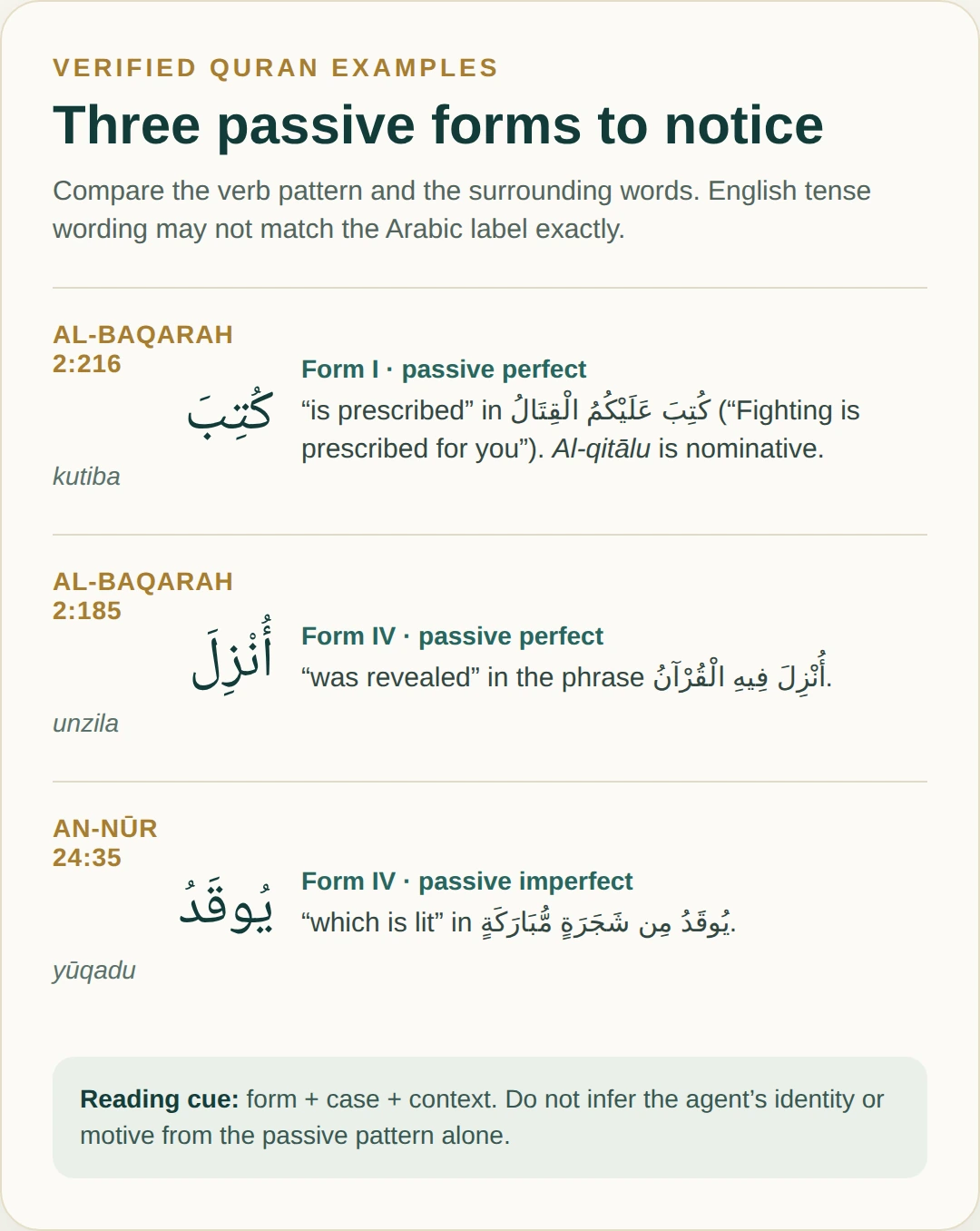
The phrase كُتِبَ عَلَيْكُمُ الْقِتَالُ (kutiba ʿalaykumu al-qitālu) is translated, “Fighting is prescribed for you.” The verb kutiba is passive perfect: the short vowels mark a past-form passive rather than active kataba. The prepositional phrase ʿalaykum means “upon you,” while al-qitālu is nominative and functions as the stand-in in the passive clause. Notice that English often chooses a simple present passive translation (“is prescribed”), even though the Arabic morphology labels the verb perfect. Morphology and English tense labels do not match one-to-one.
2. Unzila — Quran 2:185
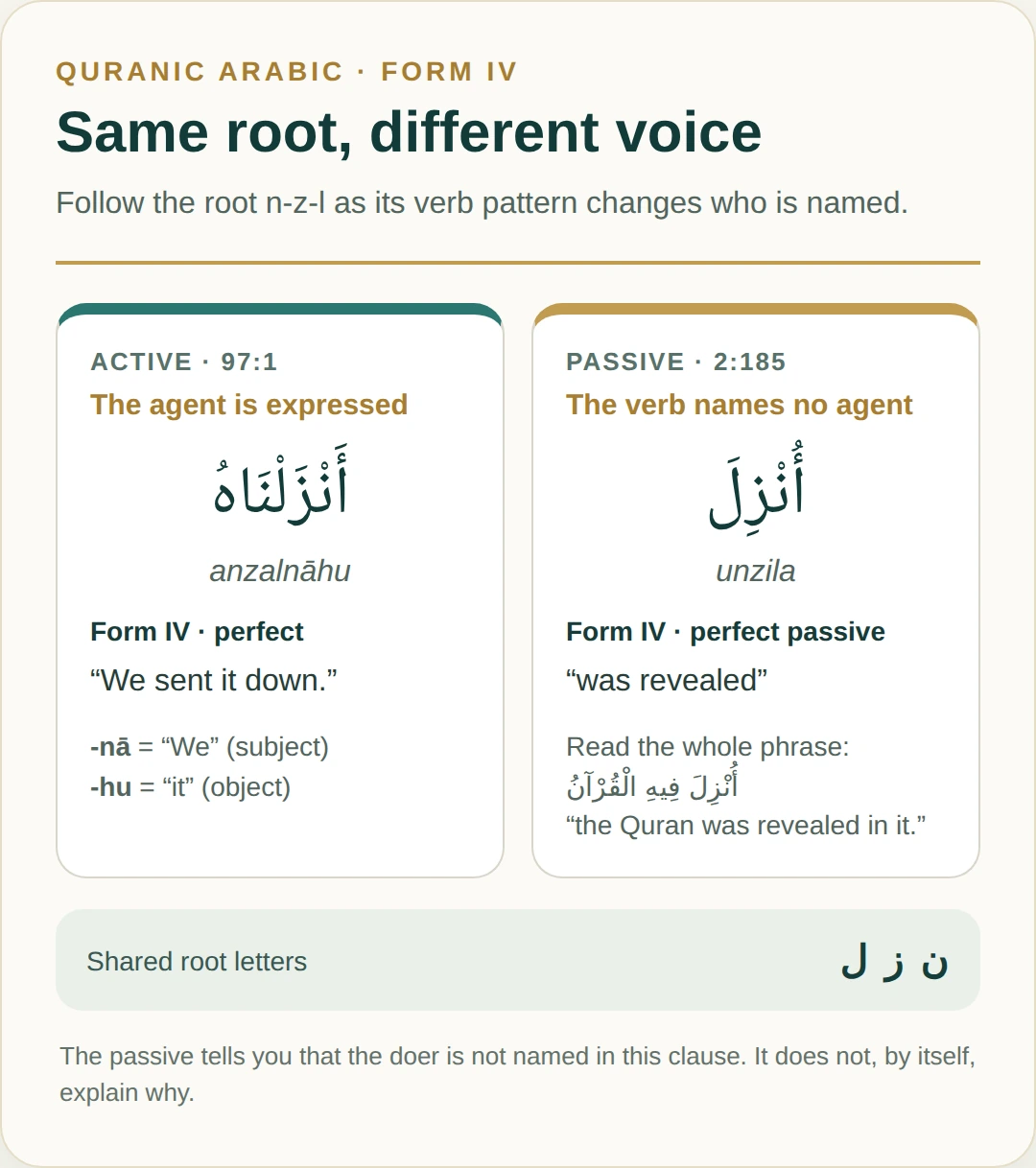
In the Ramadan verse, أُنْزِلَ فِيهِ الْقُرْآنُ (unzila fīhi al-Qurʾānu) means “the Quran was revealed in it.” The Quranic Arabic Corpus analysis of unzila in 2:185 identifies it as a third-person masculine singular Form IV passive perfect verb. The word al-Qurʾānu is nominative and names what was revealed; the verb itself does not state a doer in this clause.
Now compare Quran 97:1: إِنَّا أَنْزَلْنَاهُ فِي لَيْلَةِ الْقَدْرِ (innā anzalnāhu fī laylati al-qadr), “Indeed, We sent it down during the Night of Decree.” The root n-z-l is shared, but anzalnāhu is active Form IV: the suffix -nā marks “We” as the subject, and -hu refers to “it.” In 2:185, the passive unzila does not carry that expressed subject. This same-root comparison is often easier to remember than a list of patterns.
3. Yūqadu — Quran 24:35
In the verse’s lamp imagery, يُوقَدُ مِن شَجَرَةٍ مُّبَارَكَةٍ (yūqadu min shajaratin mubārakatin) is rendered “which is lit from a blessed tree.” The Corpus marks yūqadu as a third-person masculine singular Form IV passive imperfect. The prefix and internal vowels help distinguish the passive present/imperfect from an active form. Read the surrounding words as well: the phrase describes the lamp in the verse’s image, rather than standing alone as a vocabulary flashcard.
The object-to-stand-in clue is clearest with a transitive verb: the thing affected by the action takes the passive clause’s subject-like role. Do not apply that shortcut to every verb in a dictionary. First check that the construction is transitive, then identify the noun’s syntactic role from case and context. Arabic word order can vary, and a prepositional phrase may come between the verb and the noun. A reliable morphology reference can confirm the verb form, but the whole phrase still determines how its parts fit together.
A four-step way to read a possible passive verb
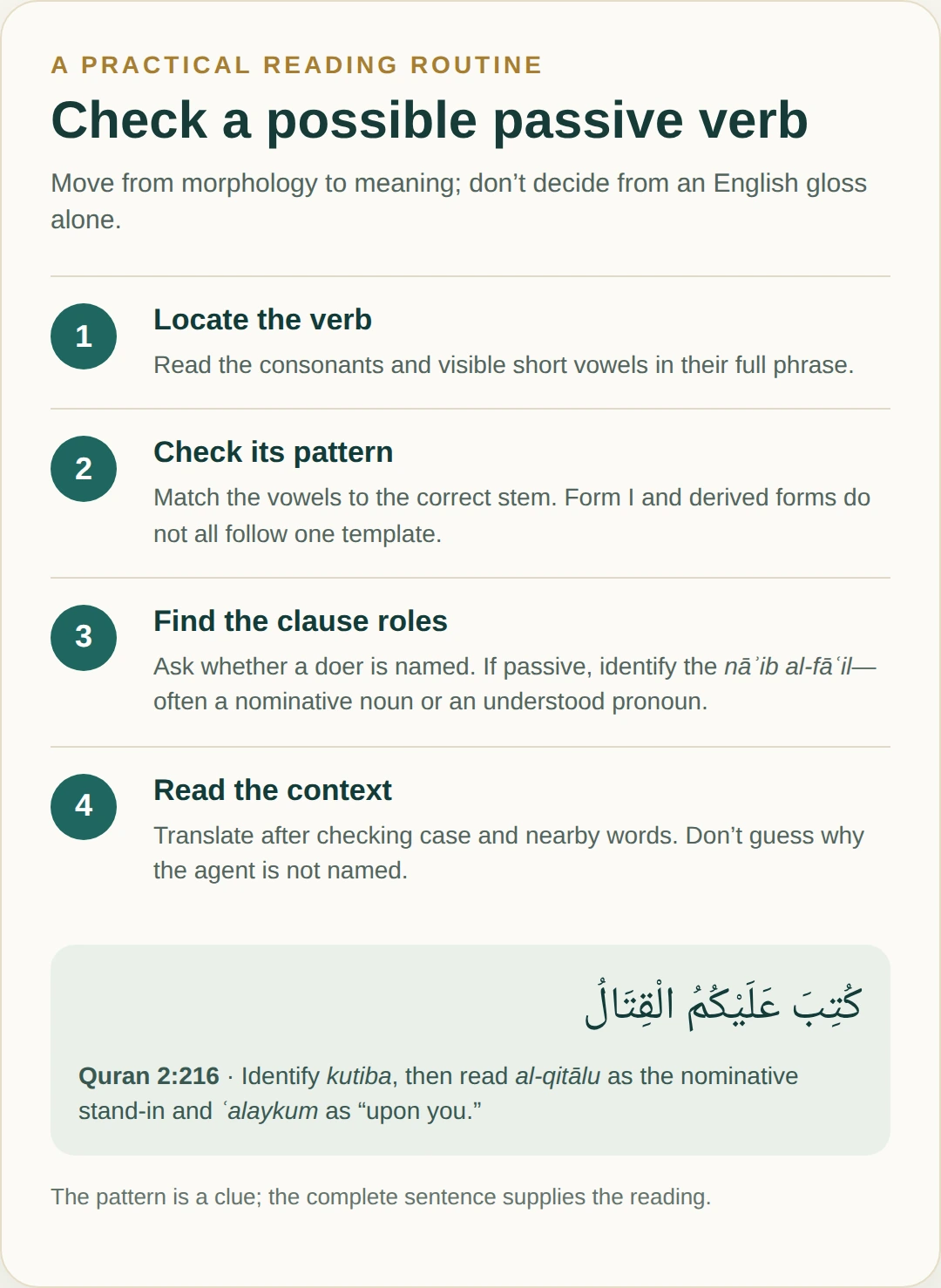
- Locate the verb. Read its consonants and any visible short vowels; do not classify it from an English translation alone.
- Check its pattern. Ask whether the vowels fit a passive form for that verb’s pattern, such as fuʿila or yufʿalu for a sound Form I verb, or the appropriate pattern for a derived form.
- Look for the clause’s doer and stand-in. Is a doer overtly named? If not, identify the word or pronoun carrying the passive clause’s subject-like role. A following noun may be nominative, but verify its relationship rather than guessing from position alone.
- Translate after checking the full phrase. Use the verb’s form, case clues, and surrounding words. Do not infer from the passive alone whether the agent is unknown, unimportant, or deliberately withheld.
Try the sequence on kutiba in 2:216: identify the verb, notice the fuʿila pattern, find al-qitālu as the nominative stand-in, and then read ʿalaykum with it. A compact guide to Arabic maṣdar forms can also help you distinguish verbs from related verbal nouns when a phrase contains both.
Common mistakes to avoid
- Calling the doer truly unknown. “Passive” means the clause does not name the doer in that verb construction. The surrounding text may make the agent clear.
- Using one template for every verb. Fuʿila is a helpful Form I pattern; Form IV and other derived stems use different shapes. Weak and doubled roots need special care.
- Assuming the next noun is always the subject. Arabic word order can vary, and prepositional phrases may intervene. Check case and syntax rather than relying on English order.
- Confusing a passive verb with a passive participle. A participle such as maktūb (“written”) is a derived noun/adjective, not the same verb form as kutiba (“was written”).
- Giving morphology a rhetorical meaning by itself. Grammar identifies the form. Explaining why a verse chooses it requires the wider context and appropriate interpretive study.
Keep the form and verse together
For another example of how Arabic verb forms guide Quranic reading, compare this explanation with Quranytime’s lesson on recognizing imperative verbs in the Quran. A conjunction or other connecting word can also change how a clause joins its neighbors; the site’s Quranic Arabic conjunction guide reviews those links. For a broader starting point, see the site’s Arabic grammar overview.
If you would like help reading verb patterns and case clues with a teacher, you can book a free Quran and Arabic trial class. Bring a short passage you are studying and ask how to identify the verb, the noun’s role, and the surrounding context.
Quick questions
What is the Arabic passive voice called?
It is commonly called al-mabnī lil-majhūl (المبني للمجهول), “built for the unknown.” The label refers to a verb whose doer is not stated in that clause, not necessarily a person or cause that is unknown in the larger passage.
How can I recognize an Arabic passive verb?
Look for the verb’s passive vowel pattern, then confirm the root and stem. A Form I perfect often follows fuʿila; a Form IV passive perfect can follow ufʿila. Check the whole clause and, when needed, a reliable morphology reference.
Does the Quranic passive always hide the agent?
The passive form does not name the doer in that verb clause. It does not, by itself, tell you whether the agent is hidden, already known, or simply not the focus. Avoid adding that explanation unless the verse context or a trusted interpretation supports it.