
Learning body parts in Arabic is easier when you connect each word to a short, useful sentence instead of memorizing a long list. This guide focuses on clear Modern Standard Arabic (MSA), readable vowel marks, and simple phrases for saying where you feel pain. You’ll get a compact vocabulary map, pronunciation cues, a repeatable review routine, and boundaries for using language practice in a health setting.
The Arabic words here are for study and everyday communication. They are not a diagnosis, treatment plan, or substitute for qualified interpretation when important medical information is involved.
Start with the register: Modern Standard Arabic
Body vocabulary is useful in class, reading, travel, and basic conversation. This lesson gives MSA forms first so learners have one consistent starting point. Arabic-speaking communities also use local dialects, and a familiar word or pronunciation may differ in Egypt, the Levant, North Africa, and elsewhere. If you are comparing formal Arabic with spoken varieties, our guide to Quranic Arabic and Modern Standard Arabic explains why it helps to label the register instead of mixing examples without warning.
The phrase for “body parts” is أَعْضَاءُ الْجِسْمِ (aʿḍāʾ al-jism). You do not need to learn every anatomical term at once. Start with common external words, practise them in a sentence, and add less frequent vocabulary only when you need it.
Keep three columns in your notes: Arabic spelling, a temporary pronunciation reminder, and meaning. The Arabic script remains the anchor; transliteration cannot show every sound or spelling distinction. For example, the mark in ʿayn reminds you that ع is a consonant. Copy a model carefully, then practise hearing and producing the sound rather than relying on English spelling alone.
Body parts in Arabic: a grouped beginner vocabulary list
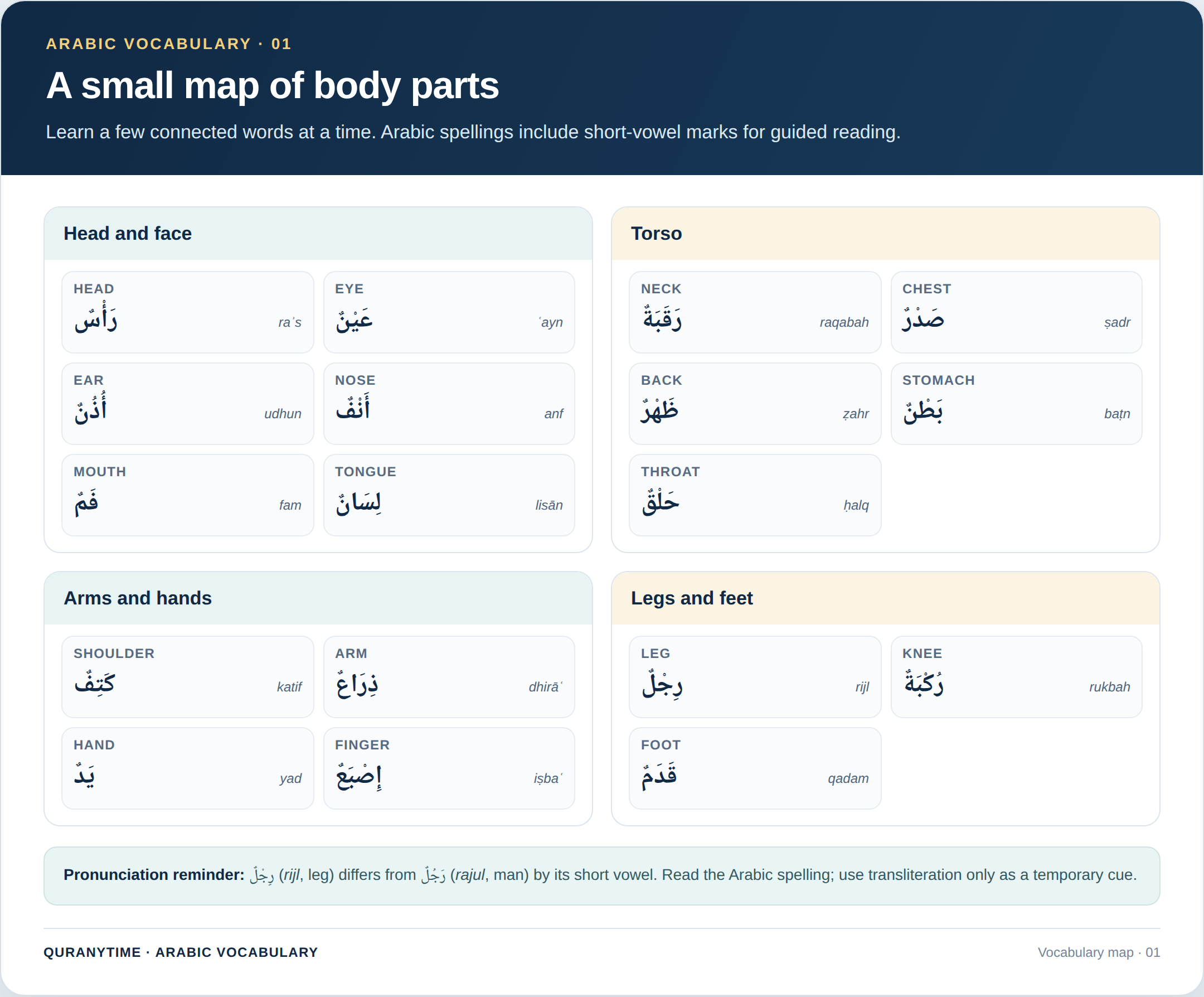
Arabic is written from right to left. The Arabic spellings below include short-vowel marks to make first practice easier; many everyday texts omit those marks. If you are still getting comfortable with letter shapes and how they join, review the Arabic alphabet and letter forms before reading the list aloud.
Head and face
| English | Arabic | Pronunciation guide |
|---|---|---|
| head | رَأْسٌ | raʾs |
| hair | شَعْرٌ | shaʿr |
| face | وَجْهٌ | wajh |
| eye | عَيْنٌ | ʿayn |
| ear | أُذُنٌ | udhun |
| nose | أَنْفٌ | anf |
| mouth | فَمٌ | fam |
| tooth | سِنٌّ | sinn |
| tongue | لِسَانٌ | lisān |
| throat | حَلْقٌ | ḥalq |
Torso, arms, and legs
| English | Arabic | Pronunciation guide |
|---|---|---|
| neck | رَقَبَةٌ | raqabah |
| shoulder | كَتِفٌ | katif |
| arm | ذِرَاعٌ | dhirāʿ |
| hand | يَدٌ | yad |
| finger | إِصْبَعٌ | iṣbaʿ |
| chest | صَدْرٌ | ṣadr |
| back | ظَهْرٌ | ẓahr |
| stomach / abdomen | بَطْنٌ | baṭn |
| leg | رِجْلٌ | rijl |
| knee | رُكْبَةٌ | rukbah |
| foot | قَدَمٌ | qadam |
Three pronunciation details that help you read the words
1. Keep the Arabic sounds distinct. The letter ع in ʿayn is a consonant, not an English vowel. The letter ح in ḥalq is also different from ordinary English “h.” Listen to a qualified Arabic speaker when you can, and treat transliteration as a reminder rather than a perfect sound recording.
2. Notice the difference between similar-looking words. رِجْلٌ (rijl) means “leg,” while رَجُلٌ (rajul) means “man.” The short vowel changes what you read. Slow down, look at the marks, and say the word in a phrase.
3. Practise singular first. You may see dual or plural forms in dictionaries, but a beginner can first recognize the singular word and its context. Later, add forms such as “two eyes” or “hands” when a reading or conversation calls for them. For broader phrase practice, use these terms alongside the beginner Arabic phrases guide, rather than memorizing isolated translations.
Build “my…” and a simple symptom phrase
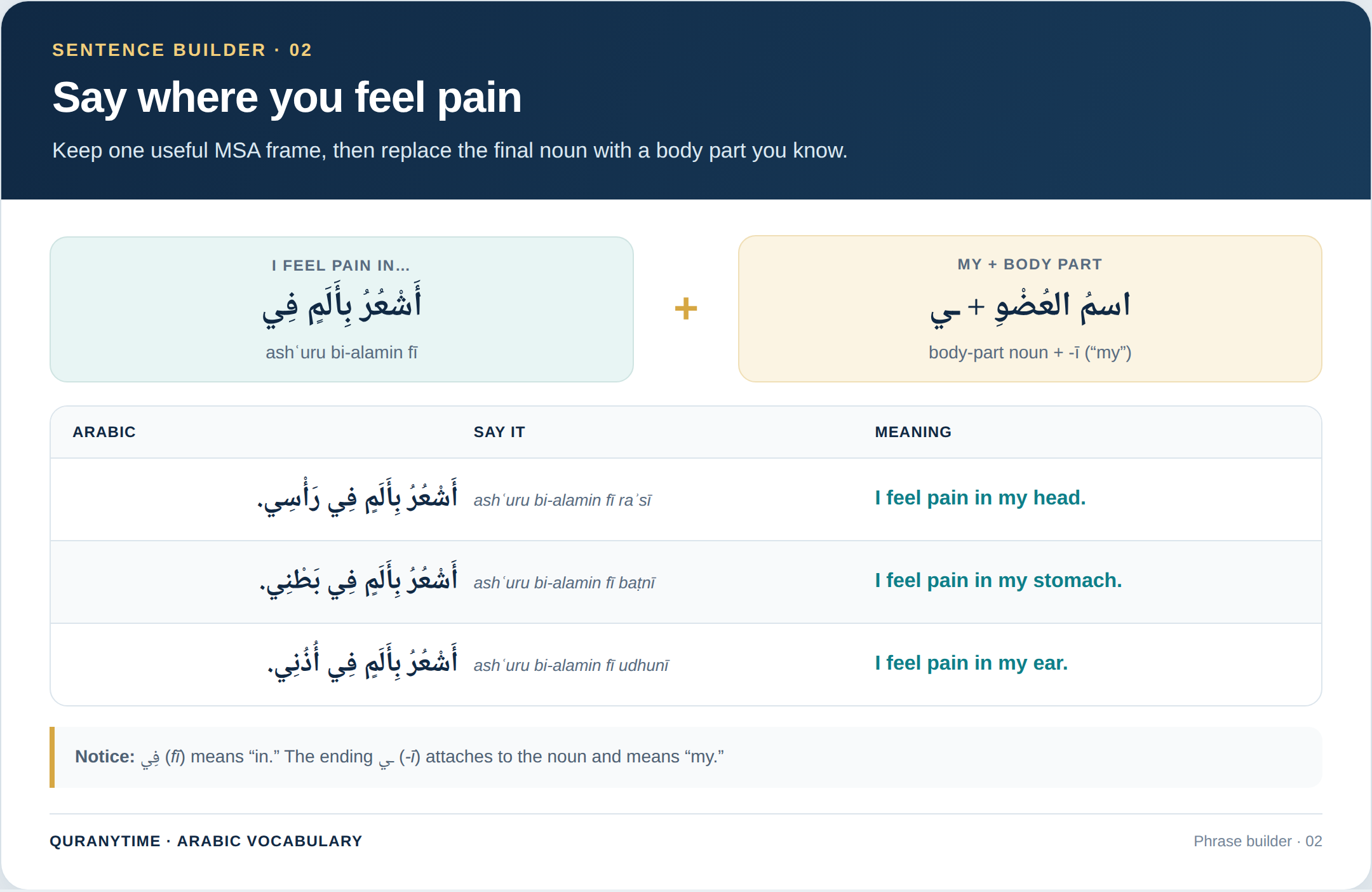
A small possessive ending turns a body-part noun into “my [body part].” In these examples, the ending ـي is read as -ī: رَأْسِي (raʾsī, my head), أُذُنِي (udhunī, my ear), يَدِي (yadī, my hand), and بَطْنِي (baṭnī, my stomach). The ending attaches to the noun; it is not a separate word. For more examples of attached “my/your/his” endings, see the guide to Arabic possessive pronouns.
A useful MSA pattern is أَشْعُرُ بِأَلَمٍ فِي + body part (ashʿuru bi-alamin fī…): “I feel pain in…” Here فِي means “in,” and the possessive ending identifies whose body part you mean.
| Arabic sentence | Pronunciation | Meaning |
|---|---|---|
| أَشْعُرُ بِأَلَمٍ فِي رَأْسِي. | ashʿuru bi-alamin fī raʾsī | I feel pain in my head. |
| أَشْعُرُ بِأَلَمٍ فِي بَطْنِي. | ashʿuru bi-alamin fī baṭnī | I feel pain in my stomach. |
| أَشْعُرُ بِأَلَمٍ فِي أُذُنِي. | ashʿuru bi-alamin fī udhunī | I feel pain in my ear. |
Read each sentence in chunks: ashʿuru (“I feel”) + bi-alamin (“pain”) + fī (“in”) + the body part with “my.” This helps you substitute a new noun without rebuilding the whole sentence. The preposition فِي also appears in other Arabic contexts; our guide to Arabic prepositions explains how small words connect larger phrases.
Ask and clarify without overloading the conversation
Two short questions can help you practise the vocabulary: أَيْنَ الْأَلَمُ؟ (ayna al-alam?, “Where is the pain?”) and مَا هَذَا؟ (mā hādhā?, “What is this?”). The question word أَيْنَ means “where.” Review other question forms in the Arabic question words lesson. If you are practising with a partner, point to a word on your worksheet and ask the question; no medical role-play is needed.
Register matters here. A phrase written in MSA may sound formal in a local conversation, and dialect expressions can vary. Learn the MSA version as a stable reading and study form, then ask a qualified teacher which local wording is appropriate for your setting. The goal is to understand the vocabulary, not to claim that one phrase sounds identical in every country.
A 10-minute routine for remembering the words
Minute 1–2: Choose five. Pick a small group, such as head, eye, ear, nose, and mouth. Read the Arabic with vowel marks and listen to a pronunciation model if available.
Minute 3–5: Cover and recall. Hide the English column, say each Arabic word, then hide the Arabic column and retrieve the meaning. Mark only the words you missed.
Minute 6–8: Use one sentence frame. Practise the “I feel pain in…” pattern with two or three known nouns. Keep the written form visible while you are still learning the sounds.
Minute 9–10: Review later. Revisit the same five words tomorrow, then again after a few days. The Quranic Arabic vocabulary study plan offers a broader structure for selecting words and reviewing them in context. Once you are comfortable, continue with another everyday set such as family members in Arabic.
On the next review, shuffle the order: say the meaning, recall the Arabic, then rebuild a sentence. If one word repeatedly slips, keep it in a small “review again” column instead of adding a large new list. A short, spaced review is easier to repeat than an exhausting single session.
Use health vocabulary carefully
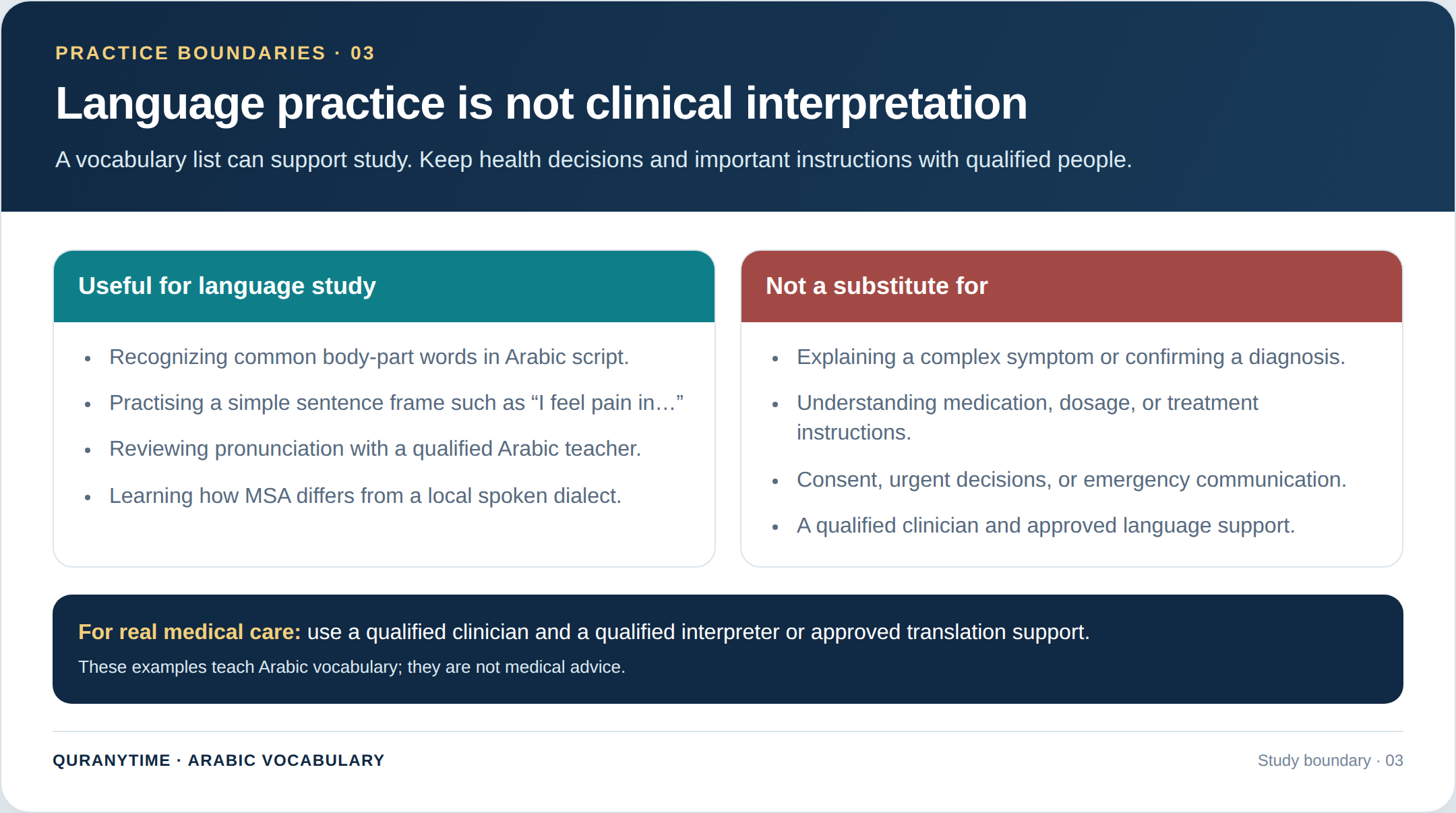
These expressions are short language examples, not a reliable method for explaining a complex symptom, understanding a diagnosis, checking a dose, or responding to an emergency. Word lists do not teach medical nuance, and a learner may mispronounce or misunderstand a phrase. A systematic review in the Oman Medical Journal describes how language barriers can contribute to communication problems in healthcare and discusses interpreter services; read the review on language barriers in healthcare. For real medical decisions, use a qualified clinician and a qualified interpreter or approved translation support rather than relying on this article.
Practise with guidance
To check your reading aloud, ask a teacher to listen for the sounds in ʿayn, ḥalq, and dhirāʿ, then build a few new sentences from the same frame. You can use Quranytime’s free trial class for an assessment of your current Arabic level and suitable next steps. Keep the first goal modest: recognize a useful group of words, pronounce them carefully, and know when a phrase is only a study aid.
Watch: body-part vocabulary in Arabic
This short vocabulary lesson is an optional listening check. Pause after each word, repeat it, and compare the sounds with the Arabic spelling in this article.
Quick answers
How do you say “body parts” in Arabic?
أَعْضَاءُ الْجِسْمِ (aʿḍāʾ al-jism) means “body parts.” For a first vocabulary set, learn head, face, eye, ear, nose, mouth, hand, stomach, leg, and foot.
How do I say “my head hurts”?
A common MSA sentence is رَأْسِي يُؤْلِمُنِي (raʾsī yuʾlimunī), literally “my head hurts me.” You can also use the more transparent study pattern أَشْعُرُ بِأَلَمٍ فِي رَأْسِي (“I feel pain in my head”).
Should I learn dialect words too?
Start with one clearly labeled variety. MSA gives you a consistent written form, while daily speech differs by region. Add local alternatives with a teacher once the basic words and phrase pattern feel familiar.