
The dagger alif in Quran reading is a small upright stroke above a letter that can change how you read the whole syllable. Also called alif khanjariyya (الألف الخنجرية), it cues a long ā sound in familiar words such as هَٰذَا and ذَٰلِكَ, even though a full alif is not written in that position on the main line.
This guide shows how to spot the mark, hear the difference between a short vowel and a long one, and practise without confusing dagger alif with other Arabic signs. The examples are learning aids: for Quran recitation, keep to the text and reading tradition used by your teacher.
What is a dagger alif?
A dagger alif is a small alif-shaped mark written above a letter. In digital Arabic it is often represented by the combining mark ٰ (Unicode U+0670). Its practical job is to indicate a long ā where the word’s recognized Quranic spelling does not show a full-size alif in the ordinary letter row at that point. It is a vowel-length cue, not a new consonant, and you do not pronounce the mark as a separate sound.
It often appears in Quranic or fully vocalized writing, where careful readers benefit from seeing details that everyday unvowelled Arabic may omit. Some words and editions display small signs differently, so use the mark as printed in your Mushaf rather than altering the spelling yourself. If you are learning the surrounding short-vowel signs first, Quranytime’s Arabic harakat guide can help you separate fatḥah, kasrah, ḍammah, sukūn and tanwīn.
Short “a” and long “ā” are not the same
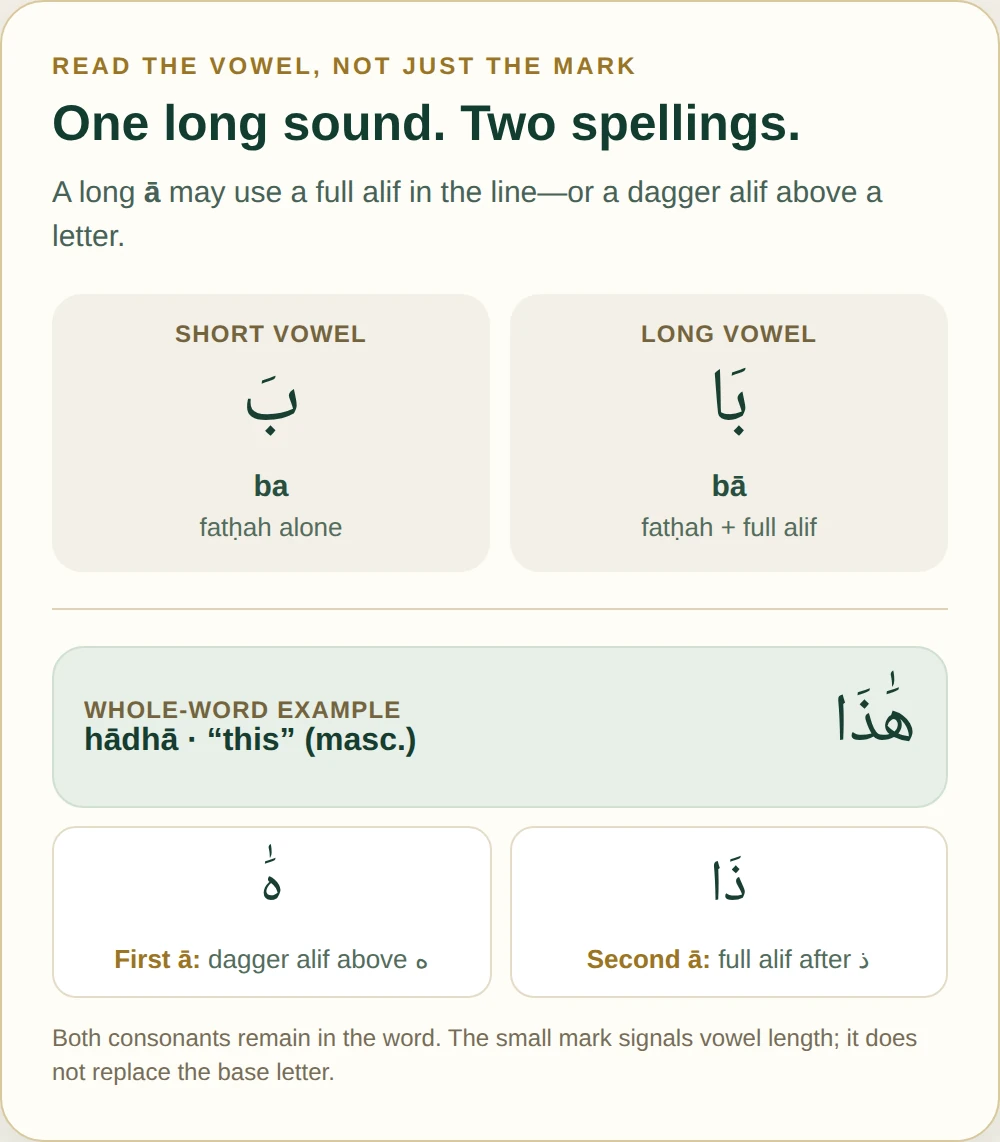
A fatḥah is a short vowel. For example, the syllable بَ is approximately ba. Add a full alif after it, as in the sound pattern بَا, and the vowel becomes long: bā. A dagger alif signals that same kind of long ā when no full alif is written at that spot.
In هَٰذَا (hādhā, “this,” masculine), notice two different spellings of the long vowel in one word. The first long ā, after the hāʾ, is signalled by the small dagger alif above it. The second long ā, after dhāl, is shown with an ordinary full alif. Do not skip the hāʾ or dhāl: each base letter is still pronounced, while the mark tells you to lengthen its vowel.
Most beginner tajweed lessons group this sound with madd ṭabīʿī, or natural madd. In the common Hafs teaching approach, it is usually introduced with a two-count baseline. A “count” is a relative recitation beat, not a fixed number of seconds; follow the qualified teacher and recitation route you are learning. A focused beginner lesson on madd with dagger alif presents the mark with a sustained “aa” practice sound. For the broader categories and examples, see Quranytime’s overview of Quranic madd rules.
Common words to recognize
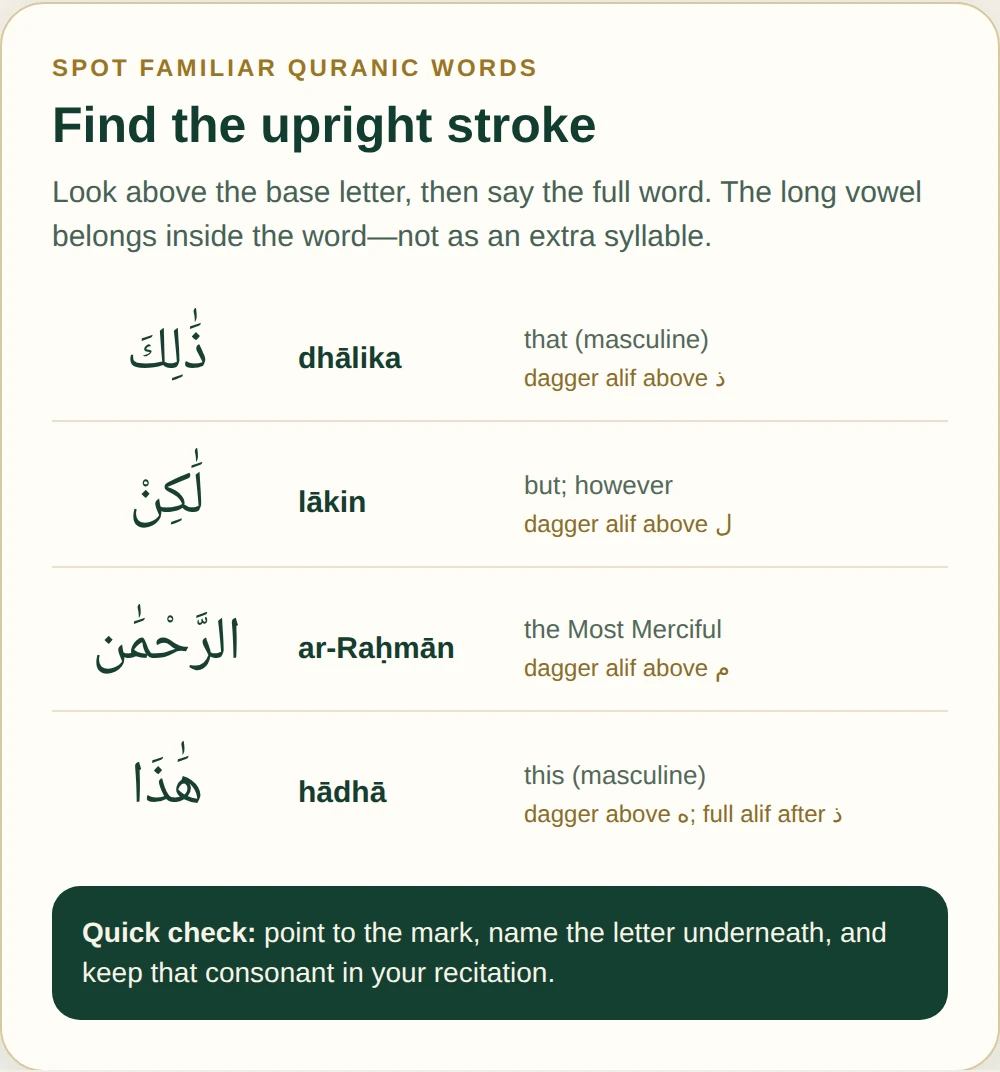
Learn the mark in whole words rather than trying to recite a floating symbol. These familiar examples let your eye connect the superscript stroke with the long vowel:
- هَٰذَا — hādhā, “this” (masculine): dagger alif above hāʾ; full alif after dhāl.
- ذَٰلِكَ — dhālika, “that” (masculine): dagger alif above dhāl.
- لَٰكِنْ — lākin, “but/however”: dagger alif above lām.
- الرَّحْمَٰن — ar-Raḥmān, “the Most Merciful”: dagger alif above mīm.
Look for the little mark, identify the consonant beneath it, and then read the full word. Transliteration can remind you where a long vowel occurs, but it does not teach the Arabic letter’s sound or the exact recitation. The comparison of Uthmani and Indo-Pak Quran scripts explains why printed layouts and visual conventions may differ. When a text leaves short marks out, use the complete word and context rather than guessing from one tiny glyph; the beginner guide to reading Arabic without vowels covers that separate skill.
Do not confuse it with these Arabic signs
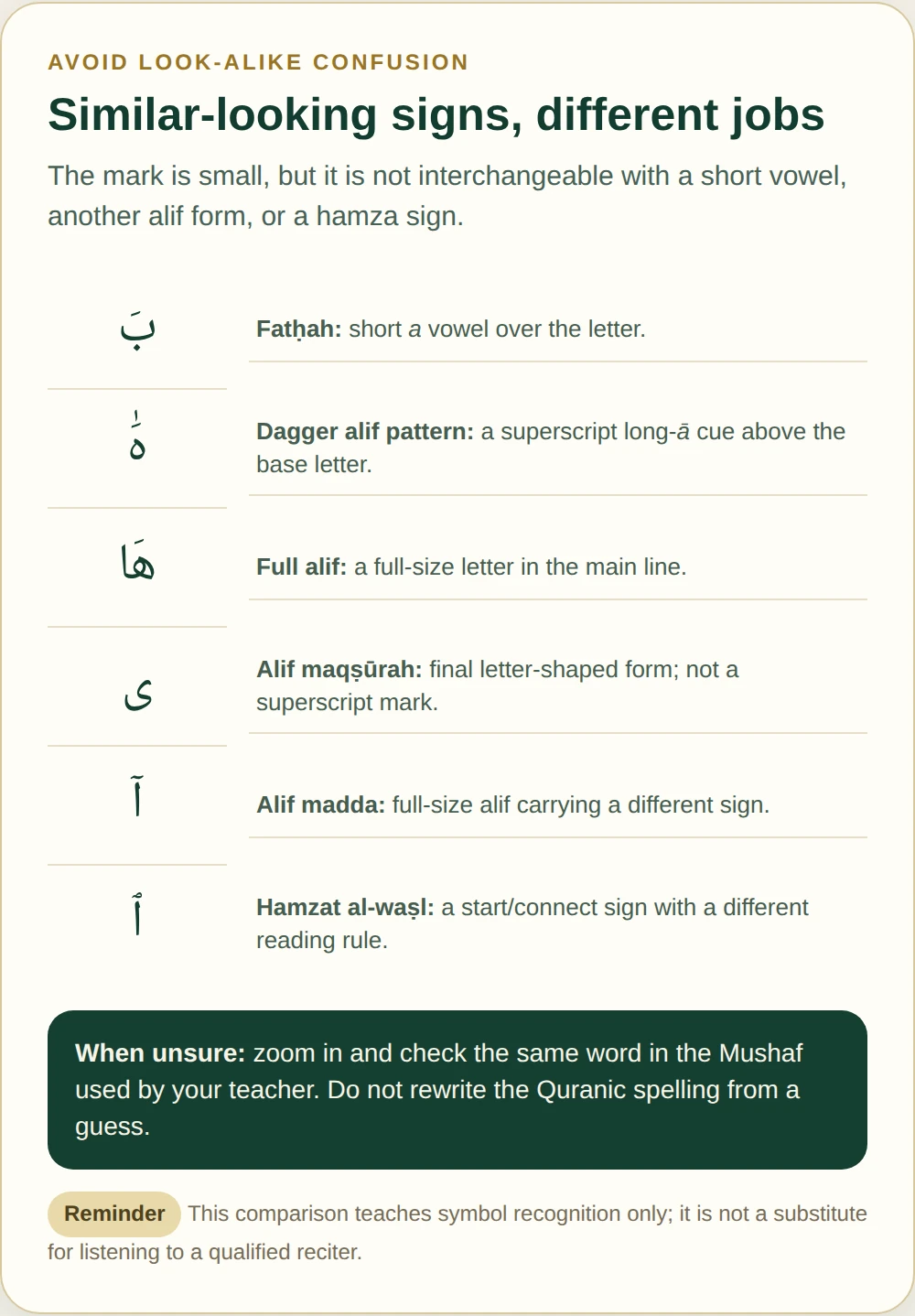
The dagger alif is easy to misread when marks are small or a screen uses a different font. Compare its job with these other forms:
- Fatḥah َ: a short a vowel sign over a letter. On its own it does not mean “hold this vowel for the long-alif duration.”
- Full alif ا: a letter written in the main row. When it follows a matching fatḥah, it can mark a long ā, as in the second long vowel in هَٰذَا.
- Alif maqṣūrah ى: a final letter shaped like yāʾ without dots. It can also represent long ā, but its shape and position are different from a superscript dagger alif.
- Alif madda آ: a full-size alif carrying a madda sign, not the tiny upright mark above another letter.
- Hamzat al-waṣl ٱ: a hamza-related starting sign with rules for starting and connecting words. It is not a dagger alif; see the separate guide to hamzat al-waṣl in Quran reading.
Fonts can make marks look less distinct, and Quran editions do not all use identical visual styling. If you cannot tell which sign you are seeing, zoom in or check a trusted copy of the same Mushaf rather than inferring a rule from appearance alone.
Common reading mistakes to avoid
Because the dagger alif is small, beginners sometimes focus on the mark and forget the word around it. Keep these corrections in mind:
- Do not drop the base consonant. In هَٰذَا, you still pronounce hāʾ and dhāl. The small mark lengthens the vowel associated with its position; it does not replace the letter beneath it.
- Do not lengthen every fatḥah. A short fatḥah remains short unless the word’s spelling and recitation indicate a long vowel. The dagger alif is one visual cue, not a license to stretch nearby vowels.
- Do not add a full alif when copying. Read the recognized spelling as printed. The sign gives reading information; it does not mean that you should rewrite the word with an extra letter.
- Do not confuse the symbol with a pause mark. Small Quranic annotations can serve different purposes. Confirm the sign in context and do not apply a madd rule to every tiny stroke.
- Do not use Latin spelling as the final test. Transliterations may write long vowels with “ā,” “aa,” or just “a.” The Arabic text and a reliable recitation model are better guides.
When a dagger alif is absent from an unvowelled edition, that does not automatically mean the familiar word has changed its sound. Many everyday Arabic texts omit most short-vowel marks, and visual detail varies by edition. Read the whole word, check the vocabulary and context, and compare the same passage in the Mushaf your class uses. Quranytime’s guide to reading Arabic without short-vowel marks explains why context matters when pronunciation marks are not fully printed.
Likewise, a dagger alif does not explain every long vowel in a verse. A word may contain a full alif, a yāʾ or wāw of madd, a different small letter, or a rule that depends on what follows or on whether you stop. This article is about recognizing one sign; it is not a replacement for a complete madd reference or a lesson in all Quranic orthographic symbols. Keep the scope narrow and ask your teacher when a word’s reading is uncertain.
A simple practice routine
Use this five-step check with one word at a time:
- Point: locate the small upright mark above the base letter.
- Name: identify the actual Arabic letter underneath it. Do not drop it or replace it with an alif.
- Compare: say a short-vowel example and a long-vowel example, then notice how the vowel duration changes. Use the printed full word, not a made-up Quranic spelling.
- Listen: hear a reliable reciter read the word in context, then imitate at a comfortable pace. Keep the vowel clear instead of adding a new syllable.
- Check: ask a qualified Quran teacher to confirm the sound and length for your Mushaf and reading tradition.
Start with هَٰذَا, then practise ذَٰلِكَ, لَٰكِنْ and الرَّحْمَٰن. First find the mark without reciting. Next read the word slowly with a trusted audio model. Finally, read it in a phrase so that the long vowel stays connected to the word rather than becoming an extra beat at the end. If you want individual feedback on your Quran and Arabic reading, you can book a free Quran and Arabic trial class.
Watch and listen to a short lesson
This beginner-friendly lesson introduces dagger alif and shows common Quranic word examples. Listen for the long ā and use your teacher’s model for exact recitation timing.
What to remember
The dagger alif is a small superscript alif cue for a long ā, often found in Quranic or fully marked Arabic text where a full alif is absent from the main line. The base letter remains part of the word. Learn the sign inside familiar examples, distinguish it from fatḥah and other alif forms, and take timing from the recitation tradition and teacher you follow—not from the size of the mark or a transliteration alone. With a little visual practice and careful listening, the tiny stroke becomes a useful reading clue rather than a mystery.
For steady progress, use Quranytime’s practice ideas for improving Quran-reading fluency without rushing, and ask a teacher to correct any word that remains unclear.