
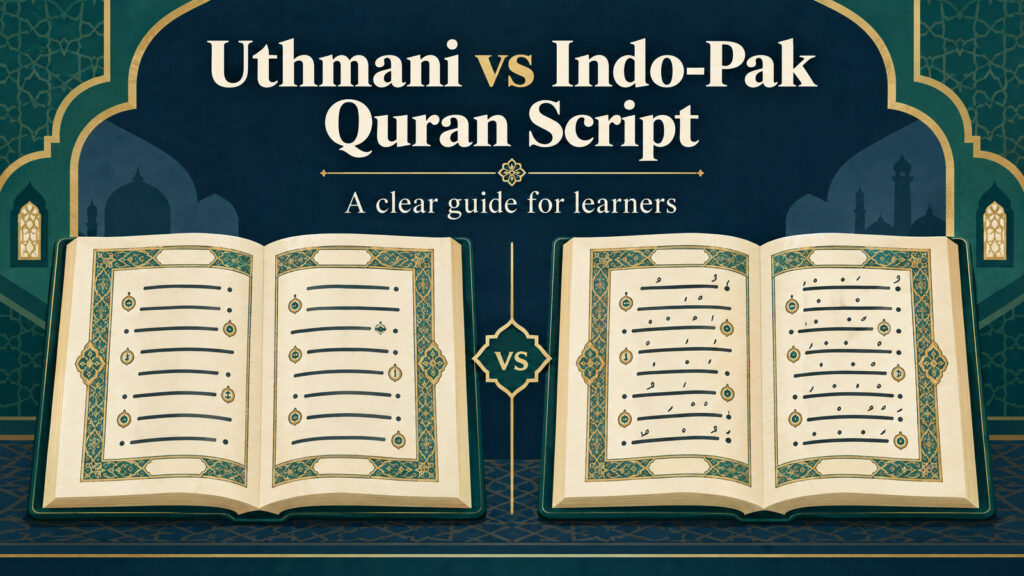
Two learners can open different Qurans to the same surah and notice that the pages do not look alike. One may know the Madinah-style Uthmani layout; another may recognize the Indo-Pak or South Asian style from home or class. If you have wondered whether one is a different Quran, or which Mushaf to learn from, the useful answer is that the printed conventions can vary while the learning decision remains practical: choose a clear copy you can use consistently and understand with a teacher.
Quick answer: Uthmani and Indo-Pak are familiar printed styles of Quran text. Letter forms, vowel marks, pause symbols, and page layout may differ by edition. Start with the style your teacher uses or the one you already read comfortably; do not treat a different-looking page as a judgment about which style is superior.
What do “Uthmani” and “Indo-Pak” mean?
Uthmani is commonly used for a Quranic writing convention associated with the Uthmanic rasm. In everyday use, “Madinah script” or “Madinah Mushaf” often refers to a widely used printed edition and its page design. Those terms are related, but they are not always exact labels for every publisher, font, or edition. Check the information printed in your own copy.
Indo-Pak, also called South Asian or sometimes Majeedi style, is a regional presentation familiar to many readers from South Asia and diaspora communities. Some letter shapes and vowel-marking conventions may look different from a Madinah-style page. Details vary between editions, so avoid assuming every Indo-Pak Mushaf uses identical symbols or pagination.
For an official example, the King Fahd Glorious Qur’an Printing Complex describes its Uthmanic font as compatible with the Madinah Mushaf, including editions in Hafs and Warsh narrations. This illustrates why script style and narration should not be treated as the same label.
What might look different on the page?
“Different script” does not usually mean learning a completely new alphabet. A learner is more likely to notice how particular letters, marks, and page cues are presented. The exact appearance depends on the publisher and the copy.
- Letter forms and small signs: Some letter shapes, hamzah forms, or auxiliary signs may be drawn or positioned differently. If you are still learning the basics, review Arabic letter shapes and sounds before comparing a full page.
- Vowel and recitation marks: Harakat, sukun, shaddah, madd cues, and other small signs can vary in shape, position, or level of detail. Learn the conventions of the specific Mushaf you use rather than transferring every symbol by appearance alone.
- Pause signs: Waqf marks may differ in shape or placement. Use the legend and your teacher’s explanation for the copy in front of you; our guide to common Quran waqf signs explains why pause cues deserve careful attention.
- Page layout: Line spacing, page endings, juz markers, and margins can vary. Page numbers belong to an edition, not to the verse itself. When sharing a passage with someone who uses another Mushaf, give the surah and ayah reference.
A familiar layout may feel easier because your eyes already know where to look. That is a learning advantage, not proof that one style is universally easier or more correct.
Uthmani vs Indo-Pak: a quick comparison
| Feature | What may vary | Helpful approach |
|---|---|---|
| Letter forms | Some shapes and small signs look different by edition. | Follow the copy used in class; ask about unfamiliar forms. |
| Vowel and pause marks | Placement, shape, or detail may differ. | Learn each cue in context instead of guessing from another edition. |
| Pages and sections | Line counts, page endings, and juz layouts depend on the edition. | Use surah and ayah numbers when locating a passage. |
Script, narration, and Tajweed are different concepts
A script or page style describes how the written text and its signs are displayed. A riwayah is a transmitted reading tradition, such as Hafs or Warsh. Tajweed concerns how letters are pronounced and how recitation rules are applied. These subjects connect in a printed Mushaf, but one term should not replace another.
A different-looking symbol does not by itself tell you that the recitation has changed. Conversely, a script label does not explain every detail of the narration printed in a particular edition. Confirm the copy’s information and ask your instructor about a specific mark. Our beginner Tajweed guide and overview of core Quran recitation rules cover the separate skill of reciting accurately.
Which Quran script should a beginner choose?
There is no one-size-fits-all answer. Choose the Mushaf you can read accurately with support and keep using consistently. Ask these questions:
- Which edition does your teacher use? Matching the teacher’s copy makes demonstrations and homework easier to follow. If you are considering a class, see what to expect in a first online Quran lesson and ask which edition is taught.
- Which style do you already recognize? A learner familiar with Indo-Pak may progress comfortably by continuing with it. Someone starting from zero may choose the edition used by a teacher or local class.
- Can you get the same edition reliably? Consistency helps your eyes learn where marks and verse divisions appear. If you alternate between books, remember that page breaks and line numbers may not match.
- Can you read it comfortably? Consider print size, contrast, spacing, and the edition’s notes. The most useful copy is the one that lets you follow each line without straining or guessing.
If you do not yet have a teacher or preference, choose one widely available edition, tell your instructor which one you are using, and keep it as your main copy while learning. A teacher can explain the marks in context instead of asking you to memorize visual differences alone.
How to switch styles without losing your place
Sometimes a class or family member uses a different copy. You do not need to relearn the Quran, but a gradual change can prevent page confusion:
- Keep one primary copy for daily practice. Use the same edition most of the time so your eyes build a stable page routine.
- Match by surah and ayah, not page number. Confirm the passage’s opening words; line breaks and page endings may differ.
- Learn one unfamiliar mark at a time. Ask what it means in that edition, make a brief note, and return to the passage instead of comparing every symbol at once.
- Read aloud for feedback. A teacher can check whether you apply the cue correctly. For sound-specific practice, use this guide for English-speaking Quran learners alongside live correction.
For memorization, keep the same primary layout when possible. If you review from another copy, locate the ayah first and read it slowly before relying on page memory. The goal is accurate recitation, not remembering where a line sits on paper.
Common mistakes to avoid
- Calling one style right and the other wrong. Do not judge a Mushaf by a different-looking page; ask about the particular edition if something is unclear.
- Confusing page style with Tajweed. A layout can show cues, but it cannot replace learning how a sound is pronounced.
- Treating color as a script rule. Color is a publisher’s teaching aid, not a universal definition. See our guide to color-coded Tajweed Mushafs for how to use visual cues carefully.
- Switching copies every day or guessing from one symbol. Choose a main edition; when an unfamiliar mark matters, check the legend and ask an instructor.
A simple first-week plan
Start with the edition your teacher recommends or the one you already read most comfortably. For a few practice sessions, read a short passage from that copy and note only the marks that are genuinely unfamiliar. Ask your teacher about them in context, then keep using the same edition while you build fluency.
Frequently asked questions
Are Uthmani and Indo-Pak two different Qurans?
No. The labels usually describe different print and notation conventions for presenting Quranic text. A particular edition may differ in signs or page layout, so ask about the exact copy if a word or mark seems unfamiliar.
Is Uthmani easier for beginners?
It depends on your experience and teacher. Someone familiar with Indo-Pak may find that style easier; another learner may prefer a Madinah-style edition. Choose support and consistency over claims that one format is universally easiest.
Can I switch from Indo-Pak to Uthmani?
Yes. Move gradually: locate passages by surah and ayah, keep one main copy for practice, and ask a teacher to explain unfamiliar marks. Do not rely on page numbers alone.
Does the script tell me whether my Mushaf uses Hafs or Warsh?
Not by itself. Script style and riwayah are different pieces of information. Check the edition’s imprint or notes and follow a qualified teacher when learning its recitation.
Bottom line: When comparing Uthmani vs Indo-Pak Quran script, focus on the letter forms, marks, pause signs, and layout you will actually encounter. Choose a copy that fits your teacher and reading background, then practise consistently. A familiar Mushaf is a useful tool; accurate recitation grows through careful study and feedback.