
A noun after a preposition is usually genitive, so Quran learners often expect to see a kasra. Yet in Surat Yusuf 12:21, the word for Egypt appears in the phrase مِن مِّصْرَ, with fatḥa at its end. That is not a mistake or an accusative noun: it is a genitive diptote. Once you separate a word’s grammatical case from the vowel used to mark it, this unusual-looking ending becomes easier to read.
Quick answer: an indefinite diptote normally takes ḍamma without tanwīn in the nominative and fatḥa without tanwīn in both the accusative and genitive. If the diptote itself has الـ or is the head noun in an iḍāfa (construct phrase), its genitive ending is kasra instead. The next sections show the pattern and a cautious way to recognize it.
Why does a genitive noun end in fatḥa?
“Genitive” describes a noun’s grammatical relationship. A preposition such as min (“from”), or a position as the second term of a construct phrase, can place a noun in the genitive. A kasra is the usual visible marker for an ordinary noun, but Arabic has noun classes whose visible endings work differently. The role and its marker are related, but they are not the same thing.
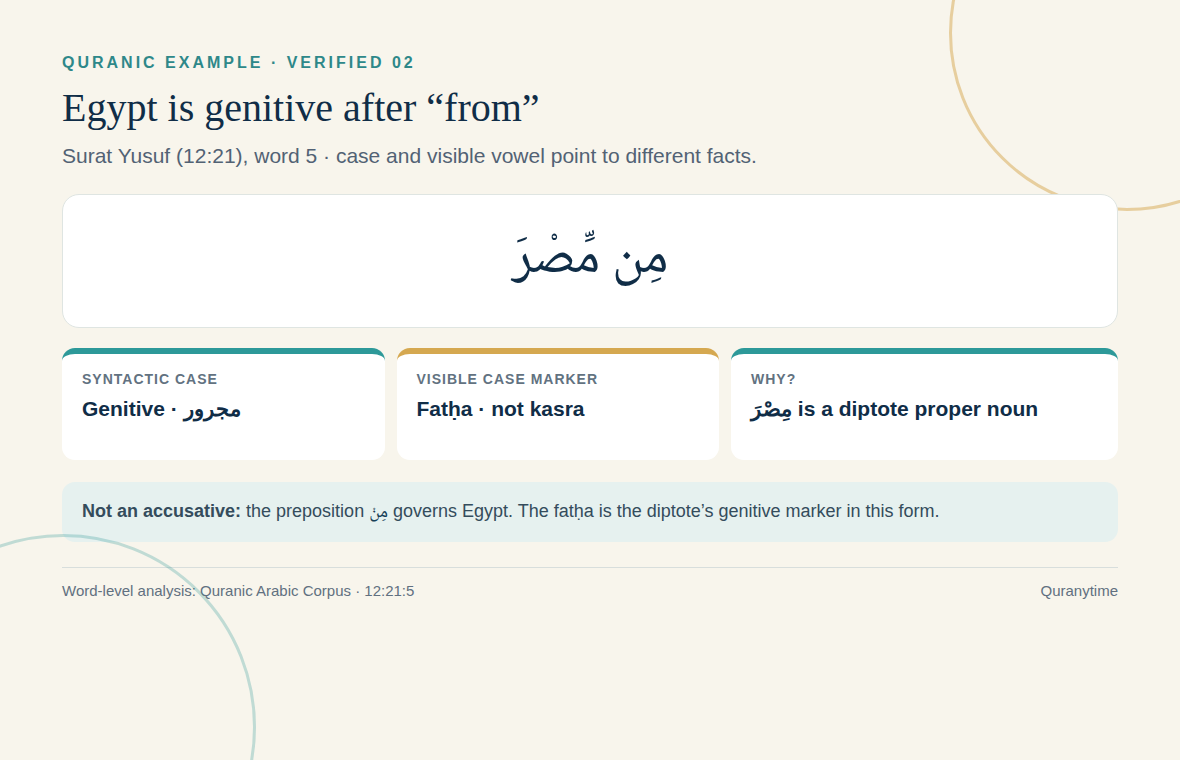
The Quranic example is especially useful because the preposition is right there: مِن مِّصْرَ, “from Egypt.” The Quranic Arabic Corpus analyzes the fifth word of Yusuf 12:21 as a genitive proper noun, explaining that its fatḥa appears instead of kasra because the name is diptote. You can review that word-level Quranic Arabic Corpus analysis of مصر in 12:21. For the broader case system, see Quranytime’s guide to Arabic case endings in Quranic reading.
What does “diptote” mean?
Diptote is the English grammar label for ممنوع من الصرف (mamnuʿ min al-ṣarf), often glossed as “restricted declension.” The beginner’s pattern is sometimes called “two-ending” because an indefinite diptote uses a damma for nominative and a fatha for accusative and genitive. Unlike an ordinary indefinite noun, it does not take tanwīn in those forms.
English grammar often calls an ordinary noun a triptote when it uses three different case-vowel patterns: ḍamma for nominative, fatḥa for accusative, and kasra for genitive. An indefinite triptote commonly has the matching tanwīn. The label is about visible endings, not the number of grammatical roles: both an ordinary noun and a diptote still have nominative, accusative, and genitive case. Do not diagnose a word as diptote just because tanwīn is absent; definiteness and a construct phrase can remove tanwīn for separate reasons.
Compare the ordinary plural بُيُوتٌ، بُيُوتًا، بُيُوتٍ with the diptote plural مَسَاجِدُ، مَسَاجِدَ، مَسَاجِدَ. The letters and short vowels encode grammatical information in a fully vocalized example; tanwīn is the doubled vowel sign that commonly marks an indefinite triptote noun. Quranytime’s primer on fatha, kasra, damma, sukūn, and tanween reviews those marks if you want to refresh the basics.
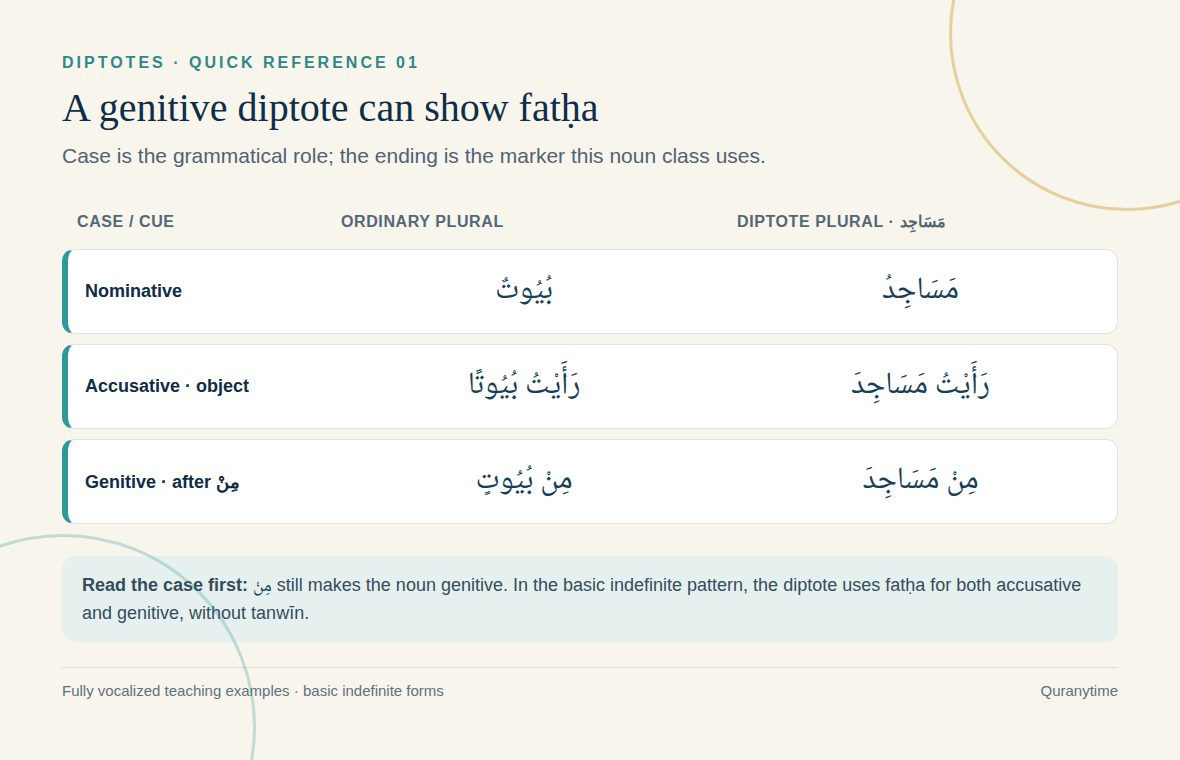
Read the examples by asking two separate questions: “What case is the noun in?” and “Which visible ending does this noun class use here?” In فِي مَسَاجِدَ, the preposition fī makes the noun genitive; its fatḥa is the diptote marker, not evidence that it is an object. In a connected, fully vocalized example, the ending makes the distinction visible. At a pause, final short vowels may not be heard, so do not diagnose the case from a stopped pronunciation alone.
How can you recognize a likely diptote?
For a reader, recognition is a check—not a guess based on the last letter. Some familiar diptotes belong to broken-plural patterns such as مَفَاعِل and مَفَاعِيل; مَسَاجِد (mosques) is a common example of the first pattern. These plurals are one group within the traditional category called ṣīghat muntahā al-jumūʿ. Quranytime’s article on broken plurals in Quranic reading can help you distinguish a changed plural pattern from a regular ending-based plural.
Other common clues include certain proper names, selected feminine names and adjectives built on particular patterns. For example, some masculine adjectives on أَفْعَل have a feminine form on فَعْلَاء; أَحْمَرُ / حَمْرَاءُ (“red”) illustrates the pair. In مَرَرْتُ بِرَجُلٍ أَحْمَرَ (“I passed by a red man”), both the noun and its adjective are genitive, but the diptote adjective shows fatḥa. This is a helpful contrast, not a complete list of eligible adjectives; see the site’s guide to Arabic adjective agreement for the wider agreement system.
Traditional grammar groups diptotes through particular combinations of meaning and form, and some patterns require more than one condition. A name being foreign, feminine, or a plural does not by itself make every word in that group a diptote. Morphology, lexical history, definiteness, syntax, and in Quranic study sometimes the reading tradition all matter. Treat these patterns as prompts to check a trusted grammar or dictionary, not a shortcut that replaces analysis.
A useful habit is to write down the syntax before naming the ending: mark the preposition or construct relationship, then decide whether the word is a verified diptote. If you start with the final vowel alone, the exception can be mistaken for an error—or an ordinary accusative fatḥa can be mistaken for a genitive one.
When does a genitive diptote take kasra?
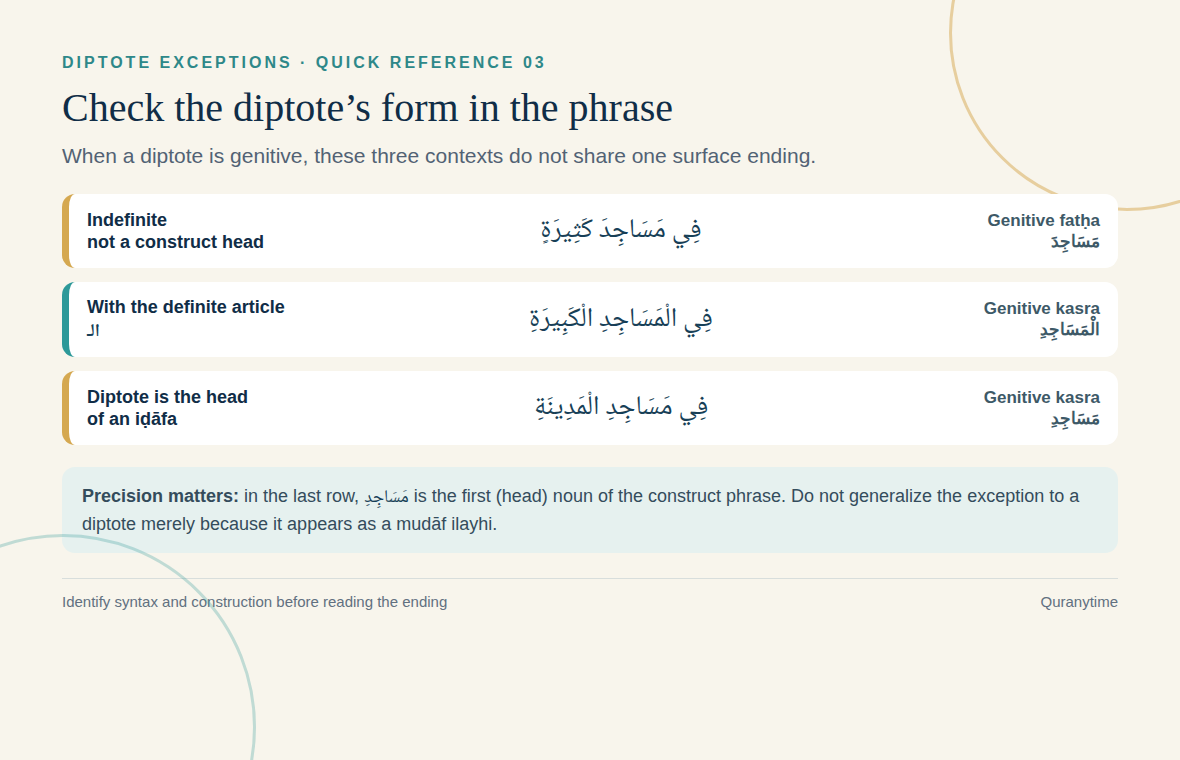
The fatḥa example above is the usual indefinite, non-construct diptote pattern. Two situations restore kasra when the diptote is genitive: it carries the definite article الـ, or the diptote itself is the first (head) noun in an iḍāfa construction. Be precise about the second point: the diptote must be the head noun, not merely some other word inside a construct phrase.
For example, compare فِي مَسَاجِدَ كَثِيرَةٍ (“in many mosques”), where the indefinite diptote مَسَاجِدَ has fatḥa, with فِي الْمَسَاجِدِ الْكَبِيرَةِ (“in the large mosques”), where al- is attached and the genitive ending is kasra. In فِي مَسَاجِدِ الْمَدِينَةِ (“in the mosques of the city”), مَسَاجِدِ is the genitive head noun of the iḍāfa, so it also takes kasra. It still does not take tanwīn as a construct head. These examples show why the condition must be checked on the diptote itself. Quranytime’s lesson on definite and indefinite nouns in Arabic offers more background on al- and indefiniteness.
In all three examples, syntax still determines the case. The change is which vowel marks the genitive ending. A noun with al- can be definite and a noun in a construct phrase is linked to the following word; neither should be read as an indefinite, non-construct noun with genitive fatḥa. The ordinary noun that follows a construct head has its own role and ending, which is why a phrase may contain more than one genitive word with different surface vowels.
A safe four-step reading check
- Find the governor or relationship. Is there a preposition, or is the noun in a construct relationship? Identify why the noun is nominative, accusative, or genitive before judging the vowel.
- Check that the word is genuinely a diptote. Use the surrounding morphology and a reliable lexical or Quranic grammar reference. Do not infer the category from a single fatḥa or from a word’s final letter alone.
- Check its form in this phrase. If it is genitive, ask whether the diptote carries الـ or is the head of an iḍāfa. If neither applies, genitive fatḥa is the usual beginner pattern.
- Consider vocalization and pause. Read the connected form if the case vowel is written. At a waqf (pause), do not expect a final short vowel to remain audible; verify the word’s grammatical role in context.
When a reading or lexical classification is uncertain, stop and verify instead of forcing the rule. A Quran dictionary can help you locate a root and compare forms; Quranytime’s guide to using a Quran dictionary explains a useful lookup process. For full case analysis, return to the linked case-ending lesson rather than trying to rebuild the whole iʿrāb system from one exception.
Try a quick check: In بِمَسَاجِدَ, the preposition bi makes مَسَاجِدَ genitive; its pattern is a common diptote clue, and it is neither definite with الـ nor the head of a construct phrase. Fatḥa is therefore expected in the basic example. Change it to بِالْمَسَاجِدِ: it is still genitive after bi, but now the definite article is attached, so kasra appears. The preposition did not change; the noun’s form did.
Common questions
Does a diptote always have fatḥa in the genitive?
No. An indefinite diptote that is not the head of a construct phrase commonly takes genitive fatḥa. If the diptote carries الـ or itself is the head noun in an iḍāfa, it takes kasra when genitive. First identify the form; then identify the case.
Does “two-ending” mean a diptote only has two grammatical cases?
No. It still has nominative, accusative, and genitive grammatical cases. “Two-ending” refers to the smaller set of visible endings used in the basic indefinite pattern: damma for nominative and fatḥa for both accusative and genitive, without tanwīn.
Are all broken plurals diptotes?
No. Only specific broken-plural patterns are diptotic. Many other broken plurals behave as ordinary triptotes and take tanwīn when indefinite. Check the word pattern and a trusted dictionary instead of treating every broken plural alike.
Is مصر accusative in Surat Yusuf 12:21?
No. In مِن مِّصْرَ, min is a preposition, so مِصْرَ is genitive. The fatḥa is its diptote marker. The linked word-level corpus analysis shows the distinction between the case and its visible ending.
Diptotes become easier once you ask what governs the noun, confirm the word class, and check whether an exception applies—in that order. If you want an instructor to listen to your Quran and Arabic reading and help check case endings in context, you can book a free Quran and Arabic trial class.