

Fear of mistakes in Quran memorization, comparison with other learners, perfectionism, and reluctance to ask for help can make Hifz feel harder than the passage itself. A practical response is to treat uncertainty as information: identify the specific sticking point, practise it carefully, and ask a qualified teacher for feedback when needed. The aim is not to remove every difficult feeling or to replace a memorization plan; it is to make the next learning step safer and clearer.
These barriers are different from a disrupted routine. If you miss sessions because of work or family demands, a consistency plan may help. But if you avoid reciting because you dread being corrected, or judge yourself against someone else’s pace, simply adding more study time may not address the real obstacle.
Why emotional barriers matter in Hifz
Memorizing the Quran involves recalling exact wording and reciting it with care. That makes practice visible: you may pause, forget a word, confuse a transition, or need correction. For some learners, the thought of being wrong becomes so uncomfortable that they delay practice, conceal uncertainty, or keep repeating a passage long after a teacher could give useful feedback.
That reaction does not tell you how sincere or capable you are, or what your eventual pace will be. It signals that something about the learning situation feels difficult. You can address that feeling while respecting the text and seeking accurate recitation. Learning support and careful correction are compatible.
Psychologists distinguish striving for high standards from being preoccupied with mistakes or never feeling that work is good enough. The American Psychological Association discusses the pressure of perfectionism in its overview of why people push themselves to be perfect. That is general psychological context, not research on Hifz, and it does not define religious standards. The modest takeaway: work toward accuracy, but do not make “I must never stumble” a condition for beginning.
Barrier 1: Fear of mistakes in Quran memorization
Separate a learning error from a verdict about yourself
A learner may think, “If I forget this line, I have failed,” or “If my teacher hears a mistake, I should have known better.” That turns one event into a judgment about the whole learner. Name what happened instead: “I lost the transition after the second verse,” or “I am unsure about this word and need it checked.” Specific descriptions point toward an action; self-criticism rarely does.
When you are practising alone, keep a small note of the location you want to revisit. Do not guess at a correction if you are unsure. Check the text against a reliable Mushaf, and bring pronunciation or recitation questions to a qualified teacher. Quranytime’s guide to testing Quran memorization explains how a self-check can reveal what to review without turning the result into a grade.
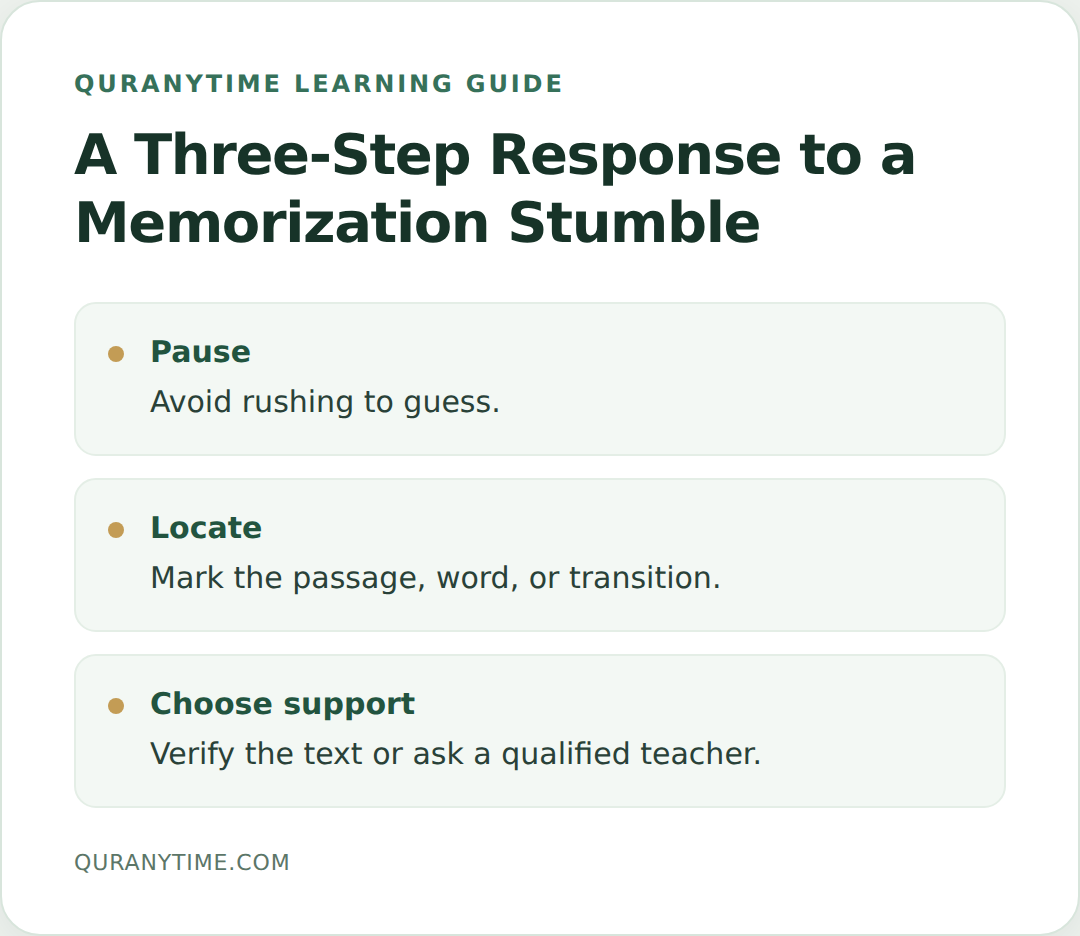
Try this three-part reset after a stumble:
- Pause: take a breath and avoid rushing to cover the uncertainty with a guess.
- Locate: note the passage, word, transition, or starting point where you became unsure.
- Choose support: verify the wording, return to a secure point, or ask your teacher what to practise next.
This does not mean mistakes are unimportant. It means responding proportionately: identify the issue, verify it, and continue with care. If your concern is specifically whether mistakes in recitation have a religious ruling, that is a separate question for a trusted, qualified scholar or teacher; this article is about learning responses, not issuing a ruling.
Barrier 2: Comparing your pace with someone else’s
Comparison may start with a visible detail: another student has memorized more lines, responds quickly, or seems confident. You may not know their prior experience, practice time, revision needs, or prompting. People can have different circumstances and still be working seriously.
Instead of asking, “Am I ahead or behind?”, ask a question you can answer from your own practice:
- Which passage can I recite more securely now than before?
- What kind of prompt did I need, if any?
- Which one correction or transition needs attention?
- What has my teacher asked me to focus on next?
You need not track every detail. A brief note can help you see your own learning without ranking yourself. If testing makes comparison more intense, agree with your teacher on a private, specific way to check recall. Quranytime’s teacher-approved random-start practice guide discusses using clear cues and treating hesitation as useful information rather than a measure of worth.
In a group setting, you can also redirect attention toward the task: “I am working on the passage assigned to me.” If comparison from family or classmates is making practice unpleasant, ask for feedback to focus on your effort, accuracy, and next step—not on someone else’s pace.
Barrier 3: Perfectionism and the “not ready yet” loop
Perfectionism can sound like devotion to quality: “I will recite only when I can do it flawlessly.” But then a learner may avoid practice and feedback that reveal what needs work, repeat a familiar section because new material feels risky, or remain distressed by a slip after correcting it.
Accuracy matters in Quran learning. But a practice attempt and a final performance are not the same thing. In a learning session, you may need to pause, check the Mushaf, or receive a prompt. That is different from claiming that the passage is fully secure. Be honest about which kind of activity you are doing, and follow your teacher’s guidance about the standard for recitation and review.
Try replacing an all-or-nothing target with a process target:
- Instead of “I must recite the whole passage perfectly,” try “I will recite the assigned section carefully and mark the point that needs checking.”
- Instead of “I cannot move on until nothing feels uncertain,” ask “What has my teacher confirmed, and what remains a question?”
- Instead of extending practice until you feel completely confident, agree on a reasonable stopping point and a later review with your teacher.
Process goals do not lower the importance of accuracy; they make practice observable and leave room for correction. For more structured ways to record teacher-confirmed feedback, see the Quran recitation mistake-log guide. Keep any note concise; it should guide your next practice, not become a list of every imperfection.
Barrier 4: Feeling embarrassed to ask for help
Some learners worry that a question will expose what they do not know, waste lesson time, or disappoint a teacher. Others stay quiet because they lack a technical term. A teacher can often help when you point to the passage and describe what you noticed in plain language.
You do not need a polished diagnosis. Try: “I can continue from the beginning, but I lose the next part after this line. Could you show me where to reconnect?” Or: “I am not sure whether I am remembering the words correctly. Can we check this section together?” Asking for help is a learning action; it does not require you to apologize for being a learner.
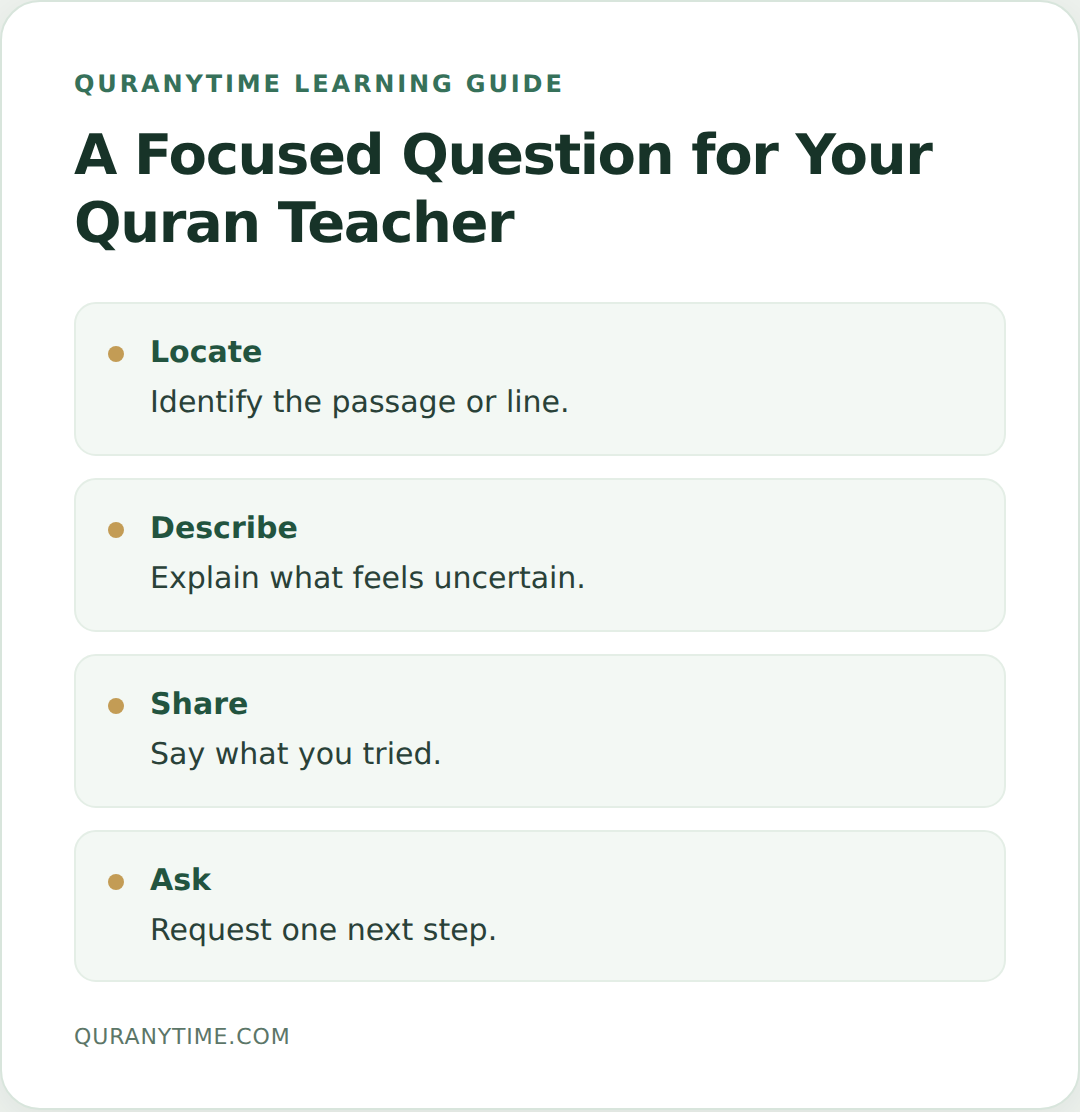
Before a lesson, write one question and mark the location. If the issue is not urgent, ask when and how your teacher prefers questions between classes. Quranytime’s guide to asking Quran teachers focused questions offers a simple format: locate the passage, describe the uncertainty, say what you tried, and request one next step.
If you are concerned about being corrected in front of others, you can ask whether feedback can be given privately or whether you can try the passage first without interruption, then review it together. Teachers may have different lesson approaches, so make a respectful request rather than assuming what they will agree to. For a younger learner, a parent or guardian can help raise the concern with the teacher.
Turn a difficult moment into a manageable next step
When fear or self-judgment rises, do not automatically increase the number of repetitions or abandon the session. First decide what kind of difficulty you are facing. Is the wording uncertain, is the task too large, are you worried about being observed, or are you comparing your progress with someone else’s? The answer shapes the support you need.
A short example
Suppose you have prepared a short passage but freeze when asked to recite without looking. Rather than deciding that you are “bad at memorizing,” tell your teacher what happened: “I can follow it with the Mushaf open, but I lose my place when I start from this point without it.” Your teacher can help determine whether to practise the entry, review the passage in context, or adjust the next check. The right response depends on the learner and passage; this example is not a universal prescription.
You might also agree on a low-pressure first attempt: recite privately, use a permitted cue, or ask the teacher to model the transition before you try. A supportive check is still a check. Its purpose is to understand what kind of help is useful, not to pretend that uncertainty is absent.
When to adjust the learning setup
If a situation repeatedly makes you avoid practice, consider changing the setup rather than blaming yourself. You could ask for a clearer assignment, a smaller passage to work on, a private recitation check, or a scheduled time to bring questions. If the challenge is a balance between new memorization and revision, discuss that balance with your teacher rather than guessing that you should simply do more.
If the same teacher interaction continues to feel unsafe or unhelpful, speak with a parent, program coordinator, or another trusted person who can help you find an appropriate way forward. That does not mean every correction is harmful; constructive feedback can be direct while still respectful. If distress is persistent or affects life beyond lessons, consider speaking with a qualified mental health professional. This article cannot assess or treat mental health concerns.
If you are exploring whether guided learning might suit you, Quranytime offers a free Quran and Arabic trial class. The page describes three free trial classes for new students. You can use a class to ask about teaching style and feedback, without treating one session as a guarantee of a particular pace or outcome.
Frequently asked questions
Is it normal to feel nervous about making mistakes during Hifz?
Learners can feel nervous about reciting or being corrected, but experiences differ. Nervousness alone does not tell you how well you will learn. Identify what you fear will happen and discuss practical support with your teacher.
Should I continue memorizing if I keep forgetting a passage?
Do not infer a universal answer from forgetting alone. Note where recall breaks down and ask your teacher whether to focus on that part, review older material, or adjust the current assignment. A qualified teacher can assess the passage and your recitation.
How do I stop comparing my Hifz progress with others?
You may not be able to prevent every comparison, but you can redirect attention to your own agreed task: what you can recall, what needs checking, and what your teacher wants you to practise next. Avoid treating another person’s visible pace as a fair measure of your circumstances.
Does asking for help mean I am not capable of memorizing?
No. A question is evidence that you have identified uncertainty and want guidance; it does not establish what you can or cannot learn. Ask for a specific demonstration, correction, or next step.
How can I aim for accurate recitation without demanding perfection?
Take accuracy seriously by checking uncertain wording and seeking qualified feedback. At the same time, distinguish a practice attempt from a polished recitation and avoid making “never stumble” the price of beginning. Your teacher can clarify the appropriate standard for the task at hand.
A calmer way to keep learning
Fear of mistakes, comparison, perfectionism, and reluctance to seek help can each turn a manageable passage into an emotional test. Meet the barrier with a specific response: identify the point of uncertainty, compare your learning with your own previous work rather than another student, use process goals, and ask a clear question when you need support.
This is not a substitute for a memorization schedule or teacher correction; it can make those supports easier to use. Choose one small next action, then ask your teacher what comes next.