
A Quran recitation mistake log is a small practice tool for turning useful teacher feedback into one clear next step. It is not an inventory of every slip, a score sheet, or a replacement for listening to a qualified teacher. The best version stays short: it records where a confirmed correction occurred, what to practise, when to revisit it, and what still needs attention.
A broad checklist can help you notice areas to ask about, while a mistake log follows a specific correction through practice and back to a teacher recheck. It keeps feedback from disappearing between lessons without encouraging you to diagnose your own recitation. Use it alongside your normal lesson notes and a teacher’s guidance.
What a Quran recitation mistake log is—and is not
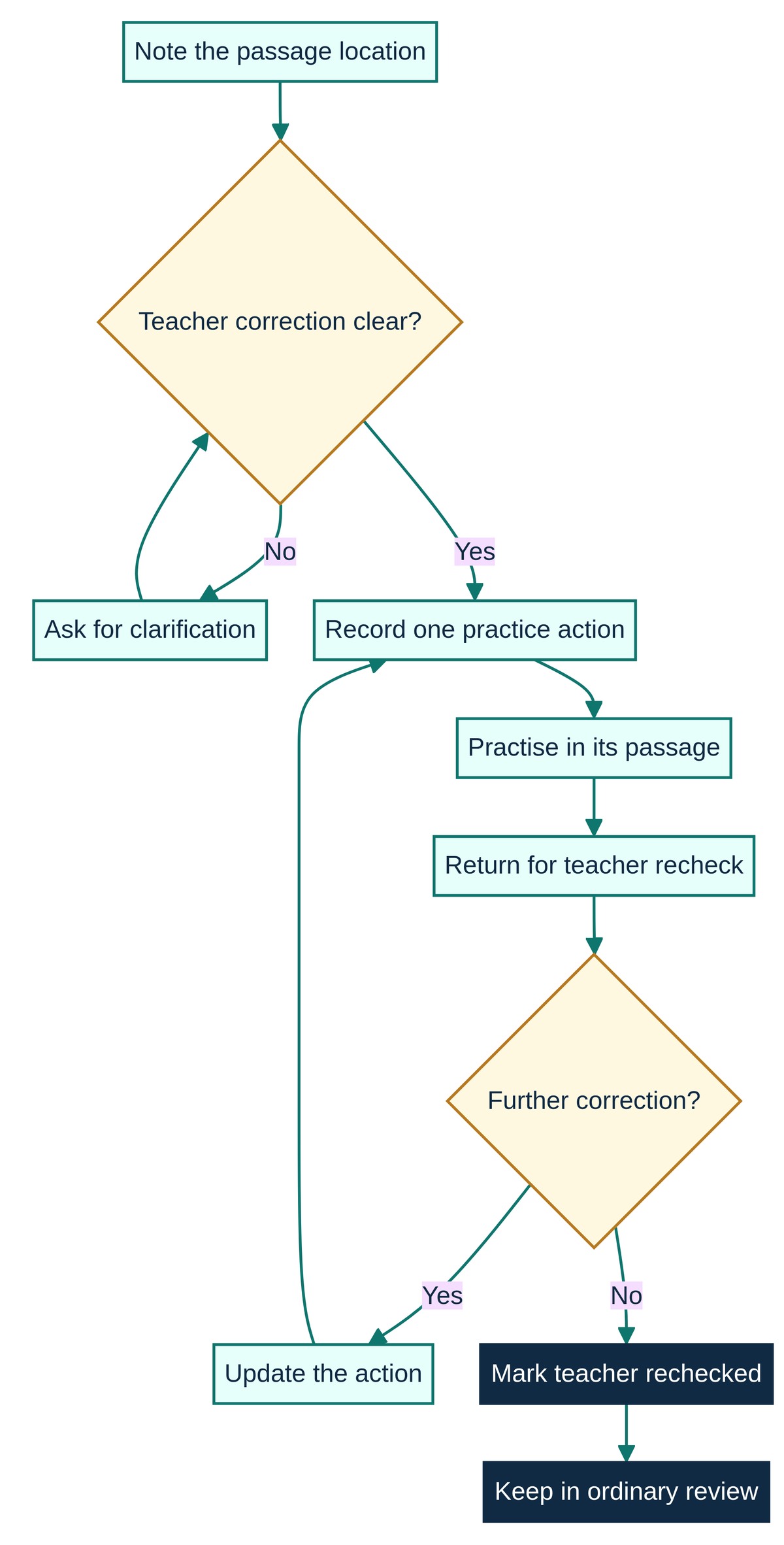
Think of the log as a temporary loop for an active issue. You hear or receive feedback on a line, ask the teacher to confirm exactly what should change, practise one manageable action, and return to that location for another check. The entry can then be marked as teacher rechecked, while remaining available if the same context causes uncertainty later.
This is different from a broad Tajweed mistakes checklist. A checklist surveys possible topics; a log captures a particular, teacher-confirmed correction. It is also different from a recording-feedback workflow, which may describe how to submit audio and receive comments. Here, the focus is the compact record you keep after the feedback arrives.
The five fields that keep the log useful
1. Location
Identify enough of the passage for you and your teacher to find the moment again: surah and verse reference, page or lesson marker, and a brief line cue if useful. You do not need to copy a long passage. The location should point back to the exact place, not merely a topic such as “heavy letters.” If the issue happens only when the line is joined to the next one, note that context.
2. Teacher correction
Record the correction in the teacher’s wording, as accurately and briefly as possible. Include what to listen for or change, and ask a follow-up question if the feedback is incomplete. Separate confirmed from uncertain: “Teacher confirmed: adjust the sound at the marked location” is actionable; “probably a pronunciation rule” is a prompt for clarification, not a conclusion.
3. One practice action
Choose one observable action that reflects the correction. For example, you might slow down the approach to the marked line, isolate the transition briefly, or return to the full line after checking the sound. Keep it specific enough to do in the next session. Do not turn the entry into a list of fixed repetitions or a promise that a certain number will guarantee improvement. The action is a way to focus attention, not a universal prescription.
4. Recheck date
Add the next planned date or lesson when the teacher can hear the location again. If the date changes, update it rather than treating the missed date as failure. A date creates a return point, which is more helpful than practising indefinitely without feedback. You can coordinate the timing with your lesson plan or with your teacher’s availability.
5. Status
Use only the three compact labels Needs clarification, Practising, and Teacher rechecked. “Needs clarification” means the correction or context is not yet clear. “Practising” means you have an agreed action to work on. “Teacher rechecked” means the teacher listened again and gave a new response. It does not mean permanent mastery, flawless recitation, or that the same sound can never need attention in another passage.
Confirmed feedback versus an uncertain impression
Your observation is valuable, but it is not automatically a diagnosis. If you notice a possible slip in a recording, mark it “Needs clarification” and bring the location to the teacher. Once confirmed, replace the uncertain note with the agreed change.
Distinguish an isolated letter sound from the same sound in context. A learner may produce it clearly when separated yet lose control while connecting surrounding words. A concern in one passage may not describe every occurrence. Note whether the action concerns an isolated moment, the full line, a connection, a stop, or a return to the line.
When feedback uses a term you do not understand, ask what to listen for, whether it applies at the marked location or across the passage, and how to practise it before the next check.
A compact worked example
This fictional example shows how little you need to write. Replace the placeholders with your own passage references and your teacher’s actual wording. The aim is to find the correction quickly when practice begins, not to reproduce a whole lesson.
| Field | Illustrative entry |
|---|---|
| Location | [Surah], [verse], [page], the connected line after [cue] |
| Teacher correction | Teacher confirmed: revisit the marked transition in context; ask if the issue remains unclear |
| One practice action | Slow the approach, check the transition once, then return to the complete line |
| Recheck date | [Next lesson date] |
| Status | Practising |
At the next lesson, open this entry before reciting the marked line. If the teacher changes the action, update that field and agree another check. If the issue is clear on recheck, move it out of your active practice list while keeping the note available for ordinary review.
How to use the log between lessons
At the end of a lesson, select corrections with a clear location and teacher-confirmed next action. If many issues arise, you might keep a maximum of three active entries as a practical capacity limit. This is an organisational suggestion, not a universal learning rule; fewer active lines can make it easier to return to the full passage.
During home practice, open the entry before reading the relevant line. Follow the one action, then read the surrounding context and return to the line. A separate guide on practising Tajweed at home between lessons can sit beside this process, but the log itself should remain concise.
At the next lesson, show the location and let the teacher listen in context. If the correction is unclear, keep Needs clarification. If you have an action but no follow-up check, use Practising. Change to Teacher rechecked only after the teacher listens again. Add a brief note beneath the old one without turning the page into an exhaustive archive.
If you record audio, the log can complement a teacher-feedback recording process. Attach a date or file label only if your teacher uses that system; do not treat an app waveform, transcript, or automated score as confirmation.
Keep related study tools separate
A focused log does one job. Revising similar verses addresses recall and comparison, while a Hifz revision schedule organises material over time. Neither needs to become a catalogue of uncertain sounds.
Keep reflective writing separate from the five fields. A Quran reflection journal for beginners supports personal observations; this log is operational and easy to scan before practice.
There is a useful general educational idea behind this separation: reflecting on an error can help a learner decide what to adjust next. Carnegie Mellon’s exam-wrapper guidance discusses that kind of structured reflection in an educational setting. It is not evidence for a specific Quran method, nor does it establish a religious or recitation rule. Borrow only the narrow habit of connecting an observed difficulty to a next action.
Reusable five-field template
Copy this compact template into your notes, then complete it with your teacher’s wording. Keep personal information out of shared files and do not publish lesson recordings without appropriate permission.
Location: [surah / verse / page / line cue / context]
Teacher correction: [confirmed wording, or question if unclear]
One practice action: [one specific action for the next session]
Recheck date: [date or next lesson]
Status: [Needs clarification | Practising | Teacher rechecked]
Before saving, ask: Can I find the exact line? Is the correction confirmed or clearly marked uncertain? Is there one next action and a return date? Does the status describe the feedback stage rather than my confidence? If not, ask the teacher before adding a stronger label.
Frequently asked questions
Should I log every mistake I hear?
No. Log a small number of clearly located issues that you can discuss with your teacher. A possible slip can be noted as a question, but it should not become a confirmed correction until the teacher checks it.
What if the same issue appears in another passage?
Add the new location or ask whether the original action applies there. Similar-looking contexts may behave differently, so do not automatically copy a label across passages.
Is “Teacher rechecked” the same as mastered?
No. It records that a follow-up check happened and received feedback. You may still revisit the line, encounter a related context, or receive a new adjustment.
How often should I review the log?
Review it briefly before practice and bring active entries to the next suitable lesson. A weekly review may be convenient if it fits your schedule, but it is not a guarantee of progress.
A gentle next step
Start with one teacher-confirmed location from your next lesson. Fill the five fields, choose one practice action, and bring the entry back for recheck. If you are exploring lessons, what to expect in online Quran classes may help you understand how to ask for a clear location and follow-up. The goal is not a longer record; it is a clearer conversation and a more deliberate return to the line.