
The honest answer to how long does it take to learn the Arabic alphabet is about 2 to 4 weeks of daily practice to read simple words. If you only want to recite the 28 letters in order, it takes a few hours. Writing neatly and reading text without vowel marks takes longer, usually a few months.
The range is wide because "learning the alphabet" means different things. Arabic letters change shape depending on where they sit in a word, and a letter’s name is not always the sound it makes inside a word. A three-hour memorization session and a three-week reading plan both claim to teach the alphabet, but only one lets you read.
This article breaks the timeline into clear milestones, gives you a weekly plan, and shows how your daily practice time changes the answer. It also places the alphabet within the total hours needed for Arabic. At Quranytime Academy we have more than 10 years of experience in Quranic education, and no previous knowledge is required to start, so the guidance below is built for that starting point.
Why the answer depends on what you mean by learned
"Learned" can mean five different things, and each has its own timeline. Knowing which one you are aiming for stops you from either rushing or doubting your progress.
Reciting letters is not the same as reading
You can memorize the 28 letters in order in about three hours. That does not let you read a single word. Inside words, letters connect and change form, and the name of a letter (ba) is not the sound it makes in a word (b). Reading is the real goal, and it is what the rest of this article times.

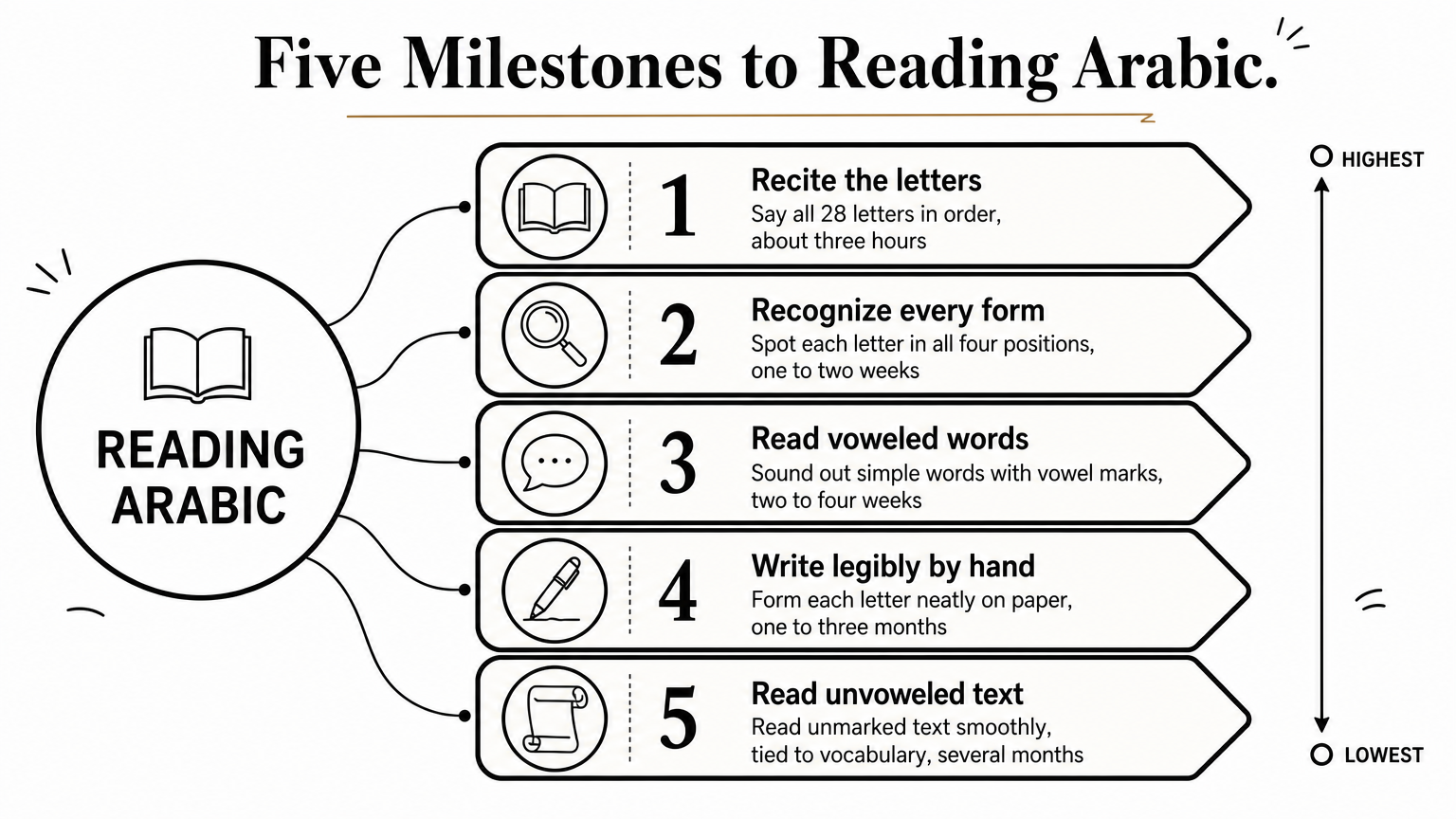
Five milestones and how long each takes
The table below assumes daily practice of 30 to 60 minutes. Some structured courses fit the whole alphabet into 13 daily lessons, and two to three weeks of daily practice is the usual range for self-learners.
| Milestone | Typical time with daily practice |
|---|---|
| Recite the 28 letters in order | About 3 hours |
| Recognize every letter in all four positions | 1 to 2 weeks |
| Read simple words with vowel marks, slowly | 2 to 4 weeks |
| Write the letters legibly by hand | 1 to 3 months |
| Read text without vowel marks smoothly | Several months, tied to vocabulary |
Children usually need longer. Most can recognize and read the letters within one to two months, and smooth handwriting follows later. The last row depends on how many words you know, not on the alphabet itself, because unvoweled text asks you to supply the vowels from memory.
Plan on two to four weeks to read simple words, not two days and not two years.
How to learn the Arabic alphabet in three to four weeks
You can learn the Arabic alphabet in three to four weeks by studying letters in small groups, reading real words from the first day, and practicing daily. The plan and the practice-time table below show what that looks like.
A three-week plan
Learn letters that share a base shape together. Ba, ta, tha, nun and ya are a natural family that differs mainly by dots.
- Week 1: Learn the first 14 letters in groups of three or four, plus the three short vowel marks (fatha, kasra, damma). After each group, read words that use only the letters you know.
- Week 2: Learn the remaining 14 letters the same way. Add sukun, shadda and the long vowels, which are the letters alif, waw and ya.
- Week 3: Read full voweled words and short sentences aloud. Practice the six letters that never connect to the next letter (alif, dal, dhal, ra, zay, waw), and write each letter in all four forms by hand.
Always say each word aloud as you read it. Handwriting the letters in isolated, initial, medial and final forms builds recognition faster than flashcards alone. A live teacher helps most with sounds that have no English equivalent, such as ع, ح, خ and ق, because you cannot hear your own mistakes.
How daily practice time changes the answer
A workable estimate is 10 to 20 hours of focused practice in total. Here is what that means at different daily commitments.

| Daily practice | Days needed | Calendar time |
|---|---|---|
| 15 minutes | 40 to 80 days | About 6 to 11 weeks |
| 30 minutes | 20 to 40 days | About 3 to 6 weeks |
| 60 minutes | 10 to 20 days | About 2 to 3 weeks |
Consistency matters as much as minutes. If you practice 30 minutes only on weekdays, you log 2.5 hours a week, so 10 to 20 hours takes 4 to 8 weeks. Practicing on weekends as well brings that back toward the 3 to 6 week range.
Short daily sessions beat long weekly ones, because letter shapes fade quickly without repetition.
What makes it faster or slower for you
Your starting point sets your pace more than talent does. Language background, age and goal are the three factors that move your timeline the most.
Is the Arabic alphabet hard to learn?
No. Compared with the rest of Arabic, the alphabet is one of the easiest parts to master. It has only 28 letters, no capital letters, and spelling that follows consistent sound rules. Most learners find it far easier than Arabic grammar.
Four things cause the real friction. Letter shapes change by position, and several letters differ only by dots. Some sounds are new to English speakers. Text runs right to left. Many texts also leave out the short vowels, so beginners who skip vowel marks often guess pronunciations wrong and carry the habit for years.
The alphabet is the easy part of Arabic, as long as you learn letters in connected words and not as isolated shapes.
Background, age and goal
- Urdu, Persian and Pashto speakers: You already read a script built on Arabic letters, so shapes come quickly. You will still need to retrain a few sound values.
- Hebrew speakers: Right-to-left reading is familiar, which removes one early hurdle.
- English and Spanish speakers: You start from zero, so use the full three to four week plan.
- Children: Allow one to two months for reading and longer for handwriting.
- Quran readers: The Quran is printed with full vowel marks, so you can read it sooner than unvoweled text. Accurate recitation still needs Tajweed, which is a separate stage.
Where the alphabet fits in the time to learn Arabic
The alphabet is a very small part of the journey. Published estimates put Arabic at roughly 2,200 hours for professional-level proficiency, and your 10 to 20 hours on the letters is under 1 percent of that.
Hours for the whole language
Sources disagree because they define levels differently. Here are the ranges side by side.
| Stage | Published hour ranges |
|---|---|
| Beginner | 150 to 600 hours |
| Conversational or intermediate (total) | About 600 to 1,200 hours |
| Advanced or professional (total) | About 1,850 to 2,600 hours |
The alphabet is a small share of the beginner stage, typically under 10 percent of a 250 to 400 hour range. At one hour a day, 2,200 hours takes about six years. At two hours a day, it takes about three.
Can you learn Arabic in one year?
You can reach a basic conversational level in one year with one to two hours of daily study, which adds up to roughly 365 to 730 hours. You cannot reach fluency in that time. The result also depends on your target. Choose between Modern Standard Arabic and a spoken dialect once the alphabet is secure, because mixing them slows you down.
If your goal is the Quran, the path differs again. Reading the letters and vowel signs accurately comes first, and understanding the language comes after. Quranic Arabic study focuses on vocabulary, selected grammar and accurate reading, and it is language study, not a substitute for Tafseer.
The alphabet takes weeks, but the language takes years, so set your first goal at reading, not fluency.
Start with the first group of letters
The Arabic alphabet takes most beginners two to four weeks to read, a few hours to recite, and a few months to write and read without vowel marks. What you practice daily and how you group the letters decide where you land. It is a small, achievable first step in a language that takes years to master.
Pick your first group of three or four letters today and read words made only from them. If you want a teacher to check your pronunciation and set a pace for your schedule, you can book a free one-to-one assessment class with Quranytime Academy. The teacher will find your level and recommend whether to start with letters, Quran reading or Arabic.