
Knowing Arabic letters and vocabulary does not automatically make spoken Arabic easy to follow. In conversation, sounds run together, familiar words may be pronounced quickly, and you cannot pause to look up every syllable. The good news is that listening improves through short, focused practice. This guide gives you a beginner routine, ways to choose audio, and a simple plan for listening more actively without turning every session into a test.
Choose the Arabic you want to understand
Start by deciding what kind of listening you need. Modern Standard Arabic is useful for formal speech, news, educational material and many scripted recordings. A spoken dialect is more helpful if your goal is everyday conversation in a particular region. Egyptian, Levantine and other varieties can differ in vocabulary, pronunciation and common expressions. A clip in one variety will not teach every other variety, so choose material that matches your current goal.
If the Arabic alphabet is still new, spend a little time recognizing letters before relying on subtitles. Quranytime’s Arabic letter guide can help you connect the sounds you hear to written forms. If you already know a few common expressions, use familiar material such as these beginner Arabic phrases as a starting point.
Try this 10-minute active listening routine
Choose one short recording, ideally about a familiar topic. A few clear sentences are enough. Replaying the same passage with a different purpose can teach you more than playing a long video in the background. Use this ten-minute loop:
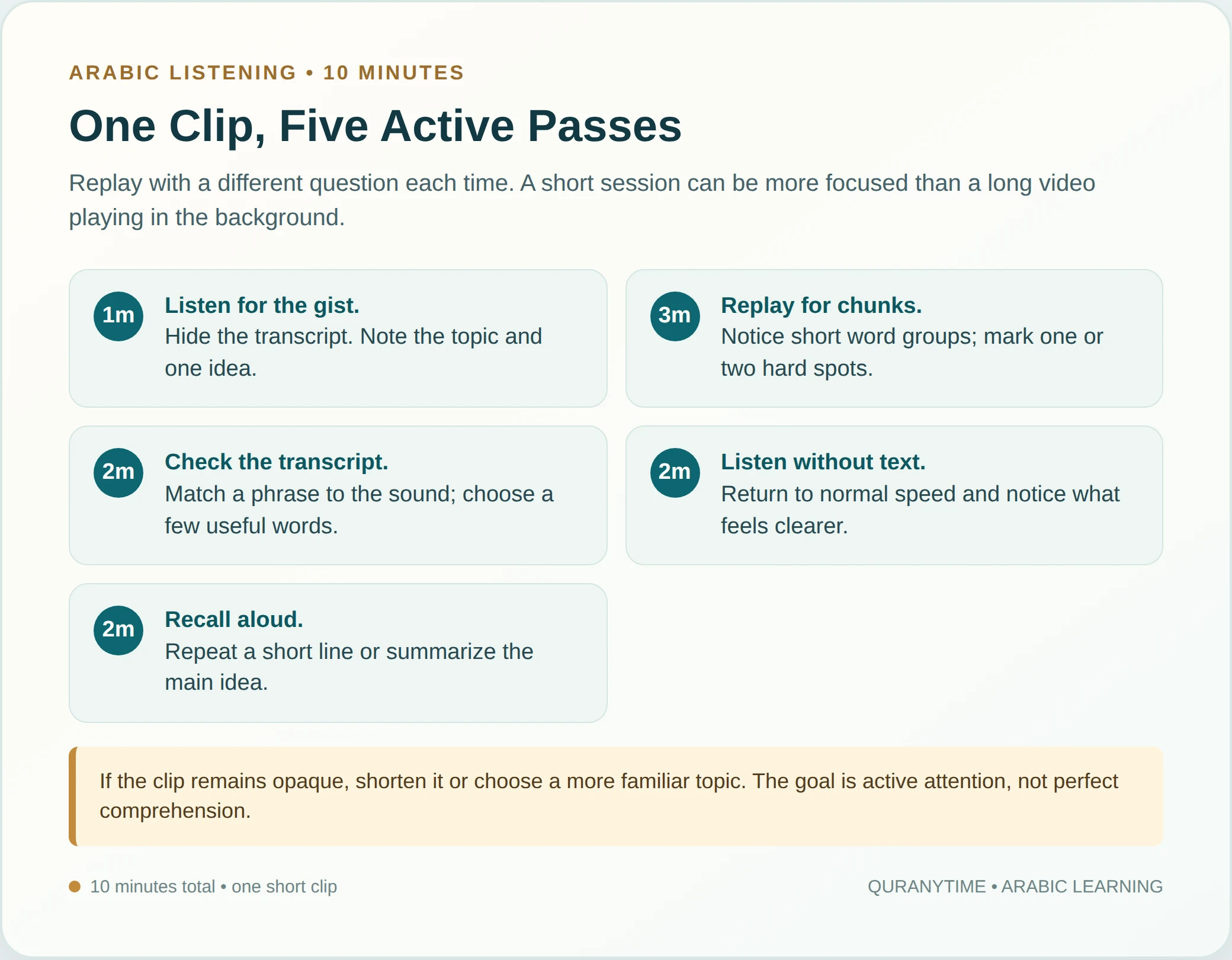
- Minute 1 — listen for the gist. Keep the transcript hidden. Decide who or what the clip is about, and note one idea you understood.
- Minutes 2–4 — replay for chunks. Listen again and notice short groups of words rather than trying to separate every sound. Mark one or two places where you lost the thread.
- Minutes 5–6 — check the transcript. Read only after your first listening attempt. Match the sound to the written phrase and look up just a few useful words.
- Minutes 7–8 — listen again without reading. Return to normal speed if you slowed the audio. Check whether the phrases now sound more familiar.
- Minutes 9–10 — recall aloud. Repeat one short line or summarize the main idea in simple words. It is fine if your summary is incomplete.
The aim is deliberate attention, not perfect comprehension. If a clip is so difficult that you cannot identify its topic after several listens, choose a shorter or more familiar one. If every sentence is already obvious, move to a slightly more challenging recording.
Pick audio that gives you a fair challenge
Look for clear speech, a short length, a subject you already know something about, and a transcript or captions you can reveal after listening. Avoid starting with a fast discussion full of unfamiliar names or specialist vocabulary. The University of Texas at Austin’s COERLL description of Aswaat Arabiyya says its listening materials and activities span Novice to Superior proficiency and draw on varied television topics and genres from across the Arab world. This is one example of selecting listening material by level and subject rather than by length alone.
For a beginner, a useful clip might last 15 seconds to a minute. A longer recording can still work if you choose one small section and repeat it. Listen to one voice before adding overlapping speakers, background noise or fast conversation. Once you can follow the main idea, increase only one difficulty at a time: length, speed, vocabulary or number of speakers.
Try this guided lesson after your first solo listen. It asks questions before three short passages, then shows Arabic text and an English explanation.
Move through a listening ladder
Do not jump from single words straight to a long, unscripted conversation. Build up in stages. The card below shows one practical progression. You can stay at a stage for as long as it remains useful; it is a guide, not an exam scale.
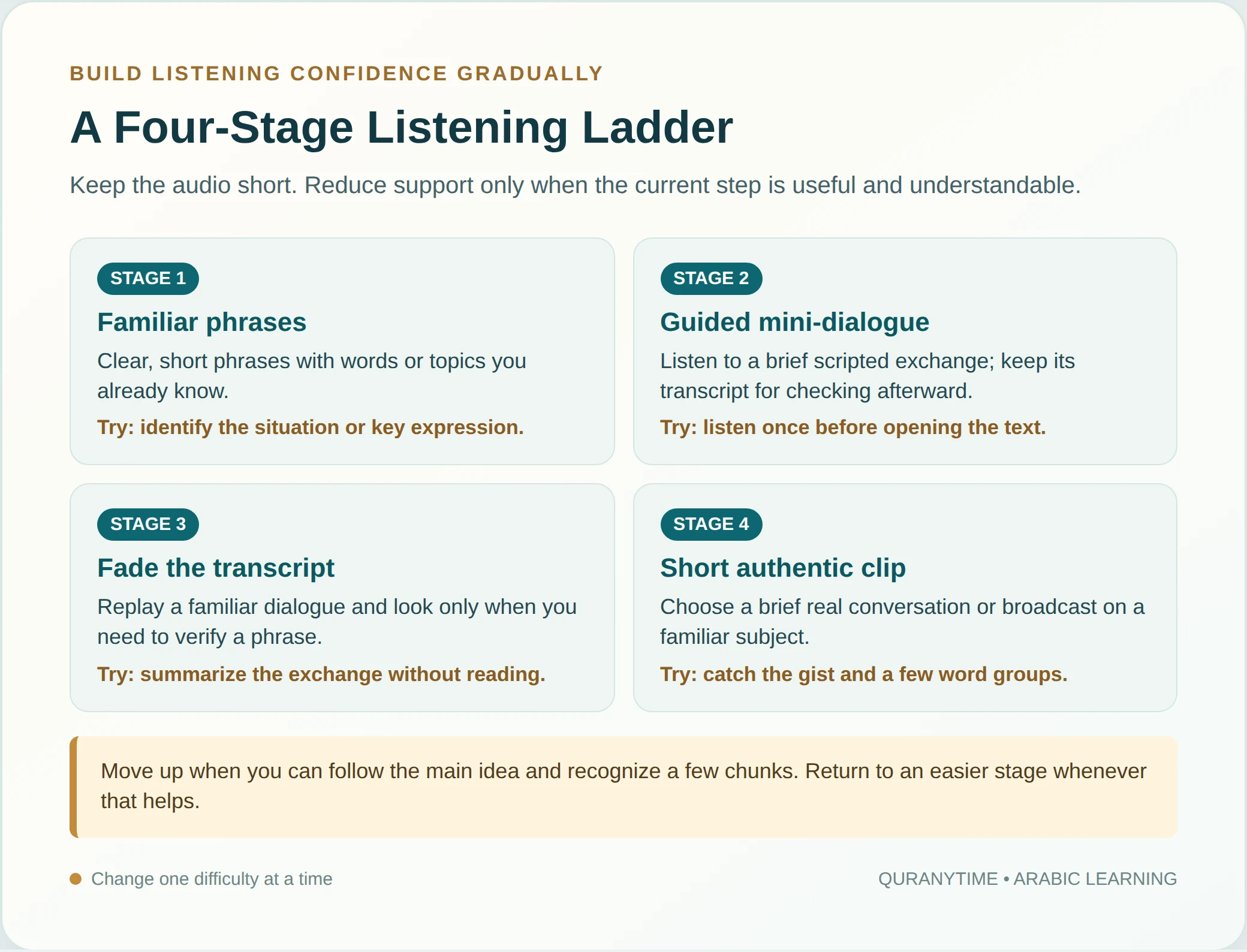
Begin with clear phrases and familiar vocabulary. Next, try a short scripted exchange where the transcript is available. When the same dialogue feels easier, replay it while looking only when you need to check a phrase. Then choose a brief clip from a real conversation or broadcast on a familiar subject. You can return to an easier stage whenever the material stops being useful.
Use transcripts without becoming dependent on them
A transcript is a checking tool, not a substitute for listening. If you read every line while the audio plays, your eyes may do most of the work. Instead, try listening once without text, write down what you think happened, then open the transcript and compare. Underline one phrase you recognized and circle one sound or word boundary that surprised you.
After checking, close or hide the words and listen again. If you still cannot hear a phrase, replay only that short section. You can slow it a little to notice a boundary, then return to ordinary speed. Do not leave every recording slowed down: normal speed is what you ultimately need to recognize. Transliteration may help with a first sound cue, but Arabic script gives you a better way to connect words to their spelling once you can read it.
Practise with four small exercises
Listen for the scene. Before looking at a transcript, answer a broad question: is someone asking for directions, describing a day, or ordering food? You do not need every noun to understand the situation.
Mark word groups. On a second listen, tap or pause at natural phrase boundaries. Arabic sounds connect across words, so noticing chunks is often more useful than trying to hear a space between every word.
Repeat one line. Choose a short phrase and imitate its rhythm, then compare your version with the recording. This is a listening exercise, not a pronunciation assessment; ask a qualified teacher for feedback when accurate pronunciation matters.
Retell one idea. After the audio ends, say or write a simple summary. If you cannot remember enough to retell anything, shorten the clip or choose a more familiar topic next time.
Follow a simple seven-day plan
Use five to ten focused minutes a day. Repetition is intentional: listening again to the same clip can show what you hear after the transcript has clarified a phrase. Keep the goal small enough to repeat through a busy week.
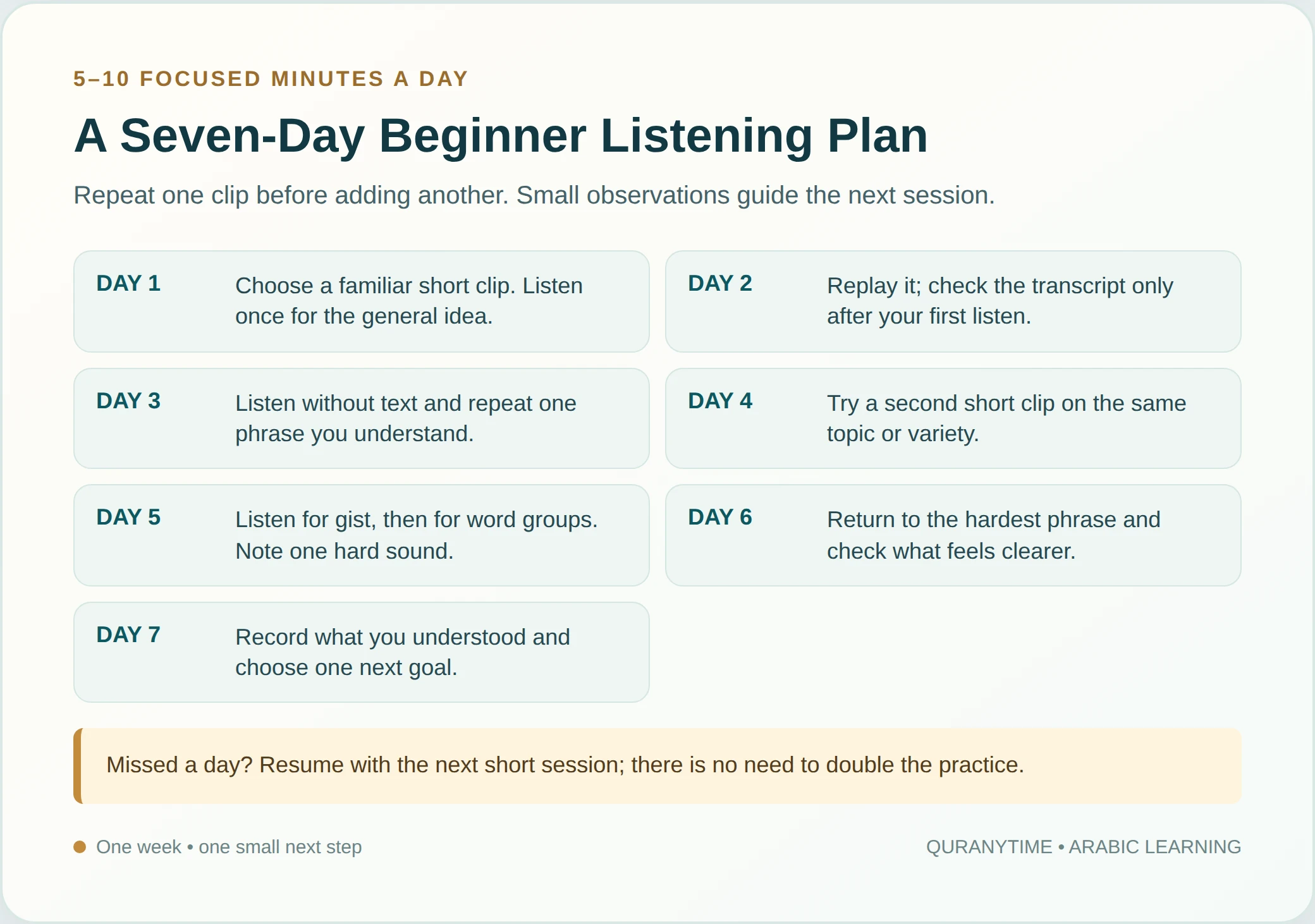
- Day 1: Choose one short clip on a familiar subject. Listen for the general idea without pausing.
- Day 2: Replay the same clip and check the transcript only after your first attempt.
- Day 3: Listen again without reading, then repeat one phrase you understand.
- Day 4: Try a second short clip on the same topic or in the same Arabic variety.
- Day 5: Listen once for the gist and a second time for word groups; note one uncertain sound.
- Day 6: Return to the phrase that was hardest and check whether it is easier to recognize.
- Day 7: Write down what you understood, choose one next goal, and select a clip for the coming week.
If you miss a day, resume with the next short session. Do not double the work to “make up” a missed practice. Quranytime’s broader Arabic-learning routine can help you fit listening beside reading and vocabulary, while the Quranic Arabic vocabulary plan offers a separate way to organize word study.
Check progress by what you can hear
After a week, ask practical questions. Can you identify the topic sooner? Do you recognize a few phrases without reading? Can you follow a short exchange when you already know the setting? These are better signals than counting how many hours a video played in the background. Write down one success and one next step after each session. If the answers do not change, make the clip shorter, slower or more familiar before adding difficulty.
Listening practice can also support Quran study, but everyday Arabic conversation and Quran recitation are different tasks. A language clip does not teach Tajweed, confirm a Quran quotation or replace correction from a qualified teacher. Quranytime’s guide to repeating Quran audio with a listen–pause–check method focuses on recitation practice, and its article on what listening alone can and cannot teach about the Quran explains why audio is not a complete substitute for guided learning.
When the speech still sounds like one long word
First reduce the length. Listen to one sentence instead of a whole dialogue. Next, replay it while looking at the Arabic script or transcript and mark only a few word groups. Check whether your recording is in the variety you are studying; unfamiliar dialect vocabulary can make a simple sentence feel much harder. If speed is the issue, slow one passage briefly, then return to normal playback and listen again.
Do not turn each session into a dictionary search. Choose two or three words at most, and keep listening for the overall message. When you want to improve both spoken Arabic and Quran-learning skills, Quranytime offers the option to book a free Quran and Arabic trial class and discuss a learning goal with a teacher.
Keep the routine small and active
A short clip, one first listen without text, one transcript check and one final replay make a complete beginner practice session. Choose one variety, repeat familiar audio, and change only one source of difficulty at a time. Some days you will understand only the topic; other days you will notice a phrase you missed before. Keep those small observations, and let them guide what you listen to next.