The best learn Arabic alphabet games do three things: they play each letter’s sound, show its shape in every position, and make you repeat it until it sticks. For young kids, pick a guided browser game or an app with audio. For a classroom or homeschool group, pick a template tool that lets you build quick quizzes. For adults, and for anyone who wants correct pronunciation from day one, start with a live teacher and use games for daily practice. The six options below cover each case.
The problem is that the Arabic alphabet has 28 letters, runs right to left, and changes shape depending on where a letter sits in a word. A flashcard deck alone rarely handles that. Many games online teach letter names but skip the sounds, or they stop at isolated letters and never show how those letters join.
At Quranytime Academy we teach Arabic and Quran reading online to beginners of all ages, so we know which practice tools learners keep using. This list walks through what each option teaches, who it suits, what it costs, and where it falls short, so you can choose one and start today.
1. Quranytime Academy trial class and interactive tools
Quranytime Academy is the pick if you want to learn the Arabic alphabet with games and a real teacher who corrects you. It combines live one-to-one online lessons with interactive tools, including an Arabic Reading Guide and educational quests and games for foundational learning.
How it works
In a live class, the teacher listens to how you say each letter, corrects pronunciation on the spot, and moves you forward when you are ready. That feedback matters most for sounds with no English equivalent, such as ع, ح, and ق. A game cannot hear you, so it cannot fix them.
Teachers include Al-Azhar University graduates and Ijazah holders, and classes fit your time zone. You begin with the free assessment class, where the teacher checks your level and recommends a path, such as Arabic for children, adult beginners, or Quranic Arabic. Between lessons, use the free games below for drill.
A game builds repetition, but a teacher fixes the mistakes that repetition would otherwise lock in.
Who it suits and what it costs
This option suits parents who want a structured start for their child, adult beginners who want a gentle step-by-step path, and learners whose goal is reading the Quran. It also suits anyone who has tried apps and still cannot tell similar letters apart by ear.
The assessment class is free. Regular lessons are paid, so this is the structured option, not a free game. If you only want casual practice, the next five items cost nothing or very little.
2. Digital Dialects Arabic alphabet games
Digital Dialects is the easiest free place to start. It offers an Arabic alphabet game with audio, plus flashcards and other learning games, and it needs no registration and no download.

How it works
The site pairs audio with letters, so you train your ear and your eye together. You open it in a browser, hear a letter, and practice matching the sound to the character through flashcards and short games.
Use it in five-minute rounds. Say each sound out loud before you click the answer, because speaking turns passive recognition into recall. Repeat the same small set of letters for several days before adding new ones.
Say the sound aloud before you click, and a simple matching game becomes pronunciation practice.
Who it suits and what it costs
It is free, which makes it the safest first stop for adults and older kids who want a no-pressure start on any device with a browser.
- Best for: self-learners, adults, and teens who want audio and quick drills.
- Skip it if: your child needs bright characters, stories, or rewards to stay interested.
- Limit: it trains recognition and listening, not handwriting.
3. World of Ziryab
World of Ziryab is the best free option for children who need a story to stay engaged. It is an online project set in Al-Andalus and built around the musician Ziryab, with an Arabic alphabet section split into Learn, Practice, and Play.
How it works
The three-step flow copies how a good teacher sequences a lesson. You first meet the letters in the Learn pages, then test yourself in Practice, and only then move to the Play games. That order prevents the common mistake of guessing at games before you have seen the letters properly.
The history theme gives the alphabet a context. Kids see letters as part of a living culture, not as a worksheet. Let your child finish the Learn pages with you, so you can repeat each sound together before they play alone.
A learn-practice-play sequence beats random games, because the child sees a letter before being tested on it.
Who it suits and what it costs
It suits children and families who prefer a guided path over a menu of unrelated games. It is free to play in a browser.
Expect a slower pace than a drill site. It is better for building a first impression of the alphabet than for speed practice, so pair it with a quick flashcard or quiz game once the letters feel familiar.
4. Wordwall community activities
Wordwall is the strongest choice for teachers, tutors, and homeschooling parents. It hosts thousands of teacher-made Arabic alphabet activities, and a search for “Arabic alphabet” returns more than 10,000 results.
How it works
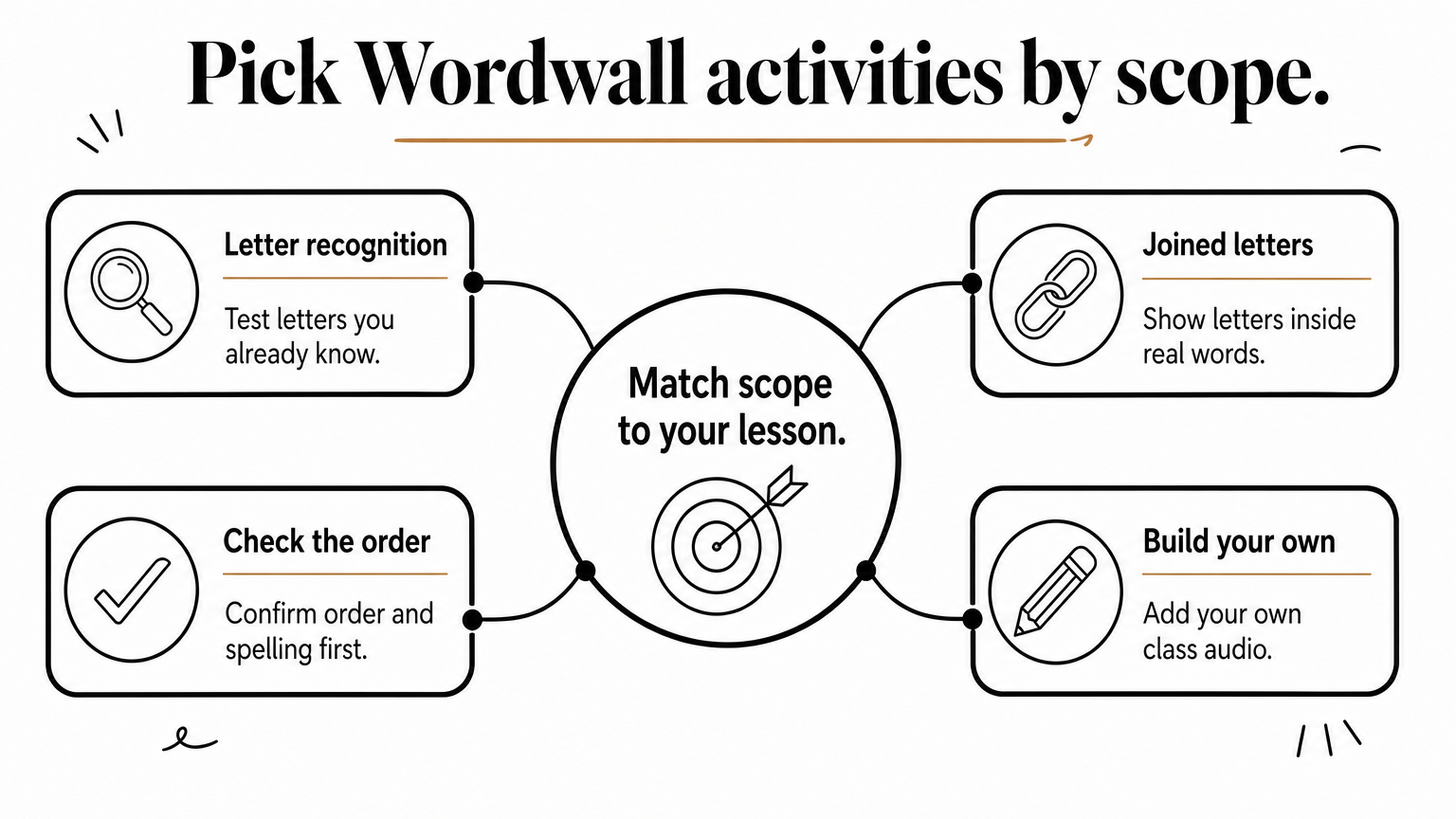
Each activity uses a game template, such as spin the wheel, match up, quiz, open the box, hangman, or gameshow quiz. Titles often state the scope, for example letters Alif to Yaa, letter recognition, or joined-letter recognition. Choose activities that match the letters your learner already knows.
Skip any set that only shows isolated letters if your goal is reading. Look for activities on different letter forms and joined letters, because real Arabic text almost never shows letters alone. You can also build your own set with a few letters and your own audio from class.
Pick activities by scope, not by title, because “Arabic alphabet” can mean four letters or all twenty-eight.
Who it suits and what it costs
It suits classrooms, tutors, and parents who want to match games to a lesson. Free sign-up is available, while paid plans unlock the full library and more editing options, so check the current limits before planning a whole curriculum around it.
Quality varies because anyone can upload. Check each set for correct letter order and spelling before your child plays it, since a wrong answer baked into a game is hard to unlearn.
5. PurposeGames and Baamboozle quizzes
PurposeGames and Baamboozle are the quickest way to test letter recognition. Both are free browser platforms where users publish quizzes and games, including Arabic alphabet sets such as PurposeGames’ “Arabic Alphabet Quiz” and Baamboozle’s “My Arabic letters”.
How it works
A PurposeGames quiz asks you to identify letters against a timer, which suits solo practice. Baamboozle plays as a team game with a game code, so a parent, tutor, or teacher can run it as a living-room or classroom contest with several kids.
Use these after you have learned the letters, not before. A quiz measures what you already know, and the misses show you which letters to review. Write down the three letters you miss most and drill only those next session.
Quizzes are tests, not lessons, so use them to find your weak letters and then go back to a teaching tool.
Who it suits and what it costs
They suit siblings, study groups, and learners who like friendly competition. Playing is free, and the quizzes work in any browser with no download.
The weakness is quality control and audio. Many quizzes show letters without sound. Once quizzes feel easy, try Khat Arabic’s word games, which have you unscramble letters into words in categories like animals, food, school, and colors, with a timed mode and hints.
6. Kids’ Arabic alphabet apps
Kids’ alphabet apps are the best pick when you want games you can download and use offline. A search for “Arabic alphabet games” on Google Play or the Apple App Store turns up many, with colorful illustrations, animations, and mini-games aimed at young children.

How it works
Strong apps combine audio, tracing, and mini-games. Kids hear the letter, trace it with a finger, and then play a matching game that rewards correct answers. Tracing builds the stroke order and right-to-left habit that a matching game never teaches.
Quality varies widely, so check before you install. Use this short list:
- Native-quality audio for every letter.
- All four forms shown: isolated, initial, medial, and final.
- Tracing or writing practice.
- A clear price and ad policy, including in-app purchases.
An app earns its place only if it teaches the sound and the shape together, not just taps and animations.
Who it suits and what it costs
Apps suit preschoolers and early primary kids, car rides, and families without steady internet. Many are free to download, but some show ads or lock lessons behind in-app purchases, so test one yourself first.
Limit sessions to ten or fifteen minutes. For a child who plays happily but still cannot say the letters correctly, add a short weekly session with a teacher.
Start with one game and add feedback
To learn the Arabic alphabet with games, pick one tool from this list and use it daily for short sessions. Digital Dialects and World of Ziryab teach the letters, Wordwall and the quiz sites test them, and apps put practice in a pocket. None of them can listen to you speak.
That is why the best routine mixes a free game with human feedback. If you or your child are ready to start, book the free assessment class at Quranytime Academy. A teacher will check your level and recommend a path, and you can keep using these games between lessons.