
A Quran in Tajweed is a copy of the Quran, in print or on screen, where color coding marks the pronunciation rules so you can recite each letter the way it was taught. The word Tajweed comes from an Arabic root meaning to make better. As a discipline, it means giving every letter its proper sound, length, and quality. You can read a color-coded Tajweed Quran free online, install one as an app, download a PDF, or buy a hardcover. The best choice is the one you will open every day, paired with audio and a teacher’s ear.
This guide explains why color-coded text helps, how to read it step by step, what the colors mean, how the formats compare, and where colors stop being enough. You will also get a worked example you can try in five minutes.
At Quranytime Academy, we teach Tajweed live and one to one, with Al-Azhar graduates and Ijazah holders. We see the same pattern in new students again and again. A good Tajweed Quran speeds up learning, but only when you know how to use it.
Why a color-coded Tajweed Quran helps you recite correctly
A color-coded Tajweed Quran helps because it shows you the rule at the exact moment you need it. That protects the words from small pronunciation errors that can change them. It does not replace listening or a teacher, but it turns an invisible rulebook into something you can see on the page.

What reciting the Quran in Tajweed protects
Reciting the Quran in Tajweed protects the exact sounds of the words as they were passed down from the Prophet Muhammad (peace be upon him). Arabic has many letters that sit close together in sound. Say ق (qaf) where ك (kaf) belongs and qalb, "heart," becomes kalb, "dog." Stretch a short vowel and kataba, "he wrote," becomes katāba, "he corresponded with." These are ordinary Arabic examples, but the same logic applies to every word of the Quran.
The instruction itself is in the Quran. In Surah Al-Muzzammil (73:4), Allah tells us to recite the Quran in a slow, measured way. Tajweed is the detailed answer to what "measured" means: how long to hold a vowel, when to echo a letter, and where the nasal sound goes. The companions learned recitation by listening and repeating, and teachers have passed it down the same way ever since.
Effort counts too. A’ishah (may Allah be pleased with her) reported that the Prophet said the one who recites the Quran skillfully will be with the noble angels, and the one who recites with difficulty, stumbling over its verses, will have a double reward. The hadith is recorded in Sahih al-Bukhari and Sahih Muslim. Beginners should hold on to it. You do not need a perfect recitation to start. You need a sincere, steady one that keeps improving.
Tajweed protects the words, and color coding makes that protection visible on the page.
Why color coding makes the rules easier to learn
On a plain page, you have to spot every rule yourself. You see a noon with a sukoon, check the next letter, recall whether the rule is idhaar, idghaam, iqlaab, or ikhfaa, and then apply it, all while reading. Most beginners lose the thread. A color-coded mushaf does the spotting for you, so your attention goes to the sound instead of the search.
Here is what that gives you in practice:
- Instant recognition. The rule is flagged before you reach the letter, so you can prepare your mouth.
- Pattern learning. After a few pages, you notice the same colors repeating in the same situations, and the rules start to stick.
- Earlier fluency. You can recite full pages sooner because you are not stopping to analyze each word.
- Easier self-review. When you record yourself, you can check each colored letter against what you heard.
The limit is just as important. A color tells you which rule applies. It does not tell you how the rule sounds. That part still comes from listening, which we return to in the last section.
Is it required to read the Quran with Tajweed?
Scholars generally teach that avoiding clear mistakes is required of every Muslim who recites. That means changing a letter, a vowel, or the meaning of a word. The finer points, such as the exact degree of ghunnah or the precise length of a madd, are discussed with more nuance. If you have a question about your own situation, ask a qualified scholar and do not rely on a blog post, including this one.
In practical terms, the question matters less than the habit. If you recite the Quran in Tajweed as best you can and keep improving, you are doing what scholars encourage. A colored mushaf is a learning tool, not a requirement. You can learn the same rules from a plain mushaf and a good teacher, and many students move to a plain mushaf once the rules become automatic.
How to read the Quran in Tajweed online, step by step
To read the Quran with Tajweed online, choose a reliable Tajweed edition, learn its color key, listen to a skilled reciter, then read one short passage slowly and record yourself. Repeat until the colors stop feeling like a code. The routine below works the same way for a browser, an app, or a PDF.
Set up your Tajweed Quran first
Setup takes about ten minutes and saves weeks of confusion. Work through this list before your first session:
- Pick the script and riwayah. Choose a Madinah-style Uthmani script following Hafs from Asim, the most widely used recitation. Most Tajweed color schemes are built around it.
- Turn on the colors. On Quran.com, open the settings menu and select the Tajweed Mushaf under "Quran Font." QuranFlash offers a page-by-page Tajweed Mushaf view, and most colored apps have a similar display option.
- Find the legend. Locate the color key and save a screenshot to your phone. You will check it often in the first weeks.
- Choose one reciter. Pick one trained reciter and stay with him for a while. Mahmoud Khalil al-Husary and Mishary Alafasy are popular choices for learners.
- Enlarge the text. Small marks such as sukoon and shaddah are easy to miss, and a bigger font makes the colors easier to read.
A routine for every page
Use the same short routine on each passage. It trains your eyes, ears, and mouth together.
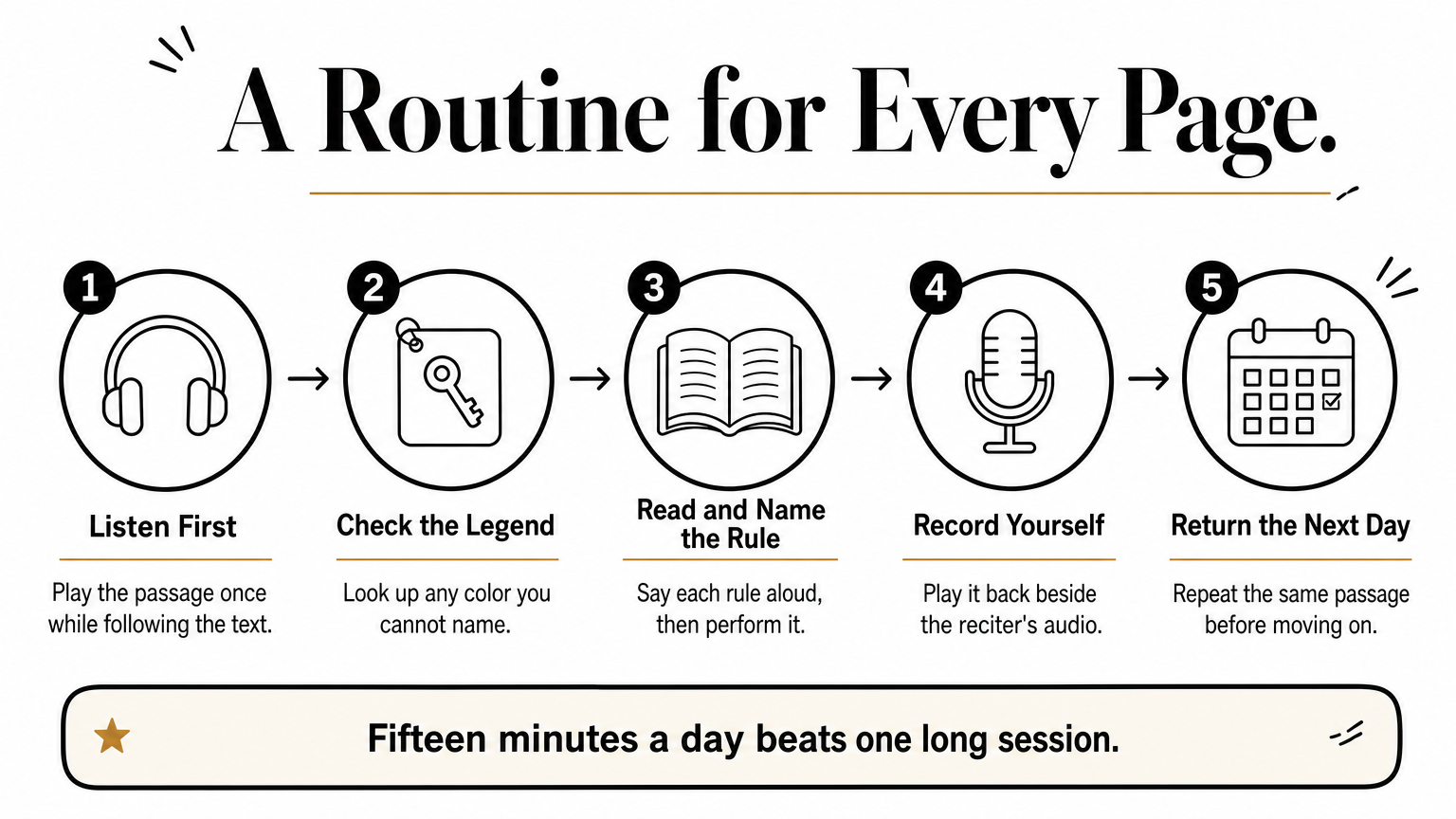
- Listen first. Play the passage once while following the text. Watch where the reciter stretches, echoes, or hums.
- Check the legend. Look up any color you cannot name before you read.
- Read slowly and name the rule. On the first pass, say the rule aloud when you reach a colored letter, then perform it.
- Read again at a normal pace. Keep the same rules, now without naming them.
- Record yourself. Use your phone’s voice recorder and play it back beside the reciter’s audio.
- Log your mistakes. Write down the rule you missed most often and focus on that one rule tomorrow.
- Return the next day. Repeat the same passage before moving on.
Fifteen minutes a day on a short passage beats one long session a week. The rules live in your mouth and ears, so they need frequent, small repetitions.
A worked example with Surah Al-Ikhlas
Surah Al-Ikhlas is four short verses, and it teaches three ideas at once. In "Qul huwa Allahu ahad," the final dal of ahad is a qalqalah letter. When you stop on it, you give it a clear echo. In "Allahu as-samad," the lam of "al" is not pronounced. It merges into the sad, which carries a shaddah, so you say "as-samad." Many Tajweed editions grey out the silent lam so you can see it.
Then compare "lam yalid" with the end of the verse. In "lam yalid wa lam yulad," the dal of yalid has a sukoon in the middle of a flowing phrase. It gets a light echo and you move quickly to the next word. When you stop on ahad or samad, the echo is stronger. That contrast between continuing and stopping is one of the most useful habits you can build.
Once Al-Ikhlas feels comfortable, move to Al-Fatiha. It adds natural madd in "ar-Rahman ar-Rahim," a shaddah on the ya of "Iyyaka na’budu," and a long six-beat madd in the final phrase "wa lad-daallin." Reading the Quran in Tajweed this way, one short surah at a time, builds real skill faster than skimming long passages.
Name the rule, perform the rule, record the result, and repeat the next day.
What the colors in a Tajweed Quran tell you to do
Colors mark which Tajweed rule applies to a letter, but there is no single universal palette. Many editions use one color family for nasal sounds, another for echoes, shades of one color for madd, and grey for letters you skip. The only dependable guide is the legend in the edition you are using.
Colors differ by edition, so read the legend
One edition’s blue can be another edition’s purple, and one app may split a rule into three colors where another uses one. That is why switching between a PDF, an app, and a printed copy can feel confusing at first. Treat each edition as its own small language and learn its key before you trust your memory from somewhere else.
The legend usually sits on the first or last page of a print edition, or in the display settings of an app or website. Take a photo of it and keep it where you can open it fast. If you study with a teacher, ask which edition they prefer, because a shared color key makes lessons much smoother.
The color tells you which rule applies. Only the legend tells you what that color means in your edition.
The main rules you will see
The table below lists the rule families that appear on almost every page of a Tajweed Quran, with what each asks of you and an example.
| Rule | What you do | Example |
|---|---|---|
| Ghunnah on noon or meem with shaddah | Hold a nasal sound for about two beats | إِنَّ (innna), ثُمَّ (thumma) |
| Idhaar | Pronounce noon sakinah or tanween clearly, with no nasal sound, before ء ه ع ح غ خ | أَنْعَمْتَ (an’amta) |
| Idghaam | Merge the noon into the next letter (ي ر م ل و ن); with ghunnah for ي ن م و, without it for ل ر | مِنْ رَبِّهِمْ (min rabbihim) |
| Iqlaab | Turn the noon sound into a hidden meem before ب | مِنْ بَعْدِ (mim ba’di) |
| Ikhfaa | Hide the noon with ghunnah before the other 15 letters | أَنتُمْ (antum) |
| Meem sakinah | Hide with ghunnah before ب, merge before م, pronounce clearly before other letters | تَرْمِيهِم بِحِجَارَةٍ |
| Qalqalah | Echo the letters ق ط ب ج د when they carry a sukoon or you stop on them | أَحَدٌ (ahad) |
| Madd | Stretch the vowel letters ا و ي by a set number of beats | جَاءَ (jaa’a) |
| Silent letters | Skip the letter, such as the lam in the definite article before sun letters | الصَّمَدُ (as-samad) |
Different courses group these rules differently. You will hear of "the seven rules of Tajweed" in some places and longer lists in others. The table covers the core families, and a good teacher will fill in the finer branches as you progress.
Counting the beats in madd
Madd is the rule that learners find hardest to time, because it asks you to hold a vowel for a measured length. A "beat" (harakah) is traditionally the time it takes to fold or open a finger at an even pace. Here is how the lengths work in Hafs:

- Natural madd, 2 beats. A madd letter with no hamza or sukoon after it, as in "yaa" or "diinukum."
- Connected madd, 4 or 5 beats. A hamza follows the madd letter in the same word, as in "jaa’a."
- Separated madd, 4 or 5 beats. A word ends in a madd letter and the next word starts with a hamza.
- Necessary madd, 6 beats. A shaddah or a permanent sukoon follows the madd letter, as in "wa lad-daallin."
- Madd at a stop, 2, 4, or 6 beats. When you stop on a word with a madd before the last letter, you may choose a length, with 2 beats as the minimum.
Ask your teacher which length they use for the 4-or-5 cases, then stay consistent across your whole recitation. Switching lengths mid-page is a more common error than choosing the "wrong" one.
Online, PDF, app, or print: choosing a Tajweed Quran
Read online if you want free access with audio, use an app for offline daily reading, download a PDF for printing and marking, and buy a hardcover for a screen-free routine. Whichever format you pick for your Quran with Tajweed, check three things: the legend, the script, and the accuracy of the text.
Reading the Quran with Tajweed online
Browser-based readers are the easiest place to start. Quran.com added a Tajweed Mushaf option, a color-unified font that marks the rule on every letter, and you switch it on under "Quran Font" in the settings. QuranFlash offers a Tajweed Mushaf with chapter navigation, translation, listening, and settings in one view. Both let you read the Quran online with Tajweed without buying anything.
Apps give you the same benefit offline. Google Play carries colored Tajweed apps that include all 114 surahs and work without a connection, which suits commutes and travel. Quality varies between apps, so open a page you already know well and compare the colors against your legend before you commit.
The main risk of screen reading is distraction. Put your phone on do-not-disturb during practice and keep one tab or one app open. A tool that pings you every few minutes works against the focus Tajweed needs.
Tajweed Quran PDF and print editions
Many learners search for a Tajweed Quran PDF because it works offline and can be printed or annotated. Be selective about where you get one. Prefer files from a recognized publisher or an established Quran project, and compare the first few pages with a trusted mushaf, since a poorly made file can carry missing marks or altered text. Check that it uses Uthmani script, and print in color, because a grayscale printout loses the very rules you wanted.
Print editions suit learners who want a screen-free routine. Hardcover color-coded Qurans, including whole-Quran editions with English translation and transliteration, are sold through major retailers such as Amazon. Treat transliteration as a short bridge, not a method. It cannot show madd length or ghunnah reliably, so learn the Arabic letters as soon as you can. If you plan to memorize later, a 604-page Madinah-layout edition will feel familiar.
Comparing the four formats
| Format | Best for | Strengths | Watch out for |
|---|---|---|---|
| Online reader | Daily reading with audio | Free, searchable, built-in audio and translation | Needs a connection, easy to get distracted |
| Mobile app | Commutes and offline study | Works offline, bookmarks, audio | Quality and color keys vary by app |
| Printing and marking up | Fixed pages, easy to annotate, works offline | Unknown source, text errors, lost colors in grayscale | |
| Print edition | Focused recitation, children | No screen, durable, translation versions available | Cost, color key differs from your app |
Before you commit to any of them, run this quick checklist:
- Is the legend clearly shown and easy to read?
- Does the text follow a recognized Uthmani script with Hafs?
- Can you pair it with audio from a reciter you trust?
- Is the text size comfortable for your eyes?
- Can you use it on the device or paper you will actually have with you?
A Tajweed Quran is only as good as its legend and the accuracy of its text.
Where a Tajweed Quran stops and a teacher starts
A color-coded Tajweed Quran tells you which rule applies. It cannot tell you what a correct sound feels like in your mouth, and that gap is where a teacher comes in. Using a colored mushaf well means knowing exactly what it cannot do.
What colors cannot teach
Colors cannot teach you where letters come from. The points of articulation (makharij) and the qualities of each letter (sifat) decide whether a letter sounds heavy or light, and no color shows that. Colors also cannot teach the true length of a beat, the quality of ghunnah, or how much to hide a noon in ikhfaa. For ikhfaa especially, you have to listen to a skilled reciter, because the degree of the sound shifts with the letter that follows.
There is a second problem that is easy to miss. It is hard to hear your own mistakes. You may repeat the same slightly wrong sound for months because it feels right to you. A teacher catches it in the first minute. Recording yourself helps, but a trained ear listening live closes the gap faster.
Common mistakes learners make with colored Qurans
These are the patterns we see most often:
- Treating colors as decoration. The reader enjoys the look but never checks what each color asks them to do.
- Reading too fast. Speed hides errors, and the colors flash past before the rule is applied.
- Ignoring stopping and starting. Many rules, such as the strength of qalqalah or the length of madd at a stop, change when you pause.
- Mixing reciters and styles. Switching between very different recording styles makes the beat length feel inconsistent.
- Leaning on transliteration. It hides the Arabic letters and cannot carry the timing.
- Changing editions constantly. Every new palette resets your recognition and slows progress.
How one-to-one teaching closes the gap
A live teacher watches your recitation as it happens, stops you at the exact word, and models the sound until you match it. At Quranytime Academy, lessons are one to one and online, taught by qualified instructors including Al-Azhar graduates and Ijazah holders. The Tajweed path is built for learners who can already read but want to improve accuracy. Classes run on flexible schedules across time zones, so you can fit them around work, school, or family.
You can keep using whichever Tajweed Quran you prefer, whether it is a PDF, an app, or a hardcover. The teacher uses it as a shared reference and corrects the sound, not just the page. If you are unsure where you stand, a short assessment class shows your current level and the right starting path.
Use the colors to see the rule, and use a teacher to hear it right.
Start reciting with confidence
A Quran in Tajweed gives you a visible map of the pronunciation rules. Choose a reliable edition, learn its legend, and listen to a trained reciter before you read. Take one short passage at a time, record yourself, and repeat it the next day. Online readers, apps, PDFs, and printed copies all work, as long as the text is accurate and you use the same format consistently.
Colors show you which rule applies. They cannot replace the trained ear that tells you whether you got it right. If you want that feedback, book a free assessment class with Quranytime Academy. We will hear you recite, find your level, and match you with a teacher and a Tajweed path that fits your schedule.