

Quran Learning for Shift Workers: A Flexible Practice Plan
If your work hours change from week to week, a Quran routine tied to one clock time can feel impossible. A better Quran learning plan for shift workers uses a reliable event, such as waking after your main sleep or getting ready to leave, and offers more than one session size. The goal is a practice you can return to without competing with rest, family, or safe work.
This guide helps you plan Quran reading, recitation, Tajweed, or Hifz (memorization) around day, night, rotating, and unpredictable shifts. It is a study framework, not medical or religious advice. If you learn with a teacher, agree on a workload that fits your actual rota.
Choose one goal and one flexible anchor
For the next two weeks, choose one main result: read a short passage more fluently, work on one pronunciation point, strengthen memorized material, or prepare an assigned lesson. Trying to advance reading, Tajweed, and new Hifz at once can turn a short window into several unfinished tasks.
Next, tie the session to an event rather than a fixed clock time. “After I wake from my main sleep” may still work when a shift changes; “at 7 a.m.” may not. Choose one main anchor and one backup, such as before leaving home or after your first meal off duty. For a starting point, write down your current goal, easiest safe anchor, and smallest useful session. This adult Quran reading and Tajweed learning plan can help you describe your level and next step.
Match the anchor to your shift pattern
There is no single best study time for every learner. Attach learning to a recognizable moment, then adjust its length to the time and attention you actually have.
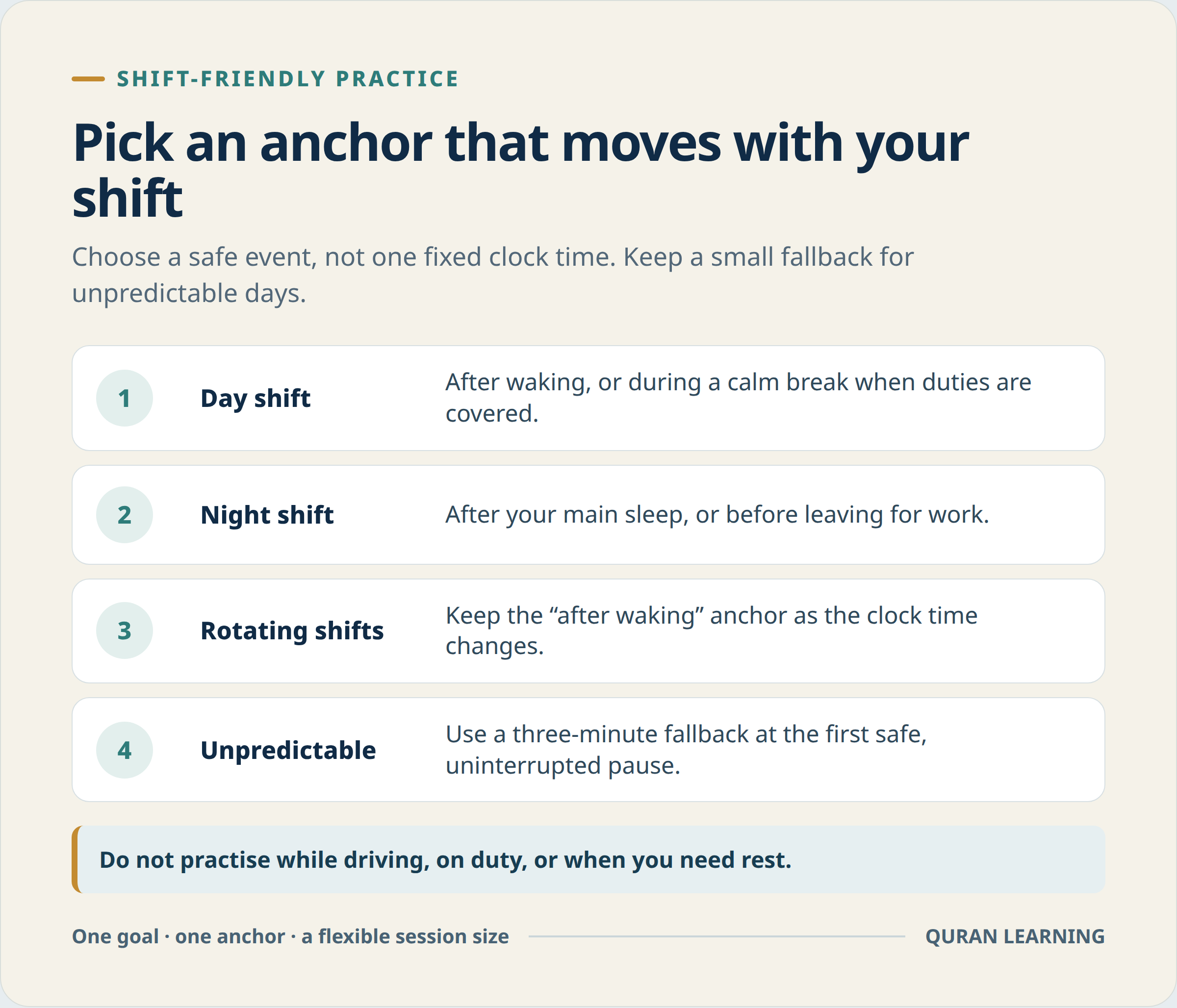
- Day shifts: Try a few minutes after waking, before the day becomes busy, or during a calm break when your duties are covered. If evenings are your only option, use the minimum session after a demanding day.
- Night shifts: Consider studying after waking from your main sleep or before leaving for work. Do not make demanding new memorization the price of returning home after a long shift.
- Rotating shifts: Keep the anchor—such as “after waking”—even when its clock time changes. You can keep the same weekly goal without moving sleep to preserve a fixed hour.
- Unpredictable or on-call work: Keep a three-minute fallback ready for the first safe, uninterrupted pause. If work allows no safe break, move the session to the next off-duty anchor.
Decide what the short session contains. A new reader might review a few lines and note one question. A Tajweed learner might repeat one teacher-approved example. A Hifz student can review assigned material instead of adding new lines whenever a shift gets busy.
Try the anchor for two weeks before changing several parts of the plan. If your rota includes night shifts followed by a free day, keep the same after-waking anchor and choose the session size that fits once you are rested. On a rotating week, note which anchor worked for each shift type. At the end of the trial, keep the simplest repeatable option and drop any trigger that repeatedly collides with work or rest. The aim is a routine you can restart, not a perfect record.
Prepare a three-level practice menu
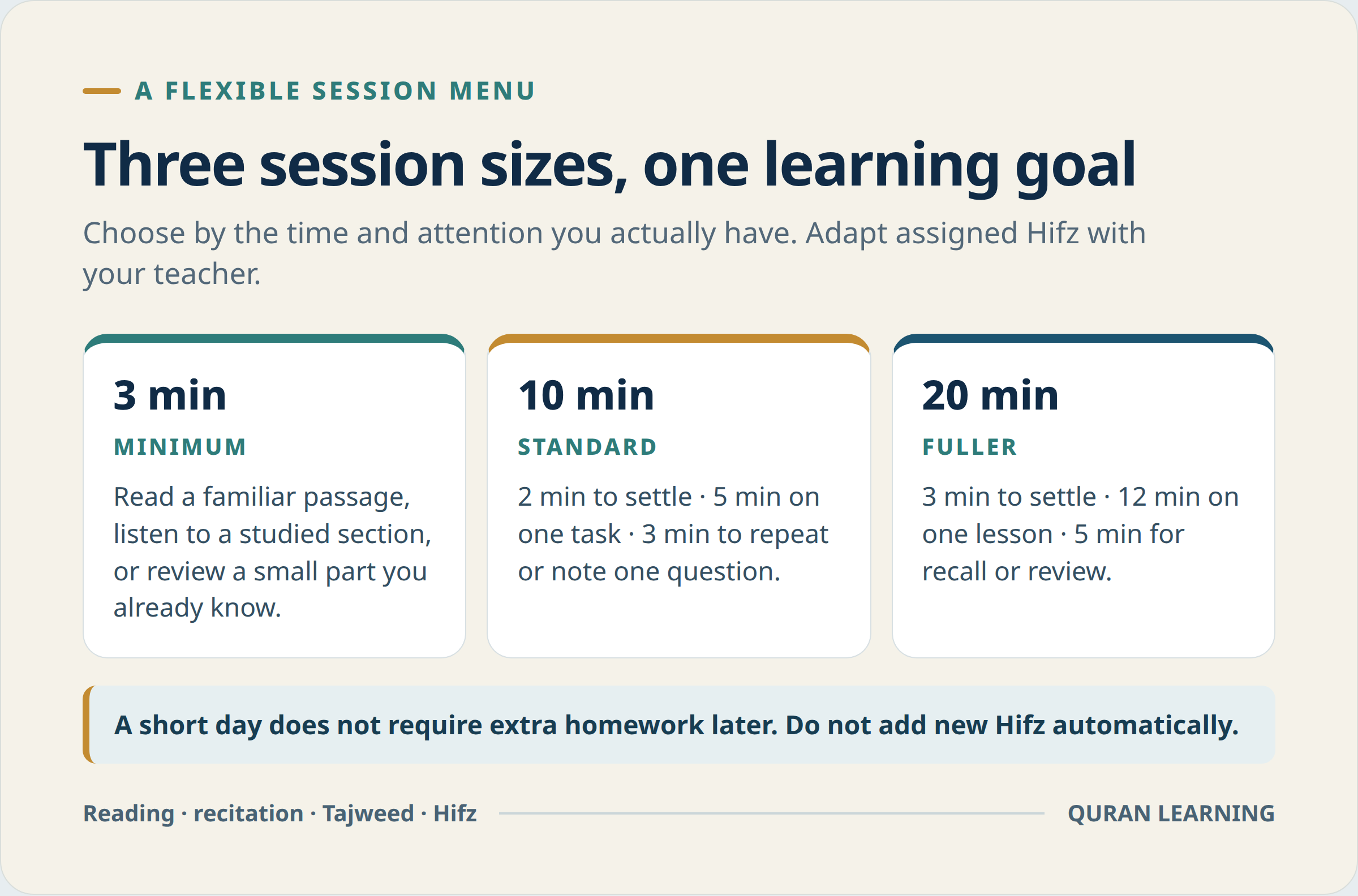
Set a minimum, standard, and fuller session before the week begins. A short break then does not have to become a missed day, and a free evening does not automatically create extra homework. Adapt these examples with your teacher; they are not required amounts.
Three-minute minimum: Read a familiar passage slowly, listen to a previously studied section, or recall a small part of recent memorization. Stop after the planned task. This keeps contact with your goal without starting new material when you are rushed or exhausted.
Ten-minute standard: Spend two minutes finding your place, five on one focused task, and three repeating or noting a question. Keep the target narrow: one passage, one pronunciation point, or one assigned review. For audio, try a listen–pause–check routine. This Quran listening practice guide can help you follow along rather than letting audio play in the background.
Twenty-minute fuller session: Use three minutes to settle, twelve for the main lesson, and five for recall or review. If you study Hifz, keep new material and revision within the workload your teacher approved. A Hifz revision schedule can help you think about review separately from new memorization.
For example, a learner with two day shifts and two night shifts could use the same after-waking anchor on all four workdays, with a three-minute review when time is short and the ten-minute task when there is a calm window. On a day off, a twenty-minute session is optional, not repayment for a short day. If the teacher has assigned Hifz, use the approved lesson and review amount rather than adding extra lines because the calendar looks open.
On a low-energy day, shorten the task before abandoning the goal. A reading learner can use a smaller passage. A Tajweed learner can revisit a taught sound instead of adding a new rule. A memorization learner can review assigned material. For ideas between live lessons, see how to practise Tajweed at home between lessons.
For a short meaning-review block, follow the Arabic on screen in this 43-second Al-Fatihah clip while listening to an English reading. It supports reading with meaning; it is not Arabic recitation or Tajweed correction.
Protect rest and keep practice safe
Do not build a study streak by giving up sleep or attention needed for safety. NIOSH’s training page is written for nurses who work shifts. It notes that night nurses may sleep fewer hours, describes a suggested compromise schedule that keeps some sleep hours consistent across work and rest days, and warns that staying awake all day before or after a night shift can increase short-term accident and injury risk. This is not a universal sleep schedule or medical advice. Use the practical boundary: do not force yourself to stay awake when you need rest. Read the CDC/NIOSH shift-work training guidance.
Keep Quran study for a safe break or off-duty time. Do not read from a screen, follow a mushaf, or handle a phone while driving, operating machinery, or doing work that needs your full attention. If you are too tired to focus safely, pause until your next suitable anchor.
Make the next session easy to begin by saving the page reference, task, and smallest fallback in a notebook or offline note. This keeps a short break from disappearing into searching for the last lesson or choosing among too many tasks. Prepare the note while off duty, and keep it short enough to update in a few seconds.
Restart without catch-up debt
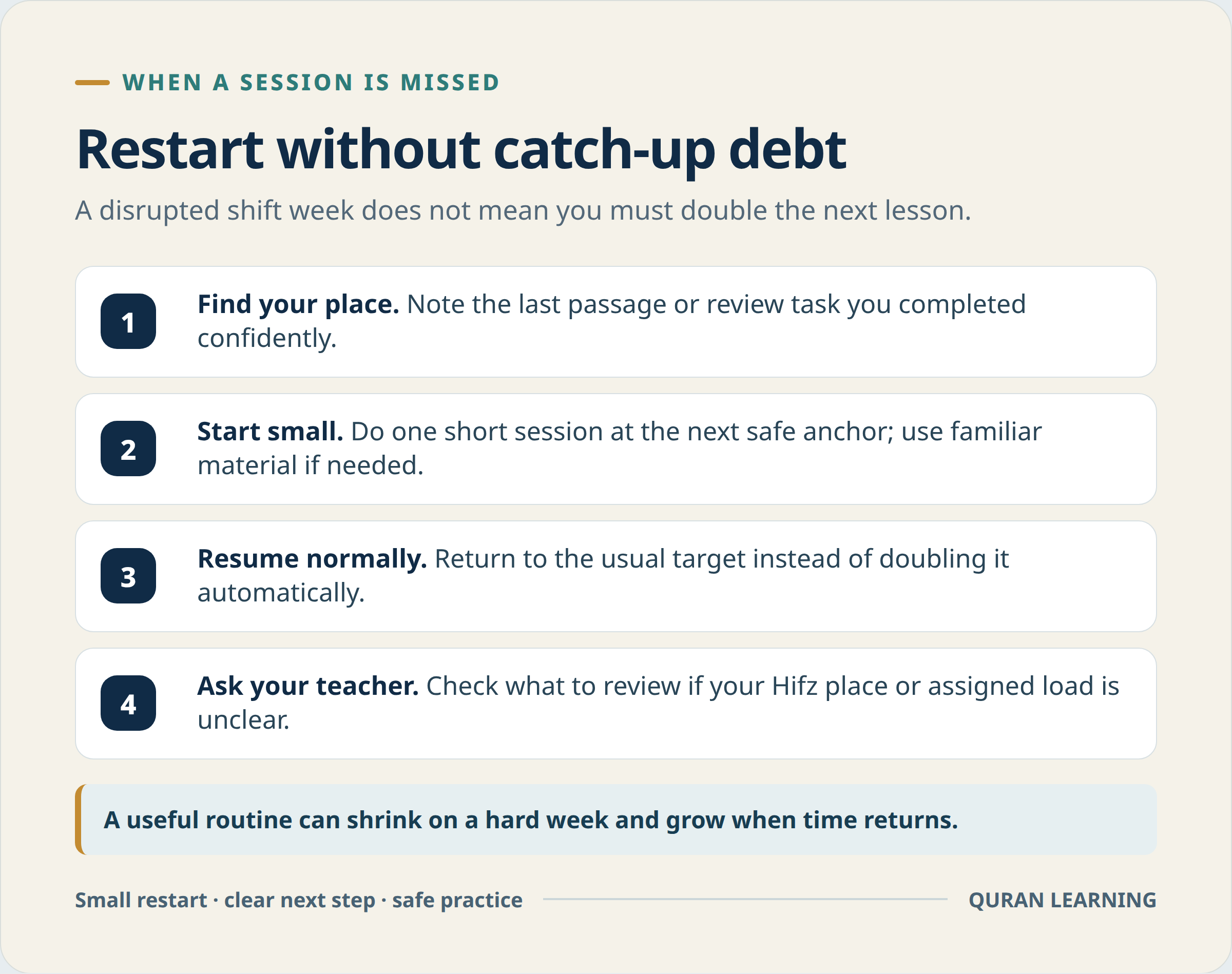
Missing a session is part of an irregular schedule. Do not repay every missed minute in one sitting, especially if that would add new memorization while you are tired. Use a small reset:
- Find the last passage, sound, or review task you completed confidently.
- Do one short session at the next safe anchor, using familiar material if needed.
- Return to the usual target rather than doubling it automatically.
- If you have lost your place in assigned Hifz or several lessons, ask your teacher what to review first.
For memorization, protect revision instead of racing to add new material. For reading or Tajweed, resume with a short example you can check accurately. If your rota changes for a week, let the session size change too; a flexible plan can shrink and grow.
Tell your teacher what your rota looks like
Share whether your shifts are fixed, rotating, or called at short notice, along with the study windows you can protect and the times that are too tiring or unsafe. Ask for a minimum version of the week’s work and a fuller version for a better window. Agree which tasks are new learning and which are review, so you do not have to guess after a disrupted week.
If you are comparing live class options, begin with a plan that fits your real work week. Quranytime’s guide to online Quran classes for adults with busy schedules can help you think through the choice. You can also read how Quranytime structures learning and feedback and this routine-planning guide for busy households for ideas on making a small learning window repeatable.
If you want help identifying a starting level and a realistic weekly goal, you can book 3 free trial classes and discuss your shift pattern with the team.
A routine you can restart is useful
Choose one learning goal, attach it to an event that moves with your schedule, and keep a three-minute fallback ready. Use a fuller session when time and focus allow. Protect rest, avoid unsafe practice, and restart without doubling missed work. That gives Quran learning room to fit around real shifts while keeping the next step clear.