

Short answer: According to Islam Question & Answer, a woman is not required to wear hijab simply to read or recite the Quran. This is separate from salah, which has its own covering requirements. Wudu, touching a printed Mushaf, and other circumstances raise separate questions.
“Can I read Quran without hijab?” often comes up in ordinary, private moments: a woman is reviewing a memorized surah at home, reading a few lines between tasks, or joining an online lesson from her room. The question sounds simple, but may refer to memory, a printed Mushaf, a phone, salah, or reciting where others can hear.
Separating those situations avoids treating every recitation like prayer or dismissing context and modesty. This general explanation leaves room for scholarly differences and personal guidance.
Recitation is not automatically the same as salah
In everyday speech, “reading Quran” can refer to several activities. A person might recite aloud from memory, follow text in a printed copy, read a Quran app, or recite verses while performing prayer. These actions overlap, but the legal questions are not identical.
For ordinary recitation outside salah, the Jordanian General Iftaa Department answers that wearing hijab is not a condition of recitation. It describes covering as recommended in that setting, connecting it with readiness for the prostration of recitation. A separate scholarly answer from SeekersGuidance says a woman alone need not wear hijab for recitation, while describing covering in that private circumstance as superior. These are answers from named institutions and scholars, not a universal ruling that settles every school, circumstance, or question.
Prayer is different. Salah has conditions of covering that are not simply copied over to every moment a person recites Quran. If the recitation is part of a formal prayer, the prayer’s requirements apply. For the details relevant to your school, circumstances, and what must be covered, ask a trusted scholar rather than treating a short blog answer as a complete guide to prayer attire.
Can you read Quran without hijab? What does the question mean?
People use “hijab” in more than one way. Sometimes they mean a headscarf; sometimes they mean a broader standard of modest dress. A question about covering one’s hair while alone is narrower than a question about dress in the presence of non-mahram people. The room, audience, and activity can all change which issue needs answering.
For a private moment of recitation, imagine a woman reading a familiar passage in her bedroom, with no one else present. The specific question is whether the headscarf is a prerequisite for reciting. The cited institutional answers say it is not. She may still choose to cover because that is her practice, helps her feel prepared, or reflects the teaching she has received. A voluntary practice should not be presented as a universal prerequisite.
Now imagine she is reciting in a mixed gathering or on a video call where other people can see her. The question is no longer only “Does recitation itself require a headscarf?” There may also be rules about modesty, who is present, the purpose of the gathering, and the norms of her school or community. Do not use the private-recitation answer as a shortcut to resolve that separate setting.
Technology can make the question arise more often: someone may open an app for a few lines while waiting, or follow along during a lesson. The fact that text is on a phone does not by itself turn private recitation into salah. A phone, printed Mushaf, and memorized recitation can prompt distinct questions, so it is useful to say exactly what you are doing when asking for guidance.
Memory, printed Mushaf, phone, and lesson: what changes?
The cited answer concerns recitation, not whether the words come from memory or a screen. State whether you are reciting from memory, following a printed Mushaf, or reading an app; handling a physical copy and ritual purity are separate questions from head covering.
If your concern is specifically wudu, handling a printed Mushaf, or reading on a phone, see our separate guide to reading Quran without wudu. That page addresses a different question; it should not be treated as the source of a ruling on dress.
In a remote class, there can be two settings at once: the student’s private room and the people visible on a shared screen. If a teacher expects a particular dress practice for a class, ask whether that is an etiquette preference, a school-specific practice, or a religious requirement for your situation. A considerate classroom norm and a binding condition of recitation are not interchangeable claims.
For a broader introduction to beginning recitation, the guide on how to start Quran recitation covers the opening phrases and transitions. It is about the recitation sequence, not dress. Keeping the two topics distinct makes it easier to find an answer without reading more into either guide than it says.
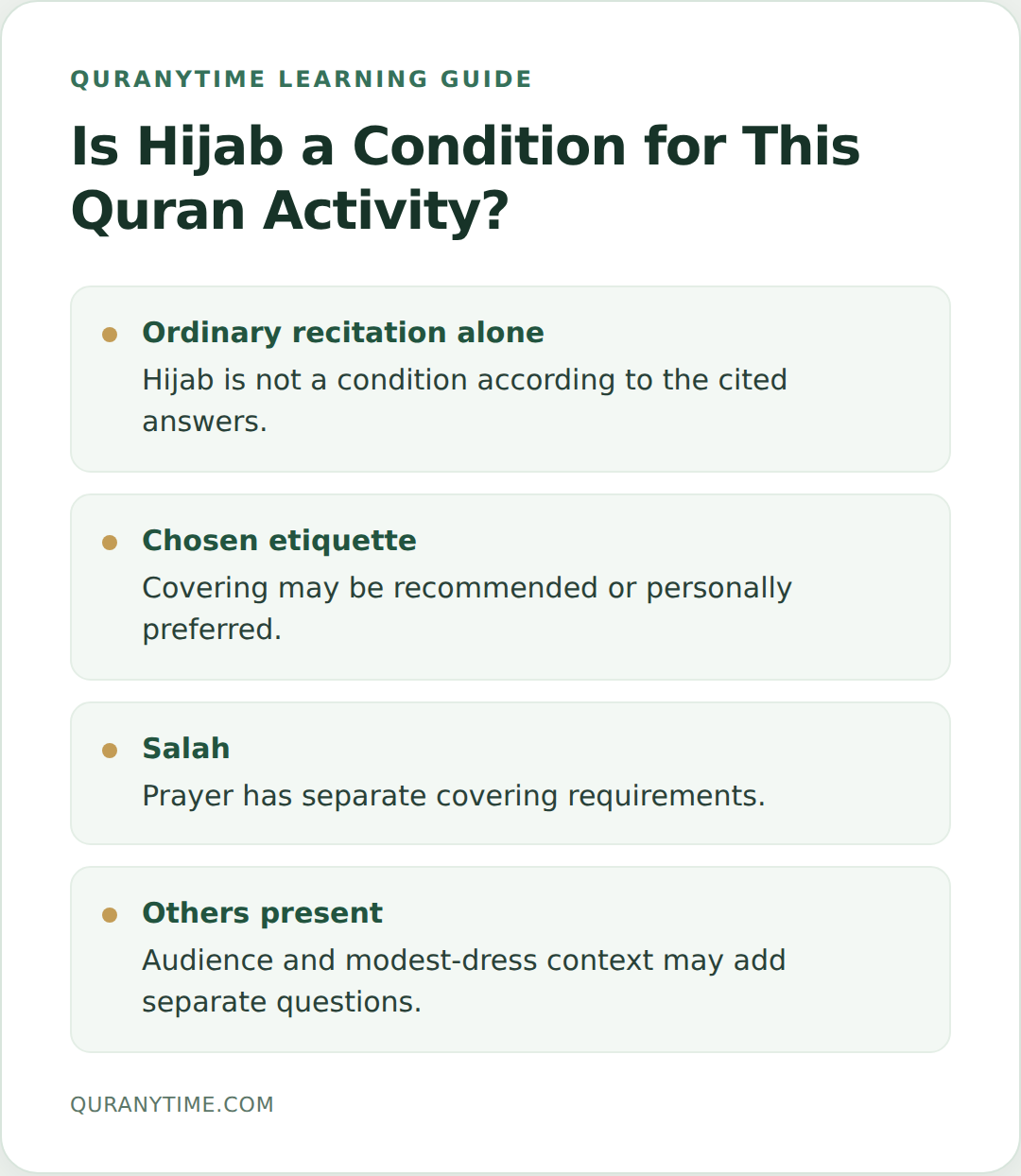
Respect is not measured by one visible practice alone. A reader may show care through attention and a thoughtful approach to the words, while another may find that covering helps her settle into recitation. This is not ranking people’s sincerity; it distinguishes what the cited answers call a requirement from a practice described as recommended or preferable.
Respectful etiquette without turning etiquette into a condition
Many Muslims approach recitation with care, choosing a quiet place, handling a Mushaf attentively, or reciting with focus. Some choose wudu or cover their hair even alone; others recite in everyday clothing when time allows. A respectful practice can be meaningful without being a prerequisite.
Learners should not feel an uncovered head makes practice pointless, nor should someone who covers be told the practice has no value. The general answer about what is required and a person’s chosen etiquette can both be acknowledged without confusing them.
Concrete examples may help:
- Quiet review at home: The cited answers do not make hijab a condition for ordinary recitation alone; she may cover if she prefers.
- Before prayer: Recitation outside salah and prayer are separate acts; prepare for salah according to its conditions when it begins.
- Family gathering: Who is present and appropriate modest dress are separate from the private-alone question.
- Online class: Ask whether a dress expectation is classroom etiquette or a claimed requirement for recitation.
Another source of confusion is that a short answer may leave its assumptions unstated. Was the questioner alone? Did they mean a headscarf specifically or modest clothing more broadly? Were they asking about prayer, touching a physical Mushaf, or reciting outside prayer? An answer can be accurate within its own frame and still be misapplied when repeated without that frame.
Why do you hear different answers?
Short answers can sound contradictory when they address different questions: whether hijab is a condition, what etiquette is preferred, or what applies during prayer or before an audience. Without that context, one answer may sound like permission and another like prohibition.
Scholars also work within legal schools and interpret details of worship through established methods. A general overview should not claim there is no difference at all, nor should it manufacture a disagreement where the cited answer is clear. The modest conclusion from the sources used here is that ordinary recitation while alone does not require hijab according to these answers, while covering can be recommended; prayer and public or mixed settings raise separate questions. Follow a trusted scholar or school for guidance in a personal case.
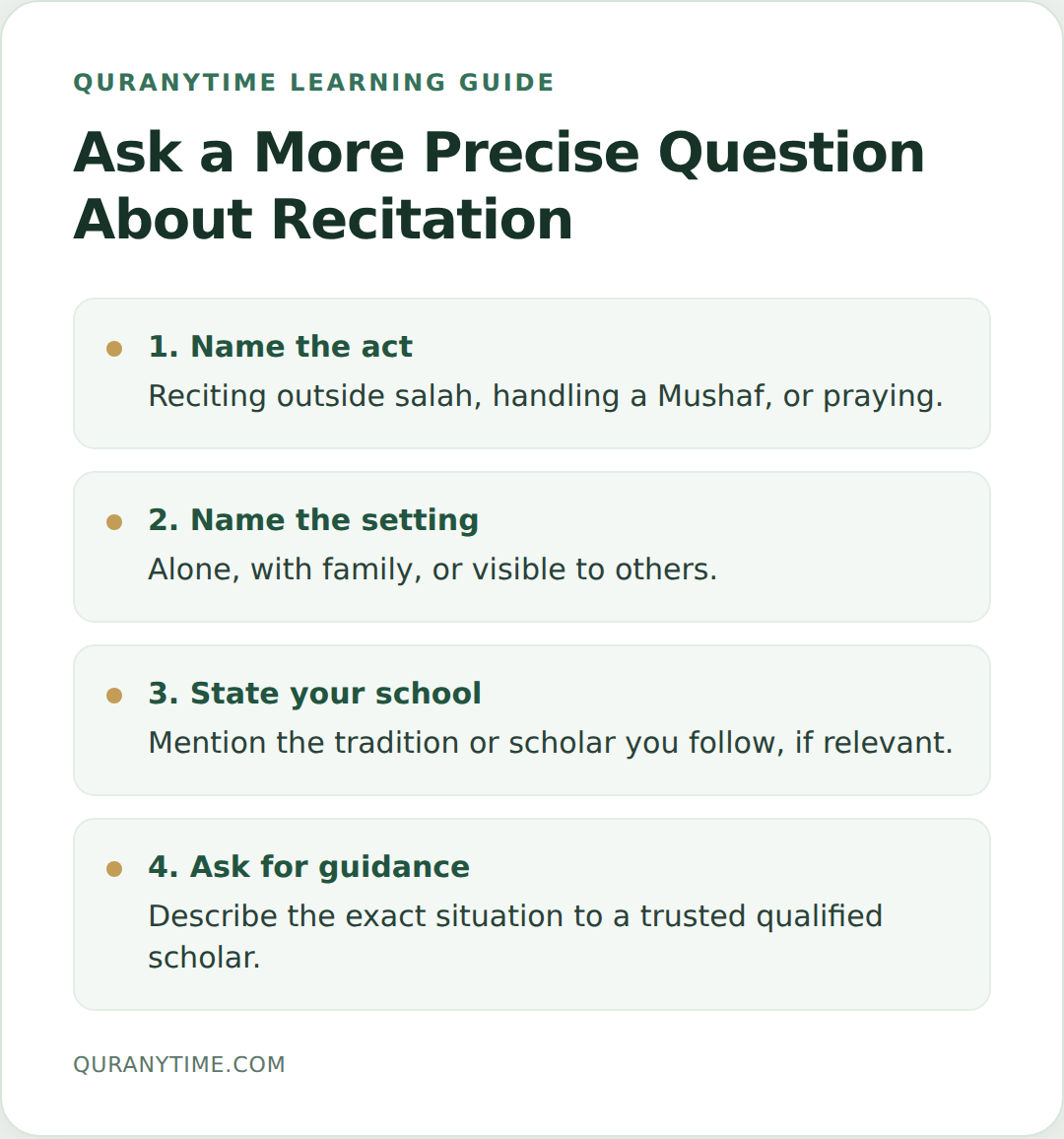
If you need to ask, describe the actual situation rather than just asking “Is it allowed?” For example: “I am alone at home, not in salah, and want to recite from memory. Is covering my hair required in the school I follow?” Or: “I will recite aloud in a mixed online class; what dress and participation guidance applies?” A precise question is more likely to receive a useful, appropriately scoped answer.
If unsure, write down the circumstances before searching for another general post. Note whether you are alone, whether this is salah, whether you are reading from memory or a copy, and what you mean by hijab. This does not replace a scholar’s judgment; it makes the question clearer and reduces the chance that advice about one situation will be mistaken for advice about another.
A calm way to decide what to do
You need not resolve every question about clothing, purity, prayer, and etiquette before reading. Identify the act—reciting outside salah, reading a printed text, or praying—and the setting: alone, with family, or visible to others. If the question is about ordinary private recitation, the sources below give a clear general answer. If it is about prayer, public dress, a separate state of ritual purity, or a school-specific practice, seek guidance for that specific case.
A simple habit can keep the issue clear: make a note of the exact question you have, ask a trusted local scholar or teacher, and save the answer with its context. Avoid forwarding a one-line answer as if it addressed every woman, every school, and every situation. Religious guidance is most useful when its scope is kept intact.
For learners who want support with reading itself, Quranytime’s adult Quran reading and Tajweed learning plan describes practical starting points. For practice pace, see how to improve Quran reading fluency without rushing. If a question comes up in class, the guide to asking your Quran teacher better questions can help you describe it clearly. You can also book a free Quran and Arabic trial class to discuss your reading goals and ask learning questions; the class page describes three free trial classes. Neither learning resource replaces a personal religious ruling.
Frequently asked questions
Can a woman read Quran without hijab at home?
Islam Question & Answer says a woman does not have to wear hijab simply to recite the Quran. Prayer, wudu, and touching a printed Mushaf have separate requirements and should not be treated as the same question. See the full answer for details.
Does a woman need hijab to recite Quran from memory?
For ordinary recitation alone, the cited answers do not make hijab a condition. Memory versus a printed copy may matter for handling questions, so mention it when seeking advice.
Is it different during salah?
Yes. Salah has its own conditions, including requirements related to covering. Do not use an answer about ordinary recitation outside prayer as a complete ruling on prayer clothing. Ask a qualified scholar about the details that apply to you.
What if I am reciting where other people can see or hear me?
That introduces questions beyond private recitation, including who is present, modest dress, and the purpose and setting of the gathering. The cited private-alone answers do not decide every public or mixed setting. Ask about the exact context.
Should I cover my hair anyway out of respect?
Some people choose to cover as a respectful practice or to feel ready to recite; the Jordanian Iftaa answer recommends covering in its stated context. A recommended etiquette should not automatically be described as a condition for every recitation. Follow guidance you trust without shaming someone who is learning or asking sincerely.
Does reading without hijab mean I can ignore all Quran etiquette?
No. The narrow answer concerns whether hijab is a condition for ordinary recitation in the stated context. It does not answer every question about prayer, modesty around others, purity, or handling a printed Mushaf. Keep each question separate and seek qualified guidance where needed.
Takeaway
For ordinary Quran recitation outside salah while alone, hijab is not a condition according to the named institutional and scholarly answers discussed here, though covering may be recommended as etiquette. Salah and recitation in front of others involve additional context. The most responsible answer is neither a one-size-fits-all fatwa nor a dismissal of etiquette: identify the action and setting, consult a trusted scholar for personal details, and keep reciting and learning with care.
Primary reference: Islam Question & Answer, “Can Women Read Quran Without Hijab?” (Answer 8950).
Source: Jordanian General Iftaa Department, “Wearing Hijab is one of Quran’s Reciting Etiquettes”. Shaykh Faraz Rabbani, SeekersGuidance, “Is Hijab Necessary to Recite Qur’an?”.