
A good rules of Tajweed PDF covers seven areas in this order: letter articulation points (makharij), heavy and light letters, noon sakin and tanween, meem sakin and ghunnah, qalqalah, madd, and waqf. Complete beginners should start with the first two. Readers who already sound out Arabic and want cleaner recitation will gain the most from noon sakin, madd, and waqf.
The problem is that most downloads either dump every rule on page one or show Arabic examples with no explanation of how to say them. You save the file, feel productive, and never open it again. This guide explains all seven rules in plain English, with letters, examples, and counts, so you can understand them first and then judge any booklet against them.
At Quranytime Academy, our Al-Azhar-trained teachers explain these same seven rules in live one-to-one Tajweed lessons, so this article follows the order in which learners actually need them.
What a good Tajweed PDF should include
A good Tajweed PDF teaches the rules from simple to complex, pairs every Arabic example with transliteration, and states how long each sound lasts. If it skips those three things, it works as a cheat sheet, not as a way to learn.
What to look for in a beginner PDF
Start by checking the order. Makharij and the heavy and light letters should come before the madd types, because every later rule assumes you can pronounce letters correctly. Next, check that durations are stated in counts, since ghunnah and madd are measured, not guessed. This table works as a quick test for any tajweed rules book pdf or booklet.
| Check | Why it matters |
|---|---|
| Rules go from simple to complex | Makharij must come before madd types |
| Arabic text plus transliteration | You see the letters and learn how they sound |
| Counts are stated (2, 4, 6) | Madd and ghunnah are measured |
| Arabic terms are translated | Izhar, idgham, and ikhfa mean nothing without explanation |
| Examples come from short surahs | You practice on what you already pray |
A Tajweed PDF is only as useful as the order it teaches in.
Why a PDF cannot replace a teacher
Tajweed is an oral science. A page can tell you that the noon in min rabbihim disappears, but it cannot tell you whether your mouth did it. Mouth position and timing are exactly what a teacher corrects and a book cannot hear.
Use the PDF to practise Tajweed between lessons. Read a rule, recite the examples aloud, and record yourself, then compare your recording with a clear reciter. Short surahs from Juz Amma make the best practice material because you already know the words.
Language, format, and age
The rules do not change by language. A tajweed rules in Amharic PDF, an Urdu booklet, and an English book all teach the same rules under the same Arabic terms. Learn those terms (izhar, idgham, iqlab, ikhfa) and any resource becomes readable.
For children, choose short pages with color coding. For adults, a one-page chart plus a slim book beats a 200-page volume. If you want a copy of this guide to keep, use your browser’s print option and choose Save as PDF.
1. Makharij: where each letter comes from
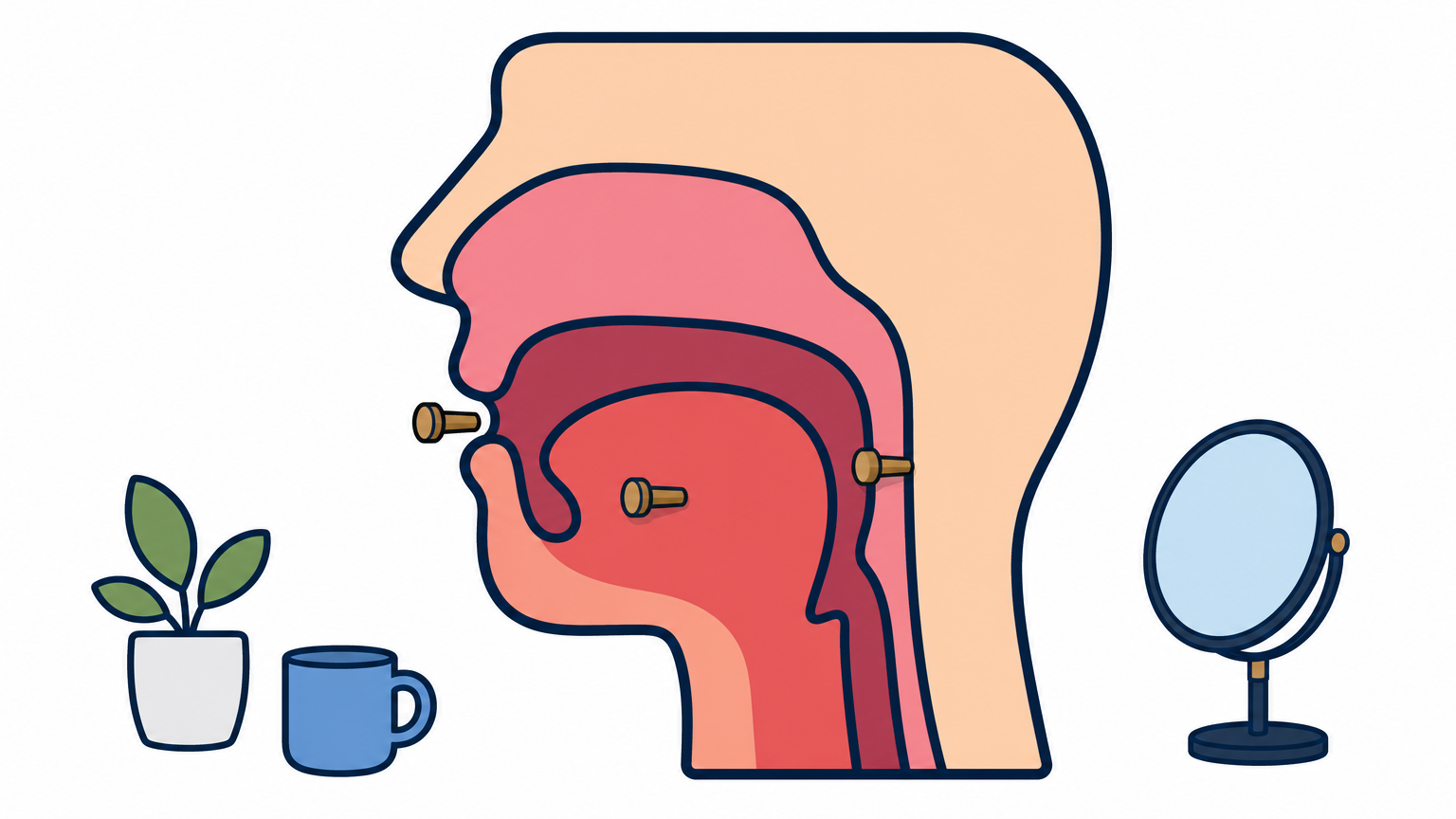
Makharij are the exit points of the Arabic letters. They come first because every other rule assumes you can say the letters correctly, and every rules of Tajweed PDF worth using opens with them.
The rule in plain terms
Scholars group the exits into five areas: the empty space of the mouth, the throat, the tongue, the lips, and the nasal passage. In the most commonly taught count, these areas hold 17 specific points. Each letter also has attributes (sifaat), such as heaviness or whistling, that separate it from letters with a nearby exit.
Letters and examples
The throat holds six letters in three levels: ء and ه from the deepest part, ع and ح from the middle, and غ and خ from the top. The lips produce ب, م, and و, and ف comes from the lip and upper teeth. The tongue produces most of the rest.
Practice the pairs that beginners confuse:
- ق and ك: qalb (heart) versus kalb (dog)
- ص and س
- ط and ت
- ض and د
- ظ and ذ
- ح and ه
- ع and ء
Common mistakes
Non-native speakers often turn ع into a soft ء, turn ح into ه, and say ق like a hard k. These swaps can change meaning. Fix one pair at a time with a teacher listening, and drill each pair inside real words before moving to the next.
If a letter leaves the wrong exit, no later rule can repair it.
2. Heavy and light letters
Seven letters are always heavy: خ ص ض غ ط ق ظ. Learn them with the phrase khusṣa ḍaghṭin qiẓ. Every other letter is light, except Raa, the Laam in Allah, and Alif, which change with context.
The rule in plain terms
A heavy letter (tafkhim) raises the back of the tongue toward the roof of the mouth, so the sound fills the mouth. A light letter (tarqiq) keeps the tongue low. Heaviness is about tongue position, not volume, and shouting a light letter does not make it heavy.
Letters and examples
Context decides these three, and every rules of Tajweed PDF should show them in a table like this one.
| Letter | Heavy when | Light when |
|---|---|---|
| Raa ر | It has a fathah or dammah, or is sakin after one (rasul) | It has a kasrah, or is sakin after one (rizq, firʿawn) |
| Laam in Allah | A fathah or dammah comes before it (rasulu llah) | A kasrah comes before it (bismillah) |
| Alif | A heavy letter comes before it (qala) | A light letter comes before it (kitab) |
When you begin a recitation with the name Allah, the Laam is heavy. Sakin Raa has a few exceptions, such as when a heavy letter follows it in the same word, and your teacher will cover those.
Common mistakes
Two errors dominate. Learners read every Raa heavy, and they forget that the Laam in Allah turns light after a kasrah. A third is making a light Alif heavy, as in kitab. Check the vowel before each Raa, and say the whole phrase with the preceding word when you practice the Laam.
Raa and the Laam of Allah follow the vowel, not habit.
3. Noon sakin and tanween rules
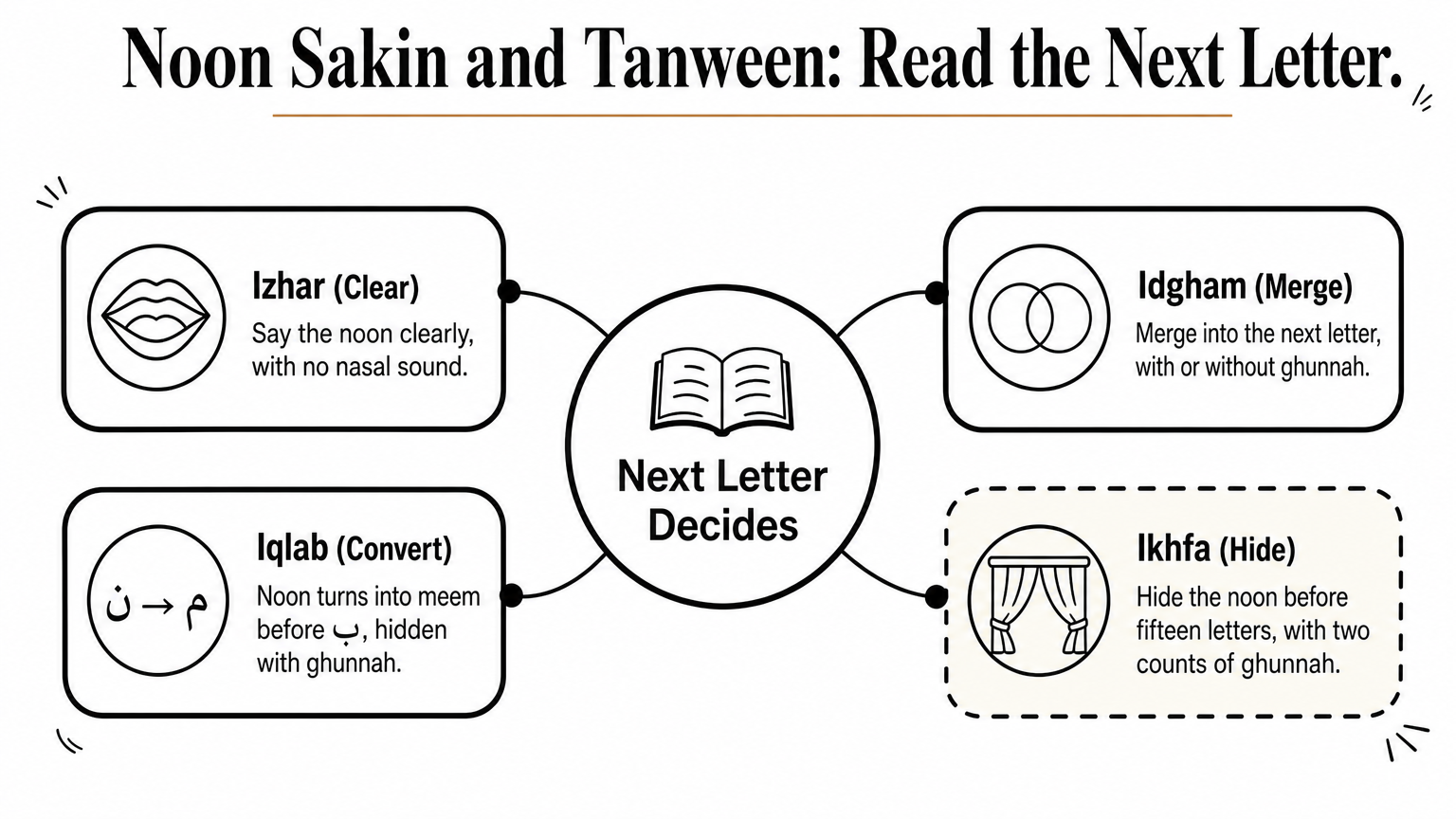
When a noon with sukoon or a tanween meets the next letter, four things can happen: izhar, idgham, iqlab, or ikhfa. These are the four rules most people mean when they ask about the four rules of Tajweed, and the next letter alone decides which one applies.
The rule in plain terms
Tanween is a hidden noon sakin at the end of a noun, written as a doubled vowel. The same four rules cover both. Look at the first letter of the next word, find it in the table, and apply the rule.
| Rule | Next letters | How to read |
|---|---|---|
| Izhar (clear) | ء ه ع ح غ خ | Say the noon clearly, no ghunnah |
| Idgham with ghunnah | ي ن م و | Merge into the next letter with 2 counts of nasal sound |
| Idgham without ghunnah | ل ر | Merge fully, no nasal sound |
| Iqlab (convert) | ب | Noon becomes a meem, hidden at the lips with ghunnah |
| Ikhfa (hide) | ت ث ج د ذ ز س ش ص ض ط ظ ف ق ك | Hide the noon between izhar and idgham, with ghunnah |
Letters and examples
Here is one example of each rule:
- Izhar: man amana (مَنْ آمَنَ)
- Idgham with ghunnah: man yaqulu (مَنْ يَقُولُ)
- Idgham without ghunnah: min rabbihim (مِنْ رَبِّهِمْ)
- Iqlab: min baʿdi (مِنْ بَعْدِ)
- Ikhfa: man kana (مَنْ كَانَ)
The six idgham letters are remembered as yarmaloon. Idgham only happens across two words. In words like dunya (دُنْيَا), the noon is read clearly.
Common mistakes
Learners pronounce the noon in idgham, skip the nasal sound in iqlab, or drop ikhfa to nothing. Ikhfa keeps a nasal sound of about two counts. Also watch for the missing ظ in short lists, because ikhfa has 15 letters, not 14.
Read the next letter first, and the rule follows.
4. Meem sakin and ghunnah rules
Meem sakin has three rules. A ب after it gives ikhfa shafawi, another م gives idgham shafawi, and any of the other 26 letters gives izhar shafawi. Most rules of Tajweed PDF files print this as a three-row chart.
The rule in plain terms
"Shafawi" means "of the lips," since the meem forms there. Ghunnah is the nasal sound held in the nose for about two counts. Noon and meem with a shaddah always carry ghunnah, whether you read on or stop on the word.
| Rule | Next letter | How to read |
|---|---|---|
| Ikhfa shafawi | ب | Hide the meem at the lips with ghunnah |
| Idgham shafawi | م | Merge two meems into one with ghunnah |
| Izhar shafawi | Any other letter | Say the meem clearly, no extra nasal sound |
Letters and examples
For ikhfa shafawi, read tarmihim bi-hijaratin (تَرْمِيهِم بِحِجَارَةٍ). For idgham shafawi, read lahum maghfirah (لَهُم مَّغْفِرَةٌ). For izhar shafawi, read alam tara (أَلَمْ تَرَ).
For ghunnah on a shaddah, practice inna (إِنَّ) and thumma (ثُمَّ). Hold the nasal sound for two counts, then release into the vowel.
Common mistakes
Learners hide the meem before و or ف because the lips are already close. Say the meem clearly in lahum fiha (لَهُمْ فِيهَا). The opposite error is over-extending ghunnah on izhar, which turns a clear meem into a hummed one. Keep ghunnah to two counts, not longer.
A meem before ba hides, before meem merges, and before everything else stays clear.
5. Qalqalah: the echo letters
Qalqalah is a slight echo or bounce on five letters when they carry sukoon: ق ط ب ج د. The mnemonic is quṭbu jadin. It is a short rule, so you can master it in one sitting.

The rule in plain terms
The letter is released with a brief burst of sound, between a sukoon and a vowel. It applies when the sukoon is original or when it appears because you stopped on the word. The echo is a release, not a new vowel. ق and ط echo heavy, while ب ج د echo light.
Letters and examples
Most teachers describe three strengths:
- Strongest: stopping on a letter with a shaddah, as in al-haqq (الْحَقّ)
- Medium: stopping on a sakin letter at the end of a word, as in falaq (فَلَق) and ahad (أَحَد)
- Lightest: a sakin letter in the middle of a word, as in yadkhulun (يَدْخُلُونَ)
Common mistakes
The most common error is adding a vowel, so ahad sounds like ahada. Another is skipping the echo on a middle-of-word letter because it feels too brief. Close the letter fully before the release, and keep the echo short. A long echo becomes an extra syllable.
Qalqalah is a bounce, never a vowel.
6. Madd: the rules of prolongation
Madd means stretching a vowel sound. Natural madd lasts two counts, and every other type of madd extends it to four, five, or six counts because a hamza or a sukoon follows the madd letter. One count is roughly the time it takes to fold or open a finger.
The rule in plain terms
There are three madd letters: Alif after a fathah, sakin waw after a dammah, and sakin ya after a kasrah. Natural examples are qala (قَالَ), yaqulu (يَقُولُ), and qila (قِيلَ). A hamza or sukoon after the madd letter triggers the longer types in the table below. This is the part where a complete Tajweed rules PDF usually gets dense.
| Type | Trigger | Length |
|---|---|---|
| Natural (tabi’i) | Madd letter, nothing after it | 2 counts |
| Muttasil | Hamza after the madd letter in the same word (ja’a) | 4 to 5 counts, required |
| Munfasil | Hamza at the start of the next word (inna a’taynaka) | 4 to 5 counts, permitted |
| Arid lissukoon | Madd letter before a final letter you stop on (nasta’in) | 2, 4, or 6 counts |
| Leen | Sakin waw or ya after a fathah, when stopping (khawf) | 2, 4, or 6 counts |
| Lazim | Original sukoon or shaddah after the madd letter (ad-dallin) | 6 counts |
Letters and examples
Lengths depend on the recitation route your teacher follows. Many teachers of Hafs use 4 or 5 counts for muttasil and munfasil. Ask your teacher which length to use, then hold it everywhere.
Common mistakes
Beginners stretch natural madd too long, cut lazim short, or change the count from one verse to the next. Consistency matters more than the exact number. If muttasil is 4 counts on page one, it should be 4 counts on page ten.
Pick one length for each madd type and keep it every time.
7. Waqf: stopping and starting
Waqf is stopping while you recite, and ibtida is restarting. The core rule is to stop only where the meaning is complete and to make the last letter sakin, because you cannot stop on a vowel.
The rule in plain terms
Stopping changes how the last letter sounds. The final vowel becomes sukoon, and a few endings change shape:
- A final vowel or tanween dammah or kasrah becomes sukoon: ahadun becomes ahad
- Tanween fathah becomes an Alif sound: hasaban becomes hasaba
- A round taa (ة) becomes a ha sound: jannah (جَنَّة)
- A shaddah at the end stays pronounced, with ghunnah on noon or meem
Letters and examples
The Madani mushaf marks stops with small signs, and any rules of Tajweed PDF should list them:
| Sign | Meaning |
|---|---|
| م | Stopping is necessary |
| لا | Do not stop on this word |
| ج | Stopping and continuing are both fine |
| قلى | Stopping is preferred |
| صلى | Continuing is preferred |
Common mistakes
Learners run out of breath and stop mid-phrase, or they restart from a point that distorts the meaning. Others leave the vowel on the word they stopped on. Breathe at a sign, not at random, and plan your stop before the breath runs out.
Stop where the meaning stops, and drop the vowel when you do.
Where to go from here
These seven rules are the core of every beginner Tajweed PDF: makharij, heavy and light letters, noon sakin and tanween, meem sakin, qalqalah, madd, and waqf. Learn them in that order, one per week, and recite the examples aloud. Reading about a rule is only half the job. Hearing it corrected is the other half.
If you want a teacher to listen to your recitation and tell you which rule to work on first, book a free assessment class with Quranytime Academy. We will check your level and match you with a teacher and a learning path.