
Surah At-Takathur explained simply: this short but searching chapter is about the way competition for “more” can occupy a person until death, and about the accountability that follows. Its eight verses do not condemn every possession or ambition. They warn against rivalry and accumulation when these distract people from Allah, gratitude, moral duty, and the life to come.
This guide explains the surah verse by verse, clarifies key Arabic terms and interpretive points, and suggests practical ways to reflect on its message without turning reflection into a claim of religious ruling.
Surah At-Takathur: quick summary
At-Takathur (التكاثر), the 102nd chapter of the Qur’an, has eight verses. The name comes from a word associated with seeking increase or abundance. The chapter opens by saying that competition for increase has distracted people; it continues with a warning that they will come to know, evokes seeing the Fire, and closes by declaring that people will be questioned about the blessings they enjoyed. The surah therefore moves from heedlessness, through death and the Hereafter, to accountability.
In one sentence: Surah At-Takathur asks readers to notice when the pursuit of “more” takes over their attention, remember that worldly life ends, and treat blessings as trusts for which they are answerable.
What does At-Takathur mean?
At-Takathur is commonly rendered “rivalry in increase,” “competition for more,” or “piling up.” These English phrases are explanations of an Arabic expression, not identical word-for-word substitutes. Quran.com’s displayed translation of 102:1 reads, “Competition for more ˹gains˺ diverts you ˹from Allah˺”. In Ma‘arif al-Qur’an, the word is explained in relation to amassing wealth; the commentary also cites an interpretation involving pride in abundance. These readings overlap: the concern is not simply having something, but becoming absorbed in having more, comparing, or boasting.
Readers sometimes ask whether the verse refers only to money. The broader sense is more useful. A person can compete through possessions, status, family numbers, achievements, influence, followers, or other measures of abundance. The Qur’anic wording does not list every modern example; these are applications of the general idea, not a claim that the verse names them individually.
Some commentaries report early explanations connecting the surah’s warning with rivalry between groups or tribes. Such reports help readers picture the social setting of boasting, but they should not be mistaken for the only possible application. The moral warning speaks beyond one historical episode.
That wider application should still be made carefully. “More” is not a fixed list of objects that are always wrong; context and intention matter. The passage asks whether a pursuit has become heedless rivalry and what it has displaced. A reader can therefore take the warning seriously without treating ordinary work, family care, or responsible provision as condemned by default.
Surah At-Takathur explained verse by verse
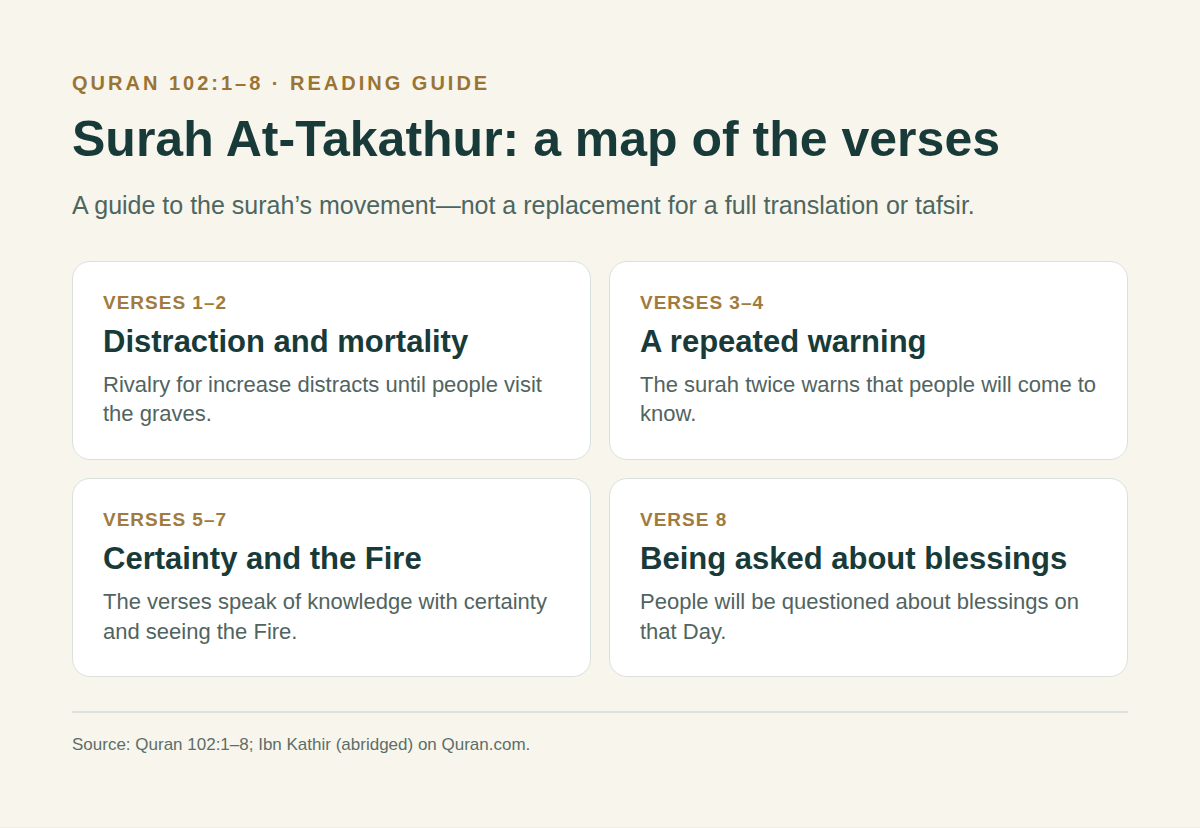
Verses 1–2: rivalry distracts “until you visit the graves”
The opening says that mutual competition for increase has alhākum—diverted or distracted you. The verb points to attention being pulled away. It is possible to earn, plan, build, and care for others without being consumed by comparison. The warning concerns a pursuit that takes over the heart and leaves little room for remembrance, worship, fair dealing, or concern for people.
Verse 2 continues, “until you visit the graves.” Classical explanations commonly understand this as death: people remain occupied with rivalry until they die and are buried. The word “visit” is striking because a grave is not the final destination in Islamic belief; the dead await resurrection and judgment. This is a reflection on mortality, not an instruction about grave-visiting practices.
The plural address also invites self-examination rather than finger-pointing. It is easy to identify someone else’s extravagance; it is harder to ask what “more” means in one’s own life. The verse gives no checklist of permissible possessions. It directs attention to the effect of rivalry and distraction.
Verses 3–4: “No indeed—you will soon know”
The phrase is repeated, intensifying the warning. The repetition interrupts the flow of worldly competition, as if to say: the consequences you overlook will become unmistakable. Interpreters explain the future “knowing” in relation to the reality people encounter after death and at the Resurrection. The verses are concise, so a careful explanation should not pretend that every detail is spelled out here.
The surah shifts its audience from the present race for more to the certainty of a reckoning. In everyday terms, it challenges the assumption that delayed consequences are absent consequences. A person may postpone reflection, repair, or gratitude, but time does not cancel accountability.
Verses 5–7: certain knowledge and seeing the Fire
Verses 5–7 speak of knowing with certainty and seeing the Hellfire. These are serious descriptions of the Hereafter, not metaphors to soften into mere regret. The warning is meant to awaken a reader before the encounter becomes direct and unavoidable.
The passage does not authorize readers to decide the fate of particular people. Its address is a warning and a call to heedfulness. Nor should its severity be detached from the Qur’an’s wider teachings about repentance, mercy, justice, and doing good. Holding the warning seriously means taking one’s own choices seriously, not making confident judgments about another person’s final standing.
Verse 8: questioned about blessings
The closing verse says, “Then, on that Day, you will definitely be questioned about ˹your worldly˺ pleasures” (Qur’an 102:8, in Quran.com’s translation). The Arabic al-na‘īm refers to blessings or enjoyments. Ma‘arif al-Qur’an explains the question as including whether people were grateful for Allah’s favors or misused them. It cites the Qur’anic reminder that hearing, sight, and the heart will be questioned about (17:36), and discusses reports about health, food, and other blessings.
This does not mean that every comfort is forbidden, or that enjoying a lawful blessing is itself blameworthy. The verse turns enjoyment into responsibility: how did a person receive and use what was given? Gratitude may include acknowledging the Giver, using resources ethically, meeting obligations, and avoiding harm. The exact form this takes depends on the blessing and a person’s circumstances; this article is not a personal fatwa.
Islam Question & Answer’s answer on the types of reckoning on the Day of Resurrection discusses reports connected to questioning about blessings, including At-Takathur 102:8. It describes a general principle of reckoning while noting an exception for people admitted to Paradise without prior reckoning. It distinguishes the presentation of deeds to a believer from thorough examination, which it says concerns disbelievers and those Allah wills among sinful believers. It also cites a scholarly view that believers and disbelievers are questioned differently. These distinctions should not be flattened into a claim that every person’s experience is identical.
Five lessons from Surah At-Takathur
1. “More” can become a distraction
Growth and provision are not automatically condemned. The question is whether comparison consumes attention and crowds out obligations. A useful personal prompt is: what am I pursuing, and what am I neglecting while pursuing it?
2. Remembering death can restore proportion
Verses 1–2 place rivalry beside the grave. Remembering mortality can help people reconsider priorities. It need not lead to despair or withdrawal from ordinary responsibilities; it can make daily work more purposeful and less dependent on status.
3. Blessings carry responsibilities
Health, time, skills, relationships, knowledge, and material resources can all be treated as opportunities to do good. Verse 8 asks readers to think beyond possession and consider use. Gratitude is more than a feeling if it shapes choices.
4. Accountability is personal
The passage invites each person to prepare for their own meeting with Allah. Its warning is not a license to shame people for their circumstances, income, disability, or family size. The moral focus is heedless rivalry and the use of blessings.
5. Reflection should lead to constructive action
A sobering message can prompt repair: fulfill a neglected duty, return what is owed, apologize, give where appropriate, or make time for worship. These are practical suggestions inspired by the theme, not a prescribed ritual or guaranteed devotional formula.
How to reflect on the surah in daily life
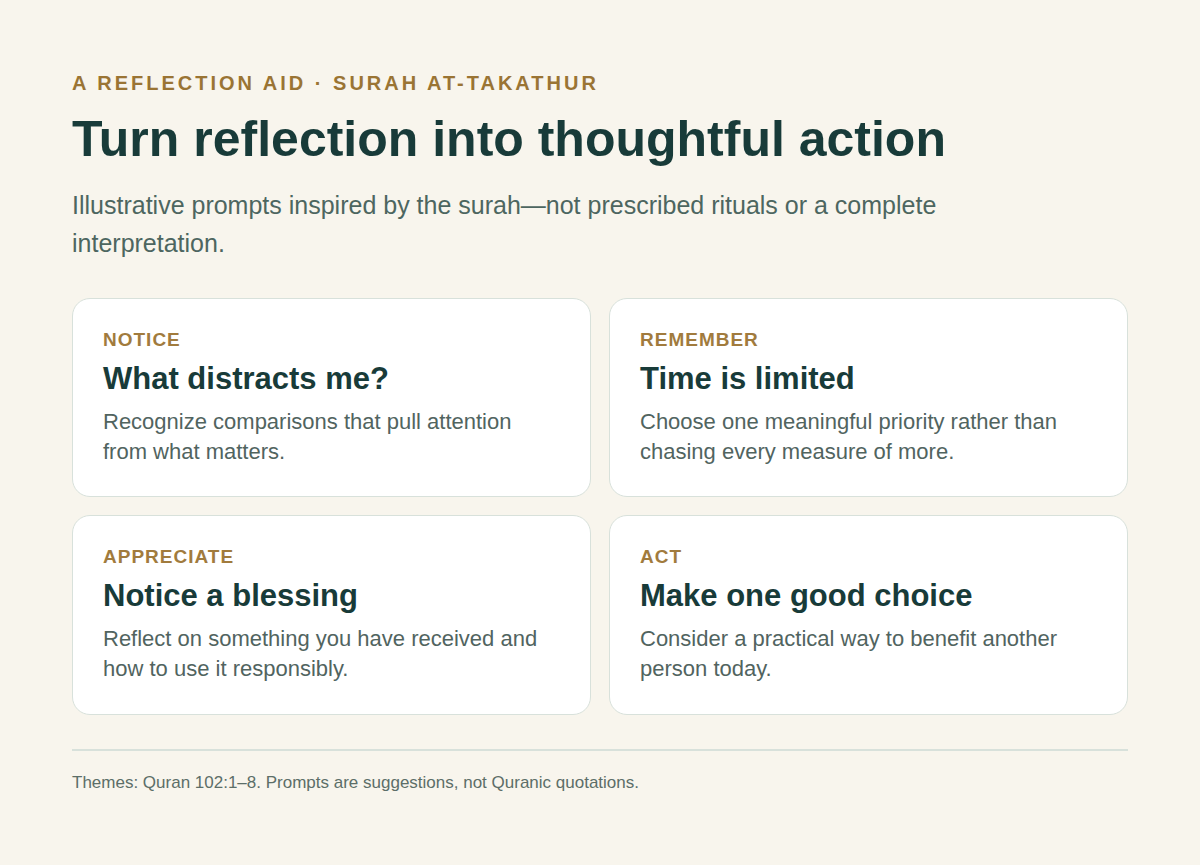
One gentle approach is to read the eight verses with a reliable translation, then pause at three points: What kind of “increase” distracts me? What blessing have I been taking for granted? What is one responsible way to use it today? Choose a small action that fits your actual situation. For one person it may be putting a phone aside to give family focused attention; for another, reviewing spending, making time for prayer, or sharing a skill. These examples are options, not religious prescriptions.
If you are studying the Arabic, learn the surah with a qualified teacher or sound recitation model, especially where pronunciation and stopping matter. Quranytime readers may find the guides to building a daily Quran reading schedule and using a Quran surah index useful for study planning and checking references. For language support, see the Quranic Arabic vocabulary notebook guide and the guided path to Quranic Arabic. These are learning aids, not substitutes for tafsir or scholarly advice.
For context on how accounts of revelation are evaluated rather than simply repeated, see Quranytime’s guide to reasons for revelation. As with any chapter, distinguish the Qur’anic text from translation, commentary, and later reflection. That distinction helps keep a personal lesson meaningful without presenting it as the only interpretation.
Frequently asked questions
What is the main message of Surah At-Takathur?
Its central warning is that rivalry for increase can distract people from Allah and the Hereafter. The chapter reminds readers of death, the reality of judgment, and accountability for blessings.
What does “until you visit the graves” mean?
Classical tafsir commonly explains this phrase as continuing in distraction until death and burial. It is not usually read as a command to visit graves; it depicts mortality and the end of worldly life.
Does Surah At-Takathur say that wealth is bad?
No simple equation of wealth with wrongdoing follows from these verses. The surah criticizes heedless competition and distraction, then asks people to consider how they used their blessings. Specific financial rulings require evidence and qualified guidance.
What does verse 8 mean by being questioned about pleasures?
It means that people are accountable for blessings they enjoyed. Tafsir discussions include gratitude and the use of gifts, from basic comforts to wider faculties and resources. The verse does not say that lawful enjoyment is itself sinful.
Is there a special guaranteed reward for reciting Surah At-Takathur?
This article does not claim a particular guaranteed reward or prescribe a special devotional formula. Reports about virtues should be checked for their wording and grading with knowledgeable hadith scholarship; a narration quoted in a commentary should not automatically be treated as established.
Is At-Takathur Makki or Madani?
Quran.com classifies it as a Meccan surah. Classifications of a surah’s revelation period are conventional scholarly labels; the eight-verse chapter’s message can be read and reflected on by Muslims in every place and period.
How many verses are in Surah At-Takathur?
It has eight verses and is the 102nd surah in the Qur’an.
References and further reading
- The Qur’an, Surah At-Takathur 102:1–8, Quran.com English translation and chapter display.
- Ma‘arif al-Qur’an, commentary on 102:1, including explanations of takathur.
- Ibn Kathir, abridged tafsir of Surah At-Takathur, Quran.com; a source credited by the verse-map graphic.
- Ma‘arif al-Qur’an, commentary on 102:2–4, and 102:5.
- Ma‘arif al-Qur’an, commentary on 102:7–8, on blessings and accountability.
- Islam Question & Answer, “Types of Reckoning on the Day of Resurrection”, specifically discussing the reckoning and reports related to 102:8.